Status as of November 18, 2026. This is a short assessment of charges announced on October 2 and the French investigation that followed. All US and French allegations are untested in court, and the defendants are presumed innocent. We will update it as the cases move.
Bottom Line Up Front
On October 2, the U.S. Justice Department charged four men with supporting Hamas, and the Treasury sanctioned a Gaza-based Hamas battalion deputy and four people and charities tied to him in France. Prosecutors allege that Saleem Alzaq, who is also spelled al-Zaq, ran social media fundraising campaigns presented as aid for Gaza and passed the proceeds to Hamas’s armed wing. France opened a formal investigation of five people the next day, including the heads of two small charities.
We assess, with moderate confidence, that the case shows a working model rather than a one-off: a diaspora-facing humanitarian appeal, a few facilitators in Western countries, and a cash-out through intermediaries and cryptocurrency. We do not assess that donors knew where the money went, and no source says so. We also find the headline amount is not settled, because the US and Treasury figures differ.
Key Judgments
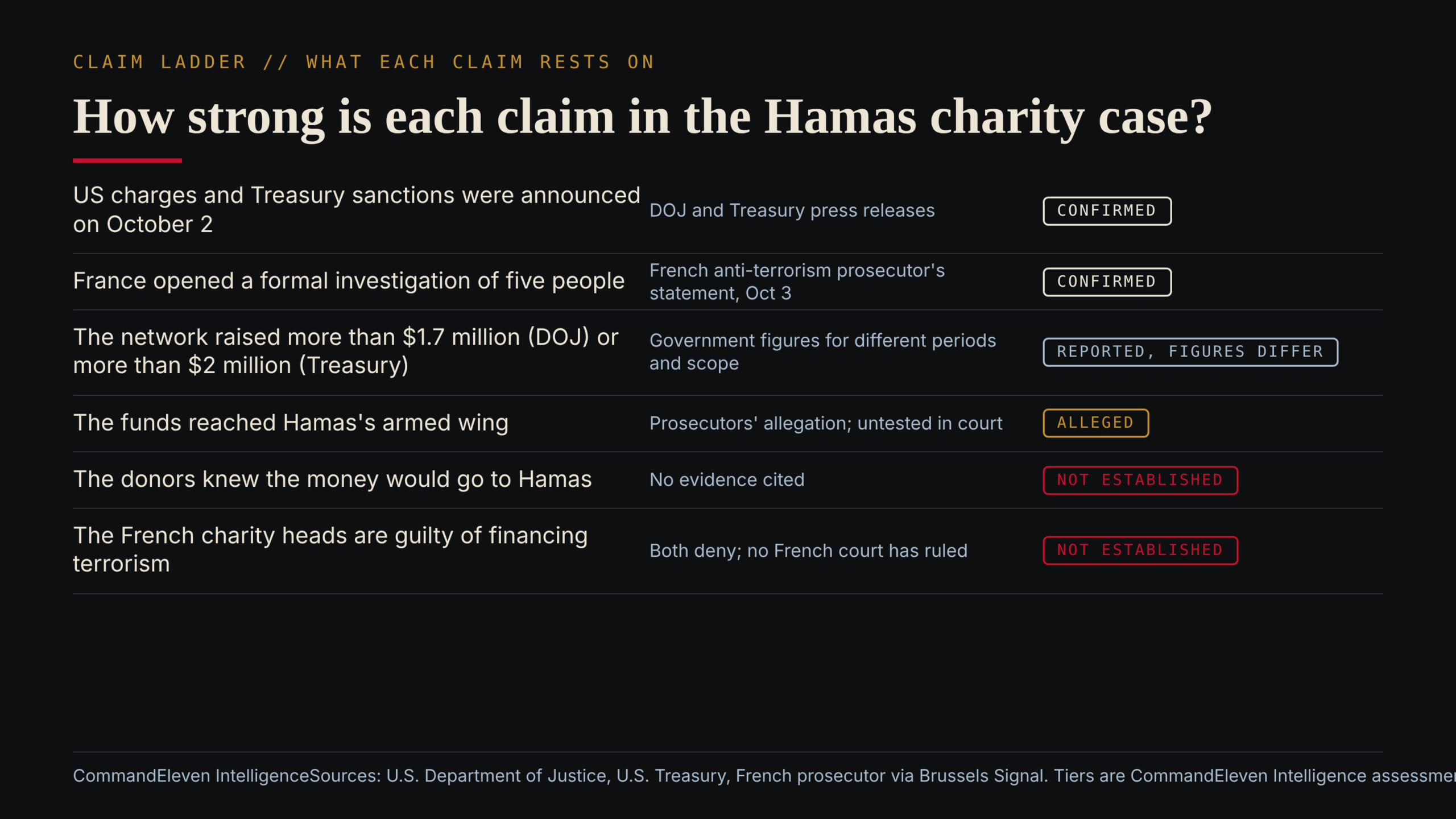
- CONFIRMED. The Justice Department announced charges against Alzaq, Omar and Abdel Adhami, and Raed Yousef on October 2, 2026. Treasury sanctioned Alzaq, Faouzi Barika, Amel Oualid, Association Baraka and Ensemble C Mieux the same day.
- CONFIRMED. French anti-terrorism prosecutors announced on October 3 that five people were under formal investigation for financing a terrorist enterprise, organized breach of trust, and laundering. Barika is held provisionally and Oualid is under judicial supervision.
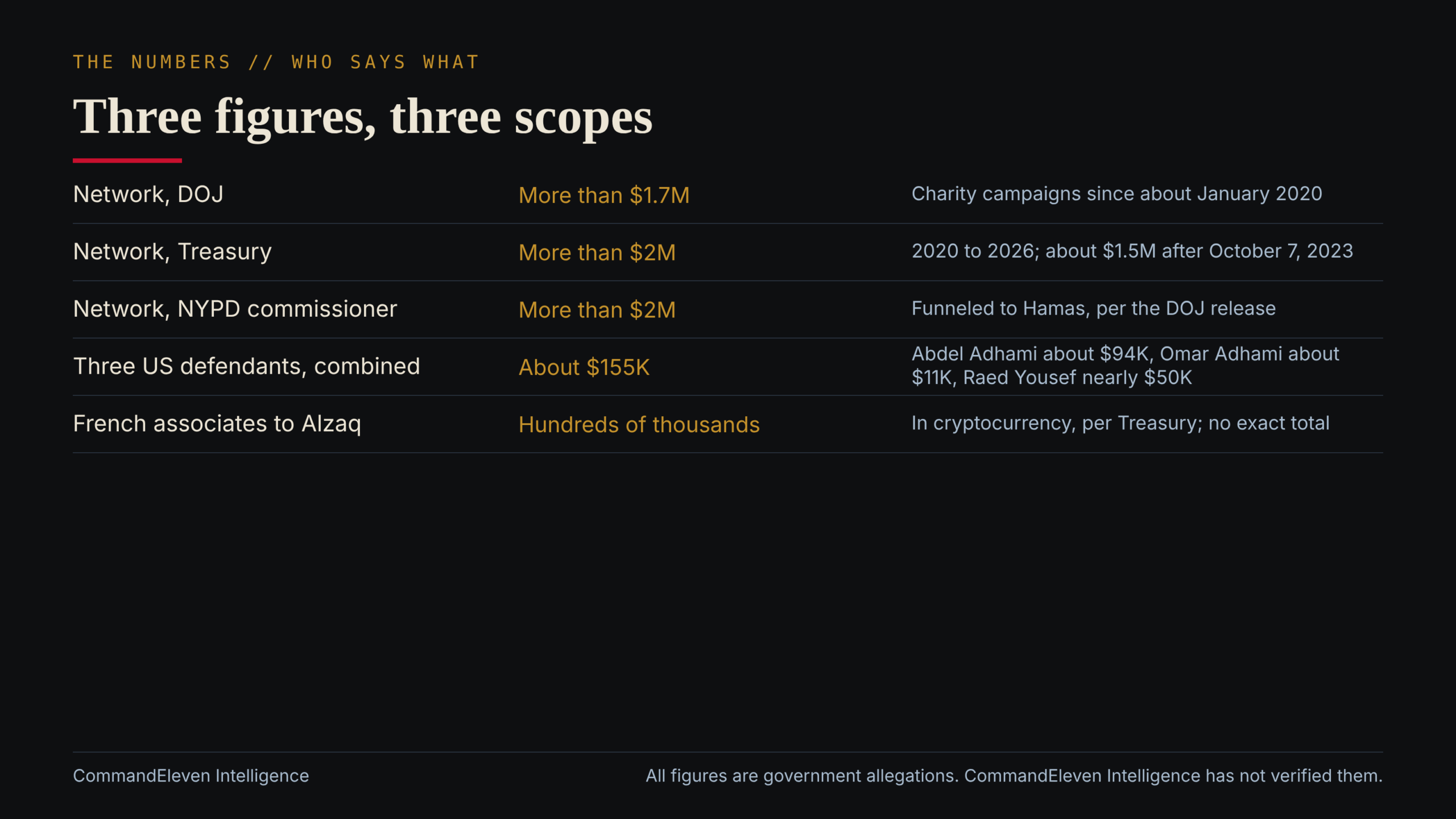
- REPORTED, FIGURES DIFFER. The Justice Department says the network collected more than $1.7 million through charity campaigns since about January 2020. Treasury says more than $2 million from 2020 to 2026, with about $1.5 million after October 7, 2023.
- ALLEGED. The funds reached Hamas’s armed wing, the Al-Qassam Brigades. This is the prosecutors’ and Treasury’s allegation and no court has tested it.
- NOT ESTABLISHED. That donors knew the money would go to Hamas, that the French charity heads are guilty, or how much money actually reached Hamas.
- ASSESSED: MODERATE. Charity-wrapped fundraising by Western-based facilitators remains an active Hamas financing channel. This case, and several earlier US actions, follow a similar pattern.
What the Authorities Allege
According to the Justice Department, Alzaq is a Hamas member and battalion deputy in the Al-Qassam Brigades and works in the media office of its Shujaiyya Brigade. It says he ran an international fundraising network that solicited donations on social media as humanitarian aid for Gaza. The Treasury says he also oversees a financial network that uses money service businesses and cryptocurrency wallets to move funds to the Brigades.
The two French charities were small. Treasury says Association Baraka was co-founded by Barika and Alzaq, and that Ensemble C Mieux was established by Oualid. It says the two collected public donations, sent them to Alzaq, and that Alzaq promoted their fundraising accounts on his own social media. Treasury says they sent hundreds of thousands of dollars in cryptocurrency to him. According to reporting on the French prosecutor’s statement, Baraka was registered on October 13, 2023, six days after the Hamas attack on Israel, and Ensemble C Mieux was set up on July 1, 2024. Both presented themselves as collecting aid for Gaza’s civilians.
The US defendants are alleged to be small contributors. The Justice Department says Abdel Adhami gave about $94,000 and Omar Adhami about $11,000, using wire transfers and intermediaries to conceal who the senders and recipients were. It says Yousef, who lives in Florida, gave nearly $50,000 and faces additional counts including passport fraud. Together, these three amounts total about $155,000. That is a small fraction of the more than $1.7 million alleged, which means most of the alleged total came from other donors that the releases do not identify.
Why the Numbers Do Not Match
The Justice Department says more than $1.7 million. Treasury says more than $2 million. The New York police commissioner also cited more than $2 million, according to the Justice Department release. The figures cover different periods and different scopes, and none of the releases explains the difference. Until a charging document or court filing gives a reconciled total, we treat the range of $1.7 million to more than $2 million as the working estimate and do not quote a single figure. We also do not know how much of the money reached Hamas, as opposed to being collected.
Why It Matters
The pattern, not the sum, is the lesson. A humanitarian appeal gives donors a reason to give and gives facilitators a reason to be in the room. Neither needs to hide where the money ends. The control point is the middle: the facilitators, the organizations that register as charities, and the platforms that carry the appeal. Here, the person at the center promoted the fundraising accounts on his own social media, which is a visible link between the front and the fighter. That kind of link is what investigators use.
TRM Labs reports that US prosecutors have recovered roughly $560,000 across five actions since March 2025 against Hamas-aligned flows, and have unwound sham charities that raised money on mainstream crowdfunding platforms. We cite those as the company’s account and have not verified them. They are consistent with this case, and they are why we assess the model as a working one.
The case also shows a limit. The three US defendants gave about $155,000, a small share of the amount alleged. Prosecuting facilitators and sanctioning charities stops one channel. It does not by itself show how much money reached Gaza or how fast a replacement appears.
What Would Change Our View
- A charging document or court filing that gives a reconciled total, and shows how much reached the Al-Qassam Brigades.
- Evidence that donors were told, or knew, that the money was for Hamas. That would change the picture for donors, which we do not now assess.
- A French court ruling or trial order in the Barika and Oualid cases, or a dismissal.
- Further actions against other Gaza-aid charities in Europe or North America.
- A Hamas denial or response with documentary evidence.
What To Watch
- Whether the US case produces plea agreements, and what the plea documents say about amounts.
- The French investigating judge’s decisions on detention and any further arrests.
- Treasury and Justice follow-on actions, including any designated crypto addresses. The Treasury release does not list any.
- Whether platforms and crowdfunding sites change how they vet Gaza aid appeals.
Calls We Will Score
- By June 30, 2027: At least one defendant in the US case pleads guilty or is convicted.
- By June 30, 2027: No French court has begun a trial of Barika or Oualid.
- By June 30, 2027: At least one more Western government announces charges or sanctions against a Gaza-aid charity for allegedly financing Hamas.
What This Assessment Does and Doesn’t Establish
- It establishes what US and French authorities have announced. It does not establish that any allegation is true.
- We read the Justice Department and Treasury releases directly. We did not see the charging documents or the French prosecutor’s statement itself. We rely on a Brussels Signal report for the French details.
- The amounts are government figures that do not match, and we have not verified them.
- TRM Labs’ figures on earlier US actions are the company’s own and are not independently verified.
Frequently Asked Questions
Who is Saleem Alzaq?
The Justice Department describes him as a Gaza-based Hamas member and battalion deputy in the Al-Qassam Brigades who ran the international fundraising network. Treasury spells his name al-Zaq.
Were the donors charged?
No source we reviewed says ordinary donors were charged. The US defendants are accused of knowingly contributing and of concealing their payments. The French suspects ran the charities.
What did the French charity heads say?
Both deny any link to Hamas, according to reporting on the prosecutor’s statement. Barika’s lawyer says the collections were humanitarian. None of this has been tested in a French court.
Related CommandEleven Intelligence Reading
- The Money: how terrorist and criminal finance share the same channels
- The Corridors: where terrorist and criminal supply chains meet
Sources
- U.S. Department of Justice: Coordinated Arrests and Charges Dismantle Hamas Terror Finance Network (Oct 2, 2026)
- U.S. Department of the Treasury: Treasury Dismantles Major Hamas Financing Network (Oct 2, 2026)
- Brussels Signal: France charges five over alleged Hamas fundraising through charities (Oct 5, 2026)
- TRM Labs: The Evolution of Terrorist Financing, 25 Years After 9/11 (2026)
Assessments and confidence tiers are CommandEleven Intelligence’s own. We do not reproduce third-party text. Attributions are to the named agencies and outlets.