Status as of November 17, 2026, 8:30 AM Eastern. This is an incident assessment. It will be updated when charges, a named complaint or an official statement on motive appear. We do not name the person reported to be in custody, because no charges have been filed.
Bottom Line Up Front
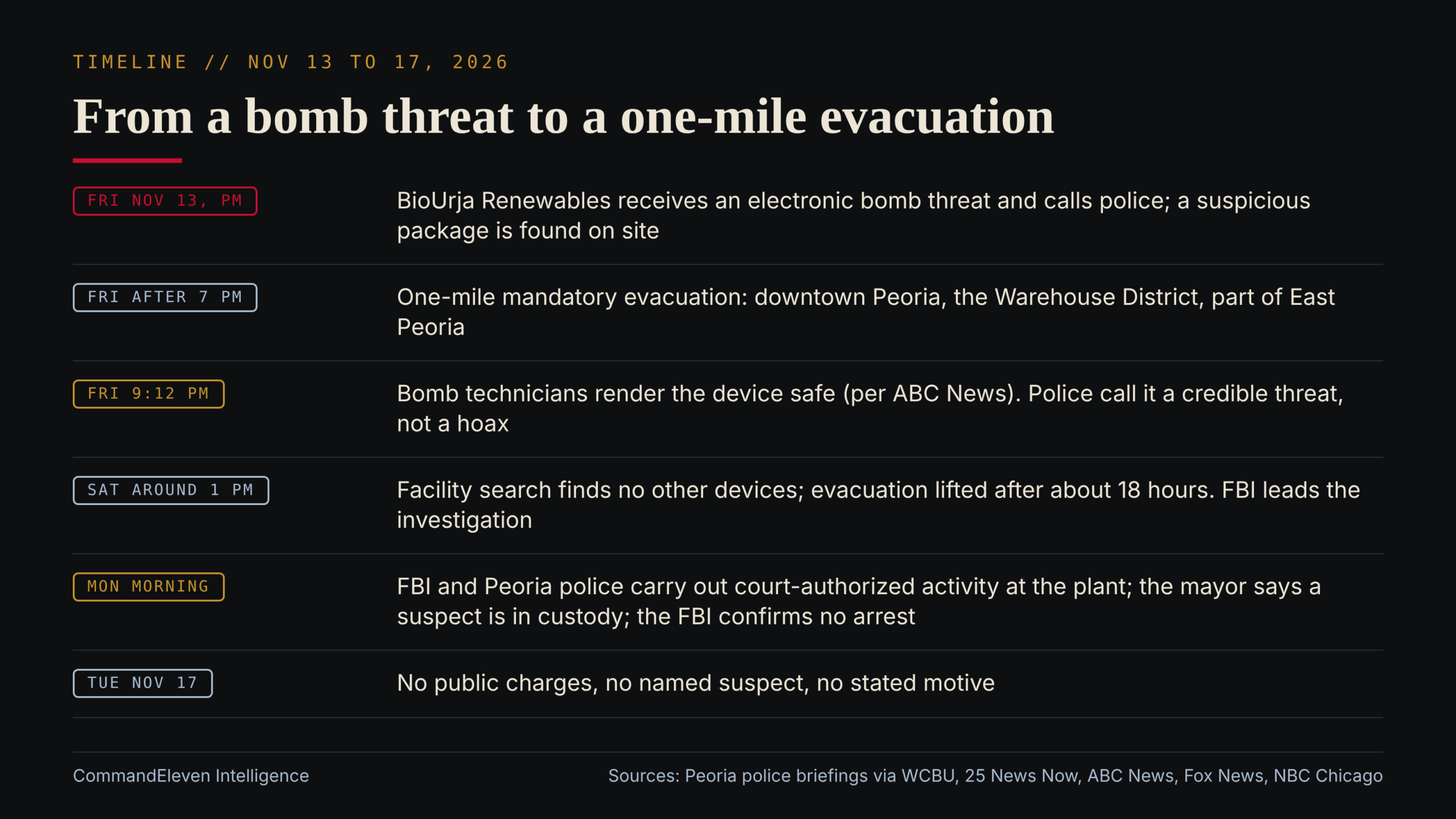
On Friday, November 13, a credible explosive device was found at the BioUrja Renewables ethanol plant in Peoria, Illinois, after the company received an electronic bomb threat. Bomb technicians rendered it safe at 9:12 p.m. A one-mile area covering downtown Peoria, the Warehouse District and part of East Peoria was evacuated for about 18 hours. No one was hurt. On Monday morning, the FBI and Peoria police carried out court-authorized activity at the plant, and the mayor said a suspect was in custody. The FBI has not confirmed an arrest, no charges are public, and no motive has been stated.
We assess that the device and the response are well established, and that the public record on who did this and why is thin. One outlet, citing unnamed federal sources, reports that the person in custody was connected to the plant. That is plausible and unconfirmed. Nothing public ties the incident to terrorism, to Iran or to any other 2026 incident, and we do not connect them. What the case does expose is a security gap that predates it: the federal program that screened chemical-plant personnel against the terrorist watchlist has been gone since 2023.
Key Judgments
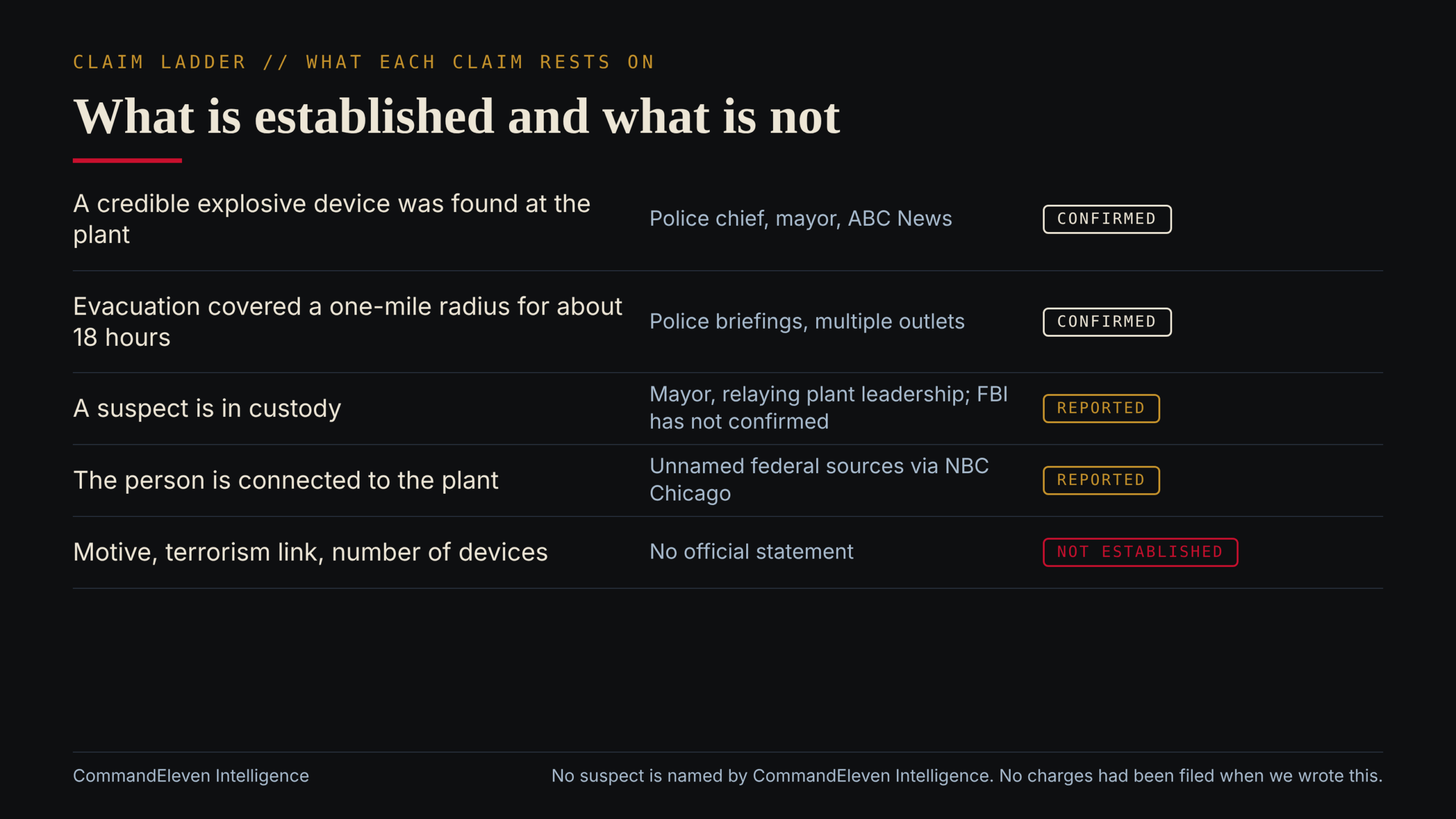
- CONFIRMED. A credible explosive device was found at the BioUrja plant on November 13 and rendered safe at 9:12 p.m. Police Chief Brad Dixon said the threat was not a hoax. No injuries were reported.
- CONFIRMED. A one-mile mandatory evacuation began shortly after 7 p.m. Friday and was lifted around 1 p.m. Saturday after a search found no other devices.
- REPORTED. A suspect is in custody. The source is the mayor, who said plant leadership told her. The Peoria police department confirmed, then withdrew, the same statement and referred questions to the FBI, which said only that it was conducting law enforcement activity.
- REPORTED (SINGLE OUTLET, UNNAMED SOURCES). NBC Chicago, citing federal sources, says the person was connected to the plant. We have not seen this confirmed by an official.
- ASSESSED: LOW. The interior placement and a threat specific enough to locate the device point to someone with knowledge of the site. This is inference from the pattern, not a finding, and one independent analyst, Tony Seruga, reaches the same inference and says so.
- NOT ESTABLISHED. Motive, any terrorism link, any foreign direction, accomplices, the number of devices, and what the device was made of. Officials have declined to say.
- NOT ESTABLISHED. Any link to the Iran dirty bomb reporting, the Mobile reservoir device, or any other 2026 incident.
What Happened
BioUrja Renewables operates the ethanol plant in south Peoria, on the Illinois River. Newsweek describes the plant as built in the 1930s. Workers reported an electronic bomb threat to police on Friday afternoon, and a suspicious package was found on the site about an hour later. After bomb technicians and fire officers judged the device credible, police set a one-mile radius and ordered an evacuation shortly after 7 p.m. Shelters opened at Manual High School and the EastSide Centre. About 60 to 80 people used the school shelter. The Coast Guard stopped vessel traffic on the river between mile markers 160 and 164, and a concert in Peoria was canceled.
Bomb technicians rendered the device safe about 9:12 p.m. On Saturday, teams searched the plant building by building and found no other explosives. Dixon, briefing alongside the FBI, ATF, Coast Guard and Peoria Fire Department, called the device a credible threat but declined to say what type it was, and at one briefing declined to call it a bomb, saying forensic work on its composition was continuing. The evacuation was lifted around 1 p.m. The FBI Springfield office then took the lead and asked the public for tips. At a Saturday briefing, an FBI agent said the investigation was at a preliminary stage and declined to discuss a motive or suspect. Illinois Governor JB Pritzker directed the Illinois State Police to coordinate with local authorities.
The Suspect Situation
The public record on the person in custody is contradictory, and we handle it carefully. On Monday morning, FBI agents and local police carried out court-authorized procedures at the plant. The FBI confirmed “law enforcement activity” related to the device and nothing more. Mayor Rita Ali said plant leadership told her a suspect was in custody. A Peoria police spokesperson confirmed custody to reporters, then withdrew the statement and referred questions to the FBI. NBC Chicago reported, citing unnamed federal sources, that the person was connected to the plant and that federal charges were expected as soon as Monday night. As of this writing, we have found no public charging document.
We do not name the person, and we do not repeat identifying details. Without charges, the record is an arrest reported by anonymous sources, and a person in that position is presumed innocent. We will revisit this if a criminal complaint is filed and publicly available.
Why a One-Mile Radius
Officials have not published how they set the one-mile radius. Several observers, including Tony Seruga, argue that it reflects the plant’s flammable inventory and process equipment more than the size of the device. That reading is consistent with standard hazard references: ethanol is flammable, its vapor is heavier than air and collects low, and a fire at a large storage site can spread and be hard to fight. We treat it as plausible and unconfirmed, because Dixon has not given the formula and has not described the device. We publish no technical detail about devices or how to defeat a plant’s protections.
The operational point is separate from the cause: a threat that claims more than one device forces a long, building-by-building search before an all-clear. Whether the message actually said that is, so far, reported by one analyst and not by officials, and we do not treat it as established.
The Vetting Gap Behind the Case
The Government Accountability Office reported on September 8, 2026 that the federal chemical facility security program established in 2007 lapsed in July 2023 and with it the personnel vetting that let high-risk chemical sites check employees and certain visitors against the terrorist watchlist. Only the government can run that check, and facilities can no longer request it. GAO reports that CISA’s chemical security staff fell from 214 in fiscal 2024 to 52 in fiscal 2025, that more than 89 million people live or work within two miles of a high-risk chemical facility, and that DHS did not concur with GAO’s recommendation to develop a voluntary vetting option. GAO has kept the recommendation open.
Nothing public connects that gap to Peoria, and it would be wrong to say it caused this incident. The limit of the program matters too. Watchlist vetting catches people already on the watchlist. It would not have flagged a person with no terrorism record, which is what the public reporting, so far, describes. The gap is a real policy problem that this case brings back into view. It is not an explanation of what happened.
Pattern, Not Connection
You will see Peoria described as part of a series of homeland incidents. The series is real in the sense that each involved an explosive threat or device in 2026. None is shown to be connected, and we keep them separate.
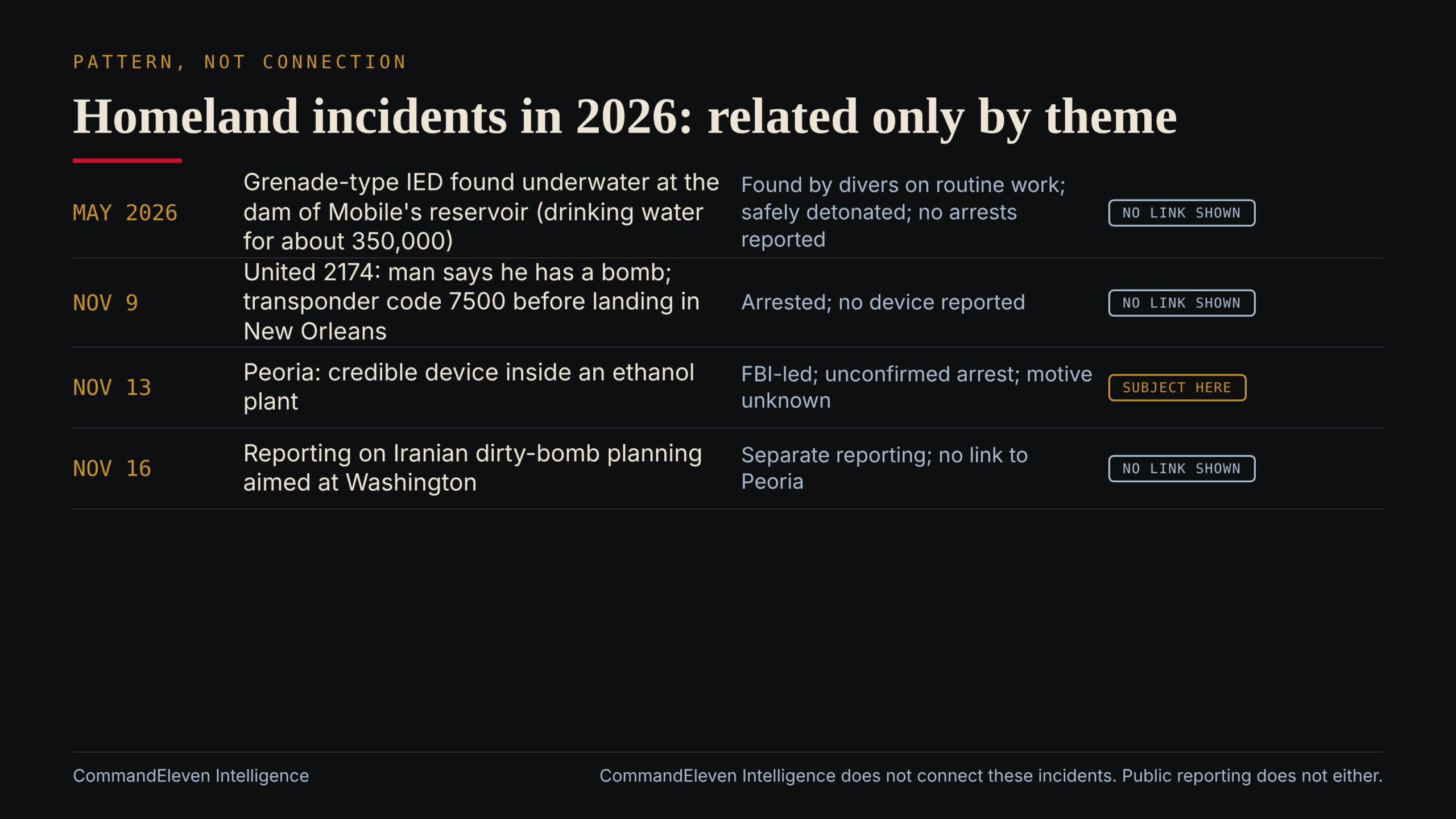
- May 2026, Mobile, Alabama. Divers on routine maintenance found a grenade-type improvised explosive device underwater at the dam of the Converse Reservoir, a drinking-water source. It was retrieved and safely detonated. The water authority called it “an unprecedented threat.” The reports we found mention no arrest and no motive.
- November 9, United flight 2174. A Newark to New Orleans flight set transponder code 7500 before landing. Deputies arrested a man who told the crew he had a bomb. No device was reported.
- November 16, Iran reporting. CNN reported U.S. officials describing Iranian planning for a dirty bomb or chemical attack in Washington. That is a different type of event, and nothing links it to Peoria. See our assessment of that reporting.
What To Watch
- A criminal complaint or indictment on the federal docket, and what it alleges about motive and the device.
- Whether the FBI or ATF says the case is being handled as terrorism, or as a criminal matter tied to the plant.
- Whether officials say how the device got inside, which determines whether this is a workforce-screening problem, a perimeter problem or both.
- Whether the plant’s operators or regulators announce changes to screening or access.
- Any action in Congress or at DHS on chemical-site personnel vetting.
Calls We Will Score
- By December 31, 2026: A federal criminal complaint or indictment in the BioUrja case becomes public, and it does not allege that the device was directed by a foreign government or a designated terrorist organization.
- By March 31, 2027: No U.S. agency publicly attributes the BioUrja device to Iran or to an Iran-directed network.
- By June 30, 2027: Congress or DHS announces a replacement federal program, mandatory or voluntary, for vetting chemical-facility personnel against the terrorist watchlist.
What This Assessment Does and Doesn’t Establish
- It establishes the device, the evacuation and the lack of injuries from police briefings and multiple outlets. It does not establish who placed the device, why, or whether the person reported in custody is the person responsible.
- The connection of the person in custody to the plant rests on unnamed sources at one outlet. We include it as reported, not as fact.
- We did not obtain the threat message, the device description or any charging document.
- The one-mile radius explanation is a plausible reading by outside observers, not an official one.
- We do not name the suspect and we do not publish technical details about the device or the plant’s defenses.
Frequently Asked Questions
Was anyone hurt in Peoria?
No injuries were reported. A one-mile area was evacuated for about 18 hours, and some events in Peoria were canceled.
Is this terrorism?
Officials have not said. The ATF and FBI describe a criminal investigation and have not said whether it is being treated as terrorism. Nothing public shows a political or ideological motive.
Who is in custody?
The mayor says a suspect is in custody. The FBI has not confirmed an arrest, no charges are public and we do not name the person.
Is this linked to the Iran dirty bomb reporting?
No link is shown. The two are separate events and we keep them separate.
Could the chemical-security gap have prevented it?
Possibly not. The vetting the program provided screened people against the terrorist watchlist. It would not flag someone with no terrorism record. The gap matters for the wider threat, not as an explanation of this case.
Related CommandEleven Intelligence Reading
- Iran dirty bomb reporting: what is established, what is disputed
- State-backed hacktivist groups and hired fronts: who is behind the attacks on Western infrastructure
- Cyberattacks, November 1 to 17, 2026
Sources
- WCBU: suspect reportedly arrested in connection with the BioUrja bomb (Nov 16, 2026)
- 25 News Now: downtown Peoria shut down over BioUrja bomb threat (Nov 14, 2026)
- ABC News: Peoria police urge evacuations after reported bomb threat (Nov 14, 2026)
- Fox News: FBI investigates who placed bomb near Illinois ethanol plant (Nov 2026)
- Newsweek: FBI issues Illinois bomb threat update as suspect detained (Nov 16, 2026)
- NBC Chicago: alleged Peoria bomber and the ethanol plant, federal sources say (Nov 16, 2026)
- Tony Seruga on X: Peoria timeline and analysis (Nov 17, 2026)
- Government Accountability Office: chemical facility security, GAO-26-108127 (Sep 8, 2026)
- Hawaii News Now (WALA): improvised explosive device found in critical reservoir (May 2026)
- Aerocorner: United UA2174 lands in New Orleans squawking 7500 (Nov 2026)
Assessments and confidence tiers are CommandEleven Intelligence’s own. We do not reproduce third-party text. Attributions are to the named outlets and officials.