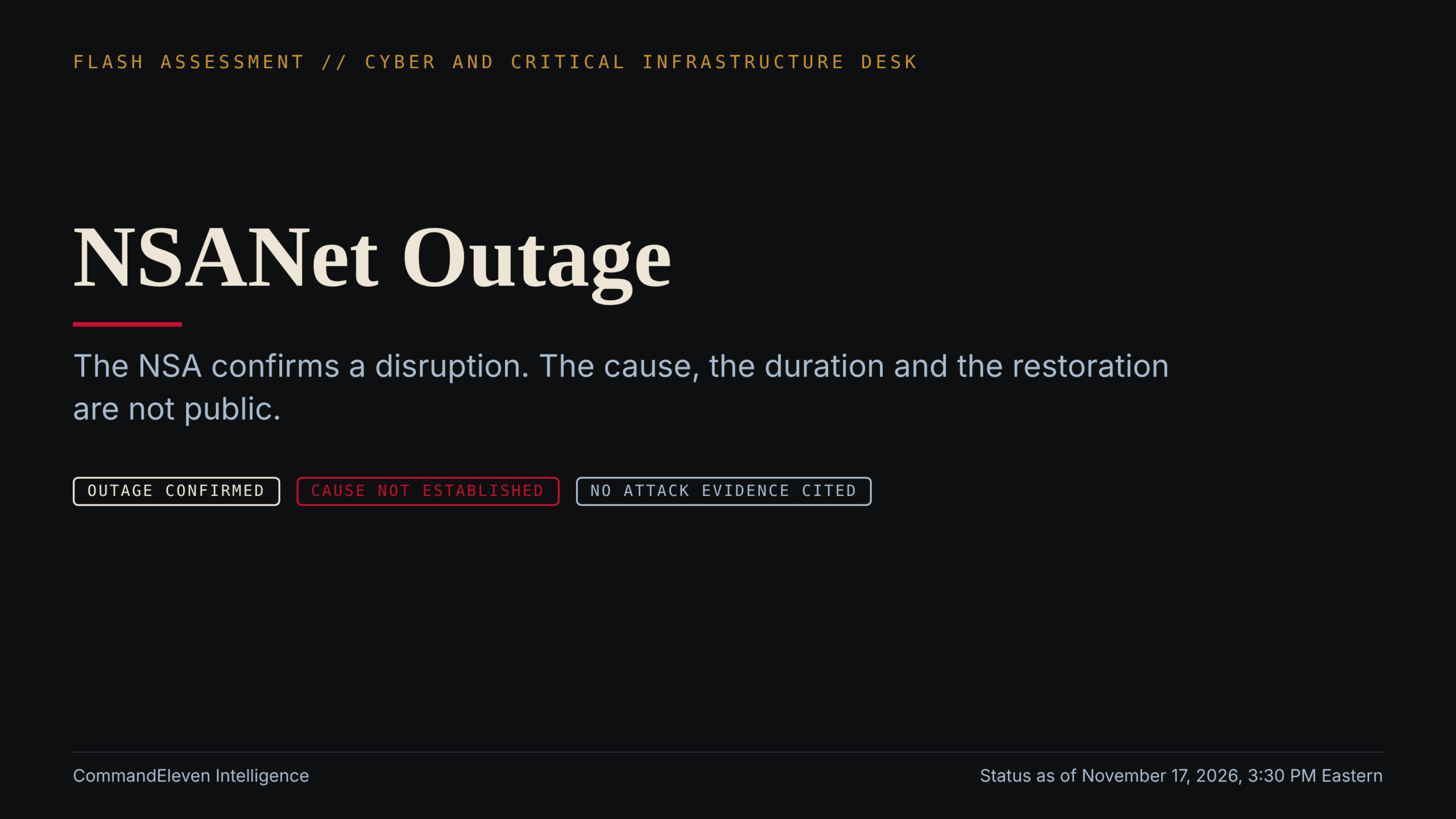
Status as of November 17, 2026, 3:30 PM Eastern. This is a developing incident. We will update it when the NSA states a cause, confirms restoration, or a government source says anything on-record about an intrusion.
Bottom Line Up Front
On Tuesday, November 17, CNN reported that NSANet, the National Security Agency’s classified internal communications network, was down. The NSA then acknowledged a “temporary degradation” during scheduled maintenance and said its mission-critical capabilities remained fully operational. The White House said it sees no evidence of a cyberattack. Sources told reporters the outage may be tied to a series of software upgrades, and staff were told to change their arrival times at Fort Meade. The cause, the length of the outage and whether the network is back are not public.
We assess that a self-inflicted maintenance or upgrade failure is the more likely explanation, with moderate confidence, because the agency’s own statement and the reporting point the same way. We also assess that it is too early to rule out a hostile cause, because a classified network is exactly where an agency would say little. The outage landed in a week of unrelated failures at Microsoft, the FAA and the banks, each with a different stated cause. We find no evidence connecting them. They show something else: how much of the country’s critical infrastructure can be taken offline by its own changes.
Key Judgments
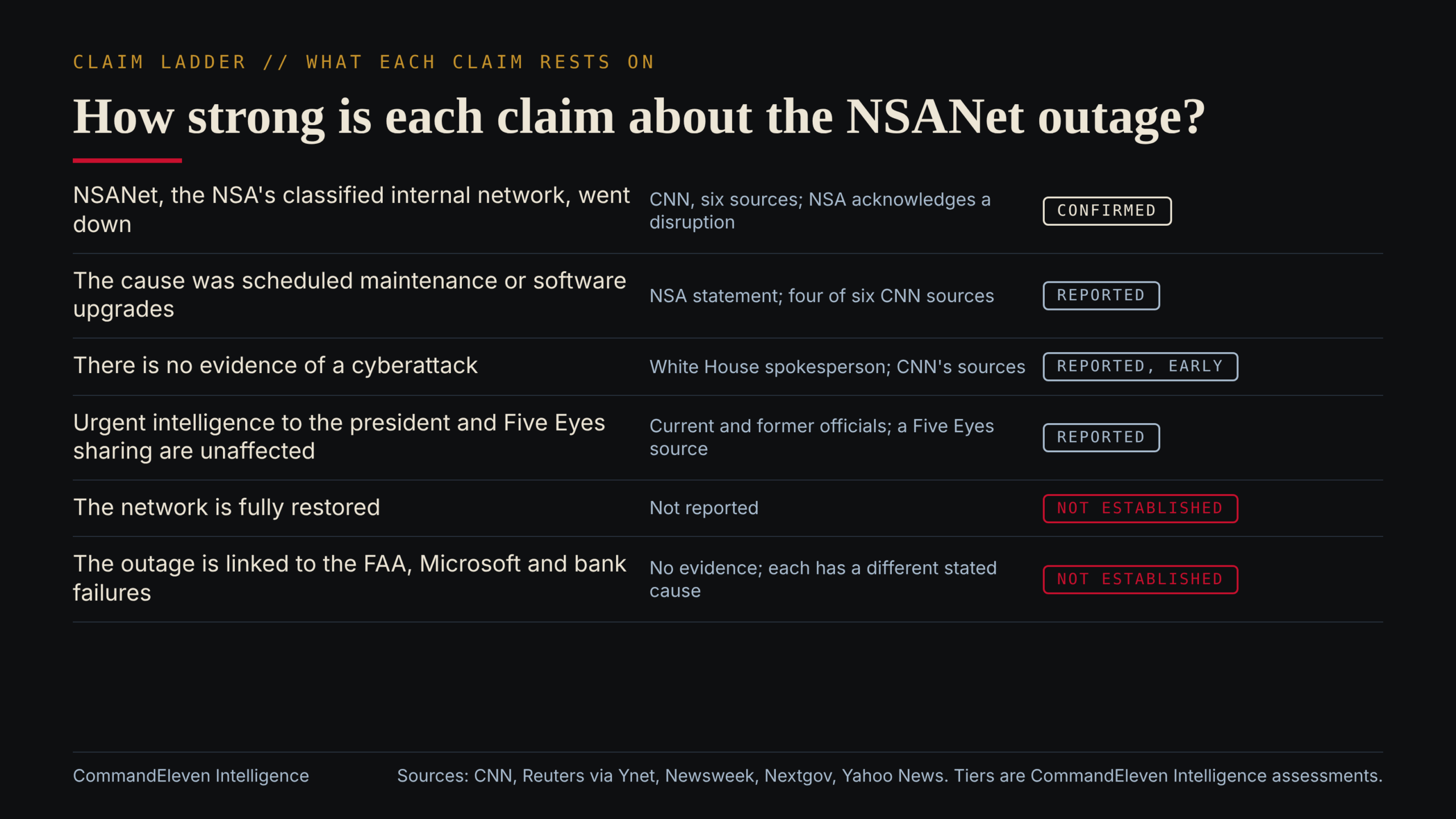
- CONFIRMED. NSANet was disrupted on November 17. The NSA acknowledged a “temporary degradation” during scheduled maintenance, in a statement reported by Reuters, and said mission-critical capabilities stayed operational.
- REPORTED. CNN, citing six people familiar with the matter, says the network went down. Four of the six told Nextgov the outage may be tied to a series of software upgrades.
- REPORTED. Staff arrival times at Fort Meade were staggered while the agency investigated, and analysts’ work slowed. Backup systems reportedly keep urgent intelligence flowing to the president, who is traveling in Asia. A Five Eyes source says allied sharing is unaffected.
- REPORTED, EARLY. White House spokesperson Lauren Bis said, “We see no evidence that this was a cyberattack.” CNN’s sources said the same. These are early statements about a network the public cannot inspect.
- ASSESSED: MODERATE. The outage is more likely a maintenance or upgrade failure than a hostile intrusion. The NSA’s own account, the sources’ account and two precedents point the same way.
- ASSESSED: LOW. The week’s outages are coordinated. Each has a different stated cause and we find nothing that links them.
- NOT ESTABLISHED. The cause, the duration, whether service is restored, what data or work was affected, and whether any hostile actor was involved.
What Happened
NSANet is the agency’s classified network for internal communications, the system its analysts use to share and work on sensitive material. CNN first reported the outage on Tuesday, citing six people familiar with it. Nextgov reported that the outage slowed analysts and led the agency to stagger employees’ arrival times at its Fort Meade campus, a step that, per Ynet, was meant to reduce the login strain on the affected systems.
The NSA confirmed a disruption later in the day. In a statement reported by Reuters, it said the network suffered a “temporary degradation” during scheduled maintenance, that some internal systems were affected, and that mission-critical capabilities remained fully operational. It did not say which systems, and it did not say the network was restored. Current and former officials told CNN that backup systems would still deliver urgent intelligence to President Trump while he is in Asia, and a source from a Five Eyes country said intelligence sharing with allies was unaffected.
Beth Sanner, a former senior U.S. intelligence official, said in the WSJ account carried by the Jerusalem Post that a cyberattack was the least likely explanation, since the network is isolated and defended by the world’s most capable cyber agency. That is a reasoned view from a former official, not evidence about this incident. House Democratic Leader Hakeem Jeffries called on the administration to brief Congress on the NSA network issue, the FAA ground stop and the Microsoft outage.
What “No Evidence of a Cyberattack” Does and Doesn’t Tell Us
Both statements are worth taking seriously and neither settles the question. The White House line was given in a television interview the same day. The agency has not said how it ruled out an intrusion, and it is unlikely to say so publicly if it had. “No evidence” in this setting means nothing has been found so far, which is a weaker claim than “it did not happen.”
What points toward a maintenance failure is the convergence, not any single statement. The NSA’s own description names scheduled maintenance. Four of six sources independently describe software upgrades. And the network’s recent history, as far as it is public, includes this kind of failure. In January 2000, an NSA network at Fort Meade was down for about 72 hours. The agency said then that it was not a virus and that intelligence collection was not affected, though processing was. In October 2013, the public nsa.gov site went down, and the agency blamed an internal error during a scheduled update and denied a rumored denial-of-service attack. The 2013 incident involved the public website, not NSANet, so we cite it only as an example of the same kind of explanation.
What would change our view: an on-record statement that investigators found unauthorized access, a recovery period far longer than a maintenance window, or reporting that data was exposed. We are not seeing any of those.
Pattern, Not Conspiracy
Over six days, four large systems failed, and each organization gave a different cause. Microsoft blamed a latent defect, a traffic surge and reduced server capacity for the Outlook and Teams outage on Thursday. The FAA traced Friday’s nationwide ground stop to a technical glitch after a routine router upgrade in Arkansas. JPMorgan Chase said a temporary issue linked to a software bug caused Monday’s disruption at major banks. The NSA cites scheduled maintenance. On Tuesday, users also reported problems with Gmail, Apple services and Marriott’s app, with no cause given. Markwayne Mullin attributed the earlier disruptions to aging systems, per the WSJ as relayed by the Jerusalem Post.
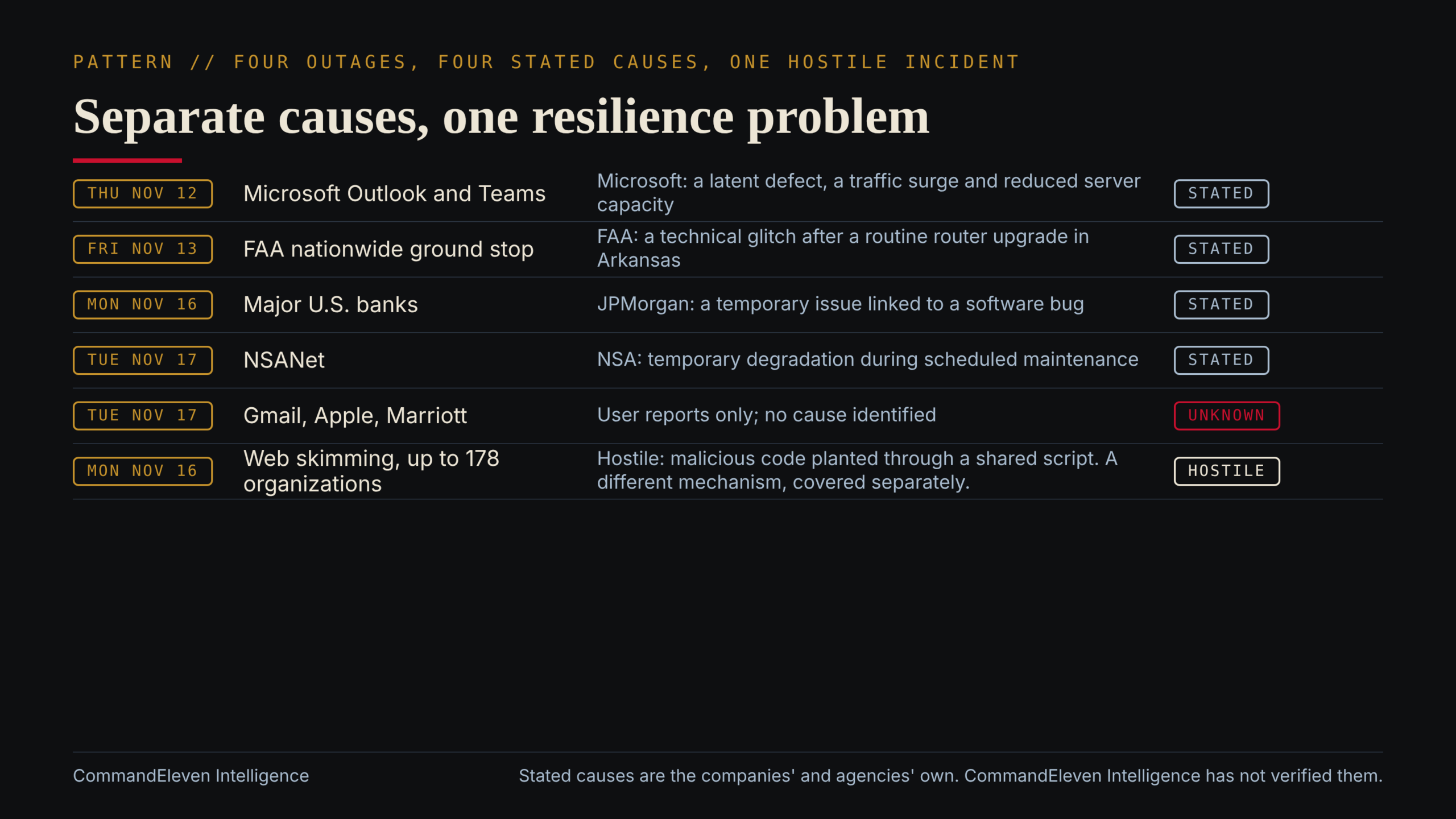
Reporters covering the week say no evidence ties the incidents together, and we agree. That is separate from a hostile campaign we cover elsewhere: on Monday, malicious code was planted on websites used by as many as 178 organizations, through a shared script. That incident has a different mechanism and a named root cause. See our November 1 to 17 cyberattack assessment.
The shared lesson is about change, not conspiracy. A routine upgrade is a risk event for any large system, and a week of failures during upgrades suggests that testing, staging and rollback practices are under strain. That matters more as agencies and companies consolidate systems onto shared platforms, because one change can reach many users at once. It also gives a hostile actor cover, since an attack can be mistaken for a bad upgrade, which is why transparency about causes matters.
What Organizations Can Take From It
- Stage upgrades and keep a tested rollback plan, with the rollback decision made before the change window opens.
- Keep an out-of-band way to communicate that does not depend on the system being changed, and test it.
- Write down in advance what you will say about the cause. An early “no evidence of an attack” statement is useful only if you can later say what you checked.
What To Watch
- An on-record NSA or ODNI statement on cause and restoration.
- Any change in the “no evidence of a cyberattack” line, or any hint of a data-exposure question.
- Whether Congress holds a briefing or hearing on the week’s outages, as Jeffries has asked.
- Whether a root-cause report is published for the FAA, Microsoft, bank or NSA incidents.
- Whether further outages follow, and what causes are stated.
Calls We Will Score
- By December 31, 2026: No U.S. government agency publicly attributes the NSANet outage to a cyberattack or a hostile actor.
- By December 31, 2026: A congressional hearing or an announced briefing addresses the NSA, FAA and Microsoft outages.
- By March 31, 2027: No public evidence links the NSANet outage to the FAA, Microsoft or bank failures as a single coordinated event.
What This Assessment Does and Doesn’t Establish
- It establishes that NSANet was disrupted and that the NSA acknowledged a degradation during scheduled maintenance. It does not establish the cause, the duration or whether the network is back.
- The software-upgrade explanation rests on an NSA statement and unnamed sources. We treat it as reported, not proven.
- We did not obtain the NSA’s statement directly. We rely on Reuters as carried by Ynet and Newsweek.
- The cited causes for the Microsoft, FAA and bank failures are the organizations’ own statements. We have not verified them.
- We cannot see inside a classified network, and we make no claim about its contents.
Frequently Asked Questions
What is NSANet?
It is the NSA’s classified internal network for communications and sharing sensitive material among its own staff.
Was the NSA hacked?
The White House and the sources say there is no evidence of a cyberattack. The NSA says the disruption occurred during scheduled maintenance. The agency has not published a root cause, so a hostile cause is not excluded.
Is intelligence reaching the president?
Current and former officials told CNN that backup systems would still deliver urgent intelligence to the president. The NSA says its mission-critical capabilities remained fully operational.
Are the NSA, FAA, Microsoft and bank outages connected?
No link is shown. Each organization gave a different cause, and reporters say no evidence ties them together.
Has this happened before?
Yes, in different forms. An NSA network at Fort Meade was down for about 72 hours in January 2000, and the agency’s public website went down in 2013 after an internal error during a scheduled update.
Related CommandEleven Intelligence Reading
- Cyberattacks, November 1 to 17, 2026: what happened, what is rumor, and how to protect yourself
- FAA ground stop: update
- FAA ground stop, Microsoft and Workday outages
- The “November 17” emergency alert and stock-up warnings
- State-backed hacktivist groups and hired fronts
Sources
- CNN: highly classified national security communications network goes down (Nov 17, 2026)
- Ynet News: NSA confirms classified network disruption, citing Reuters (Nov 17, 2026)
- Nextgov/FCW: classified NSA communications network down, people familiar say (Nov 17, 2026)
- Newsweek: NSA network, Apple services reported offline as mass outages continue (Nov 17, 2026)
- Yahoo News: NSA classified network goes down as White House says no evidence of cyberattack (Nov 17, 2026)
- Jerusalem Post: NSA network shut down, linked to software update, per WSJ (Nov 17, 2026)
- The Daily Beast: NSA’s top-secret network goes dark amid cyber chaos (Nov 17, 2026)
- Forbes: NSA’s classified internal network temporarily went down, agency says (Nov 17, 2026)
- Route Fifty: NSA puts system back online (Feb 2000)
- The Register: nsa.gov goes down after error during scheduled update (Oct 28, 2013)
Assessments and confidence tiers are CommandEleven Intelligence’s own. We do not reproduce third-party text. Attributions are to the named outlets and officials.