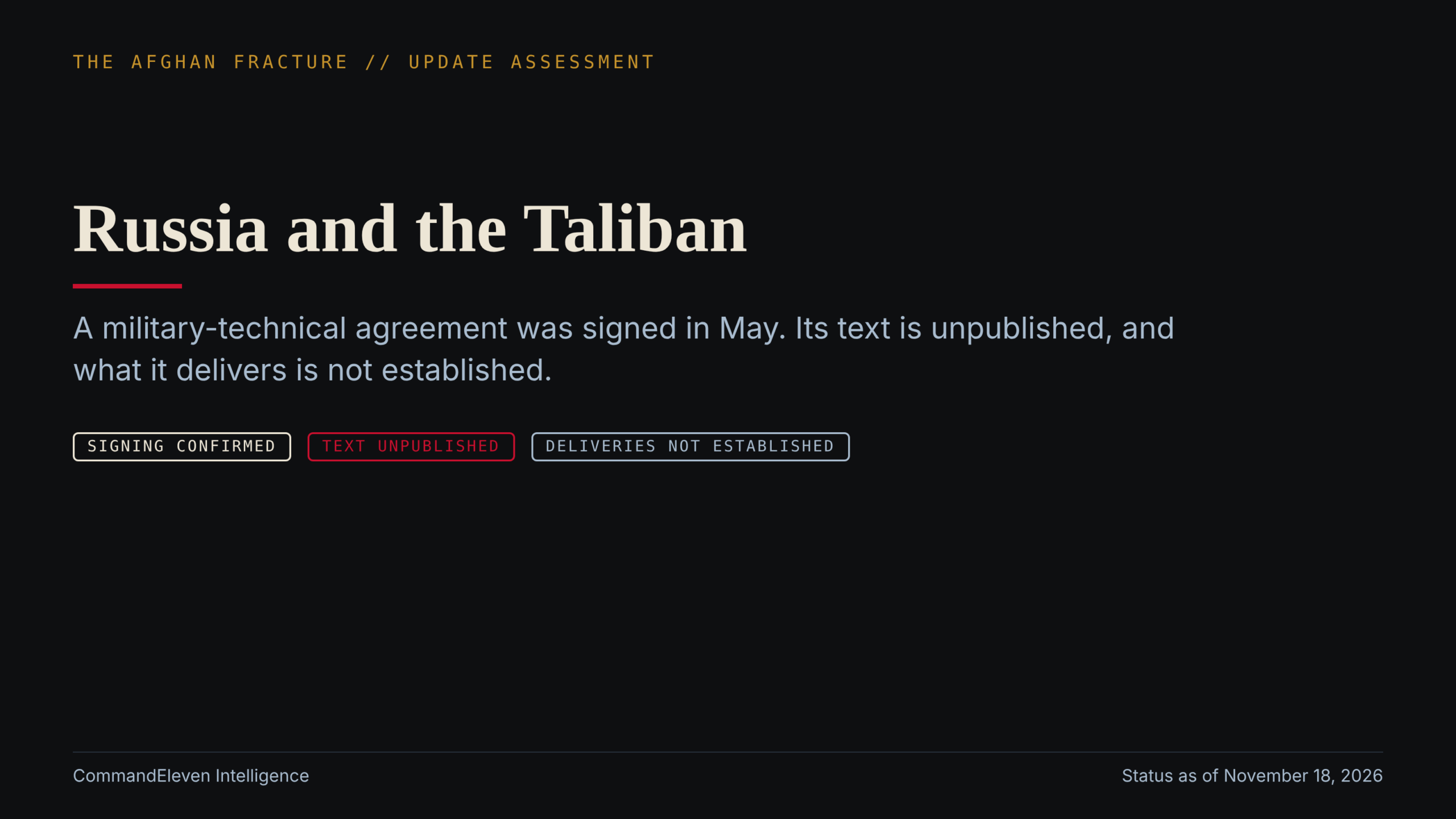
Status as of November 18, 2026. This updates Part 1 of our Afghan Fracture series with new reporting on Russia and the Taliban. We checked each claim against named outlets, and we mark what rests on a single source.
Bottom Line Up Front
On May 27, Russia’s Security Council secretary, Sergei Shoigu, and the Taliban’s defense minister, Mohammad Yaqoob, signed a military-technical cooperation agreement near Moscow. Neither side has published the text. Since then, Afghanistan International has reported that Russia’s foreign intelligence chief, Sergei Naryshkin, flew to Kabul on October 14 and met the Taliban intelligence chief, Abdul Haq Wasiq. Afghanistan International has also reported that the Taliban are talking to Belarus about weapons and drones, with Russian help and Indian financing. A newer Al Khabeer article goes further and claims the agreement has never entered into force.
We assess, with moderate confidence, that Russia’s Taliban policy is mostly political signaling and intelligence contact, with little publicly visible material support. We find no public evidence of arms deliveries or repairs under the agreement. We treat the “not in force” claim as unverified, and we explain why below. The reporting on Belarus is a serious lead with a single origin.
Key Judgments
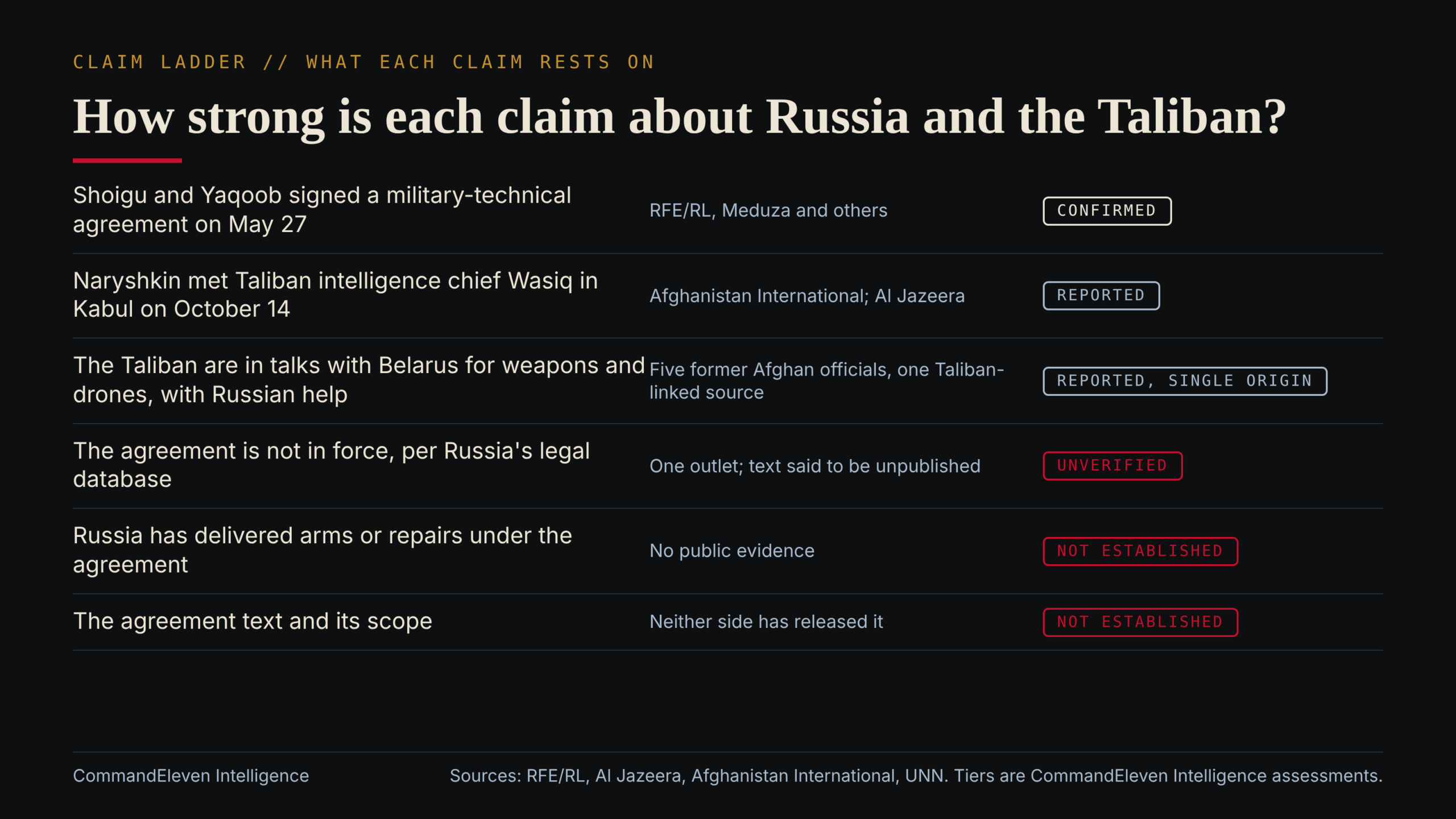
- CONFIRMED. Shoigu and Yaqoob signed a military-technical cooperation agreement on May 27, 2026, according to RFE/RL, Meduza and other outlets. RFE/RL reports that neither side has released the text.
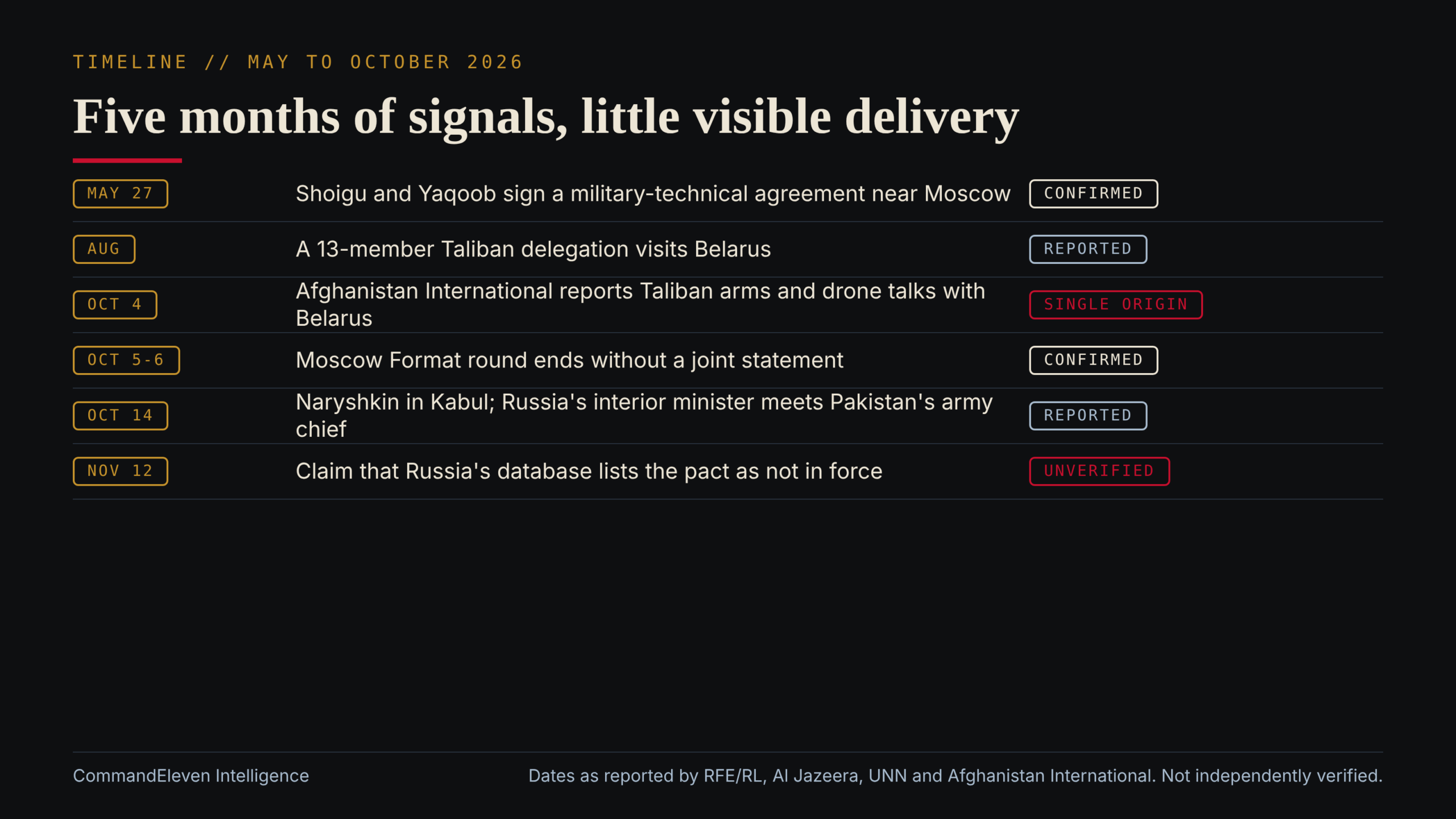
- REPORTED. Naryshkin visited Kabul on October 14 and met Wasiq (Afghanistan International; Al Jazeera). Neither government has disclosed what they discussed.
- REPORTED, SINGLE ORIGIN. Afghanistan International, citing five former senior Afghan officials and one source close to the Taliban, says Taliban officials are negotiating weapons and drone purchases from Belarus, with Russian assistance and Indian financing. UNN carried the report and noted no denials.
- UNVERIFIED. Al Khabeer says Russia’s legal database lists the agreement as not in force as of November 12. We could not confirm this, and the claim sits oddly with the unpublished text.
- ASSESSED: MODERATE. The agreement is mainly a political signal. Analysts quoted by RFE/RL say Russia’s war in Ukraine limits its capacity and that the Taliban cannot afford large purchases.
- ASSESSED: LOW. Belarus is a working channel for Russian-approved supplies to the Taliban. The reporting is plausible, but it comes from one outlet and its sources.
- NOT ESTABLISHED. The agreement’s text and scope, whether it has been ratified, any delivery of arms or repairs, and the agenda of the Naryshkin meeting.
What Is Established
The signing is established. RFE/RL reported it on May 28, naming Shoigu and Yaqoob. It said the agreement was signed on the sidelines of a security forum outside Moscow and that neither side released details. Military-technical cooperation can mean arms sales, training, maintenance or logistics, and RFE/RL notes that experts expect the focus to be on maintenance, coordination or training rather than large arms deliveries.
The context is a close but limited relationship. Russia recognized the Taliban government in July 2025, the first country to do so, as Al Jazeera notes. Moscow’s stated worry is Islamic State Khorasan, which claimed the March 2024 Crocus City Hall attack near Moscow. Russia’s public concern is that group, not Pakistan’s complaints about the Pakistani Taliban. And Russia also keeps ties to Pakistan, which chairs the Shanghai Cooperation Organisation in 2026 and 2027.
The Kabul Visit
Afghanistan International reported that Naryshkin arrived in Kabul on October 14 and met Wasiq. Al Jazeera confirmed the meeting in a piece on Russian mediation between Kabul and Islamabad. It adds that Russia’s interior minister, Vladimir Kolokoltsev, was in Pakistan at the same time and met the army chief, Asim Munir, in Rawalpindi, and that Pakistan’s military said Afghanistan was not discussed. Neither Russia nor the Taliban has said what Naryshkin and Wasiq discussed, and we found no official confirmation of the visit.
We read the visit as a channel, not a deal. An intelligence-to-intelligence meeting is the kind of contact that continues when public diplomacy stalls. The Moscow Format round that ended on October 6 without a joint statement, covered in Part 1, shows why. Russia’s envoy, Zamir Kabulov, said the Afghan delegation objected to repeated references to Afghanistan and “terrorism.” Having a private line to Kabul matters more to Moscow when its public forum is failing.
The Belarus Reporting
On October 4, Afghanistan International reported that Taliban officials had begun talks to buy weapons and drones from Belarus, and UNN carried the report. It cites five former senior Afghan defense and security officials. One person close to the Taliban confirmed the agreements and said Russia was involved. India is described as an intermediary and financier, with a precedent under the previous Afghan government, when India bought helicopters from Belarus and paid to repair equipment there. UNN reported no denials from the Taliban, Belarus, Russia or India. The same report says a 13-member Taliban delegation visited Belarus in August.
We rate this REPORTED, SINGLE ORIGIN. The outlet has sourcing, and the story fits a known pattern, but we found no second, independent confirmation. Other outlets have repeated it, which is not the same as confirming it. If it is right, it would be a way for Russia to support the Taliban without a direct transfer, but it would also put Moscow, New Delhi and Kabul in an arrangement that each has reasons to deny.
The Claim We Cannot Verify
An Al Khabeer article from November 13 says Russia’s GARANT legal database lists the May agreement as not in force, quotes treaty articles, and describes a long Taliban wish list for Soviet-era equipment. We did not use those details. The outlet is a single source, much of the piece is opinion, and we could not open the database record.
There is also a contradiction. RFE/RL reported that neither side released the text. A published database entry quoting numbered articles would mean the text is public, or that someone has leaked it. Either is possible, and none is shown. Until a second outlet or the database record itself confirms it, we treat “not in force” as UNVERIFIED, and we do not rely on its quoted articles. We also have not read the Afghanistan International report on a Taliban equipment wish list that Al Khabeer cites, so we leave that out.
Why It Matters
The practical question is whether Russia is arming the Taliban, and the public record does not say it is. What the record shows is a relationship built on recognition, forums and intelligence contact, with little confirmed material support. That matters for Pakistan, which sees any outside military help to Kabul as a threat while it fights along the border, and for India, which is reported to be financing Belarusian supplies. It also matters for the Moscow Format, because a Russia that keeps a private line to Kabul has to balance it against hosting a forum meant to bring regional states together on Afghanistan.
The limit is the war in Ukraine. Analysts quoted by RFE/RL say Russia’s industrial capacity is stretched and that the Taliban lack the money to buy much. That fits our moderate-confidence view that the agreement is mostly a signal. It also explains why reporting about Belarus and India matters more than the agreement itself: third-party routes are the cheapest way for Moscow to give something without paying for it.
What Would Change Our View
- A published text of the agreement, or an official statement of its scope.
- A second independent confirmation of the Belarus talks, or an official denial.
- Evidence of a delivery, an overhaul or a training program carried out under the agreement.
- Confirmation of the Russian database entry, or its removal.
- An on-record account of what Naryshkin and Wasiq discussed.
What To Watch
- Whether Russia or the Taliban publish or describe the agreement.
- Further reporting on Belarus, and any comment from Minsk or New Delhi.
- Russian mediation between Pakistan and the Taliban, which Kabulov has offered if both ask.
- The next Moscow Format round, and whether a joint statement returns.
Calls We Will Score
- By June 30, 2027: Neither Russia nor the Taliban publishes the full text of the May 27 agreement.
- By March 31, 2027: No Russian or Taliban government statement, and no UN monitoring report, confirms a delivery of Russian-origin military equipment to the Taliban under the agreement.
- By June 30, 2027: No government involved (Belarus, Russia, India or the Taliban) officially confirms the reported Belarus weapons and drone talks.
What This Assessment Does and Doesn’t Establish
- It establishes that an agreement was signed. It does not establish what it covers or whether it operates.
- The Kabul visit and Belarus talks come from Afghanistan International and outlets that relayed it. We did not obtain the original reports from the Taliban or Russian governments.
- We read the RFE/RL and Al Jazeera pieces and the UNN and Afghanistan International reports. We read the Al Khabeer piece but did not rely on it.
- Anonymous sources in the Belarus report cannot be checked.
Frequently Asked Questions
Did Russia sign a defense pact with the Taliban?
It signed a military-technical cooperation agreement on May 27. The text has not been published, so what it commits Russia to is unknown. Analysts expect maintenance, training and coordination more than large arms deliveries.
Is the agreement in force?
We do not know. One outlet says Russia’s legal database lists it as not in force, and we could not confirm that.
Is Russia arming the Taliban through Belarus?
One outlet reports that the Taliban are negotiating with Belarus, with Russian help and Indian financing. It is not independently confirmed and no government has commented.
Why did the spy chief go to Kabul?
No one has said. It is reported that he met the Taliban intelligence chief. We read it as a continuing channel between the two services, not as evidence of a specific deal.
Related CommandEleven Intelligence Reading
- The Afghan Fracture, Part 1: the Moscow Format collapse and the Pakistan-Taliban war
- The Afghan Fracture: a CommandEleven Intelligence series
- The Taliban at Five: where the public record differs from IISS
- Pakistan and the Taliban after Kandahar
Sources
- RFE/RL: Russia and the Taliban sign a military agreement (May 28, 2026)
- Al Jazeera: Can Russia help ease tensions between Pakistan and Afghanistan? (Oct 16, 2026)
- Afghanistan International: Naryshkin in Kabul (Oct 15, 2026)
- UNN: The Taliban have begun purchasing weapons and drones from Belarus with Russia’s assistance, media report (Oct 4, 2026)
- Al Khabeer: Russia’s Taliban Trap (read, not relied on) (Nov 13, 2026)
Assessments and confidence tiers are CommandEleven Intelligence’s own. We do not reproduce third-party text. Attributions are to the named outlets and officials.