CommandEleven Intelligence · Afghanistan Desk. Status as of November 4, 2026. This piece compares one published assessment against the public record. Where the two differ, we say which kind of difference it is.
Bottom Line Up Front
The International Institute for Strategic Studies published The Taliban after five years in power in October 2026 (IISS Strategic Comments). It concludes that the Taliban has consolidated power and avoided mass famine, state collapse and renewed civil war, while the country stays fragile, repressive and isolated. The piece is a careful synthesis and several of its facts are ones we would cite ourselves.
This note is narrower than a rebuttal. It sorts the differences into two kinds. Scope differences are things the piece does not cover, such as the Pakistan-Taliban border war and the Taliban’s own drone strikes. Evidence differences are places where a claim in the piece is not supported by, or has been overtaken by, the public record. Only the second kind is a disagreement, and it is concentrated in revenue, poppy and security.
Tier Key
CONFIRMED means an official or UN figure, or two or more independent reports. REPORTED is a credible single source or a figure with wide error bands. CLAIMED is attributed to the Taliban authorities. UNVERIFIED means we could not support the claim from public sources. ASSESSED is our judgment built on confirmed facts.
Key Judgments
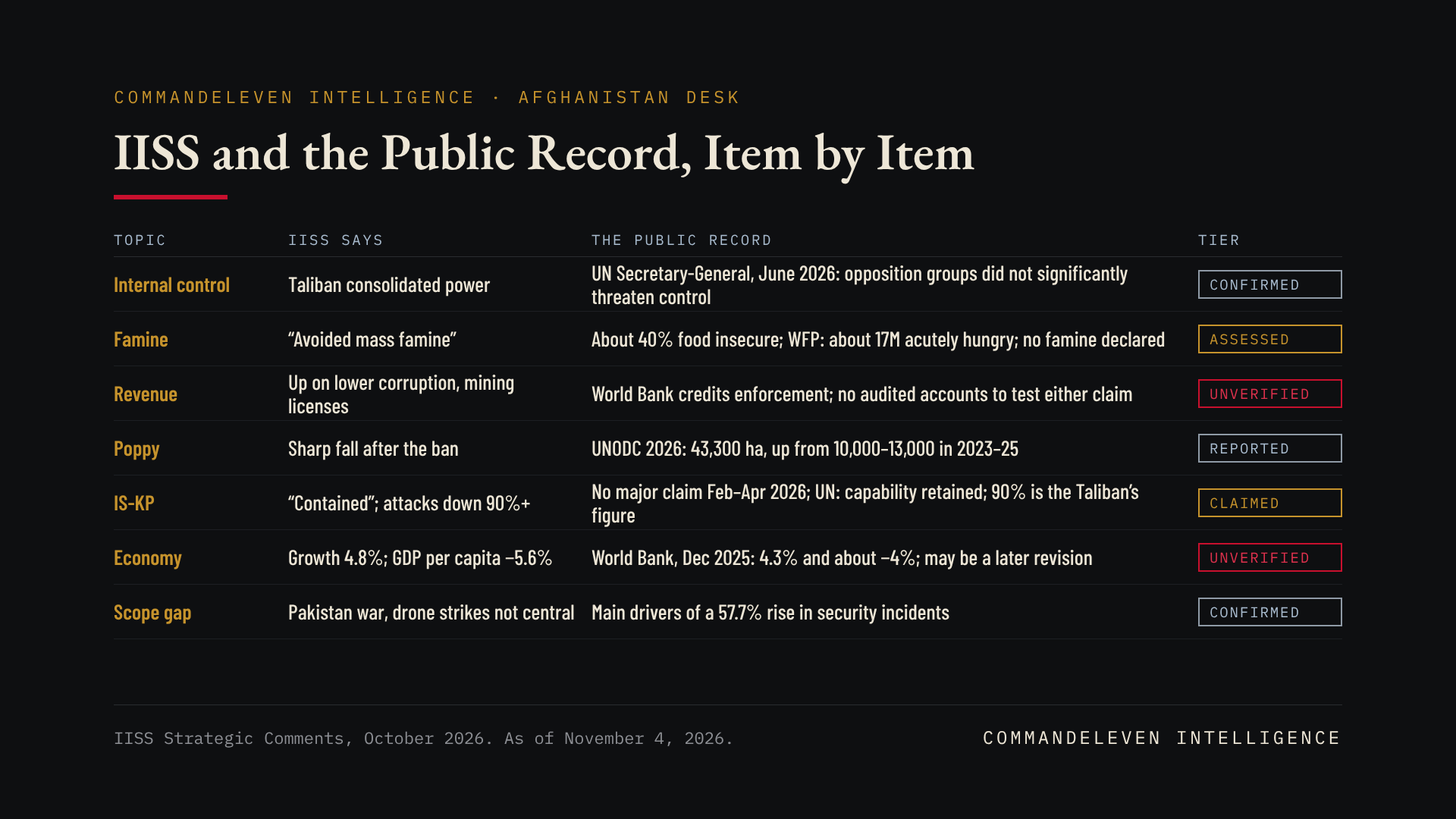
KJ1: On internal control, IISS is supported. The UN Secretary-General’s June 2026 report says armed opposition groups did not significantly threaten Taliban control of national territory. [CONFIRMED]
KJ2: “Avoided mass famine” is a framing, not a finding. IISS itself cites food insecurity near 40 percent. WFP reports about 17 million people facing acute hunger and said it could not run a significant winter response for the first time in decades. We found no famine declaration. [CONFIRMED: the figures. ASSESSED: the framing.]
KJ3: The link between lower corruption and higher revenue is not supported in public data. The World Bank attributes revenue gains to better enforcement and compliance, not to a corruption decline. Public revenue reporting has also thinned. [UNVERIFIED]
KJ4: The poppy claim reflects 2023-25, not 2026. UNODC now estimates 43,300 hectares, up from roughly 10,000 to 13,000, and says the ban appears to be weakening. [REPORTED, wide error bands]
KJ5: “Contained” is only partly supported for IS-KP. The UN recorded no major IS-KP attack claim from February to April 2026 but assesses the group retains capability. The 90 percent decline is the authorities’ figure. [CLAIMED]
KJ6: The largest gap is scope. The Pakistan-Taliban war and the Taliban’s armed drone strikes are the main drivers of a 57.7 percent rise in security incidents, and neither is central to the IISS piece. [CONFIRMED]
Where We Agree
IISS and this desk agree that Russia remains the only state to formally recognize the Taliban government, that the Taliban has refused to cut ties with the TTP and al-Qaeda, and that there has been no movement on girls’ secondary education. We also agree that the Taliban is not in danger of losing control internally. Those points are not in dispute.
The Evidence Differences
Famine and hunger
IISS says food insecurity has reached about 40 percent of the population. That matches the UN picture. WFP reported in December 2025 that three million more people faced acute hunger than the 14.8 million of the year before, that about 3.7 million children are projected to suffer acute malnutrition through 2026, and that it needed $468 million to reach six million of the most vulnerable. About 2.5 million Afghans were returned from Pakistan and Iran in 2025, with another 2.5 million expected in 2026 (Express Tribune on WFP). The numbers are not in dispute. The conclusion drawn from them is. [CONFIRMED]
Revenue, corruption and the missing accounts
IISS says domestic revenue has risen because of lower corruption and mining licences, and gives no figure or source for either. The World Bank’s December 2025 update projects domestic tax revenue at 17.1 percent of GDP, credits better enforcement and compliance, and says the gain is insufficient to offset the fall in aid (World Bank). A second World Bank update reports 2025 spending of 155.7 billion afghanis, 49 percent of it on security (CentralAsiaLight, citing the World Bank). So some revenue and spending data exist. What does not exist is an audited account that would let anyone test a corruption claim. [UNVERIFIED: the corruption link. REPORTED: the World Bank estimates.]
The transparency picture has moved the other way. Afghanistan was suspended from the Extractive Industries Transparency Initiative in June 2024, and one analysis reports that public revenue reporting from the mining ministry dropped sharply after July 2024 (Jamestown Terrorism Monitor). In January 2026 the Taliban’s own ministry reported $137 million from the Amu Darya oil field for 2025, a figure no one has independently verified, while national budget details remain withheld (Amu TV). [REPORTED]
Mining
IISS says licensing, often to Chinese firms, has helped sustain revenue and that large projects are slow to start. The second half is consistent with the record. The first is hard to size. The Jamestown analysis counts at least 205 contracts to more than 150 companies, with terms undisclosed, and names investors from China, Qatar, Türkiye, Iran and the United Kingdom. It also reports gold extraction in Badakhshan and Takhar under Taliban-linked local leaders, a deployment of about 1,000 special forces officers to Badakhshan in June 2026 to tighten control of mines, and deadly clashes linked to Chinese-backed sites. Mining income is therefore wider than one province or one set of contracts, and none of it can be audited. [REPORTED, secondary sources]
Poppy
IISS says the Taliban deserves more recognition for the sharp fall in poppy cultivation after the ban. That was true for 2023 to 2025, when cultivation stayed near 10,000 to 13,000 hectares. UNODC’s 2026 estimate is 43,300 hectares (95 percent interval 31,700 to 61,200), with 29,482 hectares in Badakhshan and poppy in 16 of 34 provinces, and UNODC says the ban appears to be weakening. The Taliban reject the estimate, and their own figures disagree with each other. Full detail is in Do Drugs Still Finance the Taliban? [REPORTED, wide error bands]
IS-KP
IISS says the Taliban has contained IS-KP and that authorities claim attacks fell more than 90 percent since 2021. The first part is partly supported: the UN Secretary-General’s report for February to April 2026 records no major IS-KP attack claimed. But the UN Monitoring Team assesses that the group still has fighting and operational capabilities, and total security incidents rose 57.7 percent (KabulNow on the UN report). The 90 percent figure is the authorities’ and we found no independent count. [CLAIMED]
The economic numbers
IISS cites growth of 4.8 percent, a 5.6 percent fall in GDP per capita, population growth near 11 percent and average inflation of 3.6 percent. The World Bank’s December 2025 update projects 4.3 percent growth, a fall of about 4 percent in per capita GDP, population growth of 8.6 percent and inflation near 2 percent. These may be the product of a later revision, and the IISS piece does not link its source. We could not reconcile them, so we do not repeat either set as settled. [UNVERIFIED]
The Scope Differences
The IISS piece treats Pakistan as a tense relationship that has not broken down. The public record from October shows an active conflict. The Moscow Format ended without a joint statement for the first time, fighting spread from Kurram and Paktia to Angoor Adda and Torkham, and Pakistan declared a state of emergency in Khyber Pakhtunkhwa (Part 6). The UN documented 764 civilian casualties from cross-border violence between January 26 and March 31 (KabulNow on the UN report). The Taliban has also used armed drones against Pakistan since February 2026 (The Afghan Taliban’s Drone War Against Pakistan). IISS also does not cover Russia’s May 2026 military-technical agreement with Kabul, which we cover in The Afghan Fracture. These are omissions of scope, and the piece may predate some of them, so we do not count them as errors. [CONFIRMED]
Data Deficits
- No audited Taliban revenue or budget accounts exist in public, so no claim about corruption levels can be tested.
- The contract terms for the 205 or more mining awards are undisclosed.
- IS-KP attack counts since 2021 come from the Taliban authorities and have no independent series that we found.
- The source of the IISS economic figures is not given, so we cannot say whether they are later World Bank revisions.
Frequently Asked Questions
Is IISS wrong about the Taliban?
Not across the board. On internal control and several diplomatic points it is supported by UN reporting. Our differences are about revenue, poppy and the framing of hunger, plus what the piece leaves out.
Why does the revenue claim matter?
Because it is used to argue that the state is becoming more capable, and the Taliban publishes no accounts that would let anyone check it. A claim that cannot be tested should be labeled that way when it reaches a policy audience.
Related Reading
- Do Drugs Still Finance the Taliban? The 2026 Opium Rebound, the Ban and the Missing Revenue Data
- Understanding the Taliban: Structure, Ideology, and Governance in Afghanistan
- Deconstructing The Genesis of Karachi’s Unrest
- Navigating the Storm: Uniting Pakistan Through Shared Goals and Strong Leadership
Sources
- IISS, The Taliban after five years in power, Strategic Comments (October 2026)
- KabulNow, UN chief’s new report shows over 50% rise in security incidents in Afghanistan (June 2026)
- World Bank, Afghan economy expands amid persistent challenges (December 10, 2025)
- CentralAsiaLight, Taliban spent nearly half of Afghanistan’s budget on security affairs: World Bank (November 26, 2025)
- Express Tribune, WFP presses alarm button on Afghanistan’s hunger crisis (report of December 16, 2025)
- Jamestown Foundation (via ecoi.net), Taliban Mining Economy: An Insurgent Way of Doing Business, Terrorism Monitor 24(13) (August 7, 2026)
- Amu TV, Taliban ministry reports $137 million income from Amu Darya oil field in 2025 (January 2, 2026)
Companion Reading
- Do Drugs Still Finance the Taliban? The 2026 Opium Rebound, the Ban and the Missing Revenue Data
- Who Gets the Aid Money? $8 Billion, 9% Traceable, and the Taliban’s Cut
- The Front Moves South: Angoor Adda, Torkham and the October Border War, Part 6
- The Afghan Taliban’s Drone War Against Pakistan
- The Afghan Fracture: A CommandEleven Intelligence Series