CommandEleven Intelligence // Afghanistan and Pakistan Desks. Status as of October 27, 2026.
Bottom Line Up Front
Donors have paid about $8 billion in humanitarian aid for Afghanistan since the Taliban took Kabul in August 2021. A new tracker from the Kabul Institute, released on October 22, finds that only $721.9 million of it, about 9 percent, can be followed in public records past the first organization that received it. Another $1.42 billion went to recipients listed only as “confidential.”
A gap in the paper trail is not proof of theft, and the researchers say so. But it lands on top of five years of documented diversion. US watchdogs found implementing partners paying the Taliban millions in taxes, the Taliban forcing their own people onto aid payrolls and steering food away from minorities, and senior UN staff accused of splitting bribes with Taliban officials. In 2025, the State Department concluded that aid for Afghans had been “systematically diverted and expropriated” by the Taliban.
The question that matters for Pakistan is where the Taliban’s money goes. The UN Security Council’s own monitors report that the Taliban pay the family of the leader of Tehreek-e-Taliban Pakistan (TTP) about $43,000 a month. No public record traces an aid dollar to a TTP payment, and money does not need to be traced to matter: every dollar of aid that the Taliban tax, skim or no longer have to spend on public services frees a dollar for everything else they fund.
Key Judgments
KJ1: Most of the aid sent to Afghanistan since 2021 cannot be followed in public. Of about $8 billion paid, only 9 percent can be traced past the first recipient, and no agency publishes program-level spending. [CONFIRMED, per the Kabul Institute’s Afghanistan Aid Tracker]
KJ2: The Taliban have taken a cut of aid by taxation, coercion and placement. US-funded partners paid the Taliban government $10.9 million in taxes and fees by 2024, and SIGAR’s final reports documented forced hiring, diversion away from minorities and alleged bribe-sharing with UN staff. [CONFIRMED on the taxes; SINGLE-SOURCE (SIGAR interviews) on the collusion allegations]
KJ3: The Taliban fund the TTP, and aid makes that easier. UN monitors report regular Taliban payments to the TTP leader’s family and continued logistical and financial support to the group. [CONFIRMED on the support; ASSESSED on the link to aid]
KJ4: Oversight is weakest just as scrutiny is rising. US aid has largely ended, SIGAR closed in January 2026, and humanitarian funding has fallen from about $3.2 billion in 2022 to about $600 million in 2026. [CONFIRMED]
The $8 Billion Question
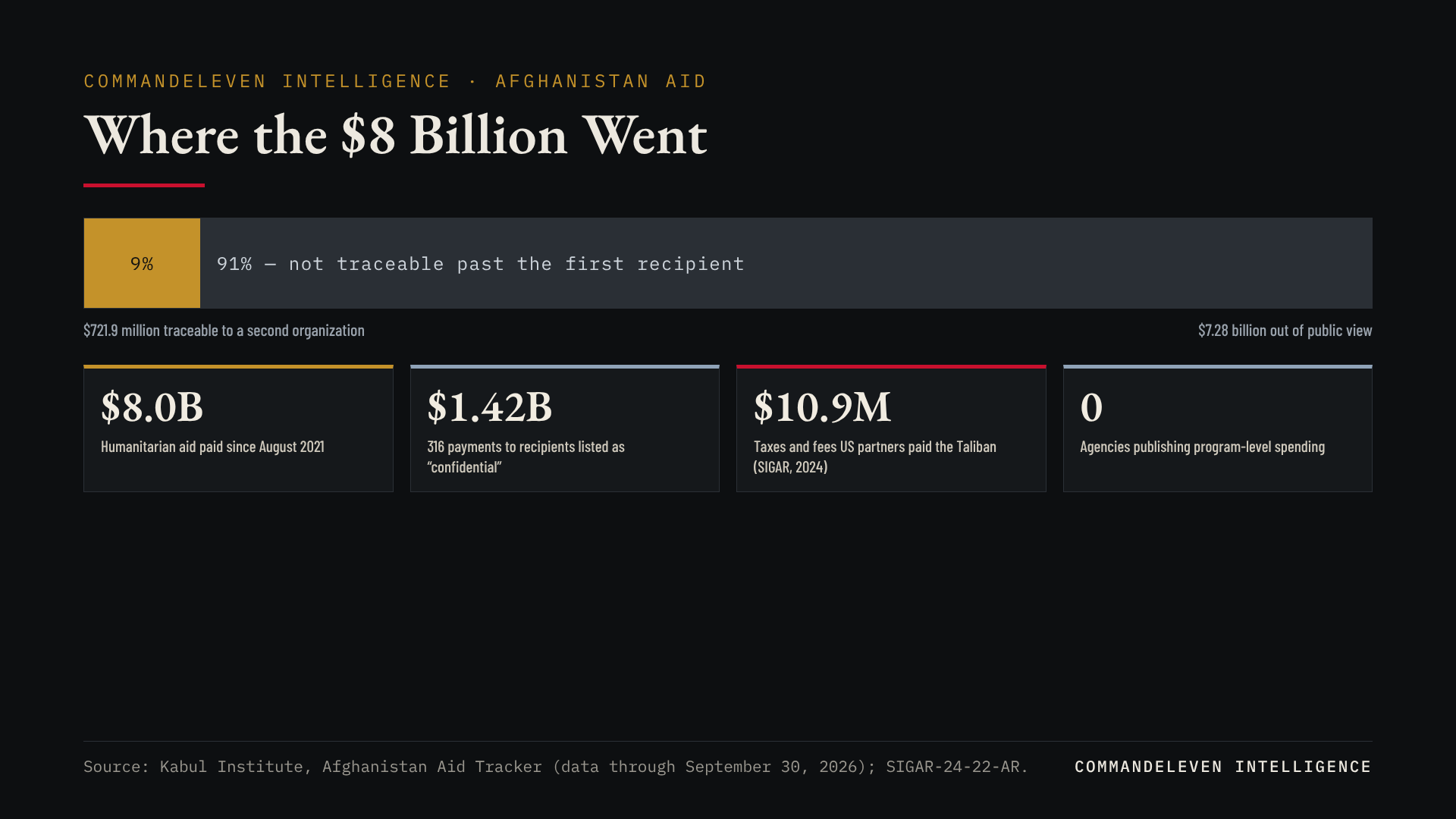
The Kabul Institute’s tracker, built from more than 21 public sources and updated through September 30, 2026, separates aid that was pledged, committed and actually paid. Its findings:
- $8.0 billion in humanitarian aid recorded as paid since August 2021.
- $721.9 million (9 percent) can be traced to a second organization in the chain. The rest “drops out of public view the moment it reaches the first recipient.”
- $1.42 billion across 316 payments went to recipients recorded as “confidential.”
- No machine-readable public source gives program-level spending for any agency.
The researchers shared the findings with the agencies named before publication. They are careful about what the numbers mean. “Just because we don’t see the money, it’s not an accusation that the money was misused,” development consultant Layma Murtaza said at the launch. Former Afghan diplomat Omar Samad put the other side: “In any humanitarian response, the public has a right to know where the money goes.” [CONFIRMED]
[ASSESSED] Both are right. The tracker does not show diversion. It shows that donors cannot show there was none. In a country run by a government that the State Department describes as a Specially Designated Global Terrorist group, that is the gap that matters.
How the Money Moves
Afghanistan’s banks were cut off from the world after August 2021, so the UN has flown in US dollars in cash to keep its operations running. By March 2024, those shipments totaled about $2.9 billion.
- The UN’s account. The cash is deposited in UN accounts at a private bank in Kabul and paid out to UN agencies and approved aid groups. The UN says none of it goes to the Taliban and that it “closely monitors, audits, and controls” the funds. [CONFIRMED as the UN’s position]
- SIGAR’s account. The US watchdog found that some of the money ends up at Afghanistan’s central bank, which the Taliban control, though it did not say how much of the US contribution was involved. [CONFIRMED as SIGAR’s finding; amount not established]
The two accounts are not as far apart as they look. Even when the cash stays in UN hands, it is spent inside an economy the Taliban tax and regulate, and the dollars support the afghani, which the Taliban government relies on. [ASSESSED]
What the Watchdogs Documented
Taxes and fees, 2024. SIGAR surveyed 65 US implementing partners. Thirty-eight reported paying taxes, fees, duties or utilities to the Taliban government, totaling $10.9 million, almost all of it in taxes. Partners that refused faced frozen bank accounts, closed offices and lost licenses. Seventeen reported direct Taliban pressure, including on program design, hiring, access to vehicles and diversion of aid. [CONFIRMED]
Missing paperwork, 2024. SIGAR also warned that about $293 million in US aid could not be shown to be free of Taliban benefit, because two State Department bureaus could not prove compliance with the rules meant to keep it out of Taliban hands. The State Department agreed to investigate. [CONFIRMED that the funds were unaccounted for; diversion itself not established]
Coercion and collusion, 2025. SIGAR’s final report on diversion, published in August 2025 and drawn from nearly 90 current and former US and UN officials and Afghans inside the country, alleged that the Taliban:
- steer aid toward Pashtun communities and away from minorities, some of whom received “spoiled or rotten food”;
- decide which aid groups may operate and place their own people on payrolls, with one aid worker estimating that at least 20 percent of international NGO staff were Taliban-affiliated;
- extort aid workers and may collude with UN officials to take bribes from contractors and split the money.
Most allegations involved the World Food Programme, the largest single recipient of aid since 2021. One estimate in the report put the share of donor funds reaching intended beneficiaries at 30 to 40 percent. The Taliban denied the allegations. Reuters could not independently confirm them. [SINGLE-SOURCE: SIGAR interviews]
The State Department, 2025. After its global aid review, the State Department said aid for Afghans had been “systematically diverted and expropriated” by the Taliban over about four years, and that it had evidence the Taliban seized US government property and used intimidation to control aid groups. The administration ended almost all US aid to Afghanistan in April 2025. [CONFIRMED as the State Department’s finding]
The UN, 2026. The UN’s humanitarian office still records Taliban interference: at least 30 incidents in a single month, reported on September 3, 2026, including the detention of two aid workers in Herat. [CONFIRMED]
The Terror-Financing Question
This is where the aid story becomes a security story for Pakistan.
What is documented:
- The Taliban fund the TTP. The UN Security Council’s monitoring team reported in February 2025 that the Taliban continued to give the TTP “logistical and operational space and financial support,” including about $43,000 a month to the family of TTP leader Noor Wali Mehsud. It put the TTP’s strength at 6,000 to 6,500 fighters, the largest terrorist group based in Afghanistan. [CONFIRMED as the UN monitors’ finding]
- The Taliban reward suicide bombers’ families. In October 2021, two months after taking Kabul, acting Interior Minister Sirajuddin Haqqani gathered relatives of suicide bombers at a Kabul hotel, called the bombers “heroes of Islam and the country,” and handed each family 10,000 afghanis with the promise of a plot of land. [CONFIRMED]
What is not documented: No public record traces a specific aid dollar to a TTP payment or a militant’s family.
[ASSESSED] That trace is not needed to see the risk. Money is fungible. Every dollar the Taliban collect in taxes on aid, skim through placement or bribes, or no longer have to spend on food and health because donors pay for them, is a dollar available for everything else the Taliban fund, including the TTP. With 91 percent of aid invisible after the first recipient, donors cannot show that their money is not doing that. This is the same pattern CommandEleven Intelligence traced in The Alphabet of Jihad: aid sent for one purpose, with no one checking where it ends up.
What Has Changed
- US aid has largely ended. The United States, which gave $3.83 billion of the $10.72 billion that donors provided between August 2021 and April 2025, cut almost all aid to Afghanistan in April 2025. [CONFIRMED]
- The watchdog is gone. SIGAR, the only body auditing US money in Afghanistan, closed in January 2026. [CONFIRMED]
- The money is shrinking. Humanitarian funding has fallen from about $3.2 billion in 2022 to about $600 million in 2026, according to researchers at the tracker’s launch. [CONFIRMED as reported]
- The need is not. Afghanistan faces the same food shocks hitting the region, set out in our Indian Subcontinent food security assessment. [CONFIRMED]
What It Means
[ASSESSED] For donors, the choice is not between aid and no aid. It is between aid that can be followed and aid that cannot. Program-level reporting, published recipient lists and access for auditors to UN financial records were SIGAR’s main recommendations. None of them has been adopted.
For Pakistan, the issue sits inside the wider war with the Taliban set out in The Afghan Fracture. Islamabad is pressing the international community to hold the Taliban to their counter-terrorism commitments. The aid record gives that argument its strongest documented evidence, provided it is argued from the documented record.
The pattern also matches what our November 2023 briefing paper forecast: that Afghanistan would again become a haven for terrorist groups operating against its neighbors. That call was scored confirmed in our Foresight Audit.
Dated Calls
These calls are registered on the Foresight Record and will be scored on the dates given.
- By March 31, 2027. None of the UN’s three largest agencies operating in Afghanistan (WFP, UNICEF and UNHCR) publishes program-level, machine-readable spending data for its Afghanistan operations. [ASSESSED]
- By March 31, 2027. The next UN Security Council monitoring team report covering Afghanistan again records Taliban financial or logistical support to the TTP. [ASSESSED]
- By March 31, 2027. No donor government restores direct bilateral aid to the Taliban-controlled government. Aid continues to flow only through the UN and aid groups. [ASSESSED]
What This Assessment Does Not Claim
- It does not claim that the 91 percent of aid that cannot be traced was stolen or diverted.
- It does not claim that any specific aid payment funded the TTP or any other group.
- It does not claim the SIGAR collusion allegations against UN officials have been proven.
Frequently Asked Questions
How much humanitarian aid has Afghanistan received since 2021?
About $8 billion has been recorded as paid since August 2021, according to the Kabul Institute’s Afghanistan Aid Tracker. A wider SIGAR count, covering all donor aid, put the total at $10.72 billion through April 2025.
Does UN cash go to the Taliban?
The UN says its cash shipments are deposited in a private bank and used only for aid operations. SIGAR found that some of the money reaches the central bank, which the Taliban control. How much is not established.
Is aid to Afghanistan funding terrorism?
No public record traces aid money to a terrorist group. But the Taliban tax and divert aid, and UN monitors report that they fund the TTP. Money is fungible, so aid the Taliban can tap makes that funding easier.
Sources
- Kabul Institute, From $8 Billion in Humanitarian Aid to Afghanistan, Only 9% Can Be Traced Past the First Recipient
- Amu TV, Aid Tracker: Only 9% of $8 billion for Afghanistan traceable
- 24 News HD, $8b humanitarian aid to Taliban-ruled Afghanistan under scrutiny
- SIGAR, US Funds Benefitting the Taliban-Controlled Government (SIGAR-24-22-AR)
- KabulNow, Nearly $11 million of US money has gone to the Taliban, SIGAR reports
- KabulNow, SIGAR chief: UN cash shipments to Afghanistan reach “bunch of terrorists”
- Ynet, $293 million in US aid may be in Taliban hands
- Semafor, Taliban colluding with senior UN officials to divert aid, new report finds
- bdnews24 (Reuters), Taliban use force to divert international aid, US watchdog says
- RFE/RL, After key report on Afghanistan, State Department says Taliban was keeping aid
- Hasht-e Subh, Weekly 40 million dollar cash shipments: what is the story behind the cash aid to Afghanistan?
- Hasht-e Subh, SIGAR to close by the end of January
- Afghanistan International, Taliban interference disrupts humanitarian operations in Afghanistan, says UN
- Dawn, TTP still gets financial, logistic support from Afghan Taliban
- Military Times (AP), Taliban promise cash, land to families of suicide bombers
Related Reading
- The Afghan Fracture: The Moscow Format Collapse and the Pakistan-Taliban War – Part 1
- The Afghan Taliban’s Drone War Against Pakistan
- Foresight Audit: “Regional Insecurity from Afghan Soil,” Three Years On
- Running to Disaster: The Alphabet of Jihad – Part 2
- The Criminal-Terror Nexus: How Insurgencies Monetize Instability – Part 1