
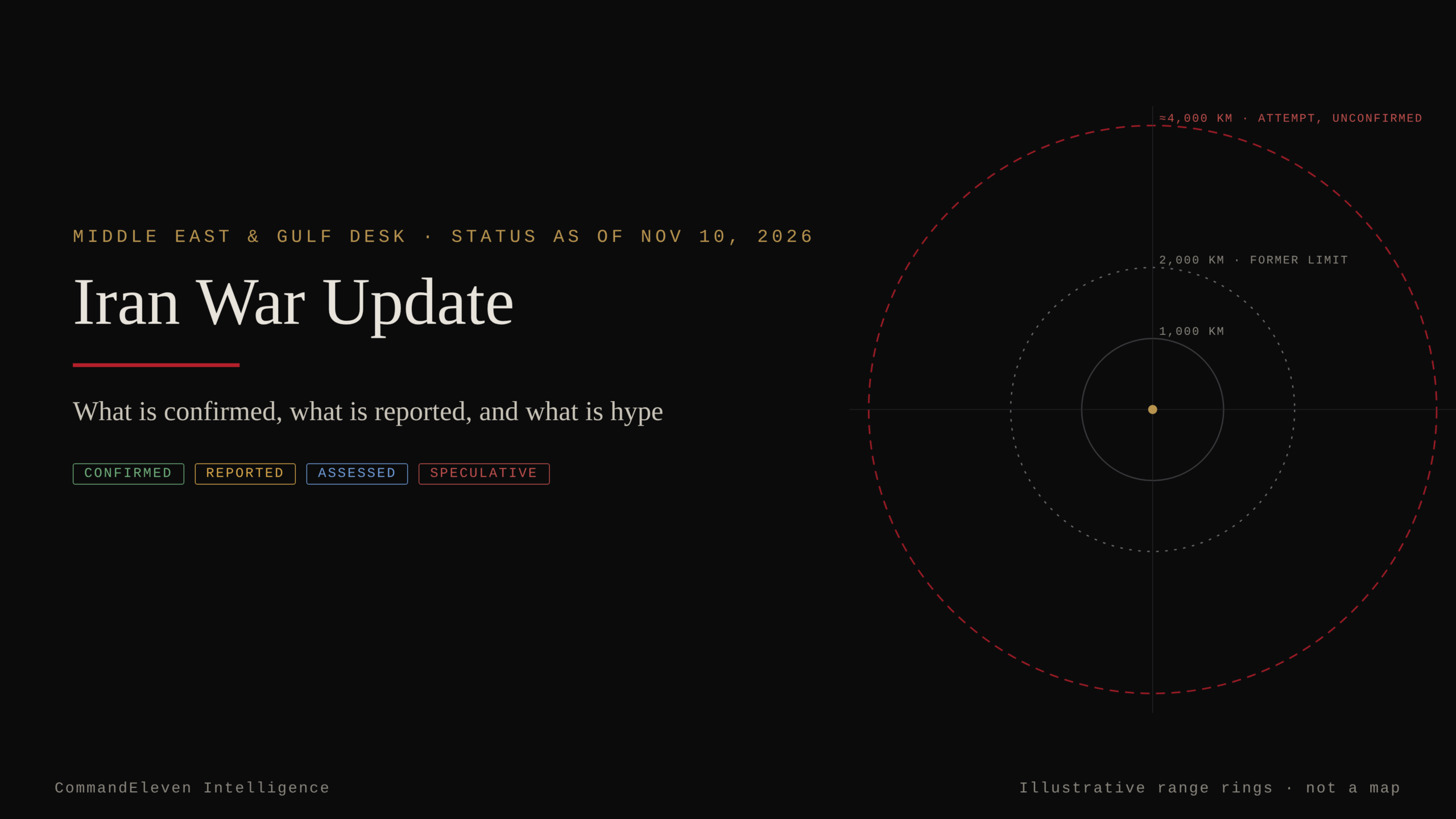
CommandEleven Intelligence Desk · Middle East & Gulf Desk, status as of November 10, 2026
Bottom Line Up Front
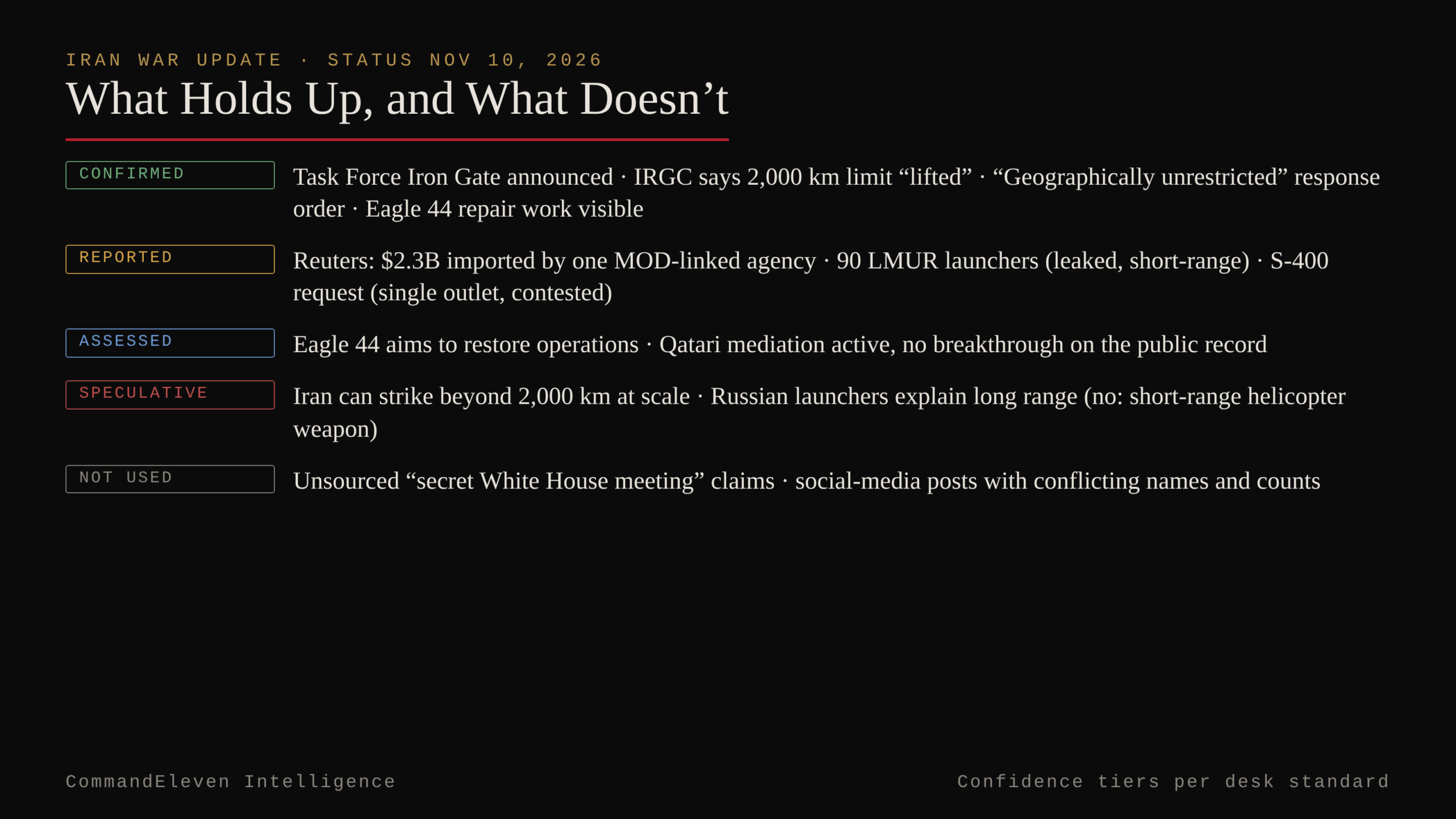
In the past week Iran-war coverage has produced a run of dramatic claims: a new US task force sealing Iran’s borders, Russian launchers explaining a missile range of 2,000 km, S-400s on the way, and a secret deal in Washington. Only some of it holds up. The US has formally opened a land-and-Caspian interdiction effort, Iran’s Revolutionary Guard has announced it no longer observes its 2,000 km missile limit, and a major Reuters investigation documents how Iran has kept importing military-relevant goods through the war. The rest is single-sourced, leaked, or unconfirmed. This assessment sorts the claims by what stands behind them.
Key Judgments
- On November 7, CENTCOM commander Adm. Brad Cooper directed the formation of Task Force Iron Gate, an internal staff of about 20 civilian and military personnel in Tampa, to coordinate with other US agencies on preventing the movement of advanced weapons, dual-use technology, sanctioned materials and illegal revenue across Iran’s land borders and the Caspian Sea. It reinforces the naval blockade announced in July; it does not replace it (CONFIRMED: CENTCOM release).
- The IRGC spokesman, Brig. Gen. Hossein Mohebbi, said on November 7 that the 2,000 km missile-range restriction “has been lifted,” and Iran’s supreme leader ordered a “geographically unrestricted” response to any new attack. No missile, test or range figure accompanied either statement (CONFIRMED as statements).
- Commercial satellite imagery from September 29 shows continued repair work at the Eagle 44 underground air base (CONFIRMED). The purpose is to restore operations, but the imagery cannot show what is inside the mountain or how many aircraft remain (ASSESSED).
- Reuters documents more than $2.3 billion in military-relevant imports by a single Defense Ministry-linked agency between January 2025 and June 2026, moved by Caspian shipping, Central Asian trucking and Chinese air freight. Reuters itself states that many goods are dual-use (REPORTED).
- Russia agreed to supply 90 helicopter-mounted launchers for LMUR missiles. The source is leaked documents attributed to Ukrainian intelligence, not authenticated; the system is short-range (reported up to about 14 km) and does not bear on long-range missile capability (REPORTED).
- Iran asked Russia for S-400 air-defense systems, reportedly in a personal letter from the supreme leader carried by Mohsen Rezaei. One outlet reports it, another reports Moscow again declined, and no Russian commitment or delivery has been reported (REPORTED, single-source and contested).
- Qatari mediation is active, and the public record shows progress claims, not a breakthrough (ASSESSED).
- Iran can strike beyond 2,000 km at any meaningful scale. The one reported attempt at roughly 4,000 km, against Diego Garcia in March, reportedly failed or was intercepted (SPECULATIVE).
Sourcing and Analytical Confidence
This assessment rests on CENTCOM’s own November 7 release, Reuters’ procurement investigation, reporting from The National, Al Jazeera, Times of Israel, The New Arab and The War Zone, and single-outlet reports that we label as such. We could not independently confirm the leaked launcher documents or the S-400 letter. A claim of a secret White House meeting with Qatari delegates is not corroborated by any public outlet and is left out.
| Tier | Meaning in this assessment |
| CONFIRMED | Stated on the record by a named government body, or corroborated by two or more independent reports. |
| REPORTED | Single-outlet reporting, or reporting based on unnamed officials, not independently corroborated here. |
| ASSESSED | Our judgment from the pattern of the evidence. |
| SPECULATIVE | Plausible but thinly supported. |
Task Force Iron Gate: Closing the Land Side of the Blockade
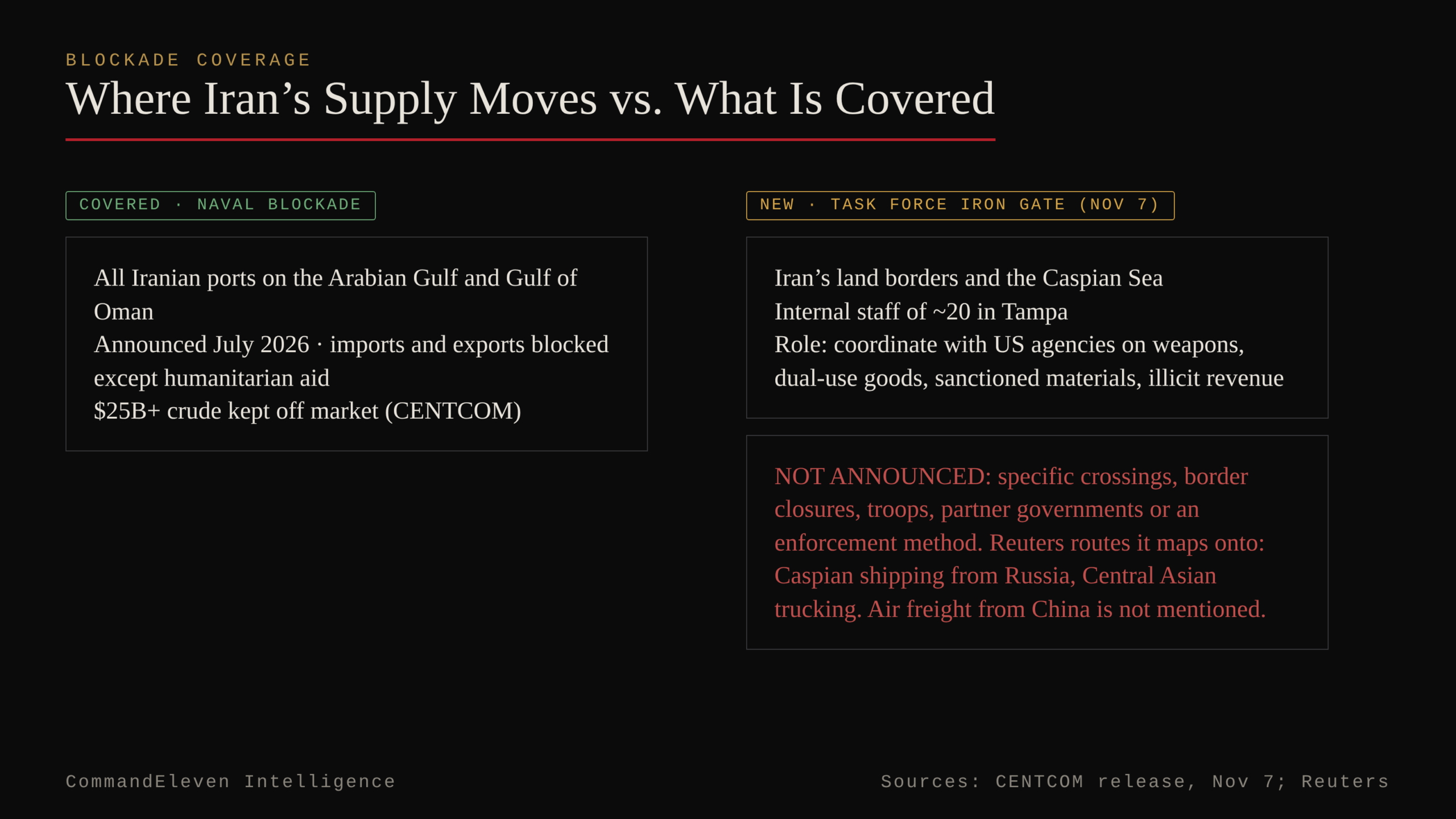
The naval blockade, announced in July 2026, covers all Iranian ports on the Arabian Gulf and Gulf of Oman and is meant to stop imports and exports other than humanitarian aid. CENTCOM says it has kept more than $25 billion of Iranian crude off the market in recent months. Ports, however, are only one way in. On November 7, Adm. Brad Cooper directed the formation of Task Force Iron Gate. CENTCOM’s release describes it as a support effort: an internal staff of about 20 civilian and military personnel in Tampa, Florida, that will coordinate with other US government agencies on stopping the movement of advanced weapons systems, dual-use technologies, sanctioned materials and illegal revenue streams across Iran’s land borders and the Caspian Sea. Cooper said it “reinforces the success of our ironclad blockade against Iran at sea” and will further constrain Iran’s ability to “rebuild weapons factories, and replenish their military.”
What the release does not say is as important. CENTCOM’s accompanying graphic marks Iran’s entire border and the Caspian, not specific crossings. It announces no border closures, no troops on any border, no partner governments and no enforcement method, and the task force depends on the cooperation of Iran’s neighbors. Analysts quoted by The National doubt it can track shipments that move through front companies and civilian carriers; its likelier effect is to raise costs and slow hard-to-replace components. The IRGC dismissed it as “merely a wordplay.”
Our assessment (ASSESSED): its stated scope matches the routes in the Reuters investigation (below), and it implicitly acknowledges that the sea blockade alone leaves Iran’s inland routes open. That reading is ours, not CENTCOM’s wording.
The 2,000 km Question
The limit has a history. In 2017 the then-IRGC commander said the supreme leader had set 2,000 km as the maximum missile range. In 2021 Ali Khamenei said some in Iran wanted 5,000 km and that he had blocked it. On November 7, Mohebbi said the restriction “has been lifted for us” and that Iran would “demonstrate these capabilities in practice.” Iranian analysts quoted by The New Arab link the change to the June 2025 and February 2026 wars and to Mojtaba Khamenei, arguing that bases in southeastern Europe and the Indian Ocean supported US attacks.
What the statement does not establish: a new missile, a test, or a range. It is a policy announcement, and it is consistent with a deterrence message ahead of a possible post-midterm resumption of US strikes.
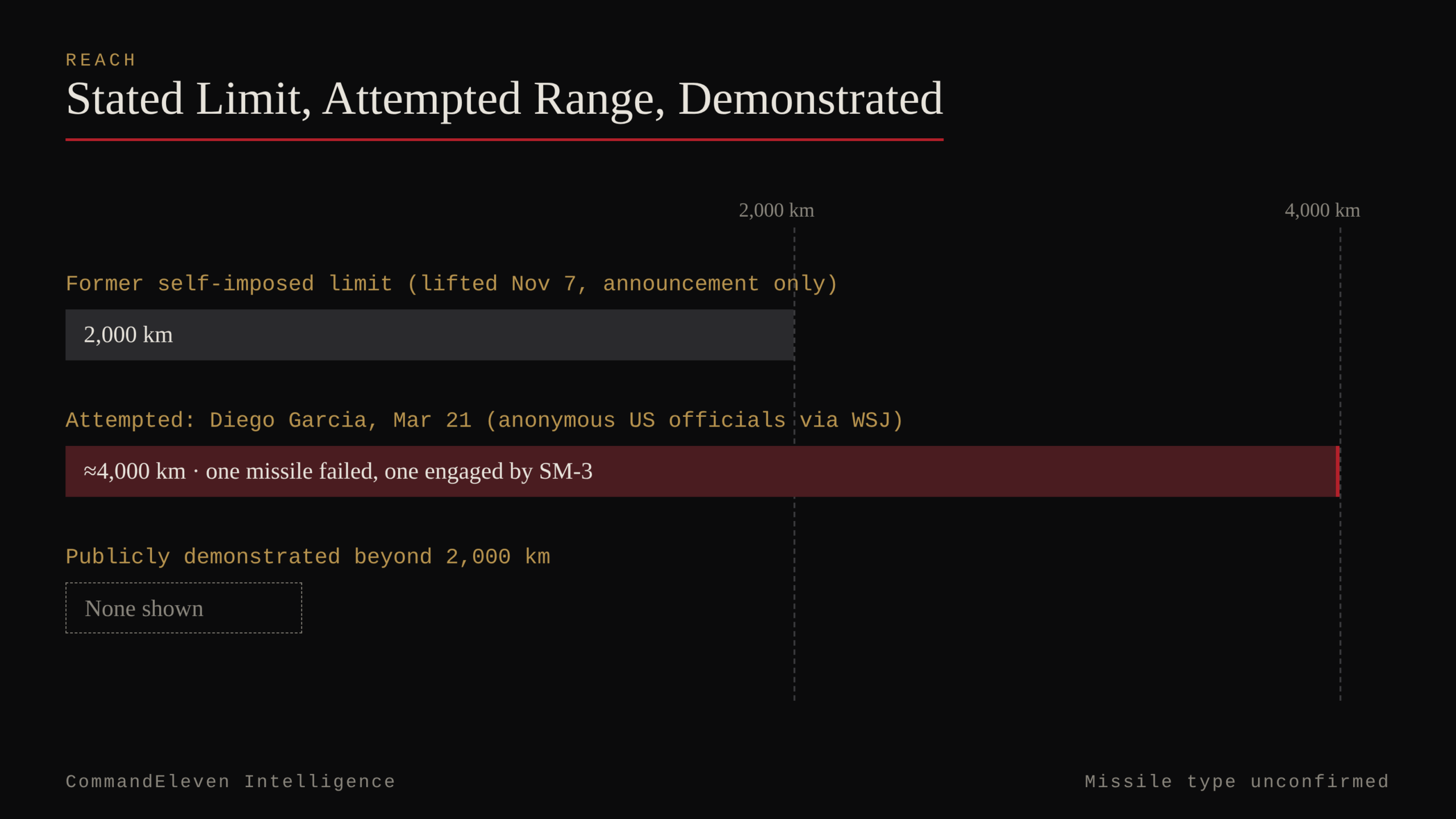
The one reported test of reach is the March 21 attempt on Diego Garcia, roughly 4,000 km away. According to US officials speaking to the Wall Street Journal, two missiles were launched; one failed, and a US destroyer engaged the other with an SM-3. The missile type is unconfirmed and the account rests on anonymous sources. If accurate, it shows intent beyond 2,000 km well before November 7 and no demonstrated success.
Russia: What Is on the Record and What Is Not
The launchers. The Financial Times reported, from leaked Russian defense-industry documents attributed to Ukrainian intelligence, that Russia agreed to supply 90 helicopter-mounted launchers for LMUR (Izdeliye 305) missiles for Mi-28 helicopters. The documents have not been publicly authenticated. The system is short-range, reported at up to about 14 km. It is a helicopter weapon, not ballistic missile technology, and it should not be read as an explanation for any long-range capability. Al Jazeera’s account quotes analysts to the same effect.
The S-400. The Telegraph reported that the supreme leader sent security chief Mohsen Rezaei to Moscow around November 5 with a letter requesting S-400 systems. Another outlet reports Moscow again declined. No Russian statement exists. Treat it as a reported request, not a deal.
The pattern. Russia has other documented ties to Iran, including a reported air-defense missile contract earlier this year and Russian detonator shipments in the Reuters data. The relationship is real; the specific items above are not established.
How Iran Keeps Importing: The Reuters Investigation
Reuters, working with the risk consultancy 240 Analytics, reviewed Iranian banking records, corporate filings and about 19,000 import records. Key findings, as reported:
- More than 5,000 agencies carry “MOD” names tied to the Ministry of Defense address; one of them imported about $2.3 billion in military-relevant goods from January 2025 to June 2026.
- Goods included rocket-fuel ingredients, aircraft and engine parts, detonators and explosives, 435 Iveco trucks, and 93 tonnes of titanium from China in February 2026.
- Routes: cargo vessels across the Caspian from Russia, trucks through Central Asia, and freight aircraft from China.
- In 97% of reviewed shipments, payment was recorded as settled without currency transfers, using funds held outside Iran.
- The named agency’s imports fell 47% to $54 million in March after the war began, and recovered to $77 million by May.
Reuters states its limits plainly: many goods are dual-use, some records could not be verified, and the investigation does not establish Iran’s current military strength.
Eagle 44
The War Zone, using Planet Labs imagery from September 29, shows the underground air base in Hormozgan province still being repaired after at least three rounds of strikes this year: the runway cleared, a new taxiway section finished, and another prepared. The four tunnel entrances appear intact; two support buildings remain destroyed. TWZ states the unknowns: what is inside the mountain, how many fighters remain, and whether the tunnels are open. Neither the Pentagon nor CENTCOM has publicly named the base. Read it as persistence and intent, not as restored capability.
The Qatar Track: Public Record Only
On November 7, Qatar’s prime minister said mediation continues, that “significant progress” has been made, and that he is confident a settlement can be reached. He said the US remains willing to pursue a solution after the midterms. Iran’s own seven-day plan, offered since September, would have the US lift its blockade, unfreeze Iranian assets and approve an Iranian-backed Hormuz route before reopening the waterway; Trump has rejected it. No scheduled talks or deadlines have been announced publicly. Claims of a specific secret meeting or a finished war-ending plan are not corroborated by public reporting and are not included here.
What Would Change Our Assessment
Base case through year-end (ASSESSED): no negotiated framework, no Iranian long-range launch, and no Russian S-400 delivery, with Task Force Iron Gate still an announcement rather than a visible enforcement effort. The public record does not support a US resumption of strikes as the base case, but it cannot rule one out.
- CENTCOM naming crossings, partner governments or enforcement methods for Iron Gate, or growing the staff beyond its initial 20.
- An acknowledged US strike campaign, or Iranian retaliation after one, including further attacks on ships using the southern Hormuz export route.
- A launch or test that demonstrates range beyond 2,000 km, independently corroborated.
- Imagery or official confirmation of S-400 components in Iran, or an official Russian or Iranian statement on the S-400 request.
- A joint public statement from Washington and Tehran, or announced dates for talks.
Calls We Will Score
- By December 10, 2026, CENTCOM or the Department of Defense will not have publicly named a specific crossing, partner government or enforcement measure for Task Force Iron Gate.
- By December 15, 2026, the US will not have publicly acknowledged strikes on targets inside Iran. Unattributed reports do not count.
- By December 31, 2026, the US and Iran will not both have publicly confirmed a signed ceasefire or settlement framework. Qatari or Pakistani claims alone do not count.
- By December 31, 2026, no Iranian ballistic missile launch or test beyond 2,000 km will have been independently corroborated.
- By December 31, 2026, no credible public evidence will show an S-400 system delivered to Iran. Reports of a request or talks do not count.
Each call is scored confirmed, partly confirmed or missed under the Foresight Record’s method, with the date and sources recorded in its entry. A call stays open until its date passes or the evidence arrives.
What This Assessment Does and Doesn’t Establish
- It establishes the official announcements and the documented procurement picture.
- It does not establish that Iran has any missile of longer range, that Russia has delivered or will deliver any specific system, that Iron Gate will materially cut supply, or that a settlement is near.
- The launcher documents and the S-400 letter are not authenticated, and the Diego Garcia account rests on anonymous US officials.
Frequently Asked Questions
Did the US close Iran’s borders?
No. CENTCOM formed a roughly 20-person coordination staff for the land borders and the Caspian; no closures, troops or enforcement method have been announced.
Do Russian launchers explain Iran’s missile range?
No. The reported launchers are short-range helicopter weapons.
Has Iran shown a missile beyond 2,000 km?
Not publicly. A reported March attempt against Diego Garcia failed or was intercepted, per anonymous US officials.
Has Russia agreed to sell Iran the S-400?
Not on the record. One outlet reports a request; no commitment is reported.
Related CommandEleven Intelligence Reading
- Qeshm, the Qataris and the Post-Midterm Window: Iran, Hormuz and the Fog of War
- Iran War Status Brief: October 2026
- Sanctions vs. Shadow Supply Chains: The Evidence Trail – Part 5
- Project C430L: Russia’s Covert Missile Assistance to Iran
- Components, Chemicals and Coordinates: China’s Supply Line to Iran’s War
- The Strike Clock: US Attack Planning and Iran’s Threat to Gulf Cables
Sources
- CENTCOM Launches Task Force to Disrupt Iranian Ground Transit Routes Supporting Illegal Shipments (U.S. Central Command, November 7, 2026)
- What Is Task Force Iron Gate? (The National, November 9, 2026)
- IRGC Claims a Self-Imposed Limit on Ballistic Missile Range “Has Been Lifted” (Times of Israel, November 7, 2026)
- Why Has Iran Scrapped Its Missile Range Limit? (The New Arab, November 2026)
- Iran’s Mojtaba Khamenei Orders “Geographically Unrestricted” Military Response to Threats (Khaleej Times, October 31, 2026)
- Iran Fires Two Intermediate-Range Ballistic Missiles at Diego Garcia Base (The Aviationist, March 21, 2026)
- Rocket Launcher Deal Illustrates Deepening Russia-Iran Relations (Al Jazeera, November 6, 2026)
- Iran’s Supreme Leader Asks Russia for S-400 Air Defense Systems in Personal Letter (UNITED24 Media, citing The Telegraph, November 7, 2026)
- Iran’s Secret $2.3B Military Supply Network Revealed Amid US Blockade (Reuters investigation, via Gulf News, November 2026)
- Construction of Iran’s “Eagle 44” Underground Airbase Hasn’t Stopped Despite War (The War Zone, October 22, 2026)
- Qatar Says Its Mediation Efforts Between US and Iran Continue to Prevent Escalation (Reuters, via Internazionale, November 7, 2026)
