
CommandEleven Intelligence Desk // Pakistan-Afghanistan Desk, status as of November 5, 2026
Bottom Line Up Front
Europe spent five years refusing to deal with the Taliban. In 2026 it is doing so, for one reason: migration. The pressure comes from voters, not from Kabul. The New York Times reported on October 12 that the far-right Alternative for Germany leads national polls and that Afghans make up about 20 percent of asylum seekers in Germany, and that public pressure to deport migrants is rising.
This assessment sets out what has actually been agreed, what the Taliban are asking for in return, and how Pakistan and the United States fit into the same picture. It also separates what is documented from what is reported by a single outlet. Where the evidence is thin, it says so.
Key Judgments
- European governments are negotiating directly with the Taliban to speed deportations of Afghans, and the contact has moved from technical talks toward a quasi-diplomatic relationship (CONFIRMED: charter flights from Germany, the June 23 Brussels meeting, and the European Commission’s own statements).
- The Taliban are using that pressure to seek wider consular access, reintegration money and, over time, standing. Their stated asks go beyond returns (ASSESSED, drawn from Taliban statements at and after Brussels and from New York Times reporting).
- No European state recognizes the Taliban government, and the Commission has said the talks “do not mean recognition.” The open question is whether practical engagement amounts to recognition in effect (CONFIRMED on non-recognition; ASSESSED on the drift).
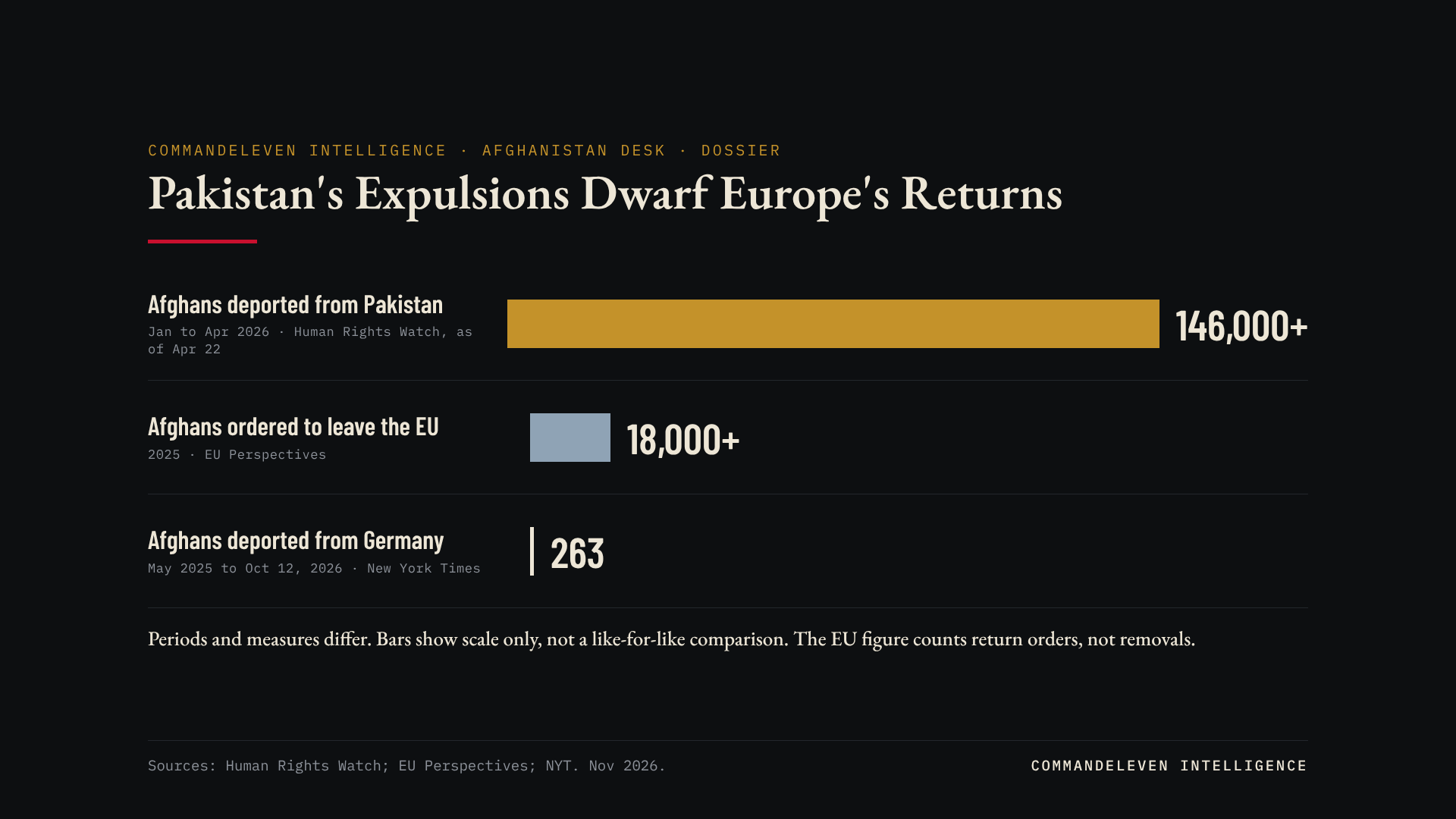
- The returns are small against the problem they are meant to address. Germany has deported 263 Afghans since May 2025, while more than 500,000 Afghans live there (REPORTED: New York Times figures, not independently confirmed). Deportation is a political signal at least as much as a migration tool (ASSESSED).
- Pakistan and the United States show the harder end of the same policy. Human Rights Watch counted more than 146,000 Afghans deported from Pakistan in 2026 as of April, and a US plan to fly Afghans to Pakistan for onward removal to Afghanistan was temporarily blocked by a court on November 3 (CONFIRMED for the court block and the ICE declaration; the plan’s size and route details are REPORTED).
- Security is the stated reason for the talks, and it is also the Taliban’s leverage. The counterterrorism relationship with Kabul cannot be separated from the migration relationship (ASSESSED).
Sourcing and Analytical Confidence
The spine of this assessment is a New York Times report by Elian Peltier and Jim Tankersley, republished on October 12, 2026. We read the republished text and cross-checked its main claims against Al Jazeera, KabulNow, EU Perspectives and Human Rights Watch where we could. Where a point rests on a single outlet, we say so.
| Tier | Meaning in this assessment |
| CONFIRMED | Stated on the record by a named government body, or corroborated by two or more independent reports. |
| REPORTED | Single-outlet reporting, or reporting based on unnamed officials, not independently corroborated here. |
| ASSESSED | Our judgment from the pattern of the evidence. |
| SPECULATIVE | Plausible but thinly supported. |
Background: How Afghans Became Europe’s Test Case
More than 18,000 Afghans were ordered to leave the European Union in 2025, according to EU Perspectives. A group of 20 countries (19 EU states and Norway) had already asked the Commission to coordinate technical contacts on returns, with priority given to people convicted of serious crimes or judged security risks. Those two categories are the political cover for everything that followed.
The legal and moral position is awkward. Human Rights Watch’s Fereshta Abbasi argues that the EU cannot credibly condemn Taliban repression while deporting Afghans into it, and the UN and some EU politicians have criticized the returns on the same ground. Governments have so far focused on convicted offenders for that reason. The Taliban can see this, and it gives them room to set a price for their cooperation (ASSESSED).
What Has Been Agreed
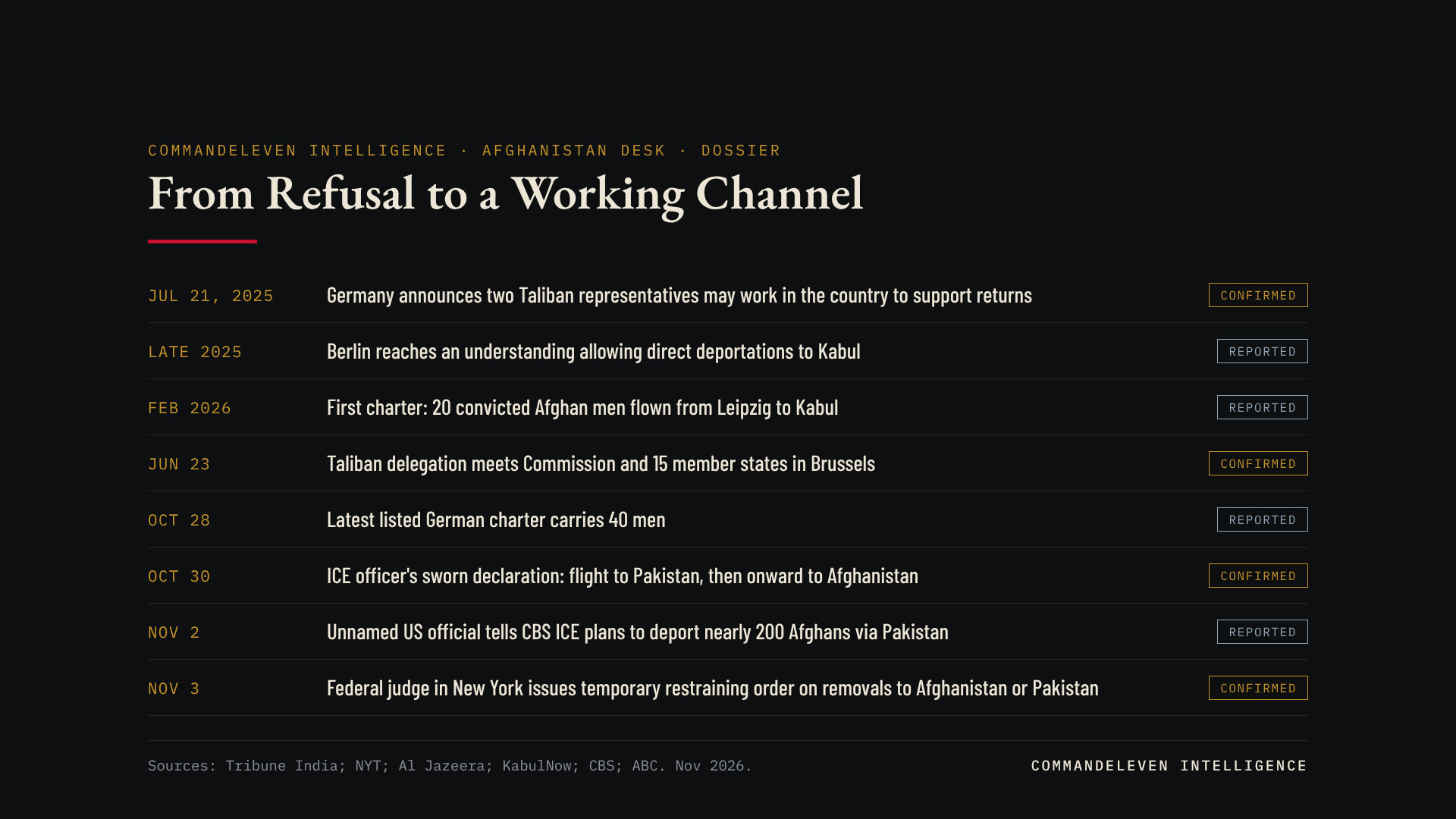
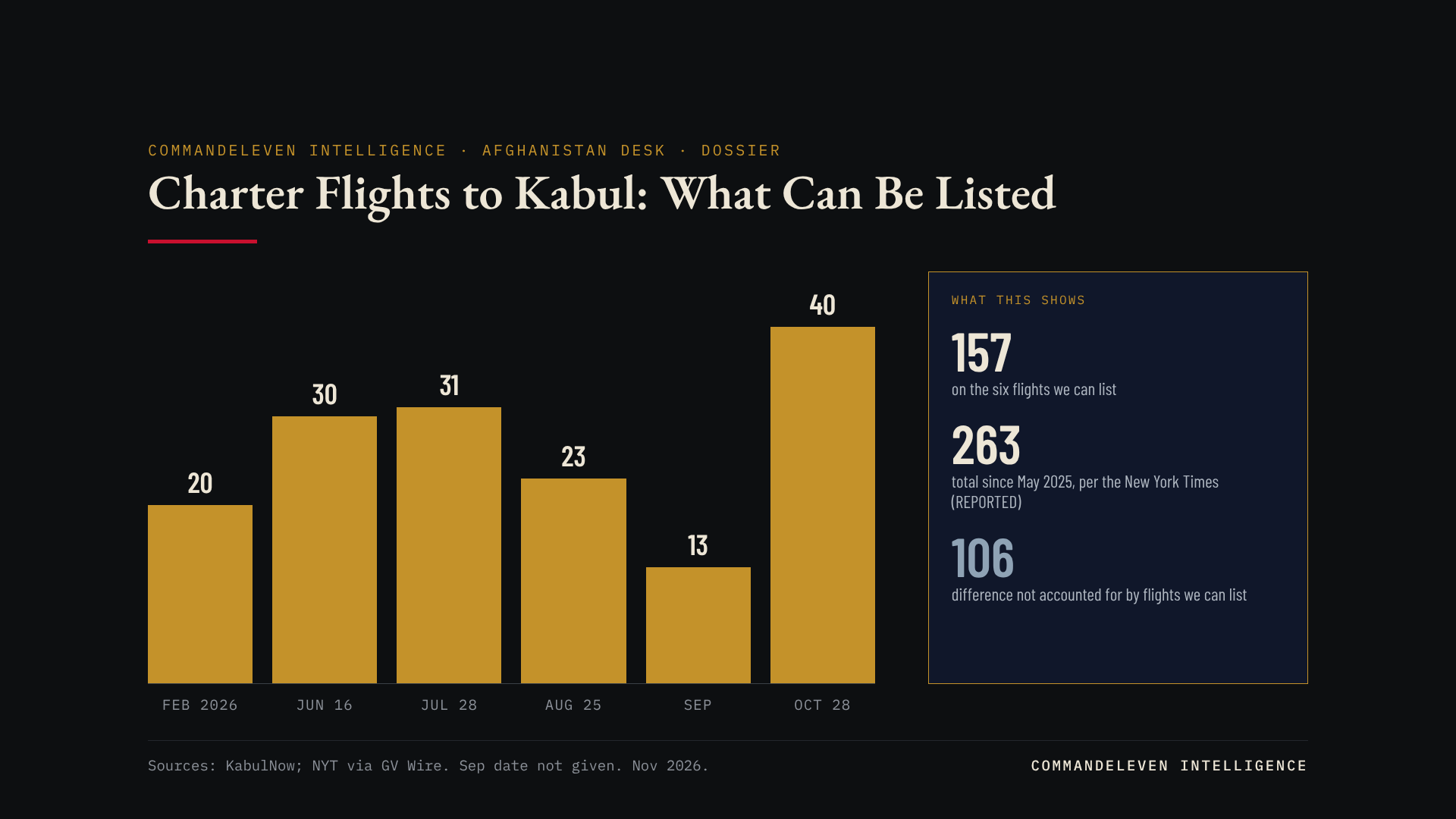
Germany. Berlin reached an understanding with the Taliban in late 2025 that allows direct deportations instead of routing people through third countries, according to the New York Times. A charter carried 20 convicted Afghan men from Leipzig to Kabul in February 2026. KabulNow lists later flights: 30 men on June 16, 31 on July 28, 23 on August 25, 13 in September and 40 on October 28. The October flight carried people convicted of sexual, violent and drug offenses, according to Bild as quoted by KabulNow. Interior Minister Alexander Dobrindt said deportations to Afghanistan are now a regular part of migration policy. The New York Times reports that deportations have since extended to Afghan men without criminal records, and puts the total at 263 since May 2025. The six flights listed here add up to 157, so the public list is incomplete.
Brussels, June 23. A Taliban delegation of technical-level officials met Commission services and 15 member states in Brussels, the first such meeting on EU soil. Sweden and the Commission co-hosted it, after an earlier meeting in Kabul in January. The Taliban spokesman called the visit “historic.” Participants did not raise Taliban human rights abuses, according to sources quoted by the New York Times. The Commission said directly: “This does not mean recognition.”
Other capitals. Sweden is working with the Taliban on the expulsion of 200 convicted Afghans, according to the New York Times. France is reported to be considering a German-style arrangement and possibly a Taliban mission in Paris. Norway has hosted Taliban diplomats discreetly for years. Britain’s officials visit Kabul regularly. On Taliban presence in Germany, the government announced on July 21, 2025 that two Taliban representatives would be allowed to work in the country to support returns. Government spokesperson Stefan Kornelius said this was not diplomatic recognition and was technical-level communication, according to the Tribune. Interior Minister Dobrindt said that without an agreement with the Taliban, Germany cannot deport Afghans or extend their detention for deportation, and he suggested handing the Afghan consulate in Berlin, still run by officials of the former government, to the Taliban. The New York Times reports that Taliban officials now operate in Afghan missions in Berlin and Bonn, without the group’s flag or official name displayed.
What the Taliban Want
The Taliban’s agenda has been wider than returns from the start. After Brussels, the Afghan Foreign Ministry spoke of a possible consular presence in the EU, resumed consular services for Afghans in Europe and “trust-building measures.” According to the New York Times, the Taliban also want financial support to reintegrate people who are expelled, and broader economic assistance. European governments treat broad economic aid as a red line because it could entrench the regime and benefit sanctioned officials.
The pattern is the one the New York Times headline describes. Deportation is the opening, and each step creates the case for the next: a flight needs travel documents, documents need consular staff, and consular staff need a standing mission. At no point does Europe have to say the word “recognition.”
Our assessment (ASSESSED): the Taliban gain the most from the process itself. A technical meeting in Brussels, officials working in Berlin and a flag-free mission in Oslo already count as steps toward normal dealings, whatever any government says about recognition. Russia remains the only state that formally recognizes the government.
The Harder End: Pakistan and the United States
Pakistan. Human Rights Watch reported on April 22, 2026 that more than 146,000 Afghans had been deported from Pakistan so far that year, with numbers rising from April 1. It described raids, detention of Afghans with valid visas and expulsions of people who could not pay bribes. Pakistan stopped renewing residency documents for Afghan refugees in 2023. Those numbers dwarf anything Europe has attempted, and they happen alongside open fighting between Pakistan and the Taliban, which our Pakistan-Afghanistan series covers.
United States. A US plan to deport Afghans through Pakistan has now become public, and the details need care. There is no formal administration statement. What exists is the following:
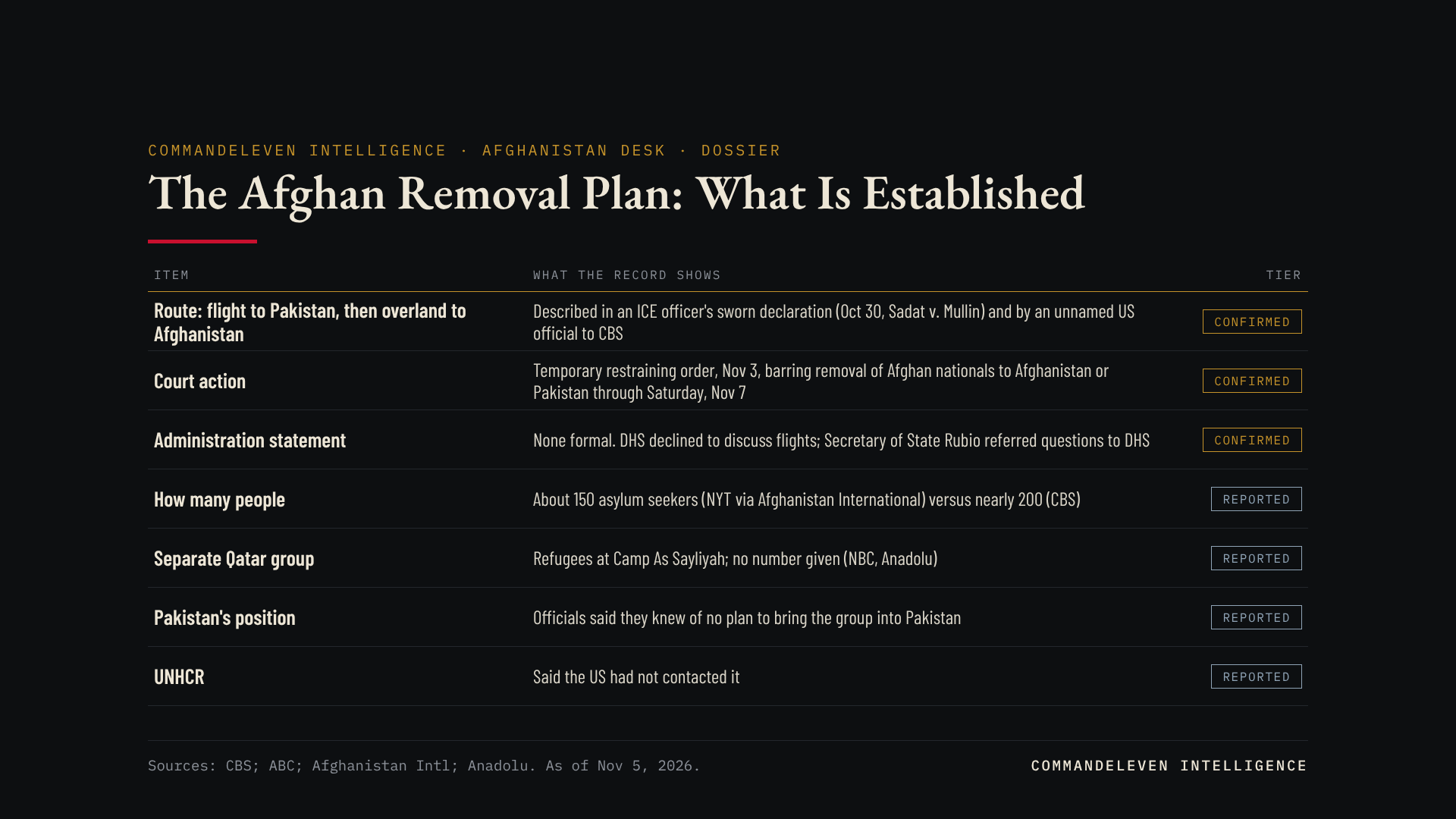
- An unnamed US official told CBS News on November 2 that ICE planned to deport nearly 200 Afghan nationals in custody by flying them to Pakistan and then moving them overland to Afghanistan. The official said the plans were still in flux.
- An ICE supervisory officer, Sergio Aguilar, described the plan in an October 30 sworn declaration in Sadat v. Mullin, writing that the flight’s “final destination would be Pakistan with further transport onward to Afghanistan.”
- DHS declined to discuss the flights, citing operational security. Secretary of State Marco Rubio referred a question to DHS on October 31.
- The people involved are described differently in different reports. CBS describes Afghans in ICE custody with removal orders. The New York Times, as reported by Afghanistan International, put the number at about 150 asylum seekers whose claims had been rejected. A separate group of refugees at Camp As Sayliyah in Qatar was reported by NBC and Anadolu with no number given. “Refugees” is therefore imprecise.
- Pakistani officials said they knew of no plan to bring the group into Pakistan, UNHCR said the US had not contacted it, and 66 members of Congress asked the administration to cancel the flights. The Taliban foreign ministry voiced concern.
- On November 3, a federal judge in New York, Valerie Caproni, issued a temporary restraining order barring the removal of Afghan nationals to Afghanistan or Pakistan through Saturday, November 7, according to ABC News and Afghanistan International. ABC reports that the government told the court no charter or commercial flights were planned or confirmed for that period. The case is not resolved.
As of the New York Times report of October 12, the United States had not sent anyone directly to Afghanistan, only to third countries. The reported Pakistan route would send people to Afghanistan by an indirect path. ASSESSED: the overland leg would cross a border where Pakistan and the Taliban have been fighting, which our coverage of the Torkham fighting documents. That makes the plan harder to carry out than its description suggests.
The Security Argument Cuts Both Ways
Every European government justifies the talks by pointing to security: removing criminals and people judged dangerous. That is a real concern. German prosecutors charged an Afghan asylum seeker with murder on August 26, 2025 over the February 13, 2025 Munich car-ramming that killed two people and injured 44. Prosecutors cited “excessive religious motivation,” according to Euronews. That is one case, not a trend, but it is the kind of case that moves German policy.
The same reasoning gives the Taliban leverage. A government that holds the travel documents and decides whether a deportee is accepted also decides how much it shares on people Europe fears. ASSESSED: counterterrorism cooperation and migration cooperation will increasingly be negotiated together, and the Taliban know it. Our own reporting places al-Qaeda in the Indian Subcontinent leaders in Kabul with Taliban-issued identity documents, citing the UN Monitoring Team. Europe is asking the same authorities to help it manage a security problem that those authorities also host.
What To Watch
Most likely (ASSESSED): more charter flights on the current monthly pattern, carrying mostly convicted offenders, with a gradual widening to people without convictions. Taliban consular access will keep expanding quietly, without any declaration of recognition.
What would change the picture:
- A European government formally accepting a Taliban-appointed ambassador or opening an official mission. France’s reported consideration of a Paris mission is the one to watch.
- A Commission mandate for structured talks, or a second Brussels round.
- Any agreement that includes reintegration funding.
- A court ruling in the US case that either allows or ends the Pakistan route, including what happens when the temporary order lapses on November 7.
- Renewed Pakistan-Taliban fighting at Torkham, and the reported November 21 deadline from the October 22 Kandahar session, which our coverage tracks.
- A serious attack in Europe involving an Afghan national, which would harden policy fast.
Recommendations
- Governments should publish what they have agreed with the Taliban, including who issues travel documents and what is promised in return. Secret arrangements are what turn “technical” contact into recognition by stealth.
- Treat consular access and returns as separate decisions, with separate approval.
- Keep the counterterrorism channel separate from the migration channel, so neither becomes a bargaining chip for the other.
What This Assessment Does and Doesn’t Establish
- The Taliban officials’ current status in Berlin and Bonn rests on New York Times reporting. The July 2025 arrangement for two Taliban representatives is confirmed by the Tribune report of the German government’s announcement. An anonymous Taliban official quoted there said no final agreement had been reached, so the sources conflict on how settled the deal was at that point.
- The number of Afghans in the US plan differs by outlet (about 150 per the New York Times via Afghanistan International; nearly 200 per CBS). We use both with attribution.
- The request by 20 countries (19 EU states and Norway) is described by EU Perspectives as having come “in October.” We have not dated it further.
Frequently Asked Questions
Does Europe now recognize the Taliban government?
No. No European state recognizes it, and the European Commission said of the June 23 Brussels meeting: “This does not mean recognition.” Russia is the only state that formally recognizes the government.
Our assessment is that practical contact, including Taliban officials working in Afghan missions in Berlin and Bonn, is drifting toward recognition in effect (ASSESSED).
How many Afghans has Germany deported?
The New York Times puts the total at 263 since May 2025, while more than 500,000 Afghans live in Germany (REPORTED). The six charter flights named in this assessment add up to 157, so the public list is incomplete.
What do the Taliban want in return for cooperating on deportations?
More than returns. After Brussels, the Afghan Foreign Ministry spoke of a consular presence in the EU, resumed consular services for Afghans in Europe and “trust-building measures.” The New York Times adds reintegration money and broader economic assistance.
European governments treat broad economic aid as a red line.
Is the US plan to deport Afghans through Pakistan going ahead?
It is blocked for now. On November 3, a federal judge in New York issued a temporary restraining order barring removal of Afghan nationals to Afghanistan or Pakistan through Saturday, November 7. The government told the court no flights were planned or confirmed for that period, according to ABC News.
The case is not resolved, and the plan’s size and route details are reported, not officially announced.
Related CommandEleven Intelligence Reading
- A Region Under Pressure: The Pakistan-Afghanistan Series
- The Front Moves South: Angoor Adda, Torkham and the October Border War – Part 6
- Pakistan and the Taliban After Kandahar: A Year of Failed Mediation and a Deadline Near November 21
- Hamza bin Laden and Al-Qaeda’s Regional Re-Emergence – Part 3
- Who Gets the Aid Money? $8 Billion, 9% Traceable, and the Taliban’s Cut
- The Taliban Losing Control of Afghanistan: Where the Evidence Shows It and Where It Does Not
Sources
- The Taliban Are Using Europe’s Fear of Migrants to Their Advantage (New York Times, republished by GV Wire, October 12, 2026)
- Germany Deports 40 Afghans Convicted of Crimes to Kabul as Removals Continue (KabulNow, October 29, 2026)
- EU Hosts Taliban Officials for the First Time in Talks on Deportations (Al Jazeera, June 23, 2026)
- The Taliban Comes to Brussels, and Europe Faces an Awkward Question (EU Perspectives, June 2026)
- Pakistan: Surge in Forced Returns of Afghan Refugees (Human Rights Watch, April 22, 2026)
- ICE Planning to Deport Afghans Through Pakistan, Official Says (CBS News, November 2, 2026)
- Judge Temporarily Blocks Deportation of Afghan Nationals (ABC News, November 3, 2026)
- US Court Halts Trump Administration’s Plan to Deport Afghans Via Pakistan (Afghanistan International, November 4, 2026)
- Trump Administration Plans to Deport Afghan Refugees to Pakistan: Report (Anadolu Agency, October 31, 2026)
- Germany Greenlights Taliban Consular Officials to Support Afghan Deportations (Tribune India, July 22, 2025)
- German Authorities Charge Afghan Suspect in Munich Car Ramming Attack That Killed Two (Euronews, August 26, 2025)