CommandEleven Intelligence · Iran Desk. Extended dossier, status as of 13:50 UTC, November 3, 2026, Election Day in the United States. This is a fast-moving story: claims about current military posture are re-verified at publication and updated below.
Fog-of-War Notice and Tier Key
In a fog of war, rumors create more conflict than the conflict does. This dossier exists to separate what is confirmed from what is circulating, and it labels every claim. CONFIRMED means an official statement or two or more independent reports. ASSESSED is our judgment built on confirmed facts. SPECULATIVE is plausible but unsupported. UNVERIFIED is a claim in circulation that we could not confirm. DATA DEFICIT means the evidence does not exist in public. Claims made only by the IRGC or Iranian state media are labeled as claims. Nothing in this dossier rests on non-public reporting.
Bottom Line Up Front
On the night of November 2, the day before the US midterms, the United States struck a missile launcher on Iran’s Qeshm Island after, US officials say, the IRGC fired surface-to-air missiles at a US aircraft near the Strait of Hormuz. The account comes from anonymous US officials in NBC, CNN, Fox News and Wall Street Journal reporting. It is the latest in a long run of Qeshm incidents, not the first, and in earlier rounds Iran answered by firing at Gulf states that host US forces.
Two tracks are open and neither is decided. Qatari mediators are in Tehran with a proposal both sides are reviewing, and the US has told regional allies to prepare for possible strikes after the elections, with no final decision. Around that core sits a thick layer of rumor: nuclear-strike claims, Iranian target maps, drone-kill claims and counts of US bases. Most of the rumor does not survive contact with the record. The part that does is narrower and more useful: Iran has already named and hit energy, water, ports, airports and data centers, and those are where any escalation lands first.
Key Judgments
KJ1: The Nov 2 strike was limited and US officials call it defensive. Three US officials told NBC and CNN the IRGC fired surface-to-air missiles at a US aircraft over the strait, and the US struck a missile launcher on Qeshm. A US official told Fox News it was not the start of new expanded strikes. [CONFIRMED: the strike. ASSESSED: that it is a limited action, not a return to major combat.]
KJ2: Qeshm is a repeat target, and Iran has answered at Gulf host states before. We count at least seven Qeshm incidents since March. After the US-acknowledged strike of June 3, CENTCOM reported Iranian missiles fired at Kuwait and Bahrain. After July strikes the IRGC claimed missiles at a US base in Jordan while Kuwait and Bahrain reported incoming fire. Any larger US action should be expected to put Gulf host states at risk within hours. [ASSESSED]
KJ3: A strike window is open and no decision has been reported. AP reported on October 29 that the US told regional allies to prepare for possible strikes after the elections, that operations could last several days and that Trump had made no final decision. Qatar is mediating at the same time. [CONFIRMED: the warning and the mediation. ASSESSED: both tracks are live.]
KJ4: Khamenei’s “geographically unrestricted” order is conditional deterrence, not an activated protocol. His office ordered an immediate, effective and geographically unrestricted response to any threat, and the IRGC says it is identifying new targets in new theaters. No operational order or published target list has followed. [CONFIRMED: the statements. ASSESSED: signaling plus planning.]
KJ5: There is no public evidence for a US or Israeli nuclear strike on Iran. The claim originated with Tucker Carlson on X, the White House dismissed it, and The War Zone could not identify his source. The difficulty of reaching a deeply buried site by conventional means feeds the rumor but is not evidence of intent. Independent experts call use highly unlikely. [ASSESSED]
KJ6: The infrastructure at risk is where Iran has already named and struck. Energy, desalination, ports, airports and data centers appear in both Iran’s statements and ACLED’s strike record. The circulated “Zero Hour” graphics add bridges, rail, hotels, malls and cables with no sourced Iranian basis, and list the mediators Qatar and Oman. [ASSESSED]
KJ7: Pentagon turnover is real, but only one departure carries an official reason. Lt. Gen. Sylvia was fired over leaks. Most other exits give no reason, and several pre-date the war. [CONFIRMED]
KJ8: The loudest claims of the week trace to weak origins. The “nuclear preparations on state TV” story is an eight-minute civil-defense video. The target maps have no issuer. The drone kills are IRGC claims. [CONFIRMED]
Not included in the Key Judgments. due to non-public reporting of any kind; the claim of a secret Trump-Netanyahu call approving a nuclear option; the 31-country stockpile count; the tug incident in Hormuz; and every circulated target list.
The Confirmed Record
The week before the strike set the stage. The table below keeps to dated, sourced events.
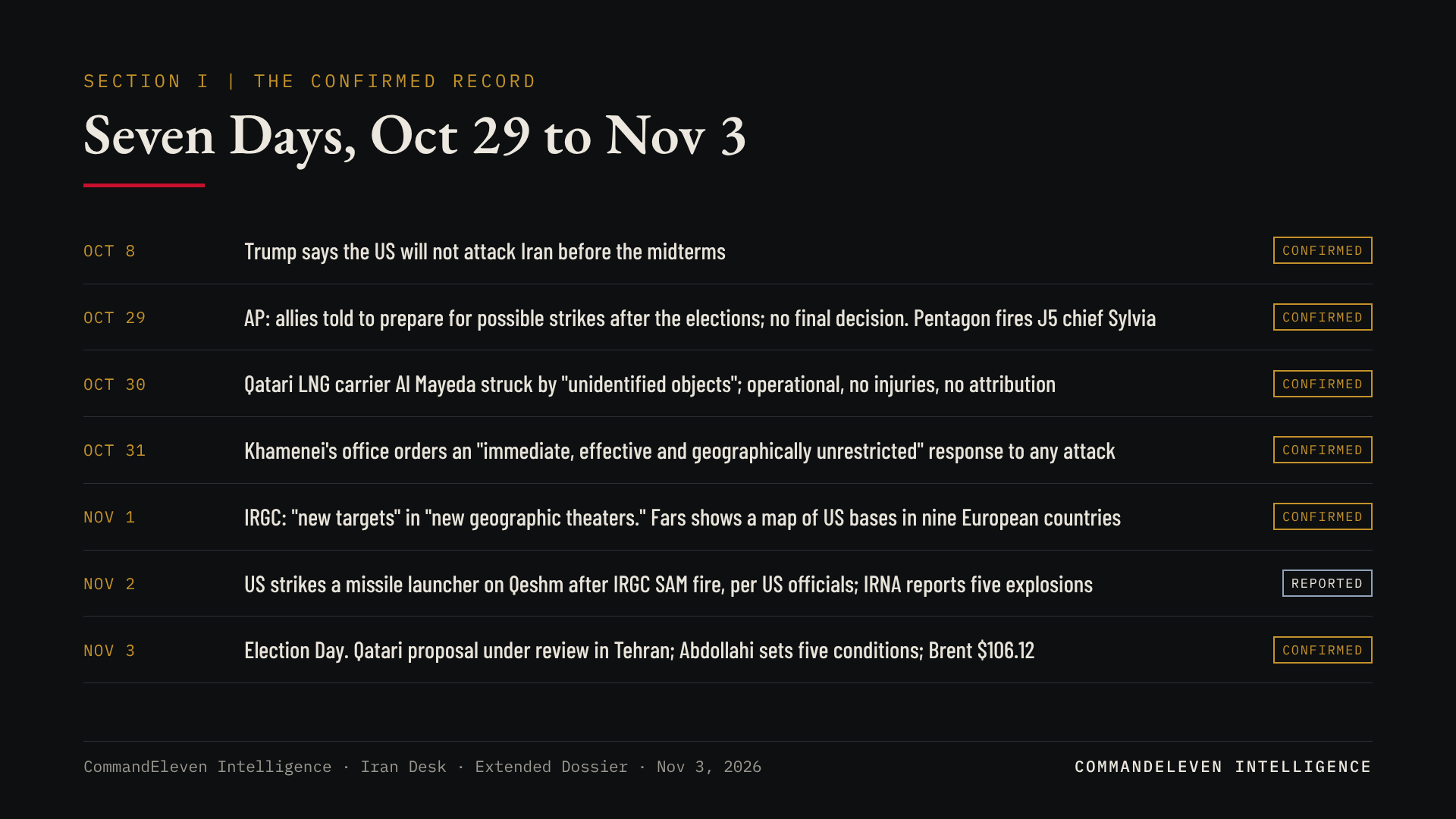
On October 8, Trump said the US “will not be attacking Iran at any time prior to the midterm elections”, a pledge reported as expiring on Election Day. On October 29, AP reported that US officials told several Middle East countries to prepare for possible strikes and retaliation after the elections, that new military action could last several days and that the president had made no final decision (AP via Fox 19). The same day the Pentagon fired Lt. Gen. Sylvia, the J5 planner, over leaks (Al Jazeera).
On Friday evening, October 30, the Qatari LNG carrier Al Mayeda was struck by “unidentified objects”; the owner said it stayed operational with no injuries or spill (Astig). On October 31 Khamenei’s office ordered a response to any threat that is “immediate, effective and geographically unrestricted”. On November 1 the IRGC spokesman said the Guards had begun identifying new targets in “new geographic theaters” (Israel Hayom). On November 2 came the strike on Qeshm. On November 3, Iran’s chief of staff laid out five conditions for lasting security while Qatar’s proposal was under review (Al Jazeera).
Qeshm and the Pattern
What happened on November 2
The Wall Street Journal first reported the strikes. Per three US officials cited by NBC News and CNN, the IRGC fired surface-to-air missiles toward a US military aircraft over the Strait of Hormuz, and the US struck a missile launcher on Qeshm with the stated aim of destroying it. A US official told Fox News the operation was “not the start of new expanded strikes”. IRNA reported five explosions on Qeshm and further blasts at Bandar Lengeh. CENTCOM had issued no formal statement at the time of the reports (NBC News, CNN, WSJ via US News, House of Saud summary). [CONFIRMED]
Credit and sourcing. Every version of the SAM-then-strike account traces to anonymous US officials. That is a single origin, repeated across outlets. The Iranian side confirms explosions but not the SAM launch. We therefore tier the strike as confirmed and the sequence of events, who fired first, as the US account. [ASSESSED]
Qeshm is a repeat target
The island sits in the strait and hosts IRGC naval and missile assets, so it keeps appearing. The table below lists the incidents we could pin to a date. Iran’s own claims are labeled as claims.
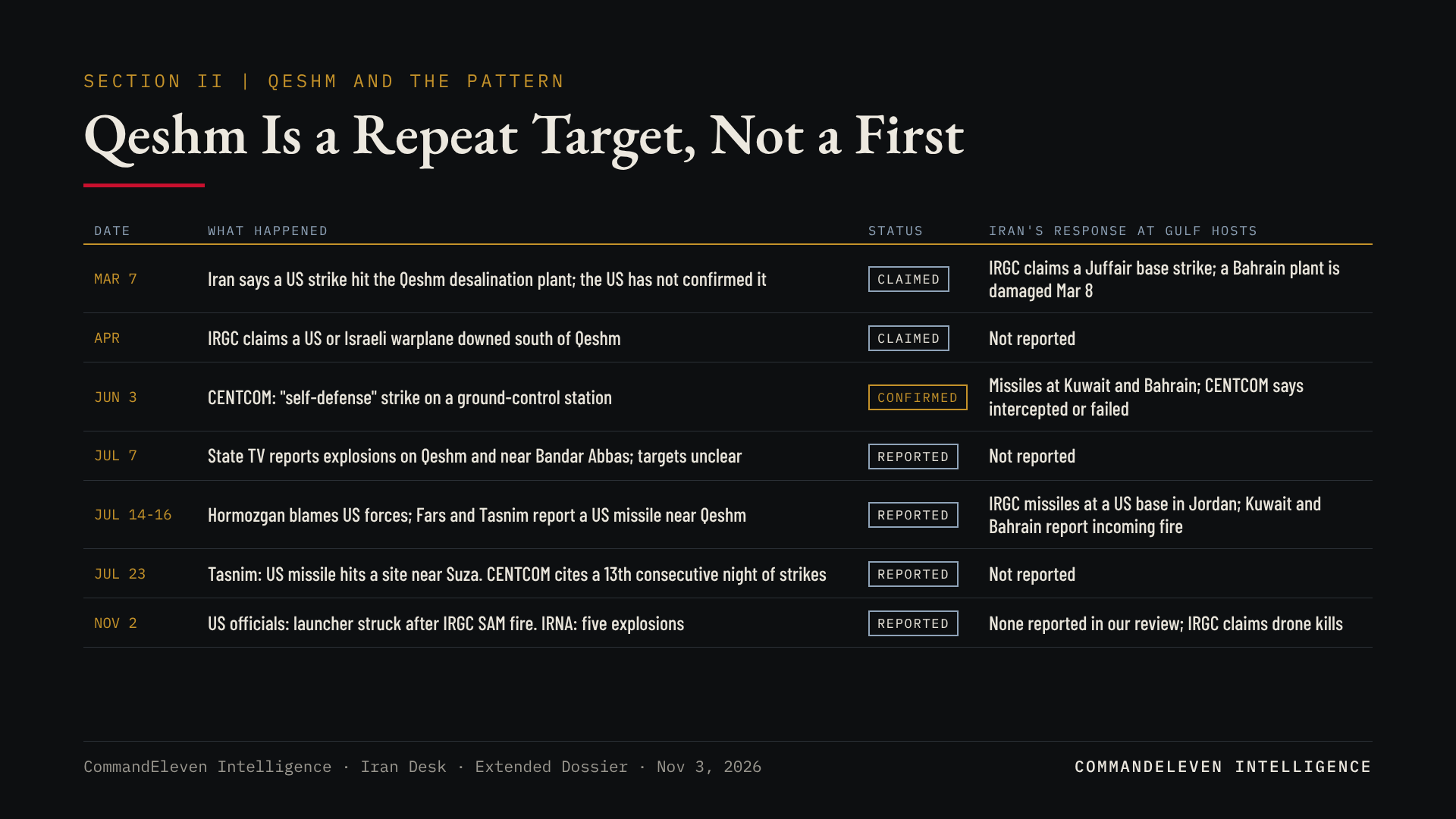
March 7. Iran said a US strike hit a desalination plant on Qeshm. The US military has not confirmed it (Stars and Stripes). Later that day the IRGC said it struck the US Juffair base in Bahrain in response (Times of Israel). On March 8 an Iranian drone damaged a desalination plant in Bahrain, with no injuries reported there. Araghchi called it retaliation for a US attack; the report does not name Qeshm. [CLAIMED]
June 3. CENTCOM described “self-defense” strikes on Qeshm that hit a military ground-control station, in response to what it called Iran’s attempted attacks across the region. CENTCOM said Iran fired two missiles at Kuwait, which fell or broke apart in flight, and three at Bahrain, which were intercepted (Adnkronos). Iran’s version was different: it said the US hit an IRGC communications tower and that it struck US bases in Kuwait and fired at a vessel, claims not independently verified (PUK Media). [CONFIRMED: the US strike and the Iranian fire. CLAIMED: Iran’s targets and results.]
July. State TV reported explosions on Qeshm and near Bandar Abbas on July 7, with targets unclear (Iran International). Hormozgan officials attributed projectile strikes on July 14 to US forces. On July 16 Fars and Tasnim reported a US missile strike near Qeshm; the IRGC said it fired ballistic missiles at a US airbase in Jordan, and Kuwait and Bahrain reported incoming attacks (Kurdistan24). On July 23 Tasnim reported a US missile hit a site near Suza on Qeshm (Kurdistan24), and CENTCOM was describing a 13th consecutive night of strikes on Iranian military targets (bne IntelliNews). [REPORTED: Iranian media claims. CONFIRMED: CENTCOM’s count.]
What the pattern shows. Qeshm incidents come in two kinds: acknowledged US strikes framed as self-defense, and Iranian claims of US strikes that the US does not confirm. In the acknowledged cases, Iranian missile or drone fire at Gulf states that host US forces followed. July also shows what sustained action looks like: strikes on consecutive nights. One night of limited action, as on November 2, is not that. [ASSESSED]
Three tensions the record has not resolved
- The pledge. Trump said the US would not attack Iran before the midterms. US officials describe November 2 as a defensive response to Iranian fire, not an attack, and say Iran fired first. No senior named US official had made that argument publicly at the time of the reports (House of Saud).
- The lull. Asharq Al-Awsat described the strike as the first US military action against Iranian targets since early September, while the WSJ reported a series of quiet, limited US strikes over recent weeks aimed at stopping Iranian attacks on shipping. Both can be true if earlier actions were unacknowledged. [ASSESSED]
- The war framing. Trump has described the situation as not a war and as largely quiet for months. The US has now confirmed combat action through officials. We do not quote a Fox News remark attributed to him on November 2 because we could not find the transcript. [UNVERIFIED]
The Diplomatic Track and the Window
Qatar. Qatari mediators held talks in Tehran aimed at restarting direct US-Iran negotiations (CNBC). A Qatari delegation met Iranian officials on Monday and both sides are reviewing Qatar’s proposal. Qatar says it is hopeful of a deal that would pave the way for future talks, and Pakistan is also mediating (Al Jazeera). [CONFIRMED]
Iran’s terms. Maj. Gen. Ali Abdollahi, Iran’s chief of staff, set out five conditions for lasting security: an end to hostilities on all fronts including Lebanon and Gaza; complete sanctions relief and unfrozen assets; reparations; recognition of Iranian sovereignty over the Strait of Hormuz; and a guarantee against future aggression within a regional security framework. Iran says the US attacked it twice during past diplomacy, so it wants concrete steps first. Vice President Vance said he felt optimistic, and Parliament Speaker Ghalibaf said the onus is on Washington to prevent war. An unnamed senior Iranian official told Reuters a deal was far off (House of Saud). [CONFIRMED: the stated positions]
The gap. Recognition of sovereignty over Hormuz and reparations are positions the US is unlikely to accept in a short interim text. The more probable interim outcome is a narrow arrangement on shipping and a pause, not the full list. This is our judgment from the stated positions, not a reported fact. [SPECULATIVE]
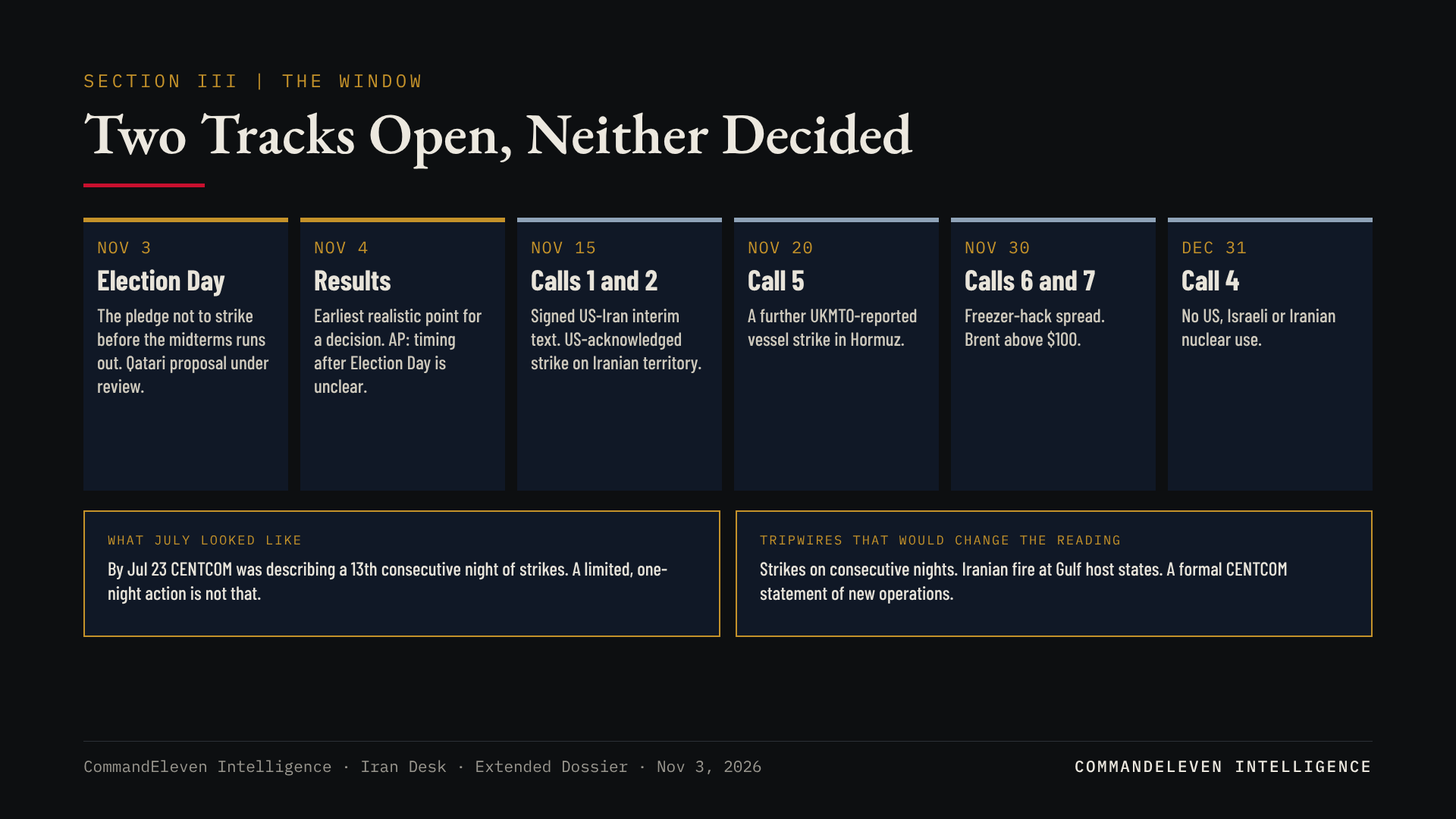
The window. AP’s sources said new military action could last several days and urged allies to take precautions against Iranian strikes on energy facilities and other critical infrastructure (AP via Fox 19). It is unclear how soon after Election Day the military would be ready, and the diplomats said Trump had not made a final decision. [CONFIRMED]
The cost. A CENTCOM estimate provided to lawmakers and obtained by CBS puts the war’s cost to the US military at no less than $47.1 billion as of mid-October: about $29 billion to replace munitions, $6.1 billion for lost equipment and $11.9 billion in incremental costs. It excludes damage to US bases (CBS News). Brent crude settled at $104.77 on Monday, down 7.63 percent on the talks, and $106.12 on Tuesday. [CONFIRMED]
The Nuclear Claim, Tested
The claim
Tucker Carlson posted on X that the Trump administration “may be within days of launching a nuclear strike on Iran”, aimed at Pickaxe Mountain, arguing that no conventional weapon can penetrate “300 feet of solid granite”. The War Zone said it did not know the source of his information or whether it is accurate. The White House dismissed the claim (The War Zone). [UNVERIFIED]
The real problem the rumor feeds on
Pickaxe Mountain is a very hardened, deeply buried Iranian site, large enough to house an enrichment plant, though its contents are not confirmed. The 300-foot granite figure is Carlson’s, and we could not verify it. The reasoning that the MOAB cannot do the job is sound: it is a fuel-air blast weapon and, as The War Zone put it, not a bunker buster. Experts told the same outlet the 30,000-pound GBU-57 may not reach the main caverns either. That shortage of conventional options is what makes the nuclear story feel plausible. [ASSESSED]
The options experts discuss short of a nuclear weapon are conventional strikes on entrances and access points, cyber sabotage and a special-operations raid, which one analyst called far riskier. The only air-delivered US nuclear weapon designed for deeply buried targets is the B61-11. None of this indicates a decision. It describes a menu.
What experts say, and how far the effects reach
Daryl Kimball, asked if use is likely, answered no, while noting a desperate president could order it. Hans Kristensen of the Federation of American Scientists called it highly unlikely. Kristensen also said a surface burst could spread debris nearly 300 kilometers downwind, and that an earth-penetrating weapon would likely increase fallout. Stephen Schwartz warned that such a blast can vent radioactive material through the hole it creates. [CONFIRMED: the statements]
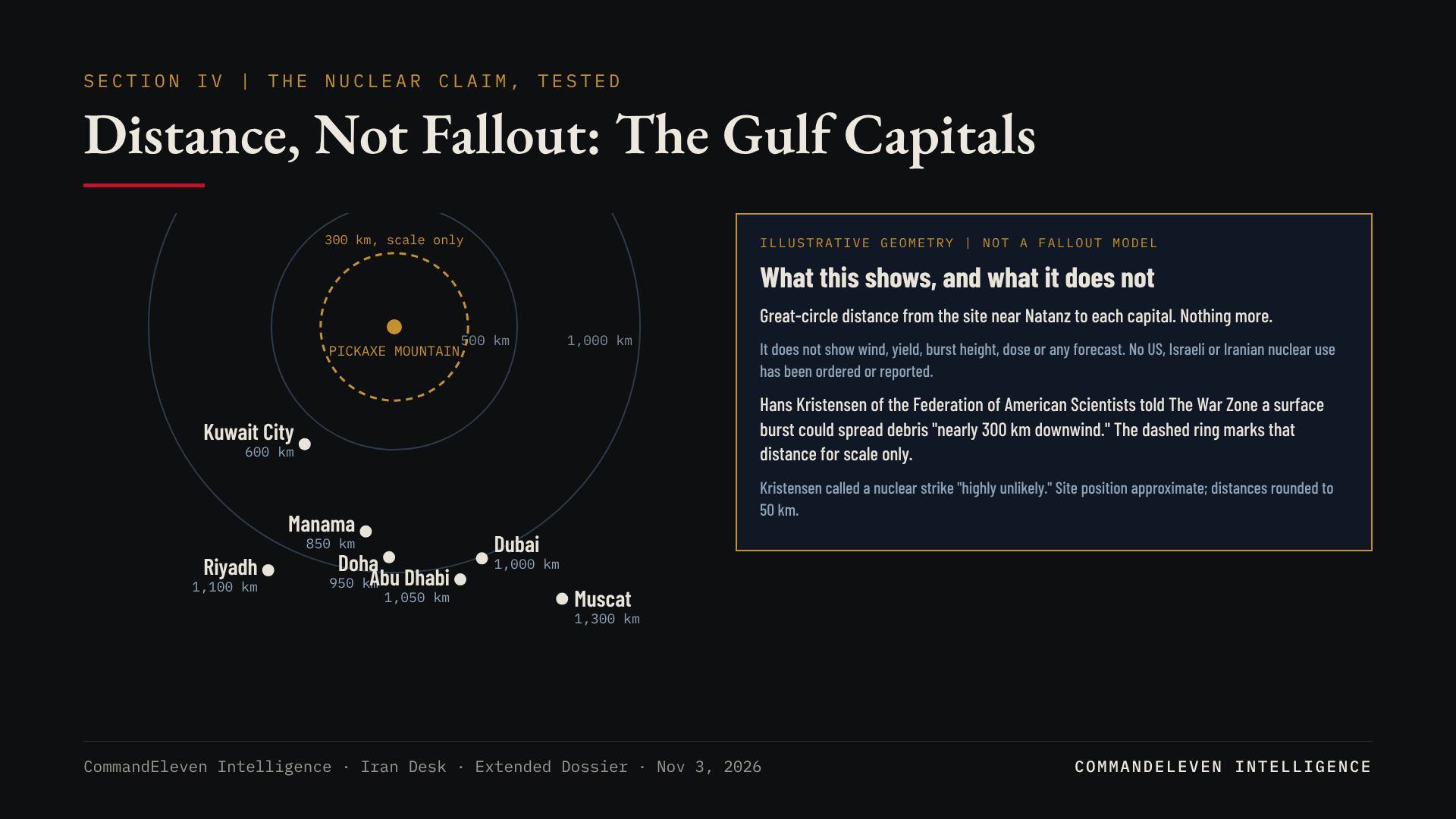
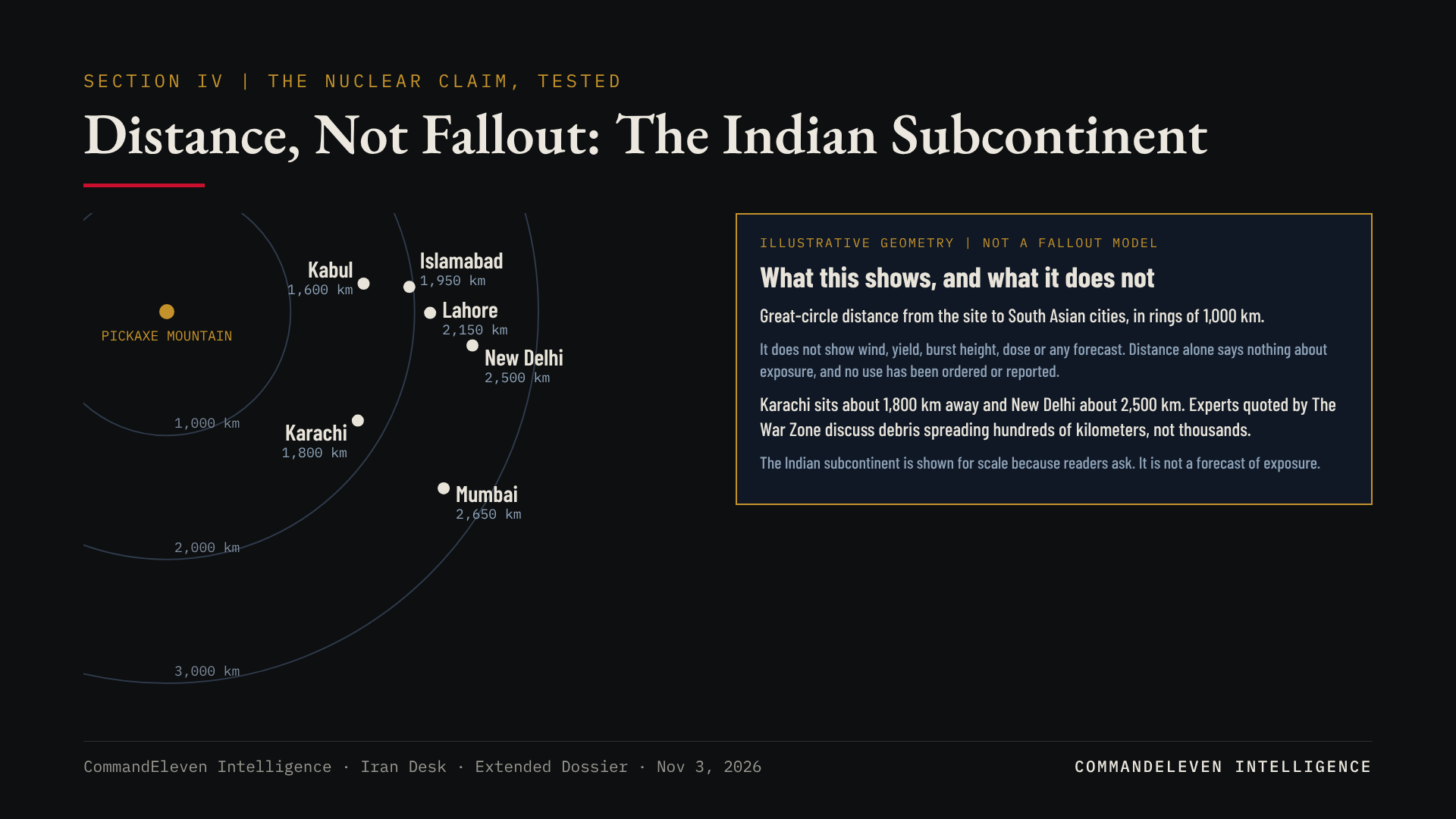
The two visuals below show only geometry: the great-circle distance from the site near Natanz to Gulf and South Asian cities. They do not model wind, yield, burst height or dose, and they do not forecast exposure. The dashed ring marks 300 kilometers, the figure Kristensen cited, for scale only. Great-circle distances are about 600 kilometers to Kuwait City, 850 to Manama, 950 to Doha, 1,000 to Dubai and Abu Dhabi, 1,100 to Riyadh and 1,300 to Muscat, and about 1,800 to Karachi, 2,000 to Islamabad and 2,500 to New Delhi.
Two nuclear-adjacent rumors
“Iran is broadcasting nuclear attack preparations on state TV.” What exists is an eight-minute civil-defense video and instruction list from Isfahan province emergency services. IRNA published it on October 29, during Passive Defence Week, and Al Arabiya reported the airing on November 3. Tehran has not linked it to any threat, and the TV channel and time are unconfirmed (Clash Report). Iran marks the week every year, but we found no earlier nuclear-specific guide. [ASSESSED: signaling that coincides with the Carlson claim, not preparation.]
“Trump gave Netanyahu a nuclear green light on a private call.” We found no readout, no named source and no sourced report of the call’s contents. It is in the Rumor Ledger and not in the analysis. [UNVERIFIED]
Iran’s Declared Response and the Target Lists
What Iran has actually said. Khamenei’s office ordered a response to any threat that is “immediate, effective and geographically unrestricted”, and said that if attacks resumed, Iran’s armed forces and nation would “determine when and under what conditions they end”. His channel circulated a missile graphic labeled “No Geographic Limits.” IRGC spokesman Hossein Mohabi said the Guards had begun identifying new targets and planning operations in new geographic theaters in case of another attack; the report names no specific targets (Israel Hayom). The order is conditional on new attacks. [CONFIRMED]
Europe. Fars, which is affiliated with the Revolutionary Guards, showed a video map of military bases in nine European countries. Israel Hayom identified four of them, Britain, Germany, Italy and Greece, and named no bases or date. Al Jazeera reports Iran has reportedly updated its target list to include US bases in Europe (Al Jazeera). [CONFIRMED: the map. REPORTED: the update.]
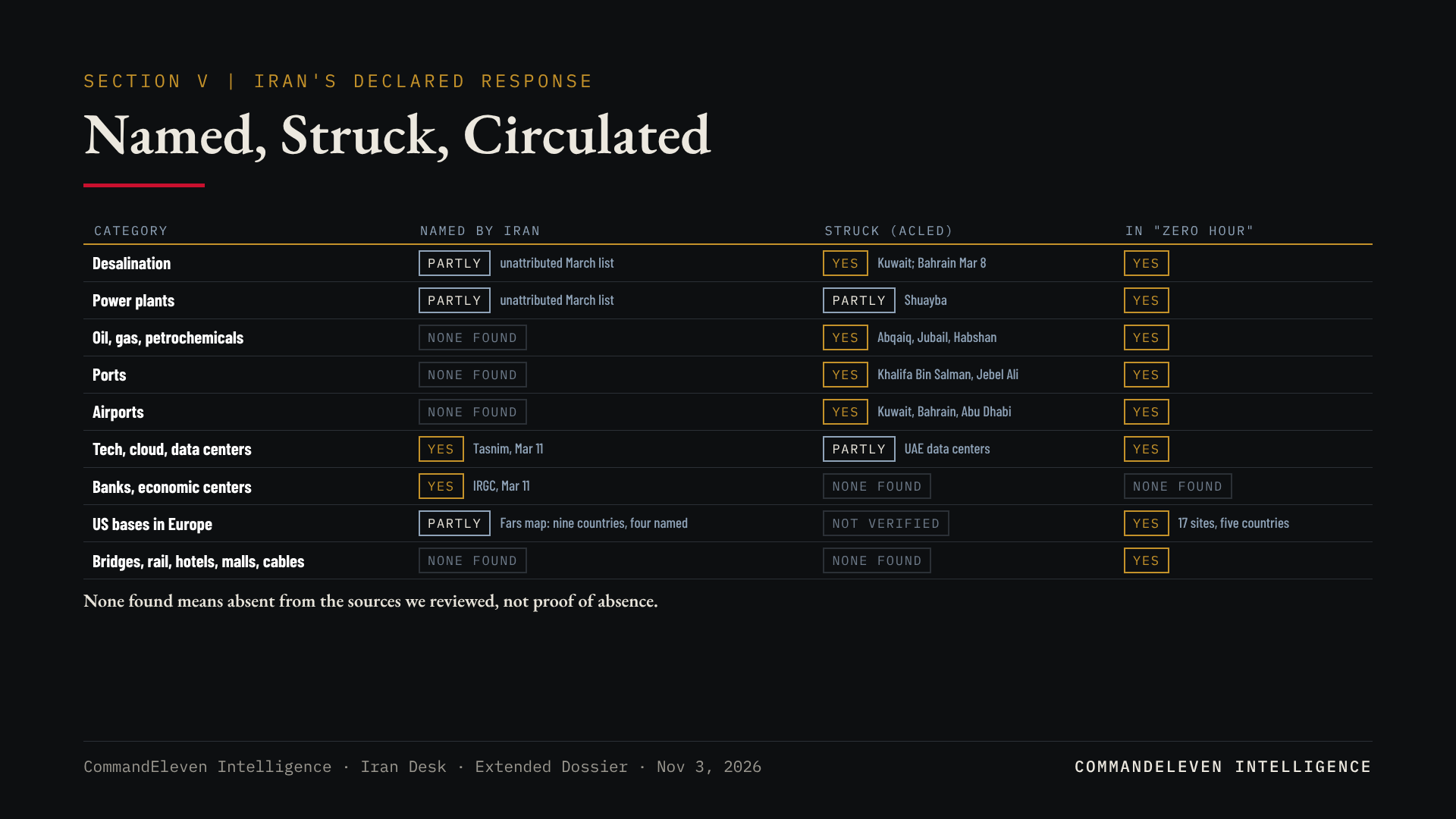
What Iran named and what it hit. On March 11 an IRGC spokesman declared US and Israeli economic centers and banks in the region open to targeting, and Tasnim published a list of “Iran’s new targets” naming Google, Microsoft, Palantir, IBM, Nvidia and Oracle sites (Al Jazeera). A separate list of power and desalination complexes across Saudi Arabia, the UAE, Kuwait, Jordan, Bahrain and Qatar surfaced in late March as retaliation for any US attack on Iranian energy infrastructure; the report does not say who issued it (SFG Media). ACLED records struck targets between February 28 and July 30: energy sites including Abqaiq, Ras Tanura, Jubail, Habshan and Bahrain’s refinery; Kuwait’s Shuayba power and desalination plant, repeatedly; airports in Kuwait, Bahrain and Abu Dhabi; Khalifa Bin Salman Port and Jebel Ali; and UAE data centers. ACLED rates Kuwait, Bahrain and Saudi Arabia most exposed and Qatar and Oman least (ACLED).
The circulated “Zero Hour” target maps
A series of graphics titled “Zero Hour Target” and a 24-second video are circulating on smaller Middle East channels. They show eight countries and eleven categories: ports, airports, power plants, desalination, petrochemicals, subsea cables, bridges, rail and metro, tech and AI firms, hotels and malls. The video says the maps are published by Iran-linked “security” media channels and shared by Iranian news sites. That is the video’s claim, and we could not verify it. No graphic names an issuer, and one carries a Persian news-channel watermark.
What we can say. The infrastructure categories overlap with what Iran has named or struck: desalination, power, energy, ports, airports and tech all appear in the sources above. The civilian and communications categories do not: bridges, rail and metro, hotels, malls and subsea cables have no sourced Iranian naming or strike in our review. The graphics also contain visible errors. The tech graphic is titled “U.S. Tech and AI” but mostly lists non-US firms. The Saudi desalination list repeats its largest plant under a generic label. The airports graphic omits the UAE and Oman. And they list Qatar and Oman, the mediators, as targets while Qatar’s delegation sits in Tehran. [ASSESSED: category overlap. UNVERIFIED: the maps.]
The “17 bases.” A related graphic lists 17 US military sites in five countries: Cyprus (2), Greece (4), Italy (8), Romania (2) and Albania (1). It is not the Fars map, which spans nine countries. Two of its sites, RAF Akrotiri and Dhekelia, are British sovereign bases, not US bases. A Pentagon count reported by Reuters from a March 2024 Congress report gives 31 permanent US bases in Europe and 19 further accessible sites, with 68,064 personnel permanently assigned as of December 2025 (Reuters factbox). Seventeen is a count of a graphic, not of US bases in Europe. [CONFIRMED: the discrepancy]
The Hormuz Incident Ledger
Al Mayeda. Nakilat reported through the Qatar Stock Exchange that the carrier was struck by “unidentified objects” on the evening of October 30. It remained operational, with no injuries or spill. Qatar’s foreign ministry condemned the attack on Sunday. Nobody has been named, and the location is given only as Gulf waters, so we do not place it inside Hormuz (Astig). [CONFIRMED]
The tug. A headline reports an offshore tug struck in Hormuz. We could not open the article and found no second source. [UNVERIFIED]
Drone claims. The IRGC Aerospace Force said it downed two MQM-170 drones south of Qeshm by electronic warfare, bringing its claimed MQM-170 total to four, and a separate IRGC statement claimed its 55th US MQ-9 destroyed east of the strait. Neither could be verified, and the date of the incidents is not established. The US had earlier rejected an IRGC Navy claim of seizing an MQM-170 (House of Saud). The MQM-170 is, as far as we know, a small tactical reconnaissance drone, not a high-end platform. We source these as IRGC-claimed. [CLAIMED]
The strait itself. CENTCOM commander Adm. Brad Cooper said on October 30 that the IRGC was “gone from Hormuz”, while Iran warned that mines remained. Araghchi proposed a two-day reopening of the strait that had drawn no public US or Saudi acceptance as of Tuesday morning (House of Saud). [CONFIRMED: the statements]
Pentagon Churn
A social graphic circulating this week links every recent removal to the Iran war. The record is more mixed. Of the departures we checked, only Lt. Gen. Sylvia’s carries an official reason: the Pentagon cited leaks, failed polygraphs and a DOJ referral (Al Jazeera). General Randy George was removed on April 2 with no reason given (CNN). Several exits pre-date the war: the February 2025 removals of Gen. Brown, Adm. Franchetti and Gen. Slife, among others, and Lt. Gen. McGee in October 2025 after reported clashes (Newsweek). Army Secretary Driscoll resigned on August 31. Gen. Donahue’s retirement was announced between late June and early July.
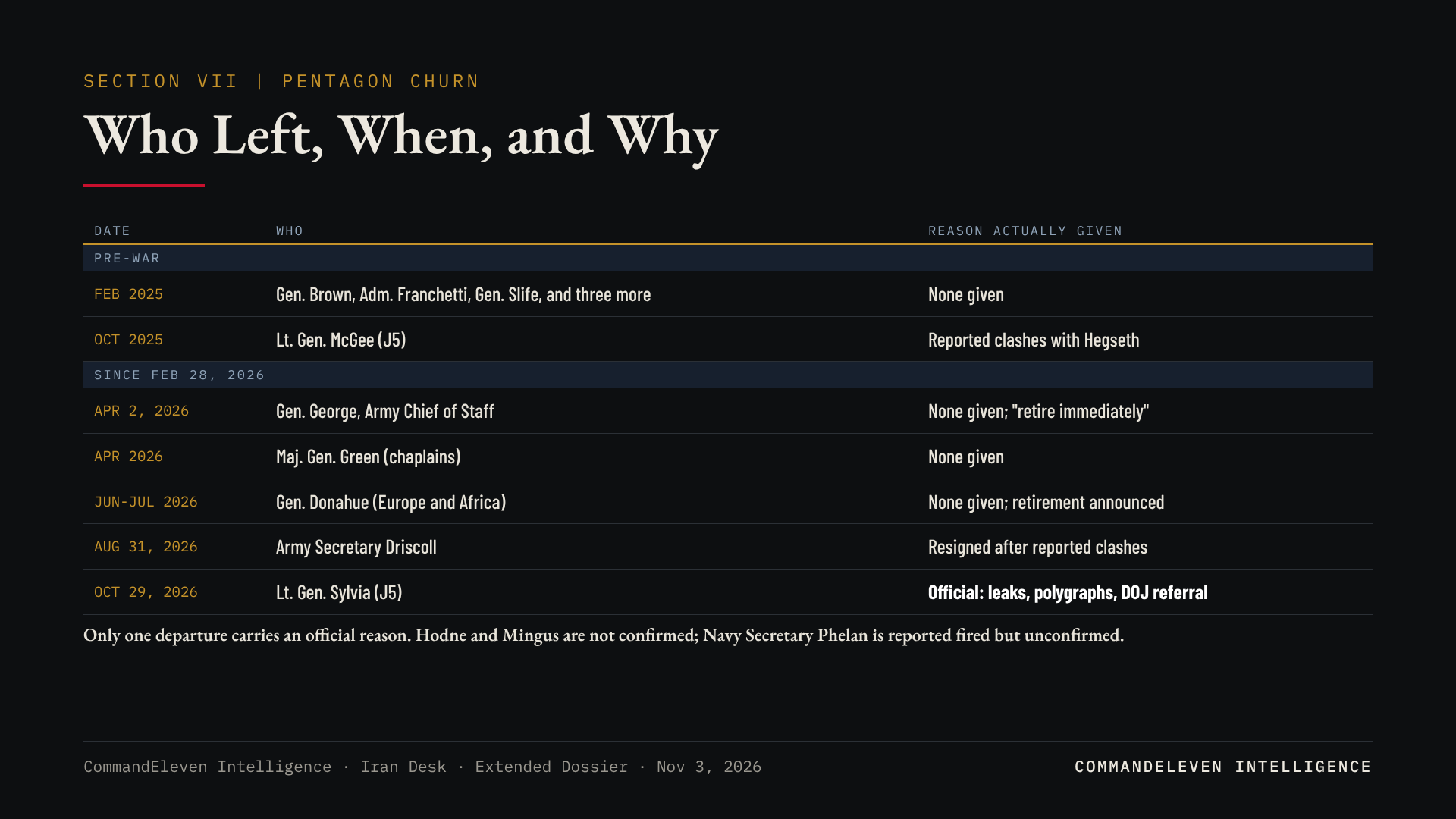
We could not confirm Lt. Gen. Hodne’s or Mingus’s departures from the sources we reviewed, and Navy Secretary Phelan’s reported firing remains unconfirmed. They are not in the table. [CONFIRMED: the table. UNVERIFIED: the omitted names.]
Branches: Freezer Hacks and Stockpile Advisories
Two threads from this week are handled in their own pieces so this dossier stays on the strike track. Freezer hacks. Compromises of commercial refrigeration controllers have spread across Europe in a second wave, with no attribution to any state; the existing report is Fridge Hacks Spread to Sweden, Belgium and Estonia. We make no link to Iran. Stockpile advisories. The count of countries advising citizens to stockpile varies by source (22, 31 and 33), and many advisories are standing policies, not new ones. A country-by-country table, with authority, date, duration, reason and whether the advice is standing or new, is in preparation.
The Rumor Ledger
This is the first entry of a running ledger. It logs claims in circulation, where they came from, how we tier them and what the record shows. It exists so that a reader who sees a claim can check it here first.
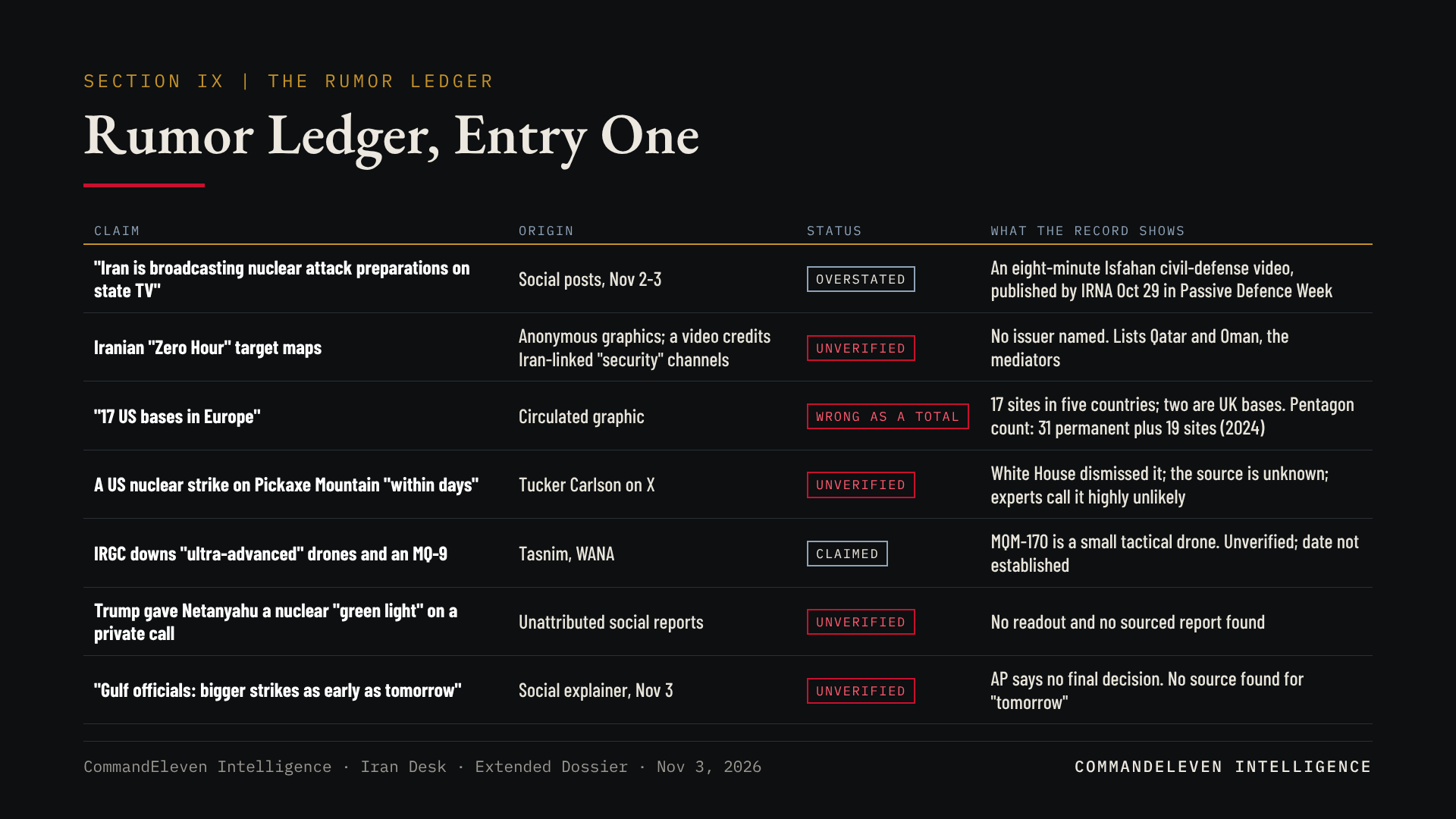
| Claim | Origin | Status | What the record shows |
|---|---|---|---|
| “Iran is broadcasting nuclear attack preparations on state TV” | Social posts, Nov 2-3 | OVERSTATED | An eight-minute Isfahan civil-defense video, published by IRNA Oct 29 during Passive Defence Week |
| Iranian “Zero Hour” target maps | Anonymous graphics; a video credits Iran-linked “security” channels | UNVERIFIED | No issuer named. Lists the mediators Qatar and Oman |
| “17 US bases in Europe” | Circulated graphic | WRONG AS A TOTAL | 17 sites in five countries, two of them UK bases. Pentagon count: 31 permanent plus 19 sites (2024) |
| A US nuclear strike on Pickaxe Mountain “within days” | Tucker Carlson on X | UNVERIFIED | White House dismissed it; source unknown; experts call it highly unlikely |
| IRGC downs “ultra-advanced” drones and an MQ-9 | Tasnim, WANA | CLAIMED | MQM-170 is a small tactical drone. Unverified; date not established |
| Trump gave Netanyahu a nuclear “green light” on a private call | Unattributed social reports | UNVERIFIED | No readout and no sourced report found |
| “Gulf officials: bigger strikes as early as tomorrow” | Social explainer, Nov 3 | UNVERIFIED | AP says no final decision. No source found for “tomorrow” |
| Trump on Fox: “when was the last time we fired anything?” | Social explainer, Nov 3 | UNVERIFIED QUOTE | We could not find the interview or transcript |
| “Five explosions across Qeshm” | Social explainer, Nov 3 | CONFIRMED | IRNA reported five explosions on Qeshm and further blasts at Bandar Lengeh |
| “At least $47.1 billion” in war costs | Social explainer, Nov 3 | CONFIRMED | CENTCOM estimate to lawmakers, obtained by CBS; excludes base damage |
What This Means for Business
The record in this dossier points to where a renewed round of fighting would land first: Iran has already named and struck energy, water, port, airport and data-center targets. For companies, that makes the post-midterm window a planning date rather than a forecast. The exposure is delay and rerouting at Gulf ports and airports, continuity of power and water at facilities in the region, and availability of services hosted in Gulf data centers. Firms with Gulf operations should confirm what their insurance and contracts say about war-risk exclusions and force majeure, and who has authority to act if a regional alert is issued.
This is a CommandEleven Intelligence assessment (ASSESSED) and general guidance, not advice tailored to any one company.
Dated Calls
These are our calls, dated and measurable, entered in the Foresight Record under its fixed method: confirmed counts 1, partly confirmed 0.5. They rest on public reporting only. We score them on the stated date, and misses will be published.
| ID | Call | Resolves | What counts |
|---|---|---|---|
| QS-01 | No signed US-Iran interim text by Nov 15 | Nov 15 | A signed or jointly announced text confirmed by both governments or the mediator |
| QS-02 | A new US strike on Iranian territory is acknowledged by Nov 15 | Nov 15 | CENTCOM, or US officials reported by two outlets, after Nov 3 |
| QS-03 | If QS-02 occurs, Iran fires at a Gulf host state within 72 hours | 72 hours after QS-02 | CENTCOM, a host state or the IRGC reports fire at Kuwait, Bahrain, Jordan, the UAE or Saudi Arabia |
| QS-04 | No US, Israeli or Iranian nuclear use by Dec 31 | Dec 31 | No detonation or confirmed use |
| QS-05 | A further UKMTO-reported vessel strike in or near Hormuz by Nov 20 | Nov 20 | A UKMTO incident notice |
| QS-06 | Freezer-hack incidents confirmed in at least two more countries by Nov 30 | Nov 30 | National CERT or vendor confirmation |
| QS-07 | Brent settles above $100 on Nov 30 | Nov 30 | Closing settlement price |
Data Deficits and Tripwires
What we do not know. Who fired first on November 2, since the account is US-sourced; what the Qatari proposal contains; whether Trump has decided; the real depth of Pickaxe Mountain; who issued the target maps; and who struck Al Mayeda. [DATA DEFICIT]
What would change the assessment.
- Strikes on consecutive nights, as in July, would move KJ1 toward a return to sustained operations.
- Iranian fire at a Gulf host state after any US action would confirm the pattern in KJ2.
- A formal CENTCOM statement announcing new operations would settle the window question.
- A signed interim text, or a joint statement by Qatar, would weaken the strike-window reading.
- Any named, sourced indicator of nuclear force posture would be the first evidence for the Carlson claim. None has been reported.
Frequently Asked Questions
Was the November 2 strike a return to war?
Not on the evidence so far. US officials describe a limited, defensive strike on a missile launcher after Iranian fire, and a US official told Fox News it was not the start of expanded strikes. In July, by contrast, CENTCOM described strikes on consecutive nights. Watch for that pattern.
Is the US about to use a nuclear weapon on Iran?
There is no public evidence of it. The claim started with a commentator’s post, the White House dismissed it and independent experts call it highly unlikely.
Are the Iranian “Zero Hour” target maps real?
They are unverified. No issuer is named, and they contain errors and list the mediators as targets. The infrastructure categories overlap with what Iran has named or hit, but the civilian and communications categories do not.
Why does Qeshm keep being hit?
It sits in the Strait of Hormuz and hosts IRGC naval and missile assets. We count at least seven incidents since March, and in the acknowledged cases Iran fired at Gulf states hosting US forces.
Related Reading
- US Takes Step Towards Embrace of Gulf Plan to Destabilize Iran
- Saudi-UAE Campaign to Isolate Qatar & Iran Puts Muslim Nations in a Bind
- Post Trump Policy in Gulf States
- Gulf Crisis – Surrender or Dig In For The Long Haul
Sources
- Associated Press (via Fox 19), US warns allies to prepare for possible Iran strikes, retaliation after elections (October 29, 2026)
- NBC News, U.S. military carries out limited strikes on Iran’s Qeshm Island, U.S. officials say (November 2, 2026)
- CNN, US military conducts strikes on Iran’s Qeshm Island in defensive operation, officials say (November 2, 2026)
- US News (Wall Street Journal report), US carries out ‘defensive’ strikes on Iran’s Qeshm Island, officials say (November 2, 2026)
- House of Saud, Iran, US aircraft and Hormuz: November 3 summary (November 3, 2026; summarizes NBC, CNN, Fox News, WSJ, Tasnim, WANA and The National)
- Al Jazeera, Iran commander sets out five conditions for regional security (November 3, 2026)
- Israel Hayom, Iran threatens to expand war beyond Middle East as US weighs new strikes (November 1, 2026)
- CBS News, Iran war cost: CENTCOM estimate of $47.1 billion (October 2026)
- CNBC, Qatari mediators held talks in Tehran aimed at restarting direct U.S.-Iran negotiations (October 31, 2026)
- ACLED, The Gulf’s critical infrastructure presents a lasting vulnerability for Iran to exploit (2026)
- Al Jazeera, Iran declares US-Israeli economic, banking interests in region as targets (March 11, 2026)
- SFG Media, Iran named targets in the Persian Gulf it will strike in response to U.S. attacks on its power plants (March 2026)
- Stars and Stripes, Bahrain desalination plant struck as water infrastructure becomes latest front in Iran war (March 8, 2026)
- Times of Israel, IRGC says it attacked US base in Bahrain, claims it was used to strike desalination plant in Iran (March 7, 2026)
- Adnkronos, US attack Qeshm island, Tehran strikes Bahrain and Kuwait (June 3, 2026)
- PUK Media, CENTCOM says US struck Qeshm Island as Iran claims retaliatory attacks on American bases (June 3, 2026)
- Iran International, Explosions reported near Bandar Abbas and Qeshm (July 7, 2026)
- Kurdistan24, US strikes reported near Iran’s Qeshm Island, Iranian media say (July 16, 2026)
- Kurdistan24, US hits site near Qeshm Island, Iranian media reports (July 23, 2026)
- bne IntelliNews, Iran reports US aircraft down over Qeshm island near Hormuz Strait (July 2026)
- The War Zone, A nuclear strike on Iran? It sounds absurd because it is. Let’s talk about it (2026)
- Clash Report, Iranian state media issues nuclear strike survival guide amid Carlson claim (November 2026)
- Astig, Qatar LNG carrier Al Mayeda Gulf attack (2026)
- Al Jazeera, Pentagon fires general it says leaked classified information to media (October 29, 2026)
- CNN, Hegseth removes Randy George as Army chief of staff (April 2, 2026)
- Newsweek, Hegseth fires top military planner: list of high-profile Pentagon departures (2026)
- Reuters (via Internazionale), Factbox: Details of U.S. troops based in Europe as Trump mulls removing some (April 10, 2026)