CommandEleven Intelligence Desk · Force Protection Desk, status as of November 10, 2026
Bottom Line Up Front
The Department of War says it delivered more than 25,000 unmanned and counter-drone systems to CENTCOM this year, for about $782 million. About 96% of them are defensive counter-drone systems. That is a real shift in posture. It is also a count of equipment, not a measure of protection: the release gives no vendors, locations, intercept rates or effectiveness data. Meanwhile, The Intercept reports that senior officials fear cheap drone attacks on U.S. and foreign bases, the Pentagon’s own inspector general found the rules for defending bases unclear and inconsistent, and the next step, a proposed Autonomous Warfare Command, still needs Congress.
Key Judgments
- CONFIRMED: More than 25,000 unmanned and counter-drone systems went to CENTCOM in 2026 for about $782 million; roughly 24,000 are counter-UAS. No effectiveness data was released.
- CONFIRMED: A January 2026 DoD Inspector General report found covered-asset rules unclear and inconsistent across installations. Hegseth signed a consolidated counter-drone policy on December 8, 2025.
- REPORTED: Senior officials fear cheap drone attacks on U.S. and foreign bases (The Intercept, citing anonymous officials).
- REPORTED: Waves of 12 to 15 drones over Barksdale Air Force Base between March 9 and 15, per a confidential document reported by ABC. NORTHCOM confirmed multiple incursions at an unnamed base.
- Reported by The Intercept (Unconfirmed): An IRGC plot against B-1 bombers at RAF Fairford in early October, via a leaked classified memo. The resemblance to Operation Spider’s Web is The Intercept’s inference, not an official finding.
- CONFIRMED (framework only): The Pentagon-BAE framework covers up to 25,000 APKWS kits per year for up to seven years. It is unfunded, needs congressional approval, and is not part of the CENTCOM delivery.
- ASSESSED: The delivery measures volume, not effectiveness. The gaps that matter are authority, layering and homeland coverage, not unit counts.
- SPECULATIVE: An Iranian adviser’s post about a “second generation of surprises” is a single social media post and is not evidence of a capability.
Sourcing and Analytical Confidence
We grade every claim in this dossier on one scale. “(Unconfirmed)” is an inline hold tag on a single claim; it is not a fifth tier.
| Tier | Meaning |
|---|---|
| CONFIRMED | Stated on the record by an official source or documented in a primary document |
| REPORTED | Credible outlet, named or anonymous sourcing, not independently verified by us |
| ASSESSED | Our judgment from the confirmed and reported record |
| SPECULATIVE | Plausible but thinly sourced; not relied on |
What Was Delivered
The November 6 release from the Direct Reporting Portfolio Manager for Unmanned Systems says more than 25,000 unmanned and counter-drone systems reached CENTCOM this year, for about $782 million. The breakdown is stark: more than 24,000 counter-UAS systems, delivered through the Joint Interagency Task Force 401 (JIATF-401); more than 1,300 one-way attack drones; and more than 100 unmanned surface and undersea vessels combined.
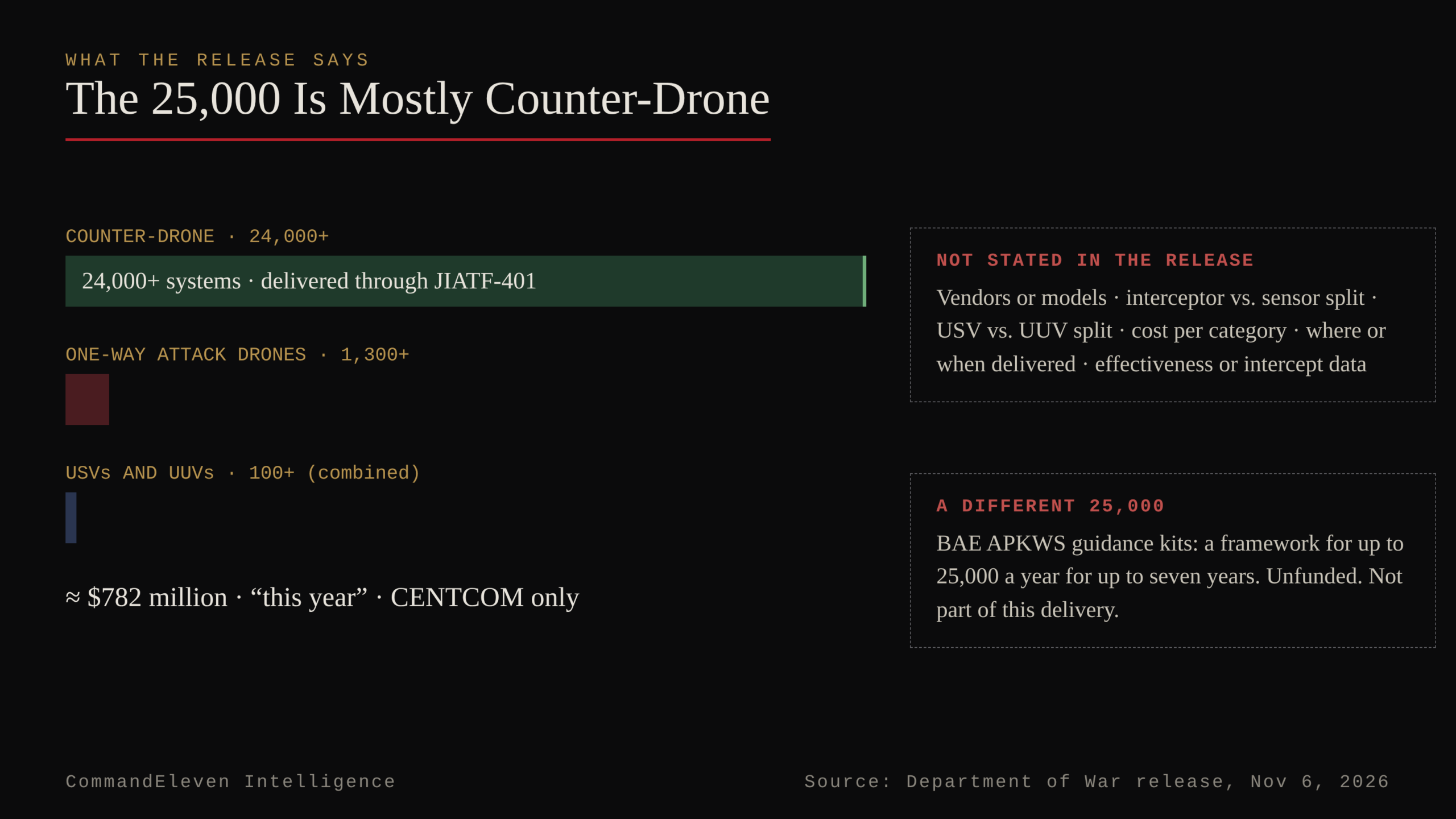
What the release does not say matters as much. It names no vendors, gives no split of cost by category, does not say where the systems are, when they arrived, or how well they work. A figure like “25,000” invites comparison with other numbers, so one caution: separately, the Pentagon-BAE framework announced in October covers up to 25,000 APKWS rocket kits per year. That is a different 25,000, for a different purpose, and it is not part of this delivery.
What the Pentagon Fears
On October 27, Nick Turse reported in The Intercept that the Pentagon fears drone attacks on U.S. and foreign bases. The reporting draws on Hegseth’s FORTRESS America framing, the January DoD Inspector General report, a September IG report saying Iranian strikes damaged or destroyed hundreds of buildings and structures at U.S. bases in eight countries, and a letter from Senators Warren, Blumenthal, Hirono, Duckworth and Peters to Adm. Cooper. An anonymous official put repair costs at upwards of $50 million, possibly far higher.
Reported by The Intercept, an early-October IRGC plot targeted B-1 bombers at RAF Fairford, patterned on Operation Spider’s Web (Unconfirmed). The claim rests on a classified October 23 memo leaked to Fox and Axios. A U.S. official questioned the leak’s motives, and Hegseth’s office and CENTCOM did not comment. The Intercept itself notes the Pentagon is “notorious for inflating threats.” We carry the report and the hold together: it is reported, and it is not confirmed.
The Incident and Damage Record
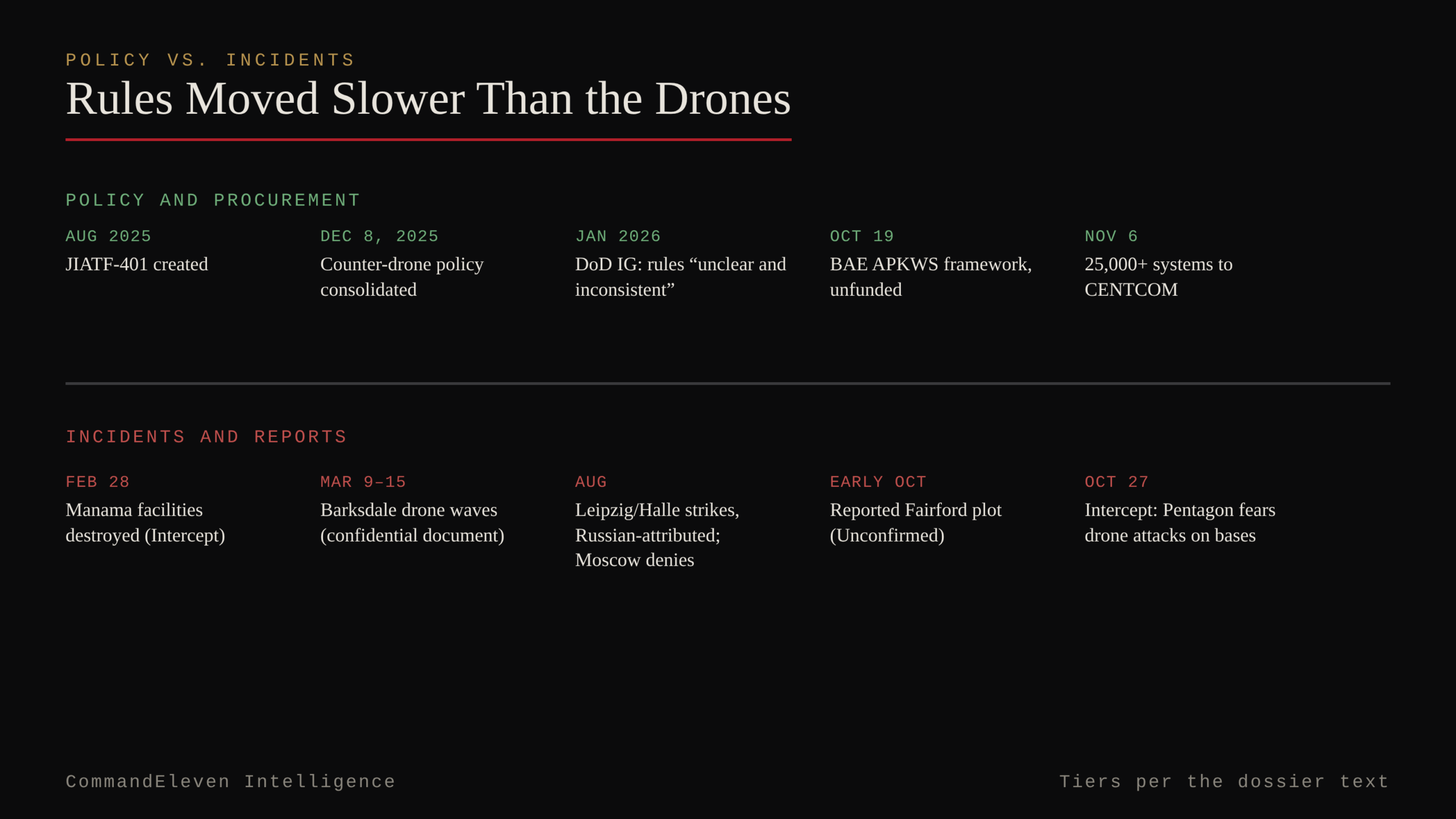
- February 28: Manama, with Al Udeid’s combined air operations center reported damaged (The Intercept).
- March 9 to 15: Barksdale. A confidential document reported by ABC describes waves of 12 to 15 drones; The War Zone could not verify that count. NORTHCOM confirmed multiple incursions at an unnamed base and used an Anduril fly-away kit. Gen. Guillot said about a quarter of detected drones are now defeated, against nearly none a year earlier. NORTHCOM had one kit, with more due in spring 2026.
- August: Leipzig/Halle, attributed by The Intercept to Russia; Russia denies it.
- Early October: RAF Fairford, reported by The Intercept (Unconfirmed), as above.
- September: The IG report on Iranian strike damage across eight countries.
The Authority Gap
The January IG report, covered by DefenseScoop, visited 10 installations and found the rules for covered assets unclear and inconsistent. Luke Air Force Base was not designated a covered asset, and the services’ approvals “differ drastically.” Hegseth’s December 8, 2025 consolidated policy expanded commanders’ authority to act against drones. JIATF-401, established in August 2025 under Army Brig. Gen. Matt Ross, responded that some of the report’s data were up to 18 months old.
JIATF-401’s first six months, per CUASHub, show $30 million-plus in rapid acquisitions, a counter-UAS marketplace and the Domestic Shield program, formerly Replicator 2. They show no unit counts and no effectiveness data. CNAS’s Molly Campbell argued for “layered density” rather than a single system. Our assessment: buying 24,000 systems does not by itself settle who may use them, where, and against what.
Where It Goes Next
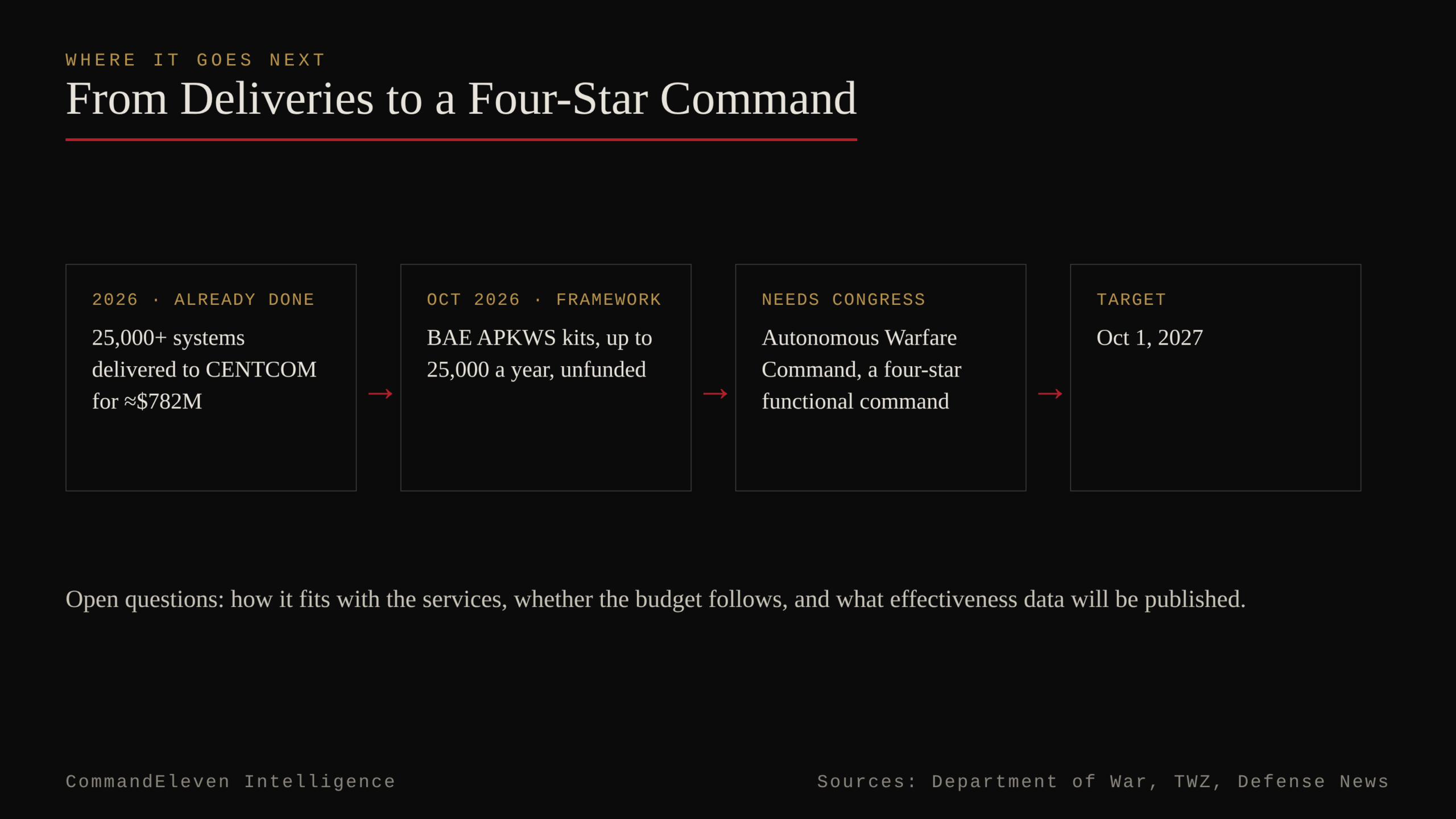
The Pentagon-BAE framework, reported by Defense News on October 19, covers up to 25,000 APKWS kits per year for up to seven years, with a path to 35,000 for allies through Foreign Military Sales. Unit cost is undisclosed; it is unfunded and needs congressional approval. Separately, The War Zone reported on September 30 that the proposed Autonomous Warfare Command (AUTOWARCOM), a four-star functional combatant command, needs Congress, with a target of October 1, 2027. The article does not say JIATF-401 or the unmanned systems portfolio will merge into it, and neither do we.
What Would Change Our Assessment
- Publication of intercept rates or effectiveness data for the CENTCOM systems, which would move our central judgment from volume to performance.
- Official confirmation or denial of the Fairford plot, which would resolve the hold.
- A confirmed, funded multiyear contract for the BAE framework.
- A new IG or GAO review showing covered-asset rules standardized across the services.
- A confirmed successful drone strike on a U.S. base in the region despite the new systems.
Calls We Will Score
- By December 31, 2026: The Pentagon will not publish intercept or effectiveness data for the systems delivered to CENTCOM.
- By December 31, 2026: DoD will not disclose the total repair cost of Iranian damage to Middle East bases.
- By December 31, 2026: The BAE APKWS framework will not have become an announced, funded multiyear contract.
- By March 31, 2027: Congress will not have formally authorized the Autonomous Warfare Command.
We score each call on its due date and publish the result, hit or miss, on the Foresight Record.
What This Assessment Does and Doesn’t Establish
- Does establish: the size, cost and composition of the delivery; that the IG found inconsistent rules; that officials fear drone attacks on bases, as reported.
- Does not establish: that the systems work, that any base is more or less safe than before, that the Fairford plot occurred, or that AUTOWARCOM will absorb existing programs.
Frequently Asked Questions
What did CENTCOM receive in 2026?
More than 25,000 unmanned and counter-drone systems for about $782 million, per the Department of War’s November 6 release: 24,000+ counter-UAS, 1,300+ one-way attack drones, and 100+ unmanned surface and undersea vessels.
Is the 25,000 figure the same as the BAE contract?
No. The BAE framework covers up to 25,000 APKWS kits per year and is unfunded. It is a separate program.
Was the RAF Fairford plot confirmed?
No. It was reported by The Intercept (Unconfirmed), based on a leaked classified memo, and officials did not comment.
Do the systems work?
The Pentagon has published no effectiveness data. Gen. Guillot said about a quarter of detected drones are now defeated, a NORTHCOM figure that is not specific to CENTCOM.
What is AUTOWARCOM?
A proposed four-star functional combatant command for autonomous warfare. It needs congressional approval, with an October 1, 2027 target.
Related CommandEleven Intelligence Reading
- Iran War Update: Confirmed vs. Hype
- RAF Fairford force-protection dossier
- RAF Fairford foresight audit
- MacDill breach and RAF Fairford plot
- Jet Gerans: threat maps
Sources
- Department of War / DRPM-UxS release on CENTCOM deliveries, November 4, 2026, Department of War
- Nick Turse, “Pentagon Fears Drone Attacks on U.S. and Foreign Bases,” The Intercept, October 27, 2026
- DoD Inspector General, DODIG-2026-045, January 2026, Department of War Inspector General, January 26
- CUASHub, JIATF-401 six-month review, March 2, 2026
- The War Zone, Barksdale drone incursions, March 24, 2026
- Defense News, Pentagon-BAE APKWS framework, October 19, 2026
- The War Zone, Vision For New Autonomous Warfare Command Laid Out By Pentagon, September 30, 2026
- Epoch Times / ZeroHedge, CHAOS 1 Vanquish Prime radar contract