CommandEleven Intelligence Desk // Middle East Desk, status as of November 25, 2026. This assessment contains no training curriculum or technical detail. It rests on one Reuters report and its re-publications, open-source records and our own earlier dossiers; where we could read only press coverage of a document, we say so.
Bottom Line Up Front
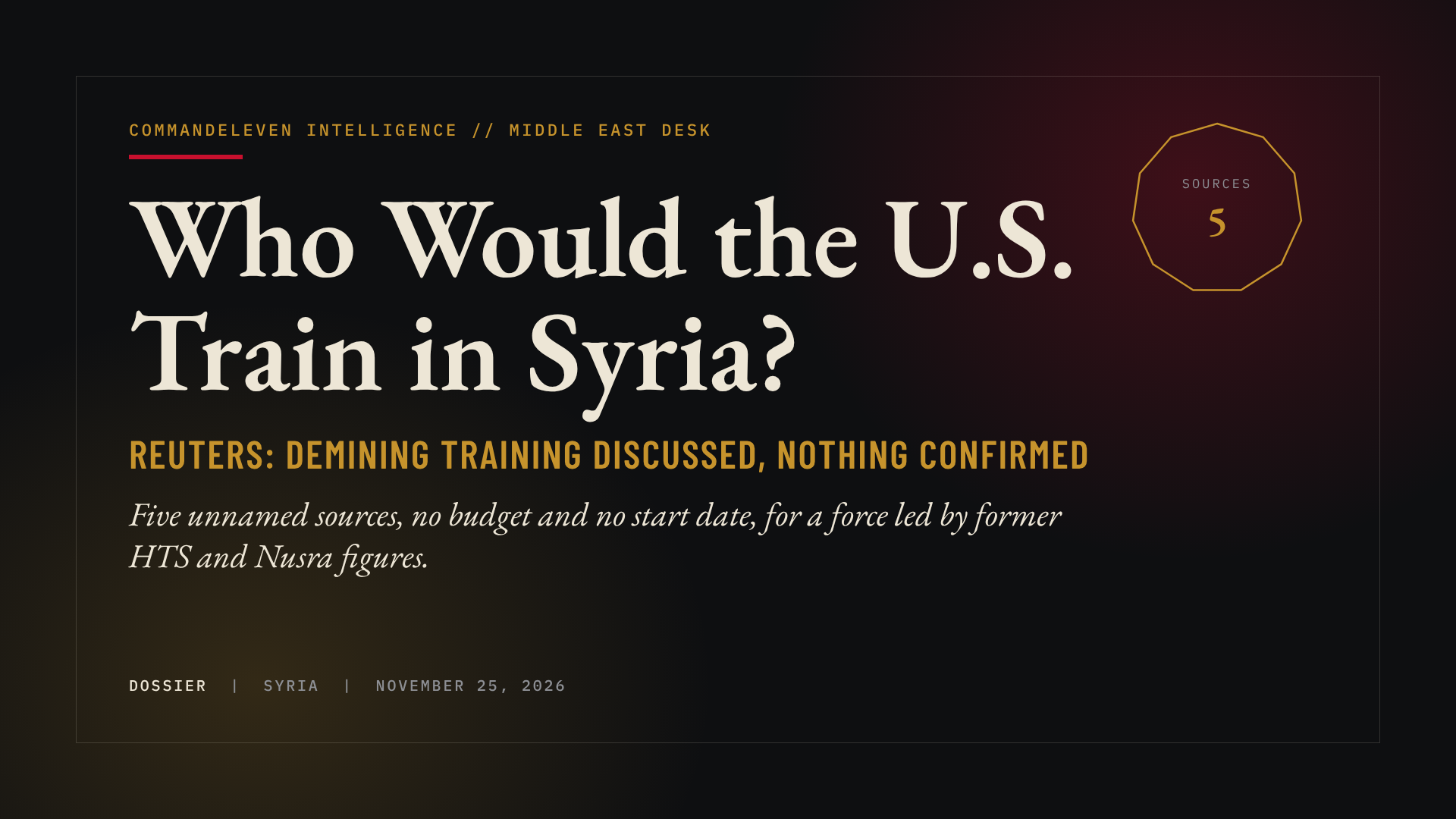
The United States is reportedly discussing a multinational program to train Syrian soldiers in demining and safe disposal of ordnance. It would be the first U.S. training mission with the Syrian military since former rebel fighters took power in Damascus in 2024. The account rests on five unnamed sources in a single Reuters report. Neither Washington nor Damascus has published a program, a budget or a start date.
The force that would be trained is led by former Hayat Tahrir al-Sham (HTS) and Nusra Front figures and includes thousands of foreign fighters. The U.S. record of arming and training such forces in Afghanistan and Iraq is mixed at best, and it argues for a narrow, slow and heavily vetted start. The risk lies in the political arrangement around the training, not in demining itself.
Key Judgments
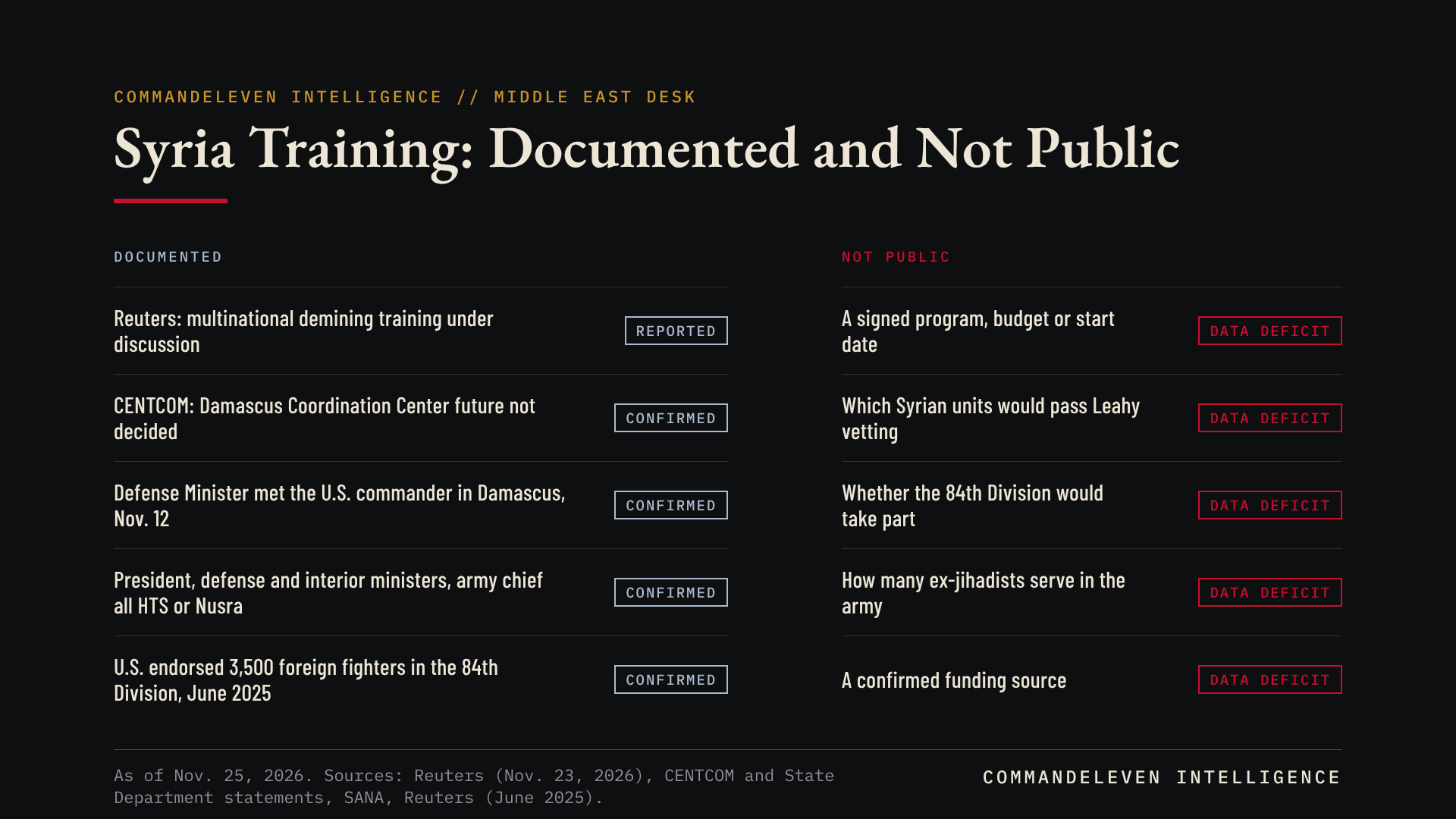
- REPORTED: U.S. officials are discussing a multinational training mission. Four of the five sources said the initial program would stress demining and safe disposal of ordnance, with the possibility of becoming a model for wider cooperation. One option would train Syrian soldiers in Jordan and Syria, potentially from March, with limited U.S. military participation.
- CONFIRMED (officials’ statements, per Reuters): A CENTCOM spokesperson, Captain Tim Hawkins, said the Damascus Coordination Center continues its work and that full decisions on its future structure and mission focus have not been taken. A State Department spokesperson said Washington welcomes a partner in Damascus committed to combating Islamic State. Neither statement confirms a training program, and the Syrian Defense Ministry did not respond to Reuters.
- CONFIRMED: U.S. law, the Leahy Laws, bars assistance to foreign security force units when there is credible information of gross human rights violations. Two sources told Reuters American officials would need to vet prospective Syrian recipients before any funding. Which units could pass is a DATA DEFICIT.
- CONFIRMED: Syria’s president, defense minister, interior minister and army chief of staff all come from HTS or its predecessor, the Nusra Front. The president, Ahmed al-Sharaa, led al-Qaeda’s Syrian branch before 2016. The foreign minister is an HTS-era political figure, not a fighter. No public count exists of former jihadists in the army overall (DATA DEFICIT).
- CONFIRMED: In June 2025 the U.S. endorsed, on condition of transparency, a plan to place about 3,500 foreign fighters, mostly Uyghurs from the Turkistan Islamic Party, in a new 84th Division of the Syrian army. Whether that unit would take part in any U.S. training is not reported (DATA DEFICIT).
- ASSESSED: The historical pattern is consistent. U.S. support for irregular or politically fragile forces in Afghanistan (1980s and 2001 to 2021) and Iraq (2006 to 2011) left skills and weapons that outlasted the political arrangement behind them, and in several cases they ended up with terrorist groups.
- ASSESSED: The most likely outcome is a small, vetted, multinational, demining-only program that starts late and slowly. The main risks are mission creep into border security, unit-level vetting failures, and the recipients’ political dependence on a leader whose own record is contested.
What Reuters Reported
The Reuters report, datelined Damascus on Nov. 23 and written by Feras Dalatey, says the proposal is for a multinational mission rather than a bilateral one. One person involved in the discussions said it would involve personnel from about 15 U.S. allies, including Britain, France, Germany, Australia, Saudi Arabia and the United Arab Emirates [REPORTED]. If it moves ahead, Reuters says, a small number of U.S. troops could return to Syria as soon as next year, about a year after the last ones left.
The plan would build on the Damascus Coordination Center, set up last year in Jordan to coordinate Syrian authorities, American forces and regional allies. The arrangement could also involve the Syrian National Mine Action Centre, the government body that coordinates mine clearance, which did not respond to Reuters. Two sources said officials are exploring whether remaining Operation Inherent Resolve funds could pay for the program. One put the amount near $200 million, which Reuters could not verify [REPORTED]. Reuters also reports reluctance among some in Syria’s Defense Ministry to give U.S. personnel access to Syrian institutions and facilities.
Syrian state news agency SANA reported that Defense Minister Murhaf Abu Qasra met Rear Admiral Liam Hulin, commander of the U.S.-led Operation Inherent Resolve, in Damascus on Nov. 12 [CONFIRMED that the meeting occurred]. A Syrian military source told Reuters it covered the multinational mechanism, demining and explosive ordnance disposal training, and unspecified border-security help [REPORTED, one source]. We do not build on the border-security item.
The Political Backdrop
Reuters places the proposal inside a rapid U.S.-Syria rapprochement since the fall of Bashar al-Assad in December 2024. Washington lifted broad sanctions in December 2025, removed Syria’s state sponsor of terrorism designation in August 2026, and in October eased arms-export and defense-services restrictions so licenses can be considered case by case. The last U.S. troops left Syria in April 2026 and Iraq in September [REPORTED]. Our Part 7 on the Makkah Pact covers the separate question of Syrian personnel in Saudi Arabia. Saudi Arabia is among the reported participants here, and we draw no link between the two without sourcing.
Who Would Be Trained: The Man at the Top
Ahmed al-Sharaa, known until December 2024 as Abu Mohammad al-Jolani, was born in 1982 in Riyadh to a family from the Golan Heights, per Britannica. He went to Iraq to fight the U.S. invasion and, by his own February 2025 account, ended up with al-Qaeda in Iraq. U.S. forces held him; detention dates differ by source. In 2011 the Islamic State of Iraq leader, Abu Bakr al-Baghdadi, sent him to Syria to build what became the Nusra Front. The State Department designated Nusra a foreign terrorist organization in December 2012, and he was listed as a global terrorist in May 2013. He broke with Baghdadi in 2013, pledged to al-Qaeda’s Ayman al-Zawahiri, and in 2016 rebranded the group and cut ties with al-Qaeda, per CNN’s fast facts and the Jewish Virtual Library [CONFIRMED]. The U.S. put a $10 million bounty on him in 2017, per Newsweek.
The rehabilitation has been fast. The bounty was lifted in December 2024. He became interim president in January 2025. The U.S. removed HTS from its foreign terrorist list in July 2025, and the UN Security Council removed him and Interior Minister Anas Khattab from its sanctions list in November 2025, with China alone abstaining, ahead of his White House visit [CONFIRMED]. Our October fact-check of his account of the Iraq years found that his “no affiliations” claim contradicts his own earlier words, and that Nusra, which he led, claimed or was linked to attacks that killed civilians, including the 2012 Damascus Midan bombing and the 2015 killing of Druze villagers. No public evidence ties him personally to an attack on civilians [ASSESSED]. In May 2025 ISIS publicly urged HTS fighters to leave him, which shows he is a target for rival jihadists as well as a former member of the movement.
Who Would Be Trained: The Ex-Jihadists in Government and Army
No official or open-source count of former jihadists in Syria’s army exists. What is documented is the leadership and one large integration decision.
| Role | Person | Documented background | Tier |
|---|---|---|---|
| President | Ahmed al-Sharaa | Led Nusra Front and HTS; al-Qaeda in Iraq; U.S. detention | CONFIRMED |
| Defense Minister | Murhaf Abu Qasra | Led HTS’s armed wing for five years (AFP); nom de guerre Abu Hassan 600 | CONFIRMED |
| Interior Minister | Anas Khattab | Founding member of Nusra; senior HTS security and intelligence figure; UN-sanctioned until Nov. 2025 | CONFIRMED |
| National Security Council head | Hussein al-Salama | Described by The National as a founder of Nusra with Sharaa and Khattab | REPORTED |
| Army chief of staff | Ali al-Naasan | Previously served in HTS (FDD’s Long War Journal) | CONFIRMED |
| Foreign Minister | Asaad al-Shaibani | Founding member of the Idlib Salvation Government in 2017 and member of HTS’s Shura council (Rudaw); no combat role reported | CONFIRMED |
Below the ministers, the new army was built from January 2025 by folding former opposition factions, including core HTS units, HTS-aligned groups and Turkish-backed Syrian National Army units, into army divisions, according to the EU Agency for Asylum. In December 2024 at least six foreigners from HTS or aligned groups were given senior military ranks, per a war monitor cited by AFP, and the Turkistan Islamic Party leader received the rank of brigadier general, per The New Arab [REPORTED]. In June 2025 Reuters reported that the U.S. had endorsed a plan to bring about 3,500 foreign fighters, mainly Uyghurs, into a new 84th Division, provided it was done transparently. One Indian think-tank brief puts foreign fighters at about 30 percent of the new force, a single estimate we cannot verify [UNVERIFIED]. The same brief says sectarian violence against Alawites on the coast in March 2025 left more than 1,500 dead and involved integrated foreign fighters [REPORTED, single source]. Saudi Arabia, our Part 7 notes, insisted that any Syrian contingent sent to it be Syrian nationals, not foreign fighters.
Lesson 1: The Mujahideen and What Followed
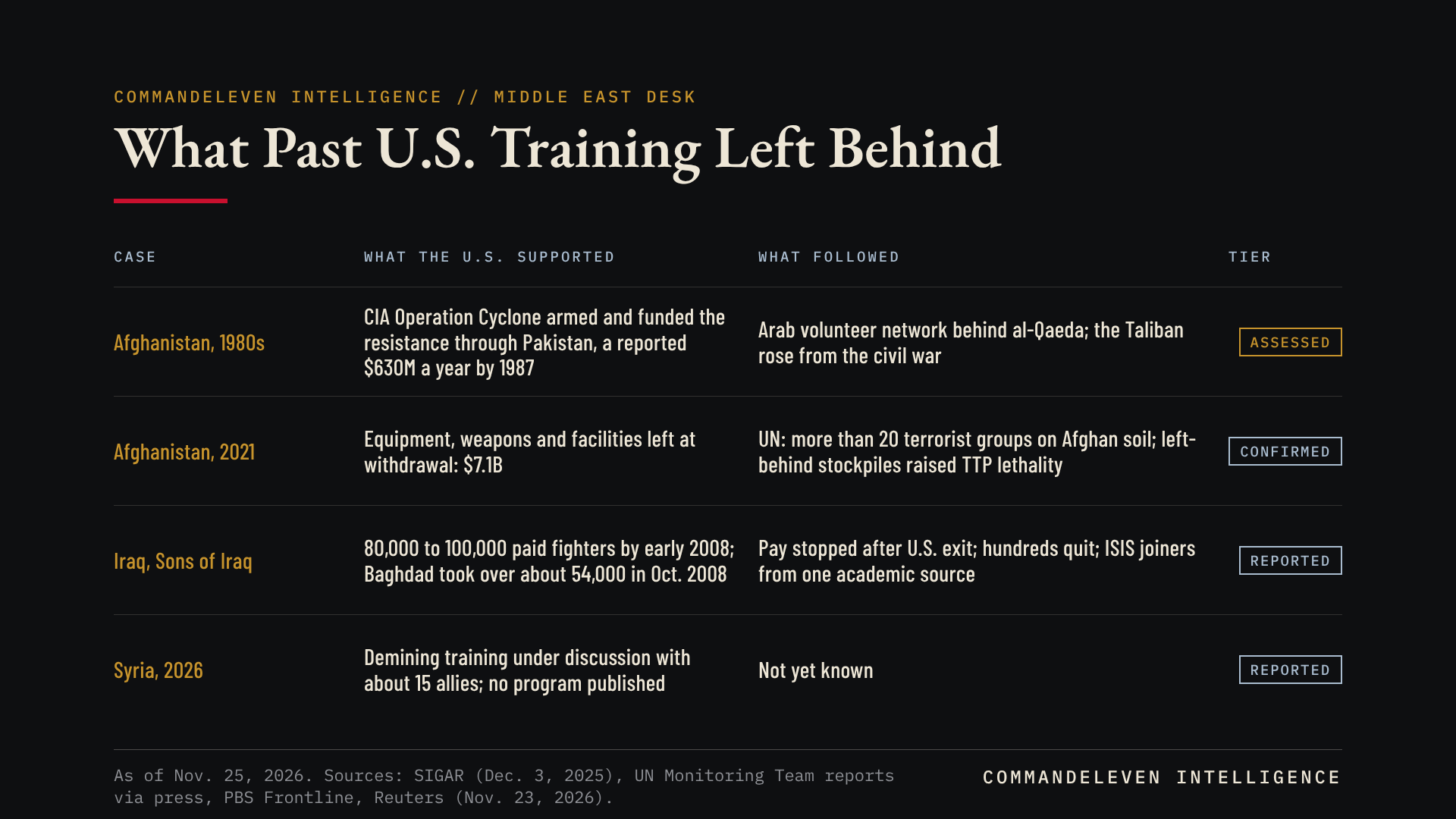
The CIA’s Operation Cyclone, begun in 1979 and run largely through Pakistan’s ISI, armed and financed Afghan resistance groups against the Soviet invasion. Funding grew from about $20 million to $30 million a year in 1980 to a reported $630 million a year by 1987, and it included Stinger missiles [CONFIRMED, per open-source histories]. Critics note that the money flowed disproportionately to the Islamist commanders Pakistan favored. Historians such as Steve Coll and Peter Bergen reject the claim that the CIA created Osama bin Laden, and we do not make it. The documented effect is different: the war built a trained, battle-hardened, transnational network of Islamist fighters, and the end of U.S. interest after 1989 left Afghanistan to civil war. Al-Qaeda emerged from the Arab volunteer network around that war, and the Taliban rose from the civil war that followed [ASSESSED]. Our Running to Disaster series covers the Zia-era politics and the covert alliance in more detail.
Lesson 2: The 2021 Withdrawal and What Was Left
The final report of the Special Inspector General for Afghanistan Reconstruction, issued in December 2025, says the Defense Department determined the U.S. left behind about $7.1 billion in equipment it had given the Afghan forces when it completed the withdrawal in August 2021. SIGAR concluded that U.S. taxpayer-funded equipment, weapons and facilities now form the core of the Taliban’s security apparatus. Its officials also cited more than $24 billion in U.S.-built military infrastructure that can be assumed to be under Taliban control [CONFIRMED]. Dawn, relaying the report, says the U.S. bought more than 427,000 weapons, 96,000 vehicles and at least 162 aircraft for the Afghan forces over the war.
The UN Monitoring Team’s reports document what the Taliban’s territory now hosts. Its sixteenth report called the Taliban’s denial that terrorist groups operate from Afghan soil “not credible,” and Amu TV, summarizing a Monitoring Team report, says more than 20 international and regional terrorist organizations remain active there. The 37th report, covering July to December 2025, says the authorities provide a permissive environment for several groups, notably the TTP, and that stockpiles left behind by the U.S.-led coalition have increased the lethality of TTP attacks. A 2026 UN report, per Express Tribune, said BLA militants received instruction and combat training from al-Qaeda trainers in Afghanistan and had access to NATO and U.S.-origin stockpiles [CONFIRMED, per press accounts of the reports]. CommandEleven Intelligence’s ground sources put the number of groups using Afghan territory for training and shelter at about 25. No public report supports that exact figure, and the UN wording is “more than 20” [REPORTED BY COMMANDELEVEN SOURCES, NOT PUBLICLY CORROBORATED].
Lesson 3: The Sons of Iraq
The Sahwa, or Awakening, began in Anbar in 2005 when Sunni tribes turned on al-Qaeda in Iraq. U.S. forces paid and armed them as the Sons of Iraq, and by early 2008 estimates put them at 80,000 to 100,000 fighters. They are widely credited with cutting violence. In October 2008 Baghdad took over paying about 54,000 of them, and a British government case study says U.S. influence faded after the 2008 withdrawal agreement set a departure date [CONFIRMED]. PBS Frontline reports that Prime Minister Nouri al-Maliki, who was never comfortable with them, eventually stopped paying them once the Americans left. By 2014 an Associated Press report quoted a Sahwa veteran saying that hundreds had quit and either stayed home or joined insurgent groups, and a Russian academic study says thousands joined ISIS [REPORTED, single academic source for the larger figure]. The lesson is not that the program failed on the ground. It worked until the political deal behind it collapsed, and then the trained and armed men were left without a state to belong to [ASSESSED].
What to Expect from U.S. Training of the Syrian Army
These are our assessments, built from the three cases and the Syria facts above.
- Demining is the right first step and a thin one. It builds contact, access and vetting data with few troops. Ordnance-disposal expertise is dual-use, so who is trained matters more than what is taught. ASSESSED.
- Vetting will set the pace. The leadership has HTS and Nusra roots and the force includes the 84th Division, so a clean unit list is hard to build. Expect narrow unit selection, and arguments over whether foreign-fighter units are excluded. ASSESSED.
- The Iraq risk is political, not technical. The Sahwa failed when Baghdad stopped paying and integrating. A Syrian state that cannot pay or discipline its fragmented factions would create the same exposure. ASSESSED.
- The Afghanistan risk is leakage and lock-in. If U.S. support ends abruptly or the political arrangement breaks, equipment and skills move with the men who hold them. Training without a post-program plan repeats that. ASSESSED.
- The upside is real. A U.S.-led, multinational frame with about 15 allies spreads accountability. Washington says Damascus is a partner against Islamic State, and ISIS has publicly urged HTS fighters to defect from Sharaa, so the government has its own reasons to fight it. ASSESSED.
- Watch for mission creep. The Syrian source’s mention of border-security help is the signal. A move from demining to border security or counter-ISIS units would carry the risks above at higher stakes. ASSESSED.
What To Watch
- An on-record statement from CENTCOM, the State Department or the Syrian Defense Ministry confirming a program, its funding source or a start date.
- Any public description of how Leahy vetting would apply to Syrian units.
- Whether the 84th Division, or any unit of foreign fighters, is named as a participant or excluded.
- Any widening of the mission from demining to border security or counter-ISIS work.
Calls We Will Score
- By Sunday, January 31, 2027: A U.S. or Syrian government body publicly acknowledges a planned U.S.-supported training program with Syrian forces. ASSESSED.
- By Wednesday, March 31, 2027: No training session with U.S. military personnel has publicly begun inside Syria or Jordan for Syrian troops. ASSESSED.
- By Wednesday, June 30, 2027: The U.S. government publicly describes a Leahy vetting process or exemption for Syrian recipients. ASSESSED.
- By Wednesday, June 30, 2027: No official account of the program names the 84th Division or another unit of foreign fighters as a participant. ASSESSED.
What This Assessment Does and Does Not Establish
It establishes what one wire report says, what two U.S. spokespeople said in response, and the documented backgrounds of Syria’s leaders. It does not establish that a program is approved, funded or scheduled, or which Syrian units, allied countries or curriculum are involved. It does not establish how many former jihadists serve in the army, since no public count exists. It does not predict that Syria will repeat Afghanistan or Iraq. It argues that the same conditions, a politically fragile recipient and a thin exit plan, produced those outcomes. The Independent, The National and Modern Diplomacy carried the same Reuters account. We found no independent confirmation and no official readout as of Nov. 25, 2026, and we read the Reuters text through the source file supplied to us. We read the SIGAR and UN findings through press coverage of them, and we cite them as reported.
Frequently Asked Questions
Is the U.S. sending troops back to Syria?
Not confirmed. Reuters says a small number could return as soon as next year if the plan advances. No official has announced it.
Why demining?
Four sources told Reuters it would be the initial focus and a possible model for wider cooperation. Our view that it is the easiest entry point is an assessment.
Is Syria’s president still al-Qaeda?
He led al-Qaeda’s Syrian branch until 2016. The U.S. removed HTS from its terrorist list in July 2025, and the UN removed him from its sanctions list in November 2025.
What is the Leahy Law problem?
The law blocks U.S. help to units with credible gross human rights violations on record. Vetting must come before funding.
Related CommandEleven Intelligence Reading
- Syria and the Makkah Pact: What Is Confirmed, What Is Claimed and Why the Troop Numbers Disagree – Part 7, the separate question of Syrian personnel in Saudi Arabia
- “A Fighter, Not a Killer”: Al-Sharaa’s Iraq Story Against His Own Record, the president’s account of the Iraq years tested
- ISIS Issues a Warning to HTS to Leave the Tyrant Jolani, the rival jihadist challenge to HTS
- Running to Disaster: Al-Zulfiqar and the Covert War – Part 7, the U.S.-Pakistan covert alliance in Afghanistan
- Evolving Profile of TTP: Transnational Safe Havens & Border Operations – Part 9, how the TTP rebuilt from Afghan safe havens
- Ajnad Beit al-Maqdis: A New al-Qaeda Banner in Syria and Iraq, and What Is Not Established, jihadist activity in Syria and Iraq
Sources
- Reuters, US discussing military training for Syrian forces (Feras Dalatey, November 23, 2026)
- The National, US ‘discussing military training for Syrian forces’ (November 23, 2026)
- Modern Diplomacy, US Weighs Military Training for Syrian Forces Amid Shifting Security Priorities
- Britannica, Ahmed al-Sharaa
- CNN, Ahmed al-Sharaa Fast Facts
- Al Jazeera, UNSC votes to drop sanctions on Syria’s al-Sharaa ahead of Washington visit (November 6, 2025)
- Jewish Virtual Library, Abu Mohammad al-Jolani
- Newsweek, Who is Syria’s Ahmed al-Sharaa?
- The National, Who are the key ministers in Syria’s new transitional government (March 30, 2025)
- Rudaw, Syria’s new cabinet: the sovereign portfolios
- AFP via Al-Monitor, Syria authorities name HTS military chief as transitional defence minister (December 2024)
- The National, Syria’s president appoints new intelligence chief (July 15, 2026)
- FDD’s Long War Journal, Profiles of foreign commanders in the new Syrian army (February 2025)
- EU Agency for Asylum, Syria Country Focus: Integration of armed groups
- The New Arab, US backs Syrian plan to integrate foreign fighters into army
- AFP via Dawn, Syria’s Sharaa taps foreign fighters for army posts (December 2024)
- Reuters via Yahoo, US gives nod to Syria to bring foreign jihadist ex-rebels into army (June 2025)
- IDSA, Challenges of Integrating Foreign Fighters in Syria
- Operation Cyclone, open-source history
- SIGAR, Final Report: Forensic Audit, Seventeen Years of Reconstruction Oversight (December 3, 2025)
- Defense One, The $148 billion failure: Watchdog’s final report
- The Washington Times, US wasted billions trying to fix Afghanistan, says acting inspector (December 3, 2025)
- Dawn, Equipment, weapons left behind by US in Afghanistan now form core of Taliban’s security apparatus (December 7, 2025)
- Dawn, Kabul’s claim of denying militants safe haven called into question (UN Monitoring Team sixteenth report)
- Amu TV, UN report says Taliban absorbed former fighters from terrorist groups into security ranks
- Arab News, UN report says Pakistani Taliban getting Afghan support (37th Monitoring Team report, February 2026)
- Express Tribune, UN report flags BLA’s tactical collaboration with Afghan-based groups (August 2026)
- EBSCO Research Starters, Awakening Councils
- PBS Frontline, The Iraq War’s key players: where are they now
- Associated Press via KSL, In Iraq, former militia program eyed for new fight
- UK Government, Iraq case study on the Awakening
- MGIMO Vestnik, academic study of the Iraqi Awakening and ISIL