
Bottom Line Up Front
In an interview with Iraq’s Dijlah TV that aired on Tuesday, October 27, Syrian President Ahmed al-Sharaa said he went to Iraq in 2003 “alone, without any organizational affiliations,” to fight the American occupation, and that he has “never attacked a civilian or an unarmed person” in his life. “There is a very big difference between a fighter and a killer,” he said.
The first claim is true only at the start of the story, and it contradicts what al-Sharaa himself said in February 2025. The second cannot be tested for his own hands, but it does not survive the record of the organization he founded and led. The interview was timed for an Iraqi audience, ahead of Prime Minister Ali al-Zaidi’s visit to Damascus, and it is best read as a reintroduction, not a confession.
What He Said
The interview’s headline news was about detainees, not history. Al-Sharaa said the handover of Islamic State suspects to Iraq “took place at a sensitive time” and that about 3,000 of them are Syrians, some with no link to the group. Iraq’s judicial council and Syria’s justice ministry have agreed a program to sort the detainees into categories and decide which can come home. Iraq’s justice ministry said in February that more than 5,000 detainees had been transferred from Syria; the US military put the figure at over 5,700. A Syrian share of about 3,000 is plausible. [ASSESSED]
Then he turned to his own past. In the subtitled clip now circulating, he says:
- He went to Iraq in 2003 out of “solidarity,” to “confront the American occupier,” and went “before the Americans entered” to wait for them.
- He went “alone, without any organizational affiliations.”
- He has “never attacked a civilian or an unarmed person,” has “principles” in combat that he passed to those who worked with him, and draws a line between “a fighter and a killer.”
According to a regional report of the same interview, he also said he was imprisoned around 2005 and took no part in Iraq’s sectarian war.
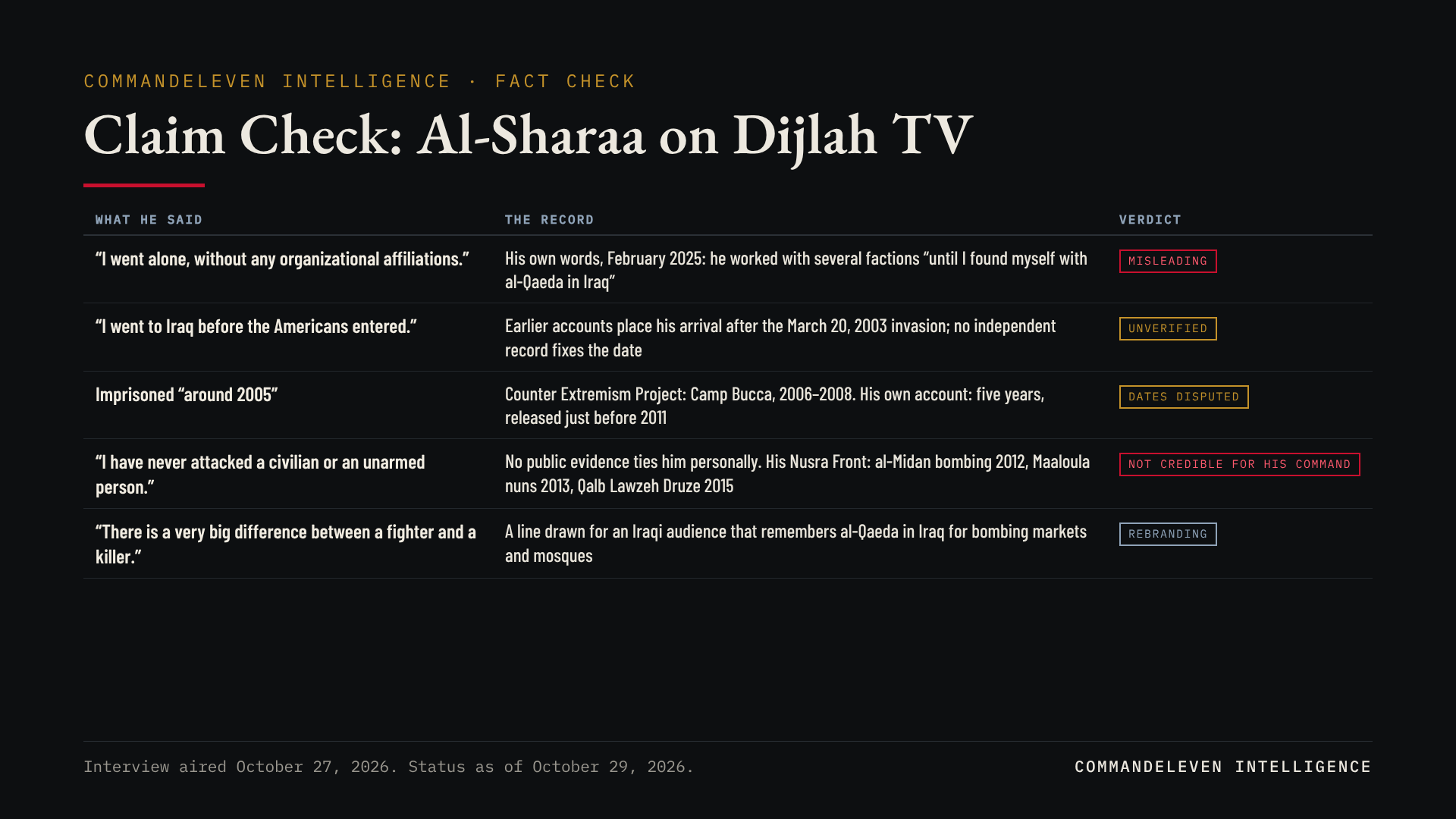
Claim by Claim
| Claim | What the record shows | Verdict |
|---|---|---|
| “I had no organizational affiliations” | In a February 2025 podcast, al-Sharaa said he worked with several factions in Iraq “until I found myself with al-Qaeda in Iraq,” the group led by Abu Musab al-Zarqawi. The US Treasury designated him a terrorist in May 2013. | Misleading. Possibly true of the day he crossed the border. False as a description of his time in Iraq, by his own earlier account. |
| “I went before the Americans entered” | The US-led invasion began on March 20, 2003. Earlier accounts place his arrival after the invasion. No independent record fixes the date. | Unverified, and inconsistent with earlier accounts. |
| Imprisoned “around 2005” | Accounts differ: the Counter Extremism Project lists 2006 to 2008 at the US-run Camp Bucca; al-Sharaa has said he spent five years in Abu Ghraib, Bucca, Kober and Taji and was released just before Syria’s uprising in 2011. | The detention is not in dispute. The dates are. |
| “I have never attacked a civilian or an unarmed person” | No public evidence ties him personally to an attack on civilians, and the claim cannot be tested. But in 2011 the leader of the Islamic State of Iraq, Abu Bakr al-Baghdadi, sent him to Syria to build what became the Nusra Front, which he led. Nusra claimed the January 6, 2012 bombing in Damascus’s al-Midan district, which killed 26 people, including civilians. In 2013 it abducted 13 nuns from the monastery at Maaloula. In June 2015 its fighters killed about 20 Druze villagers at Qalb Lawzeh; Nusra said they had “acted in violation of orders.” | Unprovable for himself. Not credible for his command. |
A note of fairness. Al-Sharaa did break with the Islamic State in 2013 and has fought it since, and the Druze killings at Qalb Lawzeh were followed by a public promise of punishment. The record shows a commander who set limits and sometimes enforced them, not one whose organization never harmed civilians. [ASSESSED]
Why He Said It, and Why Now
The audience was Iraqi, and the timing was deliberate. The interview aired just before Prime Minister al-Zaidi’s visit to Damascus, at a moment when Syria wants Iraqi oil routed through Baniyas, Iraqi investment in Syrian industry and Iraqi cooperation on the detainees. Many Iraqis remember al-Qaeda in Iraq as the organization that bombed their markets and mosques. Framing 2003 as a lone act of Arab solidarity against an occupier, and drawing a line between “a fighter and a killer,” is an attempt to separate al-Sharaa from that memory. [ASSESSED]
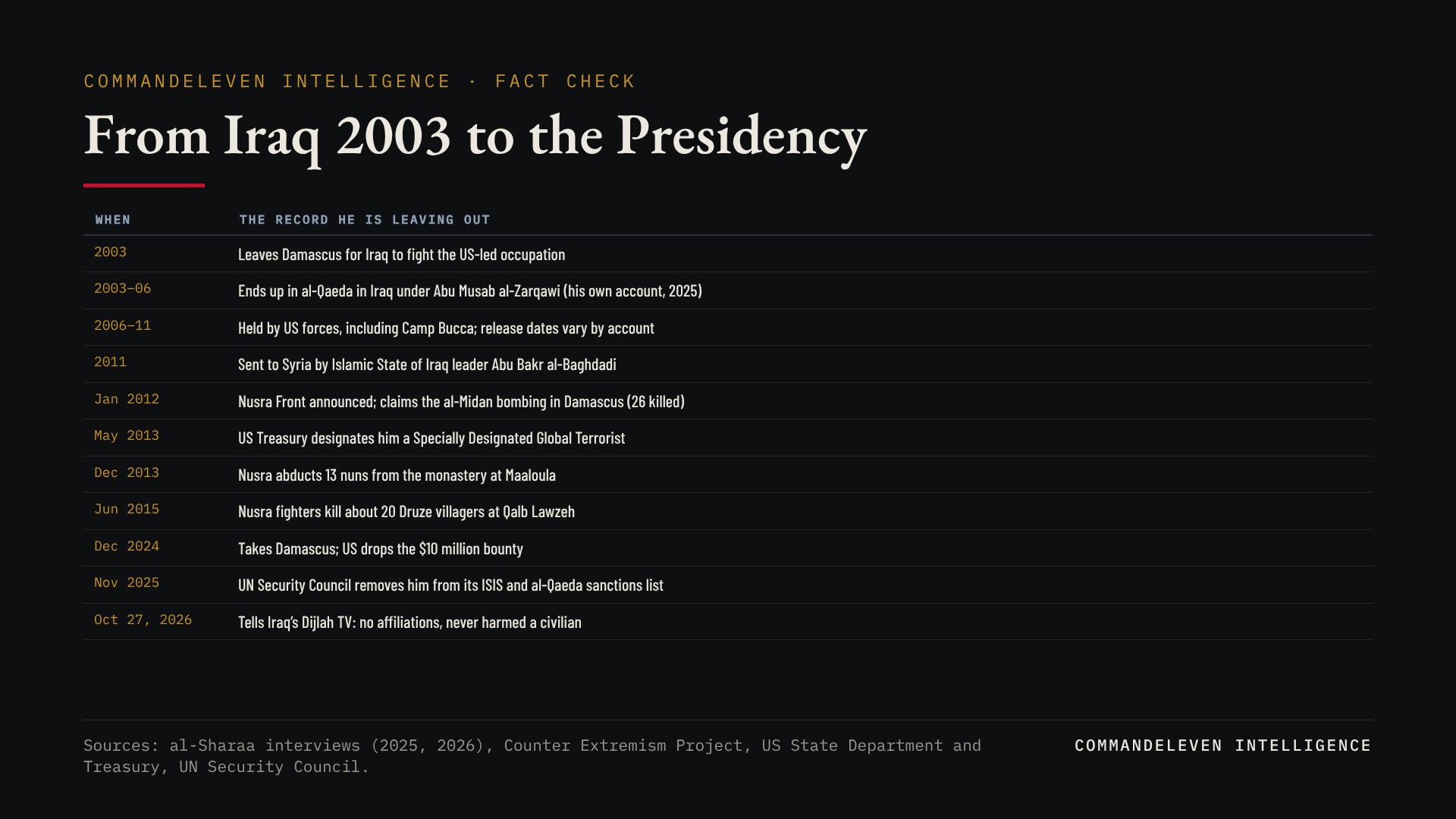
It also fits a pattern. Since taking Damascus in December 2024, al-Sharaa has steadily rewritten his biography for each audience: the reformed jihadist for Western capitals, the statesman for the Gulf, and now the anti-occupation volunteer for Baghdad. His international rehabilitation is already well advanced: Washington lifted the $10 million bounty on him in December 2024, and the UN Security Council removed him from its Islamic State and al-Qaeda sanctions list in November 2025. What he says about his past now costs him little abroad. He is not hiding a secret past. He is asking Iraqis to forget a public one. [ASSESSED]
What to Watch
- Iraqi reaction. Whether pro-Iran Iraqi factions, which objected to al-Sharaa visiting Iraq in 2025, use the interview against Prime Minister al-Zaidi’s Syria policy.
- The detainee program. Whether the first Syrian detainees actually return from Iraq, and on what terms.
- A fuller account. Whether al-Sharaa, or Syria’s state media, issues a full version of the interview that adds to or walks back the clip.
What This Assessment Does Not Claim
- It does not claim al-Sharaa personally killed or harmed civilians. No public evidence shows that.
- It does not claim every attack attributed to the Nusra Front was ordered by him.
- It relies on a subtitled clip and regional reports of the interview; it has not reviewed the full broadcast.
Sources
- Sharaa: Syria and Iraq Face Historic Opportunity for Partnership, Levant24
- Al-Sharaa reveals details of his experience in Iraq and calls for weapons to be limited to the state (Arabic), Mawteni 48, October 28, 2026
- Syrian President Al-Sharaa Admits Joining al-Qaeda in Iraq to Gain Experience and “Defend” the People, Channel 8, February 11, 2025
- Abu Muhammad al-Golani, Counter Extremism Project
- Country Reports on Terrorism 2017: Al-Nusrah Front, US Department of State via ecoi.net
- January 2012 al-Midan bombing, Wikipedia
- Syria’s al-Qaeda affiliate says it regrets killing of Druze, Times of Israel, June 13, 2015
- More than 5,000 ISIL detainees transferred from Syria, says Iraqi ministry, Al Jazeera, February 13, 2026
- US says over 5,700 suspected ISIL detainees relocated from Syria to Iraq, Al Jazeera, February 15, 2026
- UNSC votes to drop sanctions on Syria’s al-Sharaa ahead of Washington visit, Al Jazeera, November 6, 2025
- Pro-Iranian Iraqi politicians, militia leaders object to Syrian president visiting Iraq, FDD’s Long War Journal, April 28, 2025
- Al-Sharaa interview clip, Clash Report on X
