CommandEleven Intelligence Desk // AI and Cyber Desk, status as of November 24, 2026. This assessment contains no exploit, indicator or targeting detail. It works from vendor and government reports; where we could read only press coverage of a report, we say so.
Bottom Line Up Front
Amazon, Google, Palo Alto Networks’ Unit 42, Gambit Security, Microsoft and the FBI have each documented AI agent hacking frameworks in live intrusions between July and November 2026. Two names recur: ARTEX and Cairn. Both are open-source, both take a goal stated in plain language, and both use AI agents to run reconnaissance, exploitation and follow-on steps with little human steering. Both have been used by state-linked actors and by financially motivated criminals. That is documented, and it is the part of the story we stand behind. Criminal use of Cairn was documented as early as September 22, well before the cluster of vendor reports in mid-November.
The best-documented single case is Amazon’s. Cairn agents were given only a list of IP addresses and the goal “obtain shell access.” After a long run of failed attempts, they found and exploited a previously unknown flaw in an open-source medical imaging application and took over a university server. What the public record does not show is how much of all cyber activity these two tools account for. No vendor measures that, and each sees only its own telemetry. We therefore do not say that most recent attacks trace back to ARTEX or Cairn. Our own review of cyberattacks from November 1 to 17 attributes none of its incidents to either tool, and we found no vendor or agency that does.
Key Judgments
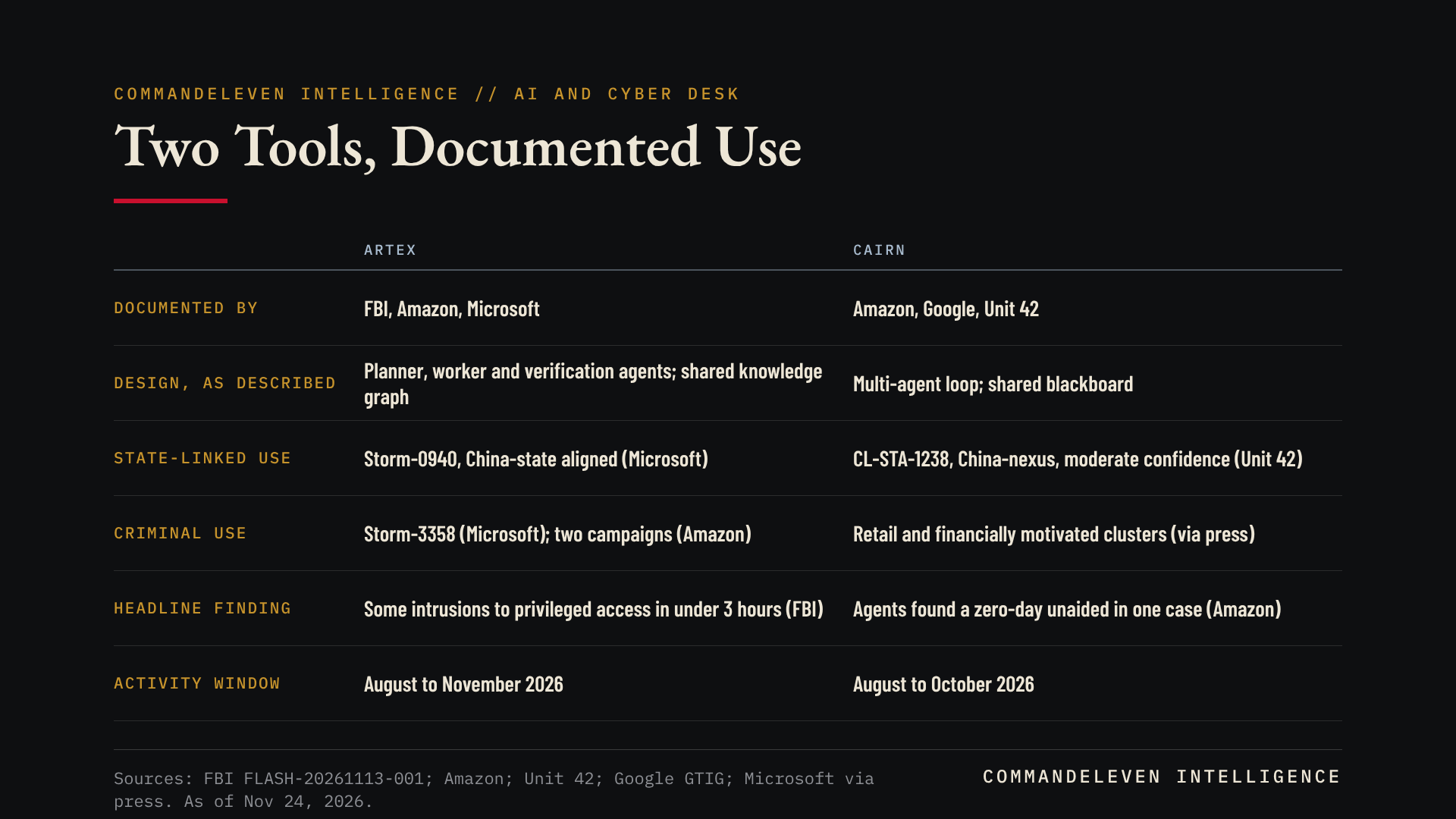
- CONFIRMED (by vendors): ARTEX and Cairn have each been observed in real intrusions by more than one independent organization. For ARTEX: the FBI, Amazon and Microsoft. For Cairn: Amazon, Google’s Threat Intelligence Group, Unit 42 and Gambit Security.
- CONFIRMED (by vendors): Use spans state-linked and criminal actors. Microsoft attributes an ARTEX supply-chain campaign to Storm-0940, a China-state aligned group, and a separate financially motivated cluster, Storm-3358, to ARTEX use. Unit 42 assesses with moderate confidence that a Cairn campaign was China-nexus intelligence collection. Gambit Security documents a financially motivated operator running Cairn against online retailers, and press coverage of NorForge findings describes further criminal clusters.
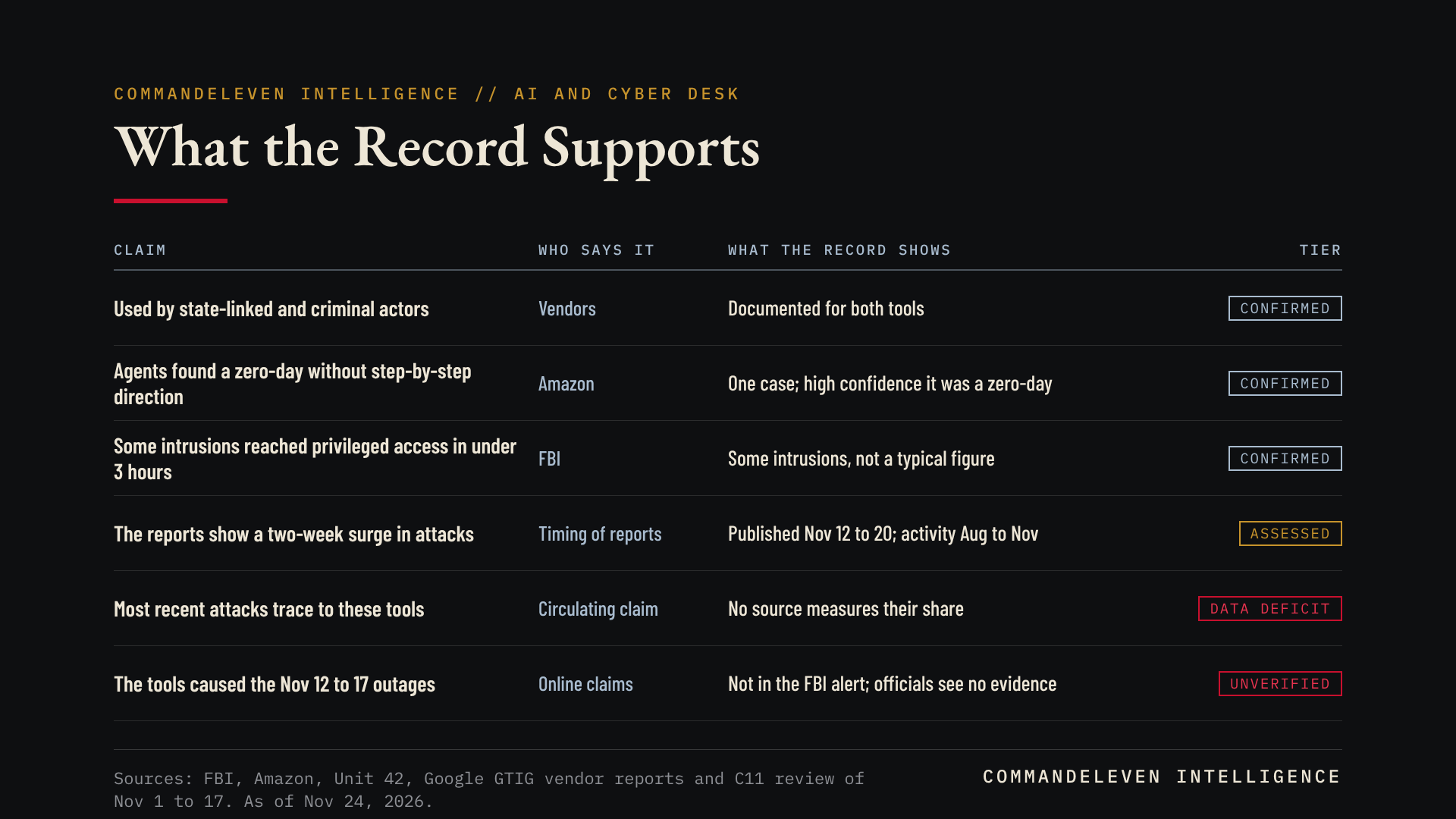
- CONFIRMED (by Amazon, one case): Cairn agents, given only target IP addresses and a goal, discovered and exploited an unpatched flaw that had no public advisory. Amazon says it assesses with high confidence that the flaw was a zero-day. The human operator later stepped in to direct the agents into a second university network, and Amazon infers the same flaw had been used to get that foothold.
- ASSESSED: These tools change speed and scale, not the kind of attack. Unit 42 says the weaknesses its campaign exploited were already known, and Amazon says none of the techniques it saw were new. What the agents add is persistence and tempo, and the ability to work many targets at once.
- ASSESSED: ARTEX and Cairn are similar in purpose and different in design. Amazon describes ARTEX agents with separate planner, worker and verification roles sharing a knowledge graph. Google describes Cairn as a multi-agent framework built around an observe, orient, decide, act loop with a shared blackboard. No public source compares them head to head, so we do not rank them.
- DATA DEFICIT: The share of recent attacks that involve either tool is unknown. The reports describe campaigns from July to October, and most were published between November 12 and 20, so the recent cluster of reporting reflects when vendors published, not necessarily when attacks happened.
- ASSESSED: Neither tool is connected, on current public evidence, to the November 12 to 17 outages or to the major incidents in our November 1 to 17 review.
The Two Tools
ARTEX. The FBI’s November 13 alert (FLASH-20261113-001) describes ARTEX as an open-source framework that directs large language model agents through the stages of a penetration test. The FBI says malicious actors have used it since at least August 2026, that some intrusions went from first targeting to privileged access in under three hours, and that over 1,600 ARTEX consoles were publicly exposed in early November. The original repository was removed on October 8, but forks and a commercial variant remain. We covered the alert in ARTEX: What the FBI Alert Says About AI-Run Intrusions. On the same day, Amazon published telemetry from decoy sensors that recorded ARTEX agents’ own records of two criminal campaigns between October 3 and November 5, one aimed at stealing credentials from AI infrastructure and one at bypassing identity checks at two cryptocurrency exchanges. Amazon assesses with moderate confidence that the groups were disparate China-nexus actors, and says it could not verify the agents’ reported outcomes.
Cairn. Cairn is an open-source multi-agent framework. Amazon says it was built as a research and problem-solving engine for defenders: given a starting point and an objective in plain language, it coordinates multiple AI agents to find a path to that goal. Google’s Threat Intelligence Group, which has seen it in real activity, describes agents that cooperate through a shared blackboard. Google also reports Cairn used in intrusion activity against US aerospace targets and gives no further detail. One naming note: Cairn is unrelated to Cisco Talos’s CAIRN malware-hunting framework, which has a similar name.
Google names two further frameworks, PentAGI and CyberStrikeAI, as seen in the wild or in experimentation, and HexStrike AI as seen in experimentation. The pattern is a category of tools, not two products. Google also notes that these frameworks “trade stealth for velocity”: unrestricted autonomous execution generates forensic traffic and leaves recognizable traces, which gives defenders something to detect.
The Best-Documented Case: Amazon and the Cairn Zero-Day
On September 10, Amazon Threat Intelligence found a Cairn server that the operator had left publicly reachable with no authentication, exposing the project configurations, the operator’s prompts and the agents’ output. The prompts were in Simplified Chinese and script timestamps were set to China Standard Time. Amazon assesses with moderate confidence that the actor is China-nexus, based on those artifacts and on the targeting of universities it describes as likely of strategic interest to China. The campaign ran for about 48 hours from September 8 against universities in East Asia outside mainland China. Amazon did not name them. They were not AWS customers, so Amazon worked with a government partner to notify them.
The operator supplied target IP addresses and variations of a one-line goal. The agents then planned and adjusted on their own. For most of the campaign, they failed. One run of 148 actions over about 16 hours against a database server got nowhere. A known-vulnerability attempt failed. More than 30,000 credential combinations tried against about 80 real usernames failed. The success came against a server running an open-source medical imaging AI application, where the agents found a previously unknown flaw. By Amazon’s account, they went from mapping the application to writing files on the server in about 11 minutes, and in a later session turned that into full control of the machine. Amazon says the flaw had no fix, issue, advisory or prior mention in vulnerability databases, and that it assesses with high confidence that it was a zero-day. Amazon notified the project’s maintainers, who released a fix and a GitHub Security Advisory. Amazon’s post does not name the application or give a CVE number.
Two points keep this in proportion. First, the agents succeeded on a small fraction of what they tried, but they ran without breaks and at machine pace, which is the point. Second, the operator still made decisions. Once the flaw was proven, the operator gave the agents a tunnel into a second university network running the same software, and Amazon infers the operator had used the same flaw to compromise that server. Amazon’s post, written by CJ Moses, says an agent that finds and exploits a zero-day in minutes finishes faster than many security operations centers can triage an alert.
The Criminal Side: Gambit Security’s Retailer Campaign
Gambit Security’s interim report, published September 22, is the earliest detailed account of Cairn in criminal hands, and Amazon itself credits Gambit as one of the first to document Cairn use by a threat group. Gambit recovered the operator’s staging server and reconstructed a campaign against online retailers that it dates to July 2026. The operator ran three open-source AI harnesses: Strix for vulnerability search, Cairn for end-to-end exploitation, and Hermes to orchestrate the campaign. By Gambit’s count the human typed 1,951 short prompts across 260 sessions, only a few per target. Between September 10 and 15 alone, 105 attack projects were launched and at least 27 companies were compromised to varying degrees. Gambit accounts for more than 600,000 unexpired card records from two companies, and for card-stealing scripts planted on the sites of at least five. Its detailed findings confirm such scripts in place on 19 of 27 targeted victims, and a researcher it names found more than 100 further infected sites. It reports that where access was achieved it usually took under a day, often a few hours.
On cost, Gambit records about $7,000 of model spend in the first four weeks and estimates the full run at $12,000 to $18,000. The operator’s own review averaged about $25 per target, from about $3 for the cheapest to about $79 for the most expensive. On models, Gambit reports that the orchestrating console used Anthropic’s Opus 4.6 after newer models refused its requests, while the Strix and Cairn runs used GLM and DeepSeek models through OpenRouter.
Two further details matter beyond the numbers. First, Gambit found that destruction came as a side effect: the operator’s own playbook told the agent to wipe data after extraction, and in one case an agent’s cleanup dropped 180 database tables, including the victim’s own backups. Second, Gambit cautions that some of what it relies on is the agents’ own logs, which it checked against direct evidence and found largely accurate, and it says the real size of the campaign is probably larger than reported. It is an interim report, and we cite it as one.
Who Else Has Documented Use
| Source and date | What it reports | Actor type and confidence |
|---|---|---|
| FBI FLASH-20261113-001, Nov 13 | ARTEX misuse since at least August 2026; privileged access in under three hours in some cases; 1,600+ exposed consoles | Actors not named |
| Amazon Threat Intelligence, Nov 13 | ARTEX agent records from decoy sensors, Oct 3 to Nov 5: two campaigns, hundreds of targets | Disparate China-nexus groups, financially motivated, moderate confidence |
| Microsoft, via press (Oct 21 and Nov 6) | ARTEX used in a ConnectWise supply-chain campaign (Storm-0940) and by Storm-3358 against financial organizations | China-state aligned (Storm-0940); Cambodia-based, financially motivated (Storm-3358) |
| Unit 42, Nov 12 | Cairn: 25 operations against at least 19 organizations in August and September, access confirmed at 10, across semiconductor, defense and civil society targets | CL-STA-1238, China-nexus intelligence collection, moderate confidence |
| Google GTIG, Nov 16 | CAIRN and PentAGI seen in the wild; CAIRN against US aerospace; ARTEX named as highly publicized; first observed full automation of vulnerability discovery and exploitation without a human in the loop | Mixed; Google does not attribute the aerospace case |
| Gambit Security, Sept 22 (interim report) | An operator ran three open-source AI harnesses, including Cairn, against online retailers: at least 27 companies compromised, 600,000+ card records from two, activity since July and still running when published | Financially motivated; Gambit says the true scale is likely larger |
| Amazon Threat Intelligence, Nov 20 | Cairn agents find and exploit a zero-day at an East Asian university during a campaign that began Sept 8 | China-nexus, moderate confidence; high confidence the flaw was a zero-day |
| NorForge, via Help Net Security (Nov 23) | More than 20 exposed Cairn panels tied to three financially motivated clusters | Financially motivated; we have not read the original |
What Is Not Established
Three claims circulate that the record does not support, and we are not adopting them.
- That most recent cyberattacks trace to ARTEX or Cairn. Vendors describe campaigns they observed, not the whole field. Amazon says its ARTEX view is limited to its own decoy telemetry and that it could not confirm activity against other organizations. In our November 1 to 17 review, the major incidents (the Optimizely script injection, the Crédit Mutuel Arkéa theft, the Poland platform shutdown, the Expedia breach, the SCKit worm) are not attributed by their reporters or victims to either tool. Absence of attribution is not proof of absence, which is why we hold this at DATA DEFICIT and not at “no.”
- That the tools caused the November 12 to 17 outages. The FBI alert does not mention outages, and officials who addressed the question said they saw no evidence of a cyberattack. Companies gave other causes. We set this out in our ARTEX dossier.
- That the timing of the reports shows a two-week surge in attacks. Gambit dates its retailer campaign to July and published on September 22. Unit 42 describes activity in August and September, Amazon’s Cairn case began on September 8, and Amazon’s ARTEX telemetry runs from October 3 to November 5. Most of the reports were published between November 12 and 20. That is a surge in disclosure.
Why It Still Matters
Strip away the overstatement and the reports still describe a real shift. Google says it has, for the first time, identified actors using these frameworks to fully automate vulnerability discovery and exploitation without a human in the loop. Unit 42 argues that autonomous orchestration removes the old limit on how many targets one operator can work, and it describes the campaign it tracked as likely a single operator or small team. Its operations ran from about 20 minutes to more than 50 hours. A patch window set for a human attacker working one target at a time is the wrong yardstick for a tool that works many targets at once and does not tire. Amazon’s advice follows from that: prioritize high-confidence detections that trigger automated response, with humans overseeing outcomes instead of reviewing every action.
The defensive points are consistent across vendors and are not exotic: identity hygiene, a smaller internet-facing attack surface, patching, and least-privilege access for human, machine and AI identities. Gambit adds a resilience point worth keeping: plan for data loss to arrive as a side effect of an attacker’s own cleanup routine, and know which systems make up the minimum viable business and how fast they can return. Google’s observation that the tools are noisy is the useful counterweight. Fast and loud is detectable. For where this fits in our series on AI-enabled attack planning, see AI Attack Planning: What the GAO Test Proved.
What We Do Not Know
- The share of all intrusions in 2026 that involve any agentic framework. No vendor has published one, and victims rarely disclose how they were breached, so the public record skews toward what vendors happen to observe. Gambit itself says its campaign is probably larger than it could document.
- Whether the Cairn and ARTEX operators overlap. The reports describe different actors and do not link them.
- Who ran the aerospace intrusion Google mentions, and when.
- The name of the medical imaging application Amazon’s agents compromised, the CVE identifier if any, and how many installations were exposed. Amazon’s post names none of them.
- Whether state actors use these tools for operations the vendors have not seen, such as stealth-focused campaigns. Google notes that stealth-focused actors are less likely to use noisy tooling.
What To Watch
- Vendor half-year or annual reports that put a number on the share of intrusions involving agentic frameworks.
- Government advisories that name Cairn, as the FBI named ARTEX.
- A second public case of an agent framework finding and exploiting an unknown flaw without step-by-step human steering.
- Model providers’ reports on blocked accounts tied to offensive frameworks, since several of these tools call commercial AI models.
- Whether exposed ARTEX consoles and exposed Cairn servers decline or multiply through forks.
Calls We Will Score
- By January 31, 2027: At least one organization other than Amazon, Google, Unit 42, Gambit Security, NorForge, Microsoft and the FBI publishes a report naming Cairn use in a real intrusion. ASSESSED.
- By March 31, 2027: A second publicly documented case, from a different reporting organization, in which an AI agent framework is reported to have found and exploited a previously unknown vulnerability without step-by-step human direction. ASSESSED.
- By June 30, 2027: At least one major vendor or government agency publishes a figure for the share of the intrusions it investigated that involved an agentic framework. If none does, the call is a miss and the data deficit stands. ASSESSED.
What This Assessment Does and Does Not Establish
It establishes what the named vendors and the FBI have reported about ARTEX and Cairn, and which of those reports describe state-linked and which criminal use. It does not establish how widespread either tool is, who is behind any campaign beyond what the vendors attribute (which are assessments, not legal findings), or any link to the November 2026 outages. We read the Unit 42 and Google reports, both Amazon posts and Gambit’s interim report directly. We read the Microsoft and NorForge findings through press coverage and cite them as reported. We did not reproduce any indicators, and none of this describes how to run or defend against a specific intrusion.
Frequently Asked Questions
What are Cairn and ARTEX?
Open-source frameworks that direct AI agents through the stages of a penetration test, from reconnaissance to exploitation, starting from a goal stated in plain language. They are built for security testing, and attackers have adopted them.
Who is using them?
State-linked and criminal actors, per vendor reports. Microsoft and Unit 42 describe China-aligned or China-nexus state activity. Amazon, Gambit and others describe financially motivated groups. The FBI does not name actors.
Did AI really find a zero-day on its own?
Amazon says Cairn agents found and exploited a flaw that had no public record, and assesses with high confidence that it was a zero-day. It is one documented case, and a human operator still set the goal and directed the next phase.
Are these tools behind the recent outages and attacks?
Not on public evidence. The FBI alert does not mention the outages, and our review of incidents from November 1 to 17 found no attribution to either tool. No source measures their share of all attacks.
What should organizations do?
The vendors converge on identity hygiene, a smaller internet-facing footprint, timely patching, least-privilege access, and monitoring for AI agent activity. Read the vendor and FBI reports for specifics.
Related CommandEleven Intelligence Reading
- ARTEX: What the FBI Alert Says About AI-Run Intrusions, and What the Outage Rumors Get Wrong, the FBI alert and the outage claim in detail
- AI Attack Planning: What the GAO Test Proved, the other side of AI and attack capability
- Cyberattacks, November 1 to 17, 2026: What Happened, What Is Rumor, and How to Protect Yourself, the incident record this assessment tests against
- FAA Ground Stop, Microsoft 365 and Workday Outages: What’s Documented and What Isn’t, the outages the tools are not linked to
- The Warnings Reassessed, our series on warnings, failures and the 2026 AI test
Sources
- Amazon Threat Intelligence (CJ Moses), Chinese-nexus actor’s Cairn AI agents found a zero-day on their own (AWS Security Blog, November 20, 2026)
- Gambit Security (Eyal Sela), Autonomous AI Agents are breaking into hundreds of Online Retailers for $25 a target in an ongoing campaign (interim report, September 22, 2026)
- Amazon Threat Intelligence observes threat actors running cybercrime campaigns with ARTEX AI agents (AWS Security Blog, November 13, 2026)
- Palo Alto Networks Unit 42, Cairn framework and AI-driven autonomous attacks, CL-STA-1238 (November 12, 2026)
- Google Threat Intelligence Group, GTIG AI Threat Tracker: Agentic Threat Activity Crosses a Significant Threshold (November 16, 2026)
- FBI, FLASH-20261113-001, Threat Overview of ARTEX Autonomous Penetration Testing Framework (TLP:CLEAR, November 13, 2026)
- Help Net Security, Open-source AI pentesting framework Cairn keeps turning up in real-world attacks (November 23, 2026), for the NorForge findings
- CyberScoop, Microsoft attributes ConnectWise supply-chain attack to China-linked Storm-0940 (reporting on Microsoft)