
CommandEleven Intelligence // Europe Desk. Rear-Area War series, status as of October 28, 2026. Criminal proceedings are active. Everything attributed to the prosecution is an allegation made in open court, and both defendants are presumed innocent.
Bottom Line Up Front
A month after five men were arrested beside RAF Fairford, the case has its first charges, and they are state-threat charges, not terrorism or explosives charges. On October 27, 2026, two London men aged 24 appeared at Westminster Magistrates’ Court charged under the National Security Act 2023:
- Mohmed Abdulkarim is charged with assisting a foreign intelligence service. Prosecutors say he acted as an “intermediary” for a handler known as “Ali,” bought equipment for the operation and received payments from Ali totaling about £70,000 (about $93,000).
- Nouman Essghir is charged with entering a prohibited place for a purpose prejudicial to the UK. Prosecutors say he filmed the perimeter of RAF Fairford at Ali’s request on August 22, about five weeks before the incident. He was one of the five men arrested on September 27.
Police believe Ali is abroad and was acting for the Iranian state. The court also heard that Ali is potentially connected to the April 2026 incident at Israel’s embassy in London, which was claimed by Harakat Ashab al-Yamin al-Islamiyya (HAYI), the Iran-linked front behind this year’s attack wave in Europe.
The prosecution’s account also settles the question this series has carried since September: what was in the vans. There were no explosives. The five drivers were allegedly told to park and walk away, then received a message that there was a bomb in the vehicles, and one of them called the police.
[ASSESSED] On the prosecution’s case, Fairford was a layered, state-run operation: a handler abroad, a well-paid intermediary in London, a reconnaissance run and a team of drivers who were not told the full plan. That is more structured and far better funded than the gig-tier tasking seen in the HAYI arsons, and it moves Fairford from a suspected to a charged case of Iranian state activity against a US-used base in Britain. Nothing has yet been tested at trial. Iran denies any role.
Key Judgments
KJ1: The charges confirm that UK prosecutors are treating Fairford as state activity, not terrorism. Both charges sit under the National Security Act 2023, and police say they believe Abdulkarim was assisting Iran. [CONFIRMED as charged; ALLEGED as to the facts]
KJ2: The operation, as alleged, had at least three layers. A handler abroad (Ali), a paid intermediary (Abdulkarim, about £70,000) and people on the ground who carried out reconnaissance (Essghir) and drove the vans (five men). [ALLEGED by the prosecution; ASSESSED as to structure]
KJ3: Fairford was not a bomb plot. No explosives or improvised devices were found. On the prosecution’s account, the “bomb” was a message sent to the drivers after they had parked. [CONFIRMED on the absence of explosives; ALLEGED on the message]
KJ4: The money points above the gig tier. £70,000 to one intermediary is orders of magnitude above the few hundred euros paid to recruits in the HAYI wave. Fairford, as alleged, looks closer to the “higher-tier criminal contractor” reading set out in Part 3 than to street-level gig tasking. [ASSESSED, moderate confidence]
KJ5: The HAYI link is possible, not proven. The court heard only that Ali is “potentially” connected to the April embassy incident. If that holds, it would be the first link made in a UK court between Fairford and the HAYI campaign. [REPORTED, one outlet’s account of the hearing; HAYI’s claim of the April incident CONFIRMED as reported]
What the Court Heard
The prosecution, led by Louise Gray, set out its case at Westminster Magistrates’ Court on October 27. Its account, as reported by ITV News and the PA news agency, runs as follows. [ALLEGED throughout]
- The handler. A man known as “Ali,” believed by police to be abroad and acting in the interests of the Iranian state, organized the operation.
- The intermediary. Abdulkarim acted as Ali’s intermediary, bought equipment for the operation and received several payments from Ali totaling about £70,000. Prosecutors say the men who drove to the base were enlisted by him.
- The reconnaissance. On August 22, Essghir filmed the perimeter of RAF Fairford at Ali’s request.
- The night of September 26–27. Five men loaded vans with petrol, about £300 worth poured into drums in the back, and drove to the base in Gloucestershire. Over the phone, the organizer told them to park the vans and walk away. “Shortly thereafter the message was received that there was a bomb in the vehicles and one of them called the police,” Gray told the court.
- What police found. Three white vans and five men, who were arrested. No explosives or improvised explosive devices. Each van held a metal oil drum, two of them containing petrol, along with plastic water butts and internet-enabled dashcams.
- The embassy. The court heard that Ali is potentially connected to the incident at the Israeli embassy earlier this year.
Abdulkarim was granted bail on conditions that include where he lives and the surrender of his passport. Essghir was remanded in custody. Both are due at the Old Bailey on November 20. Neither has entered a plea. [CONFIRMED]
Al Jazeera describes Abdulkarim as a British-Iranian dual national. The court reports we reviewed do not, and he should not be confused with the 25-year-old dual UK-Iranian national arrested on October 1, who was re-arrested on October 20 and released without charge. That man remains on police bail, as do five other men arrested in the investigation. [REPORTED; nationality unconfirmed in court reporting]
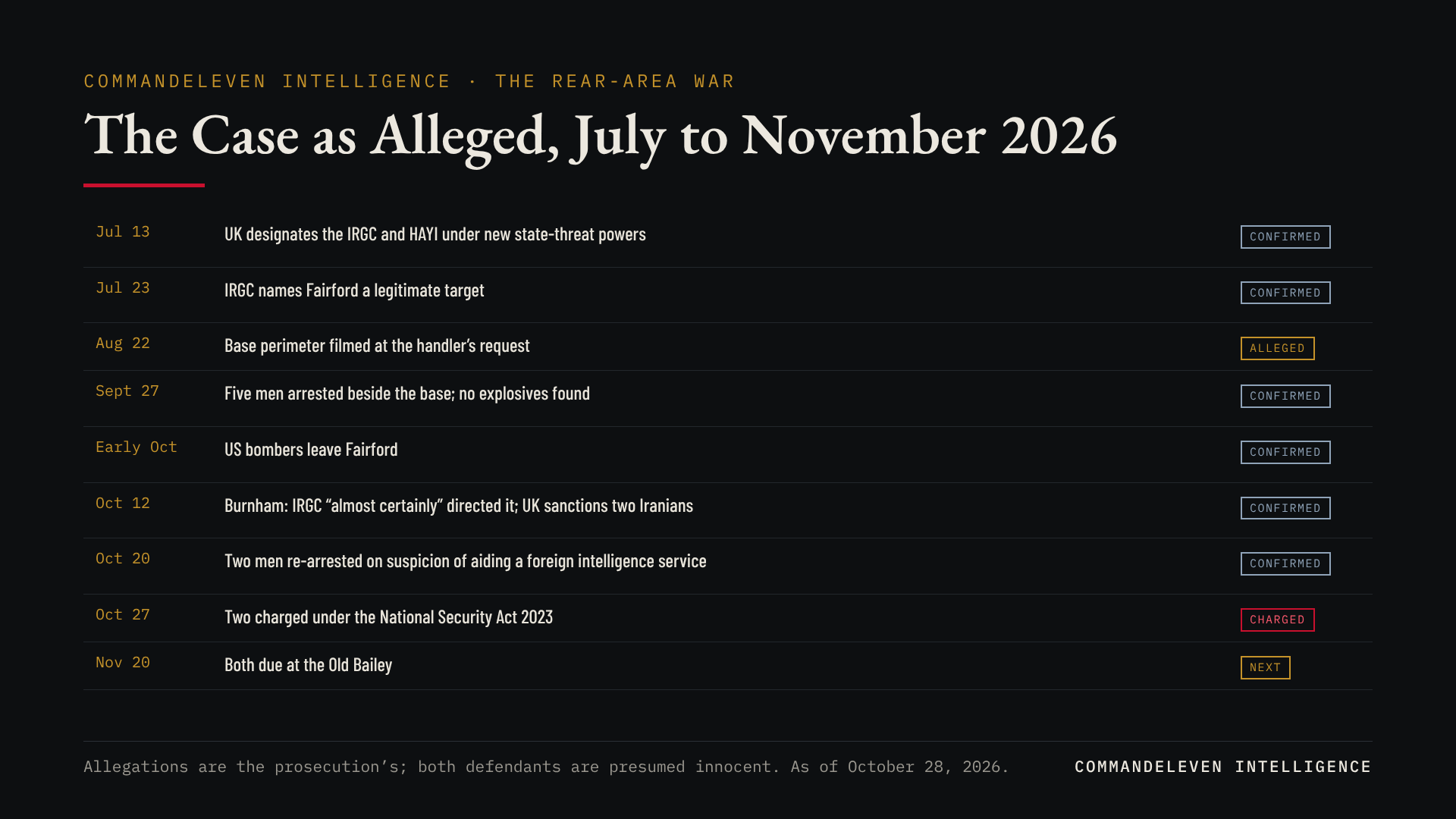
How the Case Got Here
- July 13. The UK designates the IRGC and HAYI under new state-threat powers. [CONFIRMED]
- July 23. The IRGC publicly names Fairford a legitimate target because of US bomber flights against Iran. [CONFIRMED]
- August 22. The alleged reconnaissance of the perimeter. [ALLEGED]
- September 24–26. Visible force-protection measures at Fairford are raised before the arrests, as Part 1 documented. [CONFIRMED as observed; FPCON levels not officially published]
- September 27. Five men arrested near the base; a major incident declared and homes evacuated. [CONFIRMED]
- September 28. All five released on police bail. [CONFIRMED]
- October 1. A sixth man, a 25-year-old dual UK-Iranian national, arrested. [CONFIRMED]
- Early October. US B-1 and B-52 bombers leave Fairford. US officials cite concern about a suspected Iranian plan for a drone attack on the base. [CONFIRMED as US officials’ statements]
- October 12. Prime Minister Andy Burnham tells Parliament the plot was “almost certainly” directed by the IRGC. The UK sanctions two Iranians, IRGC counterintelligence official Ruhollah Bazghandi and Zindashti network facilitator Shahram Ali Reza Tamarzadeh Jakki, and 29 countries jointly condemn Iran’s covert attacks. Iran’s ambassador denies any role. [CONFIRMED]
- October 20. Two men, Essghir and the dual national, re-arrested on suspicion of assisting a foreign intelligence service. [CONFIRMED]
- October 27. Abdulkarim and Essghir charged and in court. [CONFIRMED]
- November 20. Both due at the Old Bailey.
What the Design Suggests
The prosecution has not said what the operation was meant to achieve, and the defense has not yet put its case. Three readings fit the facts made public so far. [ASSESSED]
A disruption operation. The aim was the alarm itself: a bomb scare at the UK base from which US bombers were flying missions against Iran, with the political and operational fallout that followed. The incident produced a major incident, an evacuated village, a transatlantic row and, within weeks, the departure of the bombers, although US officials tied that move to a separate drone concern. For a sponsor, that is a large return on about £70,000.
A test of the response. The reconnaissance in August and the internet-enabled cameras in the vans fit an operation designed to watch how police and the base reacted. Part 2 raised the possibility of a “dry run.” Nothing in court confirms it.
An operation that stopped short. The drivers may have been one stage of a larger plan that ended when one of them called the police. The petrol in the vans keeps this reading open.
These readings are not mutually exclusive, and the trial may settle them. What the hearing does settle is that the drivers, on the prosecution’s own account, were not told the full plan. That fits the deniable, compartmented model Iran has used across Europe, in which the people on the ground know only their own task.
Above the Gig Tier
Part 3 described Iran’s use of hired operatives as a tiered market, from street-level recruits paid by the task to professional criminal contractors, and said the public record could not yet show which tier Fairford belonged to. The charges narrow that.
- The pay. In the HAYI wave, recruits were reportedly paid a few hundred euros per task; one in the foiled Paris attack on a Bank of America office was reportedly paid €600. The intermediary at Fairford allegedly received about £70,000. [ALLEGED for Fairford; REPORTED for Paris]
- The structure. A named intermediary who recruits, buys equipment and is paid in several installments is a contractor, not a gig worker. [ASSESSED]
- The preparation. A reconnaissance visit five weeks ahead of the operation is planning, not opportunism. It also fits a local councilor’s account, reported in September, of a specific Iranian threat to the base in mid-August. [ASSESSED; the councilor’s account remains SINGLE-SOURCE]
[ASSESSED, moderate confidence] Fairford, as alleged, sits at the professional end of the market. Part 3 named that shift as the highest-consequence scenario: if gig-tier attempts against hard targets keep failing, sponsors move up to contractors who are costlier, rarer and more capable. Fairford suggests that against a strategic military target, Iran started there.
The HAYI Thread
On April 17, 2026, a video posted online claimed that Israel’s embassy in London had been attacked by drones carrying radioactive and carcinogenic material. The claim was made in the name of Harakat Ashab al-Yamin al-Islamiyya. Police searched nearby Kensington Gardens, where they assessed discarded items, and said that “the embassy has not been attacked.” [CONFIRMED]
The court heard that Ali is potentially connected to that incident. [REPORTED by ITV News; not in the other court reports we reviewed]
If the link holds, it matters in two ways. It would tie Fairford to the same campaign the UK government already attributes to the IRGC Quds Force. And both incidents would follow the same pattern: an operation that does little physical damage and produces a large public scare. HAYI’s attack wave, as Part 3 found, escalated in its choice of targets, not in its capability. Fairford, as alleged, fits that pattern.
The word “potentially” carries weight here. The prosecution has not alleged that HAYI ran Fairford, and no claim of responsibility for Fairford has been made public.
How Our Earlier Judgments Held Up
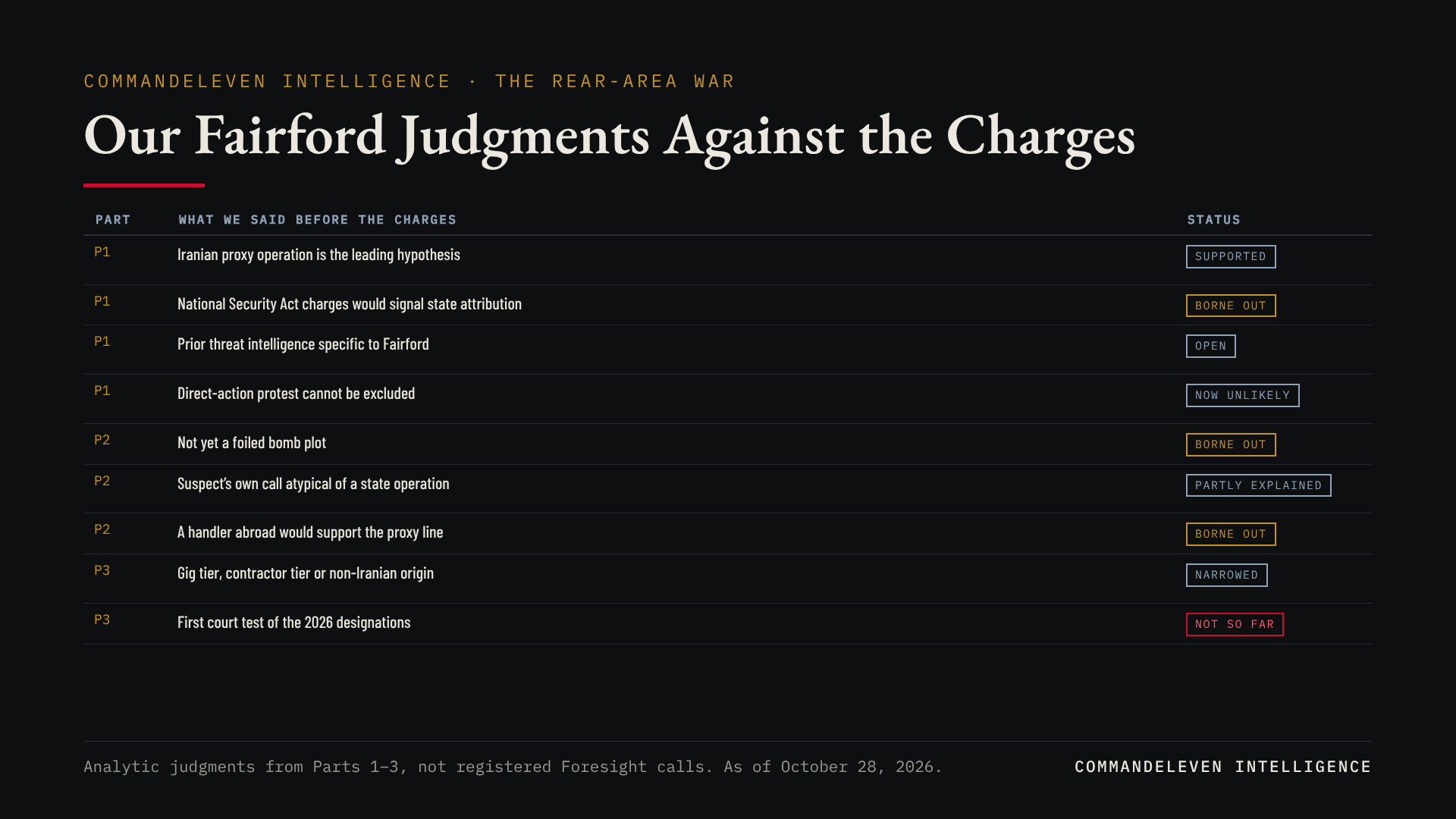
This series published three dossiers between September 28 and October 1, before any charges. CommandEleven Intelligence reports what it got right and what it got wrong. Against the prosecution’s account:
| Earlier judgment | What the charges show | Status |
|---|---|---|
| Part 1: An Iranian state-directed proxy operation is the leading hypothesis (low-to-moderate confidence) | Prosecutors allege a handler acting for Iran | Supported, not yet proven in court |
| Part 1: Charges under the National Security Act 2023 would signal state-threat attribution | Both charges are under the 2023 Act | Borne out |
| Part 1: The authorities had threat intelligence specific to Fairford before September 27 | Reconnaissance alleged on August 22; the authorities’ prior knowledge not addressed in court | Open |
| Part 1: A direct-action protest (Hypothesis 4) cannot be excluded | The prosecution alleges a paid, state-directed operation | Now unlikely |
| Part 2: Fairford should not yet be described as a foiled bomb plot | No explosives; the “bomb” was a message to the drivers | Borne out |
| Part 2: A suspect calling the emergency services is atypical of a disciplined state operation | The caller had allegedly just been told there was a bomb in the vans | Explained, partly |
| Part 2: Evidence of a handler abroad would strongly support the proxy line | Prosecutors allege a handler, Ali, believed to be abroad | Borne out |
| Part 3: Three readings open: gig-tier tasking, a higher-tier contractor, or a non-Iranian origin | A £70,000 intermediary and reconnaissance point to the contractor tier | Narrowed |
| Part 3: If Fairford produces charges, it may be the first court test of the 2026 designation regime | The charges use the 2023 Act’s foreign-intelligence-service offenses, not the designation of HAYI | Not borne out so far |
These were analytic judgments and indicators, not formally registered calls, so they are not counted on the Foresight Record. The dated calls below will be.
Dated Calls
- At least one more person is charged in the RAF Fairford investigation by March 31, 2027. Six men remain on police bail, including four of the five arrested at the scene.
- UK authorities do not publicly identify “Ali” by his real name, or sanction him, by June 30, 2027. Handlers in Iran-directed cases are rarely named, and the UK’s October sanctions named officials, not handlers.
- Neither defendant’s case reaches a verdict before June 30, 2027. Recent National Security Act cases have taken more than a year from charge to verdict.
What to Watch
- November 20, Old Bailey. Pleas, a trial date and any further detail on Ali, the payments and the embassy link.
- Further charges. Whether any of the six men on bail are charged, and under which law.
- The designation regime. Whether prosecutors bring any charge that relies on the designation of the IRGC or HAYI.
- Ali’s identity. Any sanctions listing, Interpol notice or official statement that names him.
- The bombers. Whether US bombers return to Fairford, which would signal that the threat assessment behind their departure has eased.
- Tehran. Iran’s response, and any retaliation against the UK for the sanctions and prosecutions.
- Other bases. Reconnaissance or approaches at RAF Lakenheath, RAF Mildenhall or other installations used in the war.
What This Dossier Does Not Claim
- It does not claim that either defendant is guilty. Both are presumed innocent, and neither has entered a plea.
- It does not treat the prosecution’s account as established fact. Every allegation is marked as one.
- It does not claim that Iran directed Fairford. Police and the British government say so; Iran denies it, and no court has ruled.
- It does not claim that HAYI ran Fairford. The court heard only of a potential connection between the handler and the April embassy incident.
- It does not claim that the five men who drove the vans knew what the operation was for.
- It does not describe attack methods or how any material could have been used.
Frequently Asked Questions
Who has been charged over RAF Fairford?
Two London men aged 24: Mohmed Abdulkarim, charged with assisting a foreign intelligence service, and Nouman Essghir, charged with entering a prohibited place for a purpose prejudicial to the UK. Both charges are under the National Security Act 2023.
Was there a bomb at RAF Fairford?
No. Police found no explosives or improvised explosive devices. Prosecutors say the drivers received a message that there was a bomb in the vans after being told to park and walk away.
Who is “Ali”?
The handler named in court. Police believe he is abroad and was acting for the Iranian state. He has not been publicly identified.
Is Iran behind the RAF Fairford plot?
UK police and the prime minister say Iran’s IRGC almost certainly directed it, and the prosecution alleges a handler acting for Iran. Iran denies involvement. No court has ruled.
What is HAYI’s connection?
The court heard that Ali is potentially connected to the April 2026 incident at Israel’s embassy in London, which HAYI claimed. The prosecution has not alleged that HAYI ran Fairford.
When is the next hearing?
Both men are due at the Old Bailey on November 20, 2026.
Sources
- ITV News, RAF Fairford “plot co-ordinated by handler working on behalf of Iran”
- PA (via Great Driffield Radio), RAF Fairford suspects co-ordinated by handler known as “Ali”, court hears
- Al Jazeera, UK prosecutors charge two after RAF Fairford incident
- Iran International, Two charged over alleged Iran intelligence operation at RAF Fairford
- Al Jazeera, UK blames Iran for airbase plot, sanctions two Iranian nationals
- Gulf News, Iran challenges UK to prove IRGC’s role in RAF Fairford plot
- The National, RAF Fairford suspects face new charges of working for Iranian intelligence
- Jewish News, Police confirm investigation after video claims Israeli embassy targeted by drones
- The Algemeiner, UK: Islamist group claims to attack Israeli embassy with “drones carrying radioactive, carcinogenic materials”
- The Washington Institute (Adrian Shtuni), Deniable, Disposable, Disruptive: Iran’s Hybrid Warfare in Europe Demands a Proactive Response
Related CommandEleven Intelligence Reporting
- Unit 4000 and Unit 600: How Iran Is Rebuilding Its External Plotting Arms
- Iran’s Homeland Threat to the US: Sleeper Cells, Drones, and the Arbabsiar Precedent
- Iran War Status Brief: October 2026
The Rear-Area War Series
- The Rear-Area War: Series Introduction
- Part 1: RAF Fairford Terror Plot: Dossier on the Averted Attack
- Part 2: MacDill Breach and RAF Fairford Plot: Two Bases, One War
- Part 3: The Gig Economy of Terror: From Hatzola to Fairford
- Part 4: RAF Fairford Charges: The Handler, the Money and the Iran Case (you are here)
