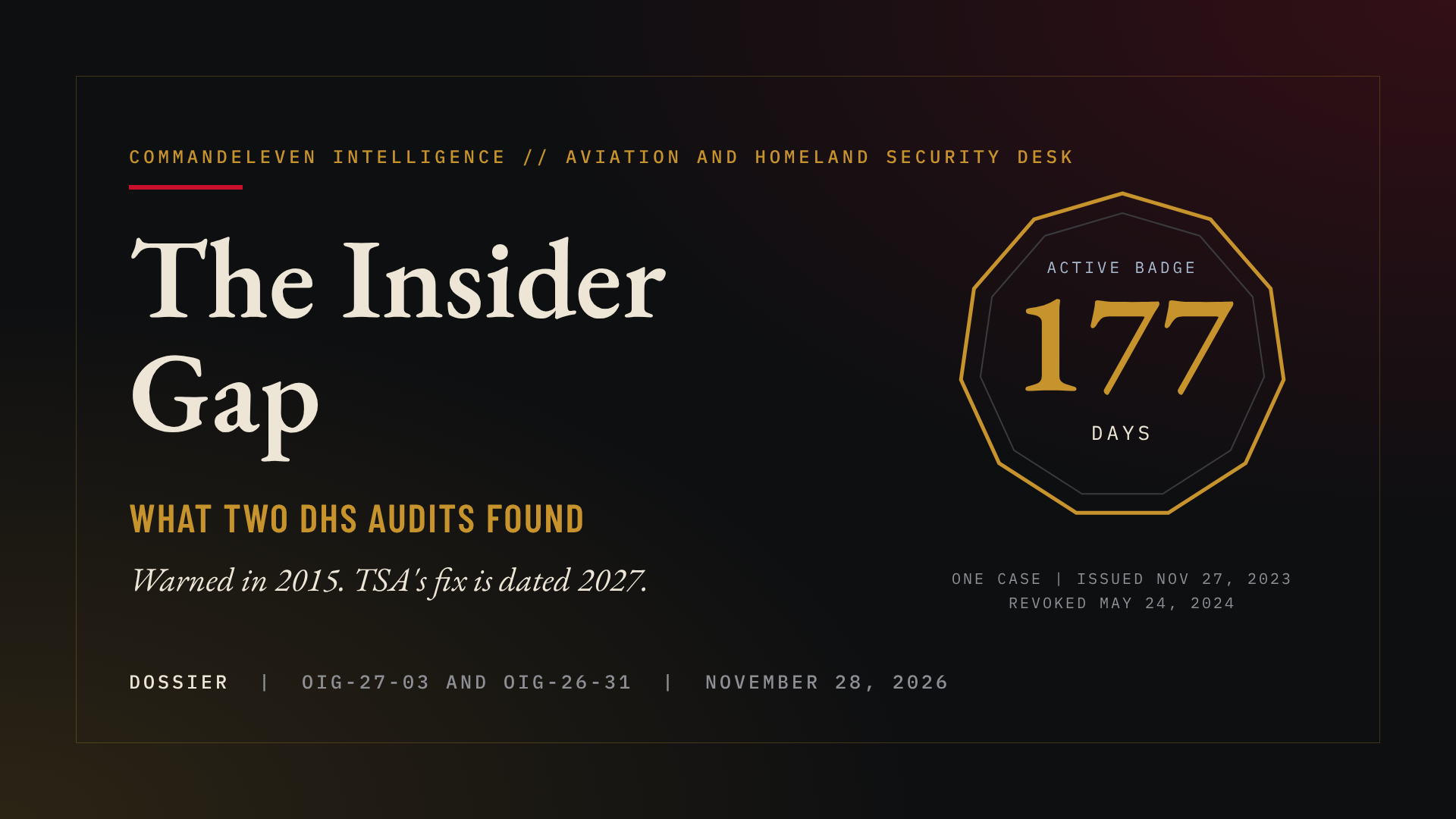
This dossier is part of the CommandEleven Intelligence Special Report – The Warnings Reassessed
CommandEleven Intelligence Desk // Aviation and Homeland Security Desk, status as of November 28, 2026
Bottom Line Up Front
Two audits by the Department of Homeland Security Inspector General (OIG), published six weeks apart, describe the same weakness in two agencies: people were allowed to work in trusted positions before, or after, the government’s own vetting said they should not. At the Transportation Security Administration (TSA), an airport operator issued a secure-area badge to a worker TSA later said it could not clear, and the badge stayed active for 177 days. At U.S. Citizenship and Immigration Services (USCIS), 14 employees recorded as denied or revoked kept working in national security positions, 10 of them for an average of about 7 years. DHS disputes how the USCIS audit frames its findings, and the public versions of both reports black out several key counts. We assess these are control failures, not evidence of a plot. They matter because al Qaeda (al-Qa’ida) is now urging supporters to copy an aviation attack, and the people with unescorted access are the part of the system that vetting exists to protect.
Key Judgments
- CONFIRMED. In OIG-27-03 (November 4, 2026), OIG found an airport operator issued a badge on November 27, 2023, and did not revoke it until May 24, 2024, after TSA had said the worker could not be cleared. OIG counts 177 days of active access.
- CONFIRMED. TSA took 7 enforcement actions against 6 airport operators over premature badges. In 19 instances, 14 operators faced no penalty. TSA did not catch the problem because it did not run the supplemental inspections that would have.
- CONFIRMED. In OIG-26-31 (September 23, 2026), OIG found 14 USCIS employees recorded as denied or revoked still in national security positions, and 18 employees with no suitability decision on file after an average of 2 years.
- CONFIRMED, DISPUTED. DHS called the USCIS draft “significantly flawed” and misleading, and said that before 2017 it lacked authority to remove some employees. OIG kept its findings. Both sides are on the record in the report, and we present both.
- DATA DEFICIT. The public versions redact the counts that would size the TSA problem: how many badge records were inconsistent, how many Social Security numbers were missing, how many workers got badges early, and how many were not enrolled in FBI Rap Back. We do not estimate them.
- ASSESSED. Neither report shows an attack, a plot or a terrorist link. Both show the kind of weakness an insider-access threat relies on: slow revocation, bad data, and no one checking.
- ASSESSED. The TSA findings are not new. A 2015 OIG audit recommended piloting FBI Rap Back for airport workers and found nearly 87,000 active workers with no Social Security number listed. Eleven years later, Rap Back enrollment and data quality are still audit findings, after a House committee wrote those recommendations into a bill in July 2015.
Why This Sits in The Warnings Reassessed
Our aviation dossier covers the September 2026 flydubai cockpit incident, al Qaeda’s call for supporters to copy it, and the FBI, DHS and TSA warning to U.S. airlines, which named no specific plot. Warnings of that kind lean on the layer behind the checkpoint: who holds a badge, who can reach an aircraft, and who is trusted with immigration decisions. The 9/11 Commission’s story was not only a missed warning. It was a system that did not check what it already knew. These two audits ask whether that habit has changed.
The limit matters. The OIG reports do not mention al Qaeda and do not link any worker to terrorism. The connection is ours, and we label it ASSESSED.
Report One: TSA and Airport Worker Badges (OIG-27-03)
Failures in TSA’s Vetting of Airport Workers Allowed Uncleared Individuals Access to Secure Areas (Project 24-041-AUD-TSA) is dated November 4, 2026. The audit ran from August 2024 to July 2026, covered October 2018 to March 2025, and was delayed by three government shutdowns in fiscal year 2026. The public copy carries a Sensitive Security Information banner and is posted on the OIG’s site. TSA concurred with all four recommendations.
How the system works. There are 440 U.S. airports, handling over 23,000 domestic and nearly 2,600 international flights a day (May 2024 figures). Atlanta has more than 63,000 airport workers and Birmingham about 2,400. Airport operators badge workers. TSA runs the security threat assessment. Level 1 checks terrorism and intelligence databases, Level 2 adds lawful presence, and Level 3 adds an FBI criminal history check. The sterile area and the Security Identification Display Area (SIDA) require Level 3. OIG sampled eight airports: Colorado Springs, Denver, Birmingham, Atlanta, Washington, New Orleans and two in Dallas.
Finding 1: The data TSA vets on was inconsistent
OIG pulled 2,657,537 applicant records from TSA’s Consolidated Screening Gateway for October 2018 to February 2025. Of those, 2,019,667 were SIDA badge applicants. It compared 457 sampled records from five airports against the operators’ own data on 13 data elements and found key biographic data inconsistent. The number of inconsistent records is redacted in the public version. TSA’s explanation was data-entry and transmission errors and IT changes. OIG’s warning is that without accurate information TSA risks vetting the wrong person.
OIG also checked Social Security numbers, which the FAA Reauthorization Act of 2018 requires for SIDA applicants. It found missing and incomplete numbers, but the counts are redacted. Applicants by fiscal year were: 314,895 (2019), 206,729 (2020), 319,201 (2021), 386,831 (2022), 385,952 (2023), 358,287 (2024) and 47,772 (2025, through February 24). In one record, SIDA access was requested but the TSA system showed public-area access only. TSA says a new data management system is planned for 2027.
Finding 2: Badges issued before TSA said no
TSA tells an operator “Do Not Issue” (DNI) when a worker fails the threat assessment. The operator must revoke or deny access within one business day. OIG found operators issued badges before TSA’s DNI and then did not revoke on time. The number of workers is redacted. OIG’s worked example:
| Date | Event |
|---|---|
| November 27, 2023 | Airport operator issues the badge |
| December 13, 2023 | TSA conveys the DNI, 16 days later. The operator still does not revoke |
| February 9, 2024 | TSA issues a Preliminary Determination of Ineligibility. The applicant was born in Costa Rica and TSA could not verify eligibility to work in the United States |
| March 13, 2024 | The applicant appeals with more documents and is denied |
| May 24, 2024 | The operator revokes the badge. OIG counts 177 days of active access |
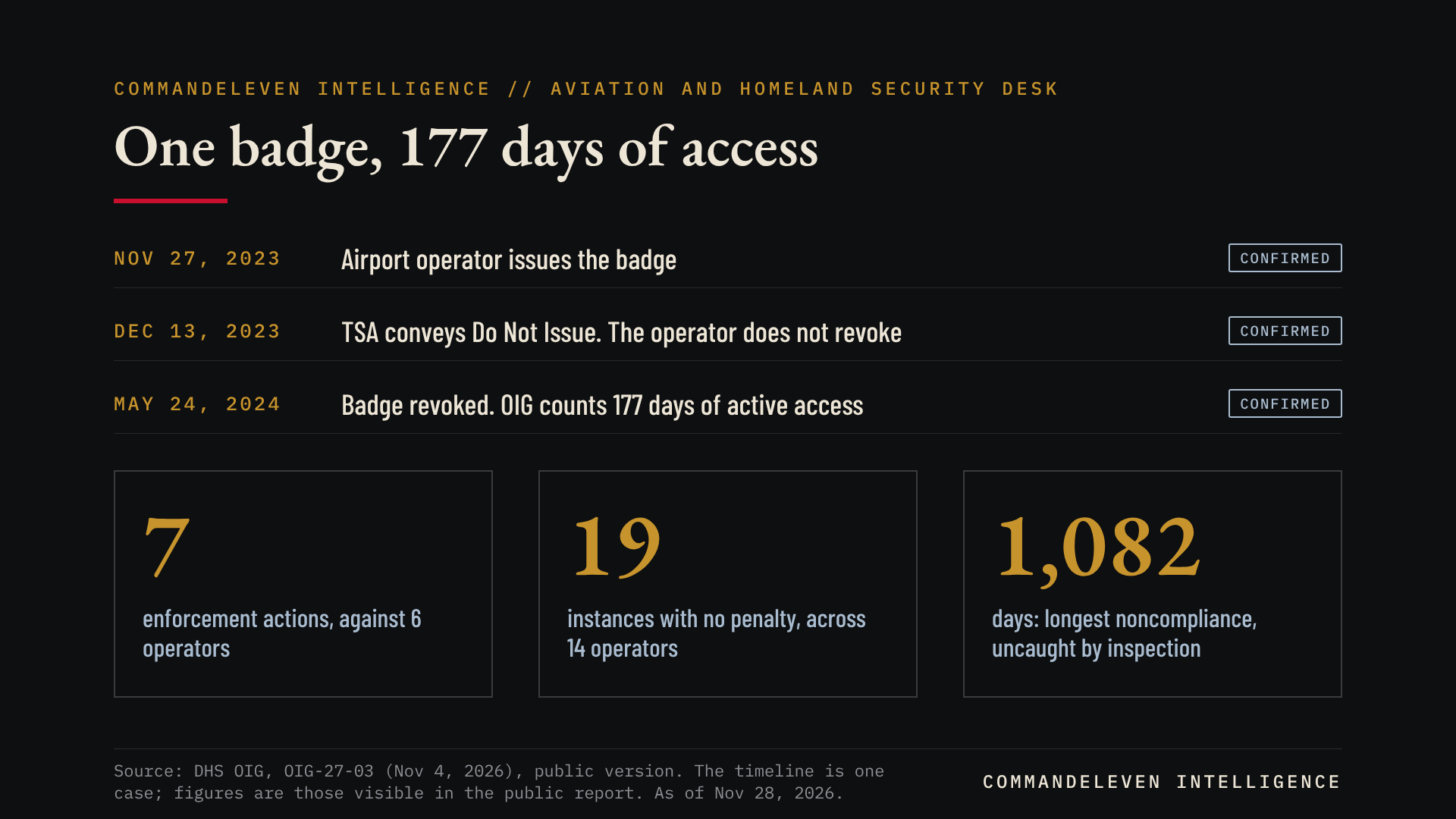
Birthplace is not a disqualifier. The failure in this case was an unverified work-eligibility check that did not stop the badge. By our own date count, November 27 to May 24 is closer to 179 days; we use OIG’s 177 figure, which probably counts from activation.
For the other workers OIG reviewed, 9 DNIs had been conveyed in error, 6 workers were law enforcement or federal employees who are exempt, and records for 4 could not be obtained (1 terminated beyond the 180-day retention period and 3 at small airports where TSA no longer had inspectors).
Enforcement. TSA took 7 enforcement actions against 6 operators: 1 counseling, 2 corrective action plans for 2 operators, and 4 warning notices to 3 operators. In 19 instances involving 14 operators there was no penalty. One case could not be determined. OIG reviewed 4,658 inspection records from fiscal years 2021 to 2024 and found TSA had not run the supplemental inspections the rules call for; operator noncompliance continued for as many as 1,082 days.
Finding 3: FBI Rap Back enrollment gaps
Rap Back notifies an airport operator if an enrolled worker is later arrested or convicted. Of the 457 sampled workers, 451 had to be enrolled. Some were not; the count is redacted. For a further 51 workers (11 percent), OIG could not tell, because they had been terminated and their records were gone. TSA told OIG it lacks the resources to review 100 percent of operators’ records.
| # | Recommendation | TSA’s estimated completion |
|---|---|---|
| 1 | Build data quality controls into the vetting system | September 30, 2027 |
| 2 | Controls to enforce revocation within one business day of a DNI | September 30, 2027 |
| 3 | Inspectors record noncompliance in the inspection database and apply sanctions | December 31, 2026 |
| 4 | Inspectors verify Rap Back enrollment, with a special-emphasis inspection in the first quarter of fiscal 2027 | December 31, 2026 |
In its response, TSA Administrator David Cummins pointed to steps already taken: Security Directive 1542-04-08Y (October 31, 2025) replaced the earlier version, Executive Order 14385 (February 6, 2026) widened access to criminal history information, and TSA gained expanded visa-revocation data access on August 10, 2026.
Report Two: USCIS and National Security Positions (OIG-26-31)
USCIS Allowed Employees Who Did Not Meet Security and Suitability Requirements to Occupy National Security Positions (Project 24-027-AUD-USCIS) is dated September 23, 2026. The audit ran from May 2024 to December 2025, with an April 30, 2025 data cutoff. The public version is marked For Official Use Only and carries redactions. OIG says Congress raised concerns in 2023 after an adjudication officer posted support for Hamas online. USCIS suspended that person’s clearance quickly, and removed them from federal service in 2025.
According to USCIS, 15,684 employees, 78 percent of its workforce, held Special-Sensitive or Critical-Sensitive positions. These include immigration officers, asylum officers, adjudication officers, supervisors in security roles, cybersecurity staff and intelligence analysts.
Finding 1: 14 employees denied or revoked, still working
| Group | What OIG found |
|---|---|
| 10 employees | Stayed active an average of about 7 years after denial or revocation. The longest was more than 12 years after a clearance denial |
| 1 employee, FDNS | Stayed about 1 year 5 months in the Fraud Detection and National Security directorate while awaiting an appeal decision. OIG notes FDNS works closely with the Intelligence Community |
| 1 employee | Stayed more than 11 years until death |
| 2 employees | Worked about 4 years in Critical-Sensitive positions until later favorably adjudicated |
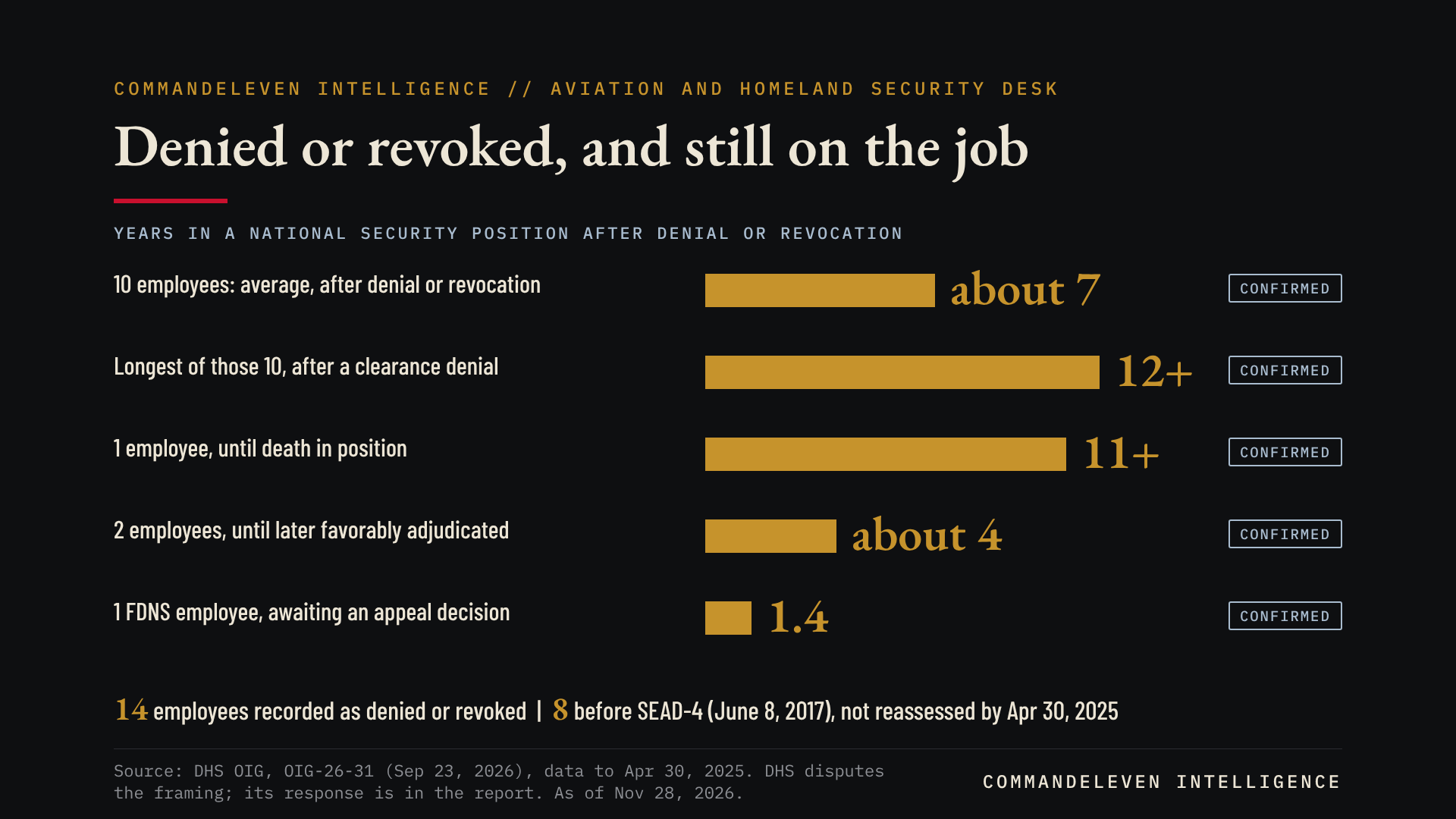
Eight of the 14 had clearances denied or revoked before the national adjudication standard, SEAD-4, took effect on June 8, 2017. As of April 30, 2025, USCIS had not reassessed them. The reasons for denial are redacted in detail, but OIG’s illustrations include: threatening someone and then lying about the arrest, viewing pornography on a government computer, approving immigration benefits for friends and relatives, failing to pay federal income taxes for several years, repeated unauthorized queries about self and relatives in a law enforcement sensitive system, and omitting foreign contacts and dual citizenship.
The retained asylum officer. One employee hired in 2015 was denied twice. In March 2025 the DHS Security Appeals Board upheld the denial, and the USCIS personnel security division told the supervisor to remove the person from the sensitive position. As of June 2025, OIG confirmed the employee was still working as an asylum officer. USCIS provided no documentation that duties had been restricted. The Supervisor’s Guide of August 21, 2020 allowed removal of sensitive duties only, while OPM rules attach the designation to the whole position.
Finding 2: 18 employees with no suitability decision
Eighteen employees had no suitability decision recorded after an average of about 2 years. Five were recording errors. For the other 13, the background investigation had been complete for a year or more, and each had significant derogatory information: marriage fraud, tax evasion, potential money laundering, or ongoing contact with people illegally residing in the United States.
| Case | Timeline in the report |
|---|---|
| Hired April 2022 | Background investigation completed September 2022. Still under review as of June 2026 |
| Hired October 2023 | History of immigration fraud. FDNS confirmed the fraud in May 2024 and referred it to the Office of Investigations. USCIS suspended eligibility in February 2026 and the employee resigned in March 2026 |
| Hired May 2022 | Married to a foreign national (details redacted). Notice of Determination issued September 2024. In the appeals process as of August 2025. USCIS says sensitive duties were removed but gave no documentation |
OIG found no timeframes in USCIS procedures and described a pattern of extended time and benefit of the doubt. In one case, derogatory information was known 4 days before the start date and the person was kept past probation. Another had a theft charge noted in pre-appointment vetting. OIG also found 27 more employees with suitability exceptions, which it checked only in the records system. Its conclusion is that employees with criminal records, financial instability or anti-government ideologies may be more susceptible to coercion, blackmail or foreign influence.
The DHS and USCIS response, in full balance
Jeffrey Bobich, DHS Executive Director for Financial Management and Systems, responded on August 7, 2026. DHS’s position:
- The draft is “significantly flawed” and misleading, and OIG changed the audit scope about a year in.
- Before SEAD-4, USCIS lacked authority to remove an employee from a sensitive position where a clearance was not a condition of employment, and SEAD-4 cannot be applied retroactively.
- All eligible employees are in continuous vetting under Trusted Workforce 2.0, and the security office has done more than 138,000 adjudications since 2007, with every denial upheld by the Security Appeals Board.
- Since SEAD-4, 48 employees were removed or reassigned, and 52 more left during review or appeal. DHS says some of the 14 cases were later cleared, and one employee died in position.
- The personnel security office does not control administrative actions, and USCIS Labor and Employee Relations was not interviewed.
OIG replied that it disagreed, noted USCIS concurred with all four recommendations, and said USCIS did not document that sensitive assignments were removed.
| # | Recommendation | USCIS’s estimated completion |
|---|---|---|
| 1 | Reevaluate the 14 employees | September 30, 2026 |
| 2 | Review the 27 suitability exceptions | September 30, 2026 |
| 3 | Set timeframes for suitability decisions | September 30, 2027 |
| 4 | DHS policy memo from the Chief Security Officer and Chief Human Capital Officer | August 31, 2027 |
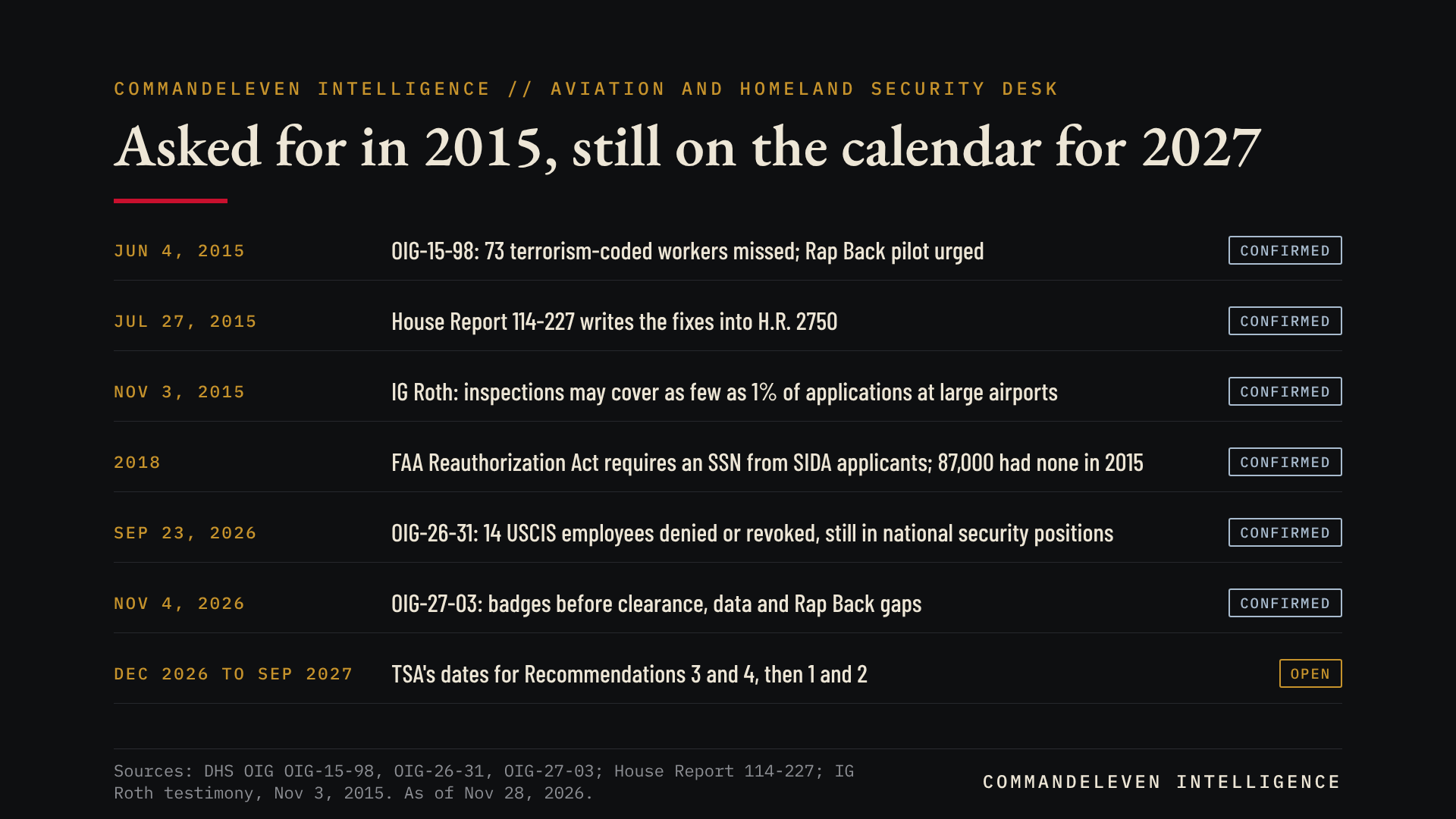
The first two dates have passed. In the report, OIG called all four recommendations open and resolved, meaning it accepts USCIS’s plan but closes each one only on documentation. For Recommendation 1, that means a favorably adjudicated background investigation and continuous-vetting enrollment for each of the 14, or confirmation that they no longer hold a sensitive position. For Recommendation 2, it means a confirmed review of each of the 27 exceptions. We found no public closure notice, which we label DATA DEFICIT.
The 2015 Precedent: Same Questions, Eleven Years Earlier
OIG-15-98, TSA Can Improve Aviation Worker Vetting (June 4, 2015), matched over 900,000 active aviation worker records against the terrorism database and found TSA did not identify 73 individuals with terrorism-related category codes. The reason was policy: TSA was not authorized under watchlisting rules to receive certain codes. That specific gap is a different problem from today’s, and we do not equate them. The same audit found nearly 87,000 active workers with no Social Security number listed, and recommended that TSA pilot FBI Rap Back and set up recurrent criminal-history vetting at all commercial airports. TSA concurred.
The 2026 audit finds Rap Back enrollment and data quality still short, and TSA’s fix for the data is dated 2027. That is persistence, not proof of neglect: the 2026 audit covers 2018 to 2025 and TSA has since expanded access to data. But recommendations that take a decade to close are a warning in themselves.
Congress read it the same way in 2015
The House Homeland Security Committee turned the 2015 audit into a bill. Its report on H.R. 2750, the Improved Security Vetting for Aviation Workers Act of 2015 (House Report 114-227, July 27, 2015), summarized OIG-15-98 as finding 73 aviation workers with secure-area access who had links to terrorism, and said the report made six recommendations that the bill would codify in part. The bill would have required TSA, by December 31, 2015, to ask the Director of National Intelligence for additional terrorism data, to issue guidance for inspectors to review airport badging offices every year (including criminal history checks and work-authorization documents), and to pilot FBI Rap Back.
Those are the same three levers the 2026 audit examines: terrorism data, inspection oversight of airport badging, and Rap Back. The committee also wrote that incidents in recent years, including gun and drug smuggling and the radicalization of aviation workers, showed gaps in vetting, while noting there had not yet been a successful terrorist attack carried out by an aviation worker. We have not traced the bill’s later history, and we do not claim it became law as written.
Inspector General John Roth gave the House Oversight Committee the detail behind that audit on November 3, 2015. He said TSA’s inspection of airport badging offices may look at as few as one percent of workers’ applications at large airports, and that inspectors often reviewed photocopies of documents, not the documents themselves. He also said it took eighteen months to get authorization to match TSA’s worker data against the terrorism database. Compare the 2026 audit, where TSA told OIG it does not have the resources to review 100 percent of airport operators’ records.
What did change, and what did not
Two of the 2015 problems map directly onto 2026. First, OIG found in 2015 that TSA had to deny credentials to about 4,800 people whom airports had already cleared for work in the United States, because TSA could not verify their lawful status. The 2026 worked example is the same failure at the level of one worker: an operator badged someone whose work eligibility TSA could not verify. Second, the Social Security number gap. In 2015 TSA was not authorized to require the numbers, and nearly 87,000 active workers had none listed. Congress later changed that: the FAA Reauthorization Act of 2018 requires a Social Security number from SIDA applicants. The 2026 audit still found missing and incomplete numbers, though the counts are redacted. The law moved. The data discipline behind it, on OIG’s evidence, did not fully follow.
A note on the blacked-out counts
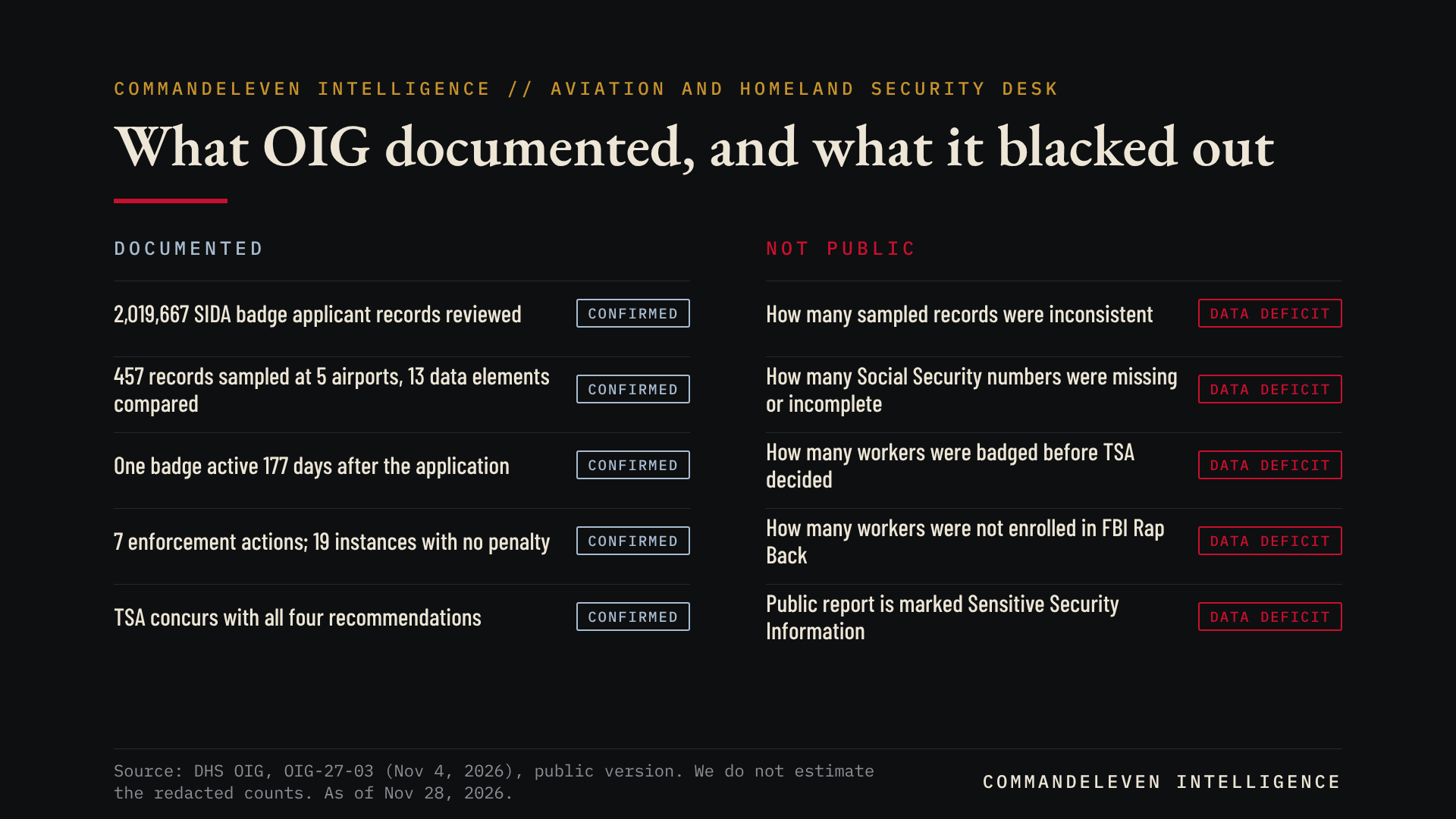
OIG-27-03 carries a Sensitive Security Information marking, and the counts that would size the problem are redacted. Inspector General John Roth told the House Oversight Committee on March 2, 2017 that TSA had a history of applying SSI redactions aggressively. He cited examples where TSA marked information that OIG had already published, or that TSA itself had made public, and an instance where it took nearly six months to resolve a challenge. That is 2017 testimony about a different set of reports. It does not show that the 2026 redactions are improper, and we do not suggest it. It is context for why a reader should not take blacked-out numbers as a sign that the numbers are small or large, and why we mark them DATA DEFICIT and leave them unestimated.
The same testimony lists the OIG’s earlier work on vetting and badges, which gives the audit trail: TSA Can Improve Aviation Worker Vetting (OIG-15-98, June 2015), TWIC Background Checks Not as Reliable as They Could Be (OIG-16-128, September 2016) and TSA Could Improve Its Oversight of Airport Controls over Access Media Badges (OIG-17-04, October 2016). The 2026 audit is the latest entry in that list, not the first.
Through the model: Threat, Vulnerability and Risk
Our threat, vulnerability and risk primer keeps these apart. Applied here:
- Threat. Al Qaeda urges supporters to copy a cockpit attack, and the FBI, DHS and TSA warned airlines, with no specific plot known. CONFIRMED, as reported in our aviation dossier.
- Vulnerability. Badges issued before clearance and revoked late, inconsistent data, gaps in Rap Back enrollment, and USCIS staff kept in sensitive posts after denials. CONFIRMED, OIG-27-03 and OIG-26-31. Sizes are redacted.
- Consequence. Unescorted access to aircraft and secured areas; immigration decisions made by people who failed security review. ASSESSED.
- Risk. Low for any single traveler. The concern is systemic and rises with the number of workers involved, which the public reports do not give us. ASSESSED.
- Where this could be wrong. The counts are redacted, the TSA samples are judgmental, not random, and DHS disputes the USCIS framing. CONFIRMED, from the reports.
What Each Audience Should Do
| Audience | What it means | Do this |
|---|---|---|
| Airport operators and security directors | Badging speed and TSA vetting can run out of step | Check how many days pass between badge issue and a TSA final determination. Confirm same-day revocation on a Do Not Issue notice and verify Rap Back enrollment |
| Executives with badge or clearance programs | A pending decision is not a decision | Ask who owns workers whose vetting is unresolved, and whether their access is limited until it is |
| Policymakers | Recommendations from 2015 are still open in 2026 | Ask TSA and DHS for the redacted counts in a classified or closed setting, and for dated closure reports on Recommendations 1 to 4 |
| The public | Risk to any one traveler is low and these are control findings | Nothing to change. Report unattended items and unusual behavior near aircraft or secure doors to airport police |
What To Watch
- Whether TSA reports completion of the special-emphasis Rap Back inspection in the first quarter of fiscal 2027, and whether it states how many workers were found not enrolled.
- Whether USCIS and OIG confirm closure of Recommendations 1 and 2, whose September 30, 2026 date has passed.
- Congressional letters or hearings on either report, and any request to unredact the counts.
- The next al Qaeda or affiliate propaganda that names aviation staff or airport access, and any FBI or DHS bulletin that follows.
Calls We Will Score
- By December 31, 2026: TSA reports Recommendations 3 and 4 as implemented to OIG, without publishing the unredacted Rap Back non-enrollment count. ASSESSED.
- By March 31, 2027: at least one congressional committee holds a hearing or sends a public letter on the TSA badge findings or the USCIS findings. ASSESSED.
- By August 31, 2027: DHS issues the policy memo on suitability timeframes, or OIG records a revised date. ASSESSED.
- By September 30, 2027: TSA’s data quality and one-business-day revocation controls (Recommendations 1 and 2) are reported complete, or a revised date is set. We assess a revision is more likely than not. ASSESSED.
- During 2027: no public report ties a terrorist attack or disrupted plot at a U.S. airport to a worker whose badge was affected by the gaps in OIG-27-03. ASSESSED.
What This Assessment Does and Doesn’t Establish
It establishes that, by the Inspector General’s own findings, TSA and airport operators let at least some workers hold badges after TSA said no, did not enforce the rules consistently, and had unreliable data and incomplete Rap Back enrollment, and that USCIS kept some employees denied or unresolved in national security positions for long periods.
It does not establish how many workers were affected at TSA, whether any of them posed a threat, whether any acted on one, or whether the USCIS cases led to harm. The counts are redacted, the TSA samples were judgmental, and DHS contests the USCIS audit’s scope and standards. We use only figures visible in the public versions. We did not use advocacy claims about the reports that go beyond them, such as workforce totals and screening percentages that the OIG documents do not state.
Frequently Asked Questions
Did a terrorist get an airport badge?
The report does not say so. The worked example was a worker whose work eligibility TSA could not verify. OIG found no terrorism link.
How many workers were affected?
The public version redacts the number of workers who received badges early, so we cannot say. The visible figures are 19 instances across 14 operators with no penalty, and 7 enforcement actions against 6 operators.
Is it safe to fly this holiday season?
These are audit findings on control weaknesses over several years, not a new threat. The FBI, DHS and TSA warning in our aviation dossier named no specific plot. The practical step is awareness and reporting unusual behavior.
Was the USCIS report wrong?
DHS says it was flawed and misleading, citing authority limits before 2017 and the scope change. OIG disagreed and USCIS still concurred with all four recommendations. Both positions are in the published report.
Related CommandEleven Intelligence Reading
- The Warnings Reassessed, the hub for this run
- Our aviation dossier on the al Qaeda call to copy the flydubai cockpit attack
- Our dossier on the GAO AI attack-planning test
- How CommandEleven Intelligence Thinks, the method behind every label in this dossier
- The 9/11 Commission dossier, publishing next
Sources
- DHS OIG, OIG-27-03, Failures in TSA’s Vetting of Airport Workers Allowed Uncleared Individuals Access to Secure Areas (November 4, 2026, redacted)
- DHS OIG, OIG-26-31, USCIS Allowed Employees Who Did Not Meet Security and Suitability Requirements to Occupy National Security Positions (September 23, 2026, redacted)
- U.S. House of Representatives, House Report 114-227, Improved Security Vetting for Aviation Workers Act of 2015 (July 27, 2015), via the U.S. Government Publishing Office
- DHS OIG, Testimony of Inspector General John Roth, “Transparency at TSA,” House Committee on Oversight and Government Reform (March 2, 2017)
- U.S. House of Representatives, hearing record, “Transparency at TSA,” Serial No. 115-17 (March 2, 2017), via the U.S. Government Publishing Office
- DHS OIG, Testimony of Inspector General John Roth, “TSA: Security Gaps,” House Committee on Oversight and Government Reform (November 3, 2015)
- DHS OIG, OIG-15-98, TSA Can Improve Aviation Worker Vetting (June 4, 2015), copy hosted by Prison Legal News