AI in Warfare is part of the CommandEleven Intelligence Special Report – The Warnings Reassessed
Series Introduction · AI in Warfare · Military Technology Desk · November 2026
Bottom Line Up Front
Artificial intelligence is no longer waiting at the edge of the battlefield. It is already inside the targeting process: sorting imagery, ranking suspects, recommending strikes and shaping the information fight around them. The argument over whether it will arrive is over. The argument that matters now is about governance: who is responsible when a system that recommends a target is wrong, and whether the rules, reviews and tests that are supposed to constrain it keep pace.
This series follows that question through eight parts, from the targeting systems themselves to the companies that build them, the speed that strains human judgment, the contest over perception, and the cyber and terrorism risks that sit at the edge of state capability. Its working conclusion, which the parts test rather than assume, is that in each case AI accelerates what people and institutions were already doing. The failures we can document are mostly failures of data, process and oversight, not of a machine acting alone.
Two cautions run through every part. We do not claim that AI caused any specific strike, including the Minab school strike, where reporting on AI’s role is disputed and the final report has not been released. And where we describe systems said to have been used in Gaza, we attribute them as reported.
Key Judgments
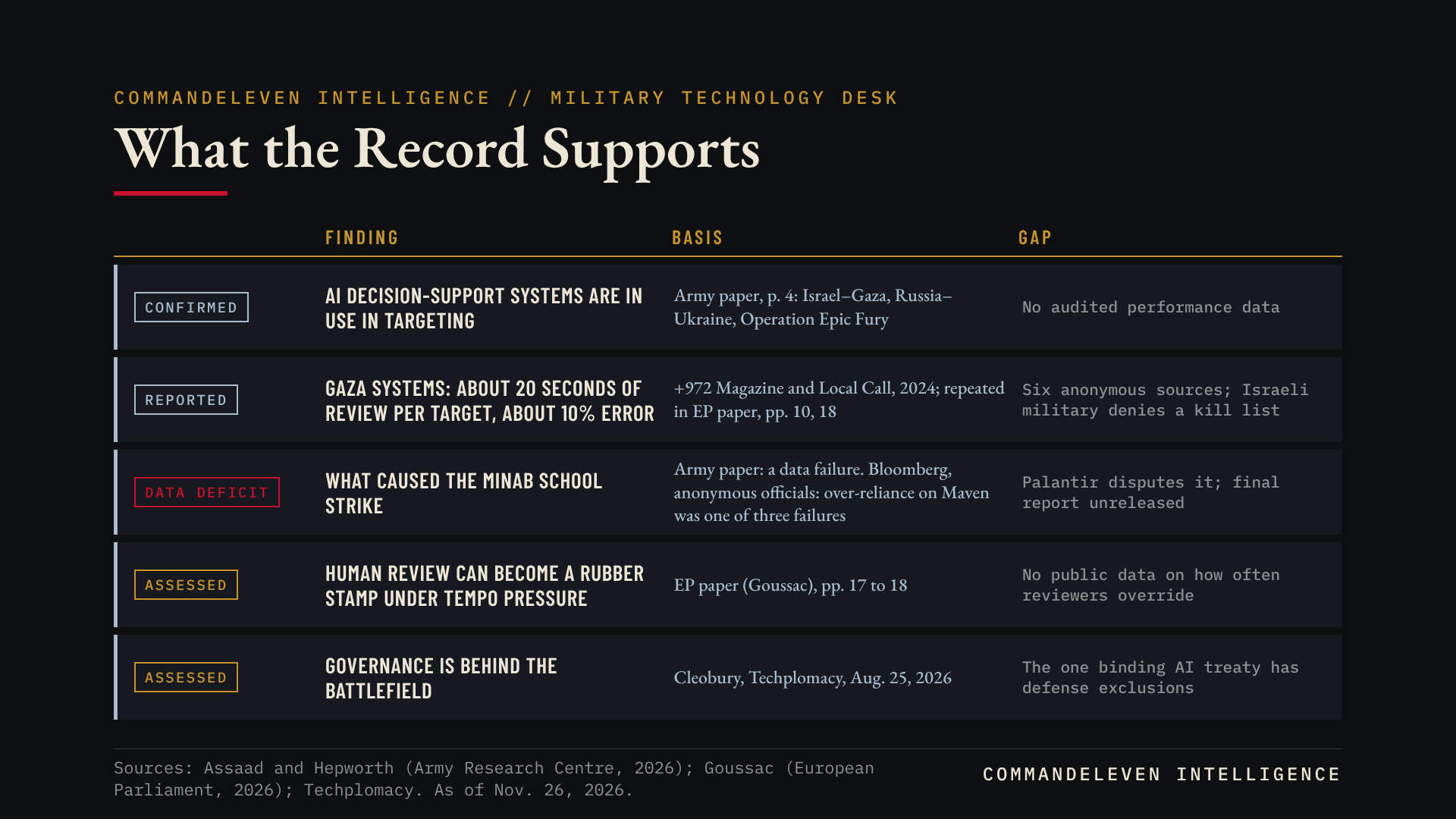
- ASSESSED. AI is already part of military targeting, so the central question is governance, not arrival. The Australian Army Research Centre’s 2026 papers start from that premise: AI decision-support systems are in use, and the issue is whether acquisition, testing, legal review and command accountability adapt (Assaad and Hepworth, pp. 3 to 20).
- ASSESSED. “Human in the loop” has never been a fixed standard. P. W. Singer’s 2009 account of systems such as the Navy’s Aegis shows the loop widening as the technology advanced (Wired for War, ch. 6). The same word now covers very different arrangements. A European Parliament workshop paper separates human control, human oversight and human judgment, and notes that the June 5, 2026 chair’s rolling text in the UN expert group on lethal autonomous weapons says human judgment and control are needed but “does not imply constant direct human control” (Goussac, pp. 11 to 12).
- REPORTED. The most documented decision-support systems are those said to have been used by the Israeli military in Gaza. Reporting in 2024 described tools called Gospel and Lavender, and the European Parliament paper repeats the reported figures of about twenty seconds of review per generated target against an acknowledged 10 percent error rate (Goussac, pp. 10 and 18). These come from press reporting, not from an audited record. We carry them as reported.
- REPORTED, with a DATA DEFICIT. The Minab school strike on the first morning of Operation Epic Fury killed approximately 156 people, including 120 children, according to the Australian Army paper, which reports that a preliminary U.S. military investigation found U.S. responsibility. The paper’s account of the cause is a data failure: the building was separated from a nearby Islamic Revolutionary Guard Corps compound and made a school in 2016, an analyst recorded the change in 2019, and that record never reached the targeting database (Assaad and Hepworth, pp. 13 to 14). The paper says it was widely reported that Palantir’s Maven Smart System and Anthropic’s Claude were used, but it locates the failure in upstream decisions, not in a model acting alone. At the European Parliament workshop, journalist Katrina Manson said she knew of no AI role at that time. Bloomberg later reported, citing anonymous officials involved in the internal Pentagon review, that over-reliance on Palantir’s Maven Smart System by some Central Command personnel was one of three failures, alongside bad intelligence and outdated satellite imagery. Palantir told Bloomberg it is not responsible for the underlying data and that there is no evidence its software was at fault. The final report has not been released. We report the dispute and do not assign cause.
- ASSESSED. Three problems define the human-control challenge: speed, automation bias and opacity. The European Parliament paper argues that decision-support tools that merely recommend can turn the formal human step into a “rubber stamp” under tempo pressure, and that each error then propagates through the next judgment (Goussac, pp. 17 to 18). Singer’s 2009 account of enemy jamming pushing commanders toward letting machines fire back on their own is the same pressure seen from the other end (ch. 6).
- ASSESSED. Governance is behind the battlefield. Simon Cleobury of the Geneva Centre for Security Policy lists ten obstacles to a global framework, among them agreeing what an “autonomous weapon system” is, verifying compliance, the consensus rule, and industry’s lack of a formal role, and concludes that “the battlefield is way ahead of Geneva” (Techplomacy, Aug. 25, 2026). The Council of Europe’s AI treaty, the one binding instrument in the field, has exclusions for national defense and qualifications for national security (Techplomacy, Sept. 3, 2026). One Army paper author argues new hard law is “almost certainly a non-starter,” and that process, soft law and existing rules must carry the load (Rob McLaughlin and Conor McLaughlin).
- ASSESSED. AI speeds up the contest over perception but does not guarantee it a result. Mitrović’s comparison of Moldova, Germany and Ukraine-related operations finds that AI makes influence operations faster, cheaper and more personalized, while strategic effect still depends on infrastructure, target vulnerability and trust. OpenAI reported disrupting more than twenty deceptive operations by October 2024 without evidence of significant audience reach, as Mitrović cites it. That is a limit on what AI alone achieves, not a reason for comfort.
- ASSESSED. The same human-in-the-loop question reaches below the threshold of armed conflict. The European Parliament paper argues that human rights law, which is stricter than the law of armed conflict on lethal force, governs AI-enabled systems used in counterterrorism, border security and internal security, and that accountability is strained where the causal chain between a human decision and an outcome is obscured (Goussac, pp. 14 to 15).
How the Series Works
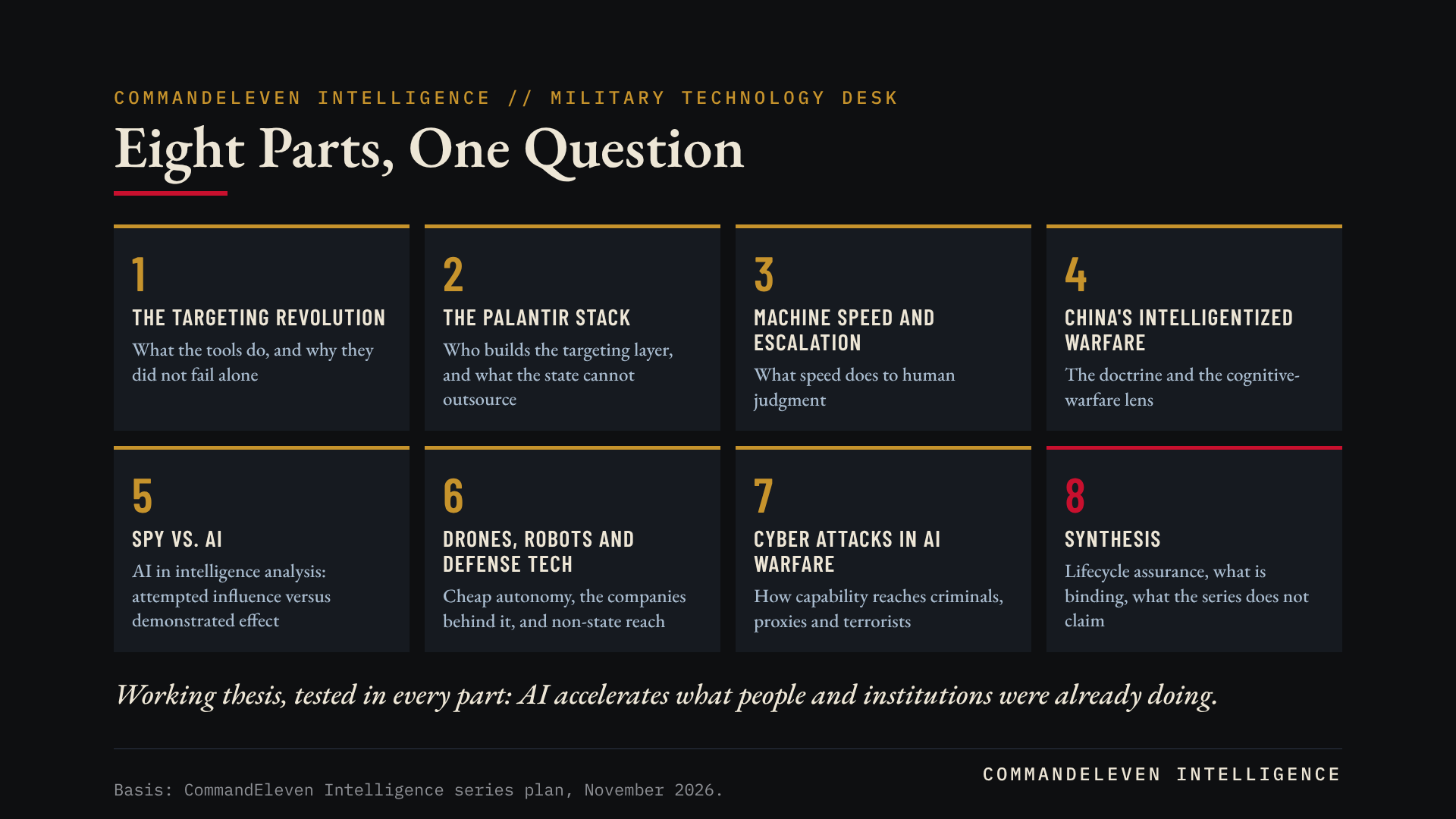
The eight parts share one thesis and test it in different places.
- Part 1, The Targeting Revolution: From Maven to Lavender. What decision-support systems do, what has been reported about their use, and why the tool did not fail alone.
- Part 2, The Palantir Stack. Who builds and sells the targeting layer, and why commercial design choices carry legal risk the state cannot outsource.
- Part 3, Machine Speed and the Escalation Problem. What speed does to human judgment, and where escalation risk sits.
- Part 4, China’s Intelligentized Warfare. The doctrine, and the cognitive-warfare lens.
- Part 5, Spy vs. AI. What AI does to intelligence analysis, and the discipline of separating attempted influence from demonstrated effect.
- Part 6, Drones, Robots and the Defense-Tech Market. Cheap autonomy, the companies behind it, and how it reaches non-state users.
- Part 7, Cyber Attacks in AI Warfare. How AI-enabled capability reaches criminals, proxies and terrorists, and what is known about patch-to-exploit timing.
- Part 8, Synthesis. Lifecycle assurance, what is binding and what is not, and what the series does not claim.
What This Series Does Not Claim
- That AI caused the Minab school strike. The accounts we hold describe failures of data, process and human reliance on a tool, AI’s role is disputed, and the final report is unreleased.
- That humans are absent from these systems. In the cases we examine, they are present and often overloaded.
- That any state’s legal review regime is adequate. The Army papers propose governance. They do not certify anyone’s practice.
- That reported figures for Gaza systems are audited. They are reported, attributed and not independently verified here.
- That AI-enabled influence or cyber operations have decided any political outcome. The evidence we hold shows capability, not proven effect.
What We Do Not Know
- How much the Maven Smart System contributed to the Minab strike. Anonymous officials cite over-reliance on it, Palantir and its chief technology officer dispute that, and the final report is unreleased.
- How often reviewers override or accept recommendations in practice, beyond the reported Gaza figures.
- How states are applying their legal weapons reviews to AI decision-support tools, which are not weapons in the technical sense but shape the use of force.
- Whether a binding instrument is coming. Nobody in the sources we hold expects one soon.
What to Watch
- The final findings on the Minab strike.
- The next rolling text of the UN expert group on lethal autonomous weapons, and the language on human judgment and control.
- The Fourth REAIM Summit, which Kenya is to host in Nairobi in April 2027.
- Any public reporting on how decision-support recommendations are reviewed before strikes.
- Ratification and implementation of the Council of Europe AI treaty, and how its national defense exclusions are used.
Frequently Asked Questions
Is AI already choosing targets in war?
AI is used in the targeting process, from analyzing imagery to recommending targets. Whether a human decision stands between the recommendation and the strike is the question the series examines. A UN panel reported the apparent use of a loitering munition in autonomous mode in Libya in 2020, a rarer case (Goussac, p. 10).
Did AI cause the Minab school strike?
We do not know. The Army paper describes a data and process failure. Bloomberg reported that officials cited over-reliance on the Maven Smart System as one of three failures. Palantir disputes that, and the final report has not been released.
What does “human in the loop” actually mean?
It means different things. The European Parliament paper separates human control, oversight and judgment. Singer’s 2009 account shows the loop widening as technology advanced. The series treats it as a question to test, not a guarantee.
Is there a treaty on military AI?
Not one binding on military use. The Council of Europe AI treaty has exclusions for national defense. The UN expert group has met for more than ten years without negotiating a binding instrument, according to Cleobury.
Why read a 2009 book about robots?
Singer’s Wired for War is a baseline written before today’s systems. It shows what was predicted, including the widening loop and non-state use of cheap robots, and what has actually arrived.
Related Reading
- Jet Gerans and the Geography of Fear
- AI Attack Planning: What the GAO Test Proved
- Six Weapons Programs, One AI Model: What Anthropic’s Report Establishes and What It Does Not
- Cairn and ARTEX: What Vendors Have Documented About AI Agent Hacking Tools, and What They Have Not
- Rules of the Modern Battlefield: Series Introduction
- Palantir AI Architecture: Intelligence & Surveillance Capabilities
- Project Meridian Meets Fort Irwin: The Pentagon’s Technology Bet and the Field Test It Already Failed
Sources
- Zena Assaad and Adam Hepworth, “AI-DSS and the Erosion of Technical Integrity,” in Safety, Legal and Ethical Implications of Artificial Intelligence in the Military Domain, Australian Army Research Centre, Australian Army Occasional Papers, 2026, pp. 3 to 22.
- Rob McLaughlin and Conor McLaughlin, lifecycle governance paper in the same volume.
- Netta Goussac, Human control and AI-enabled military systems: Human rights risks, accountability and policy options for the European Union, European Parliament DROI workshop, PE 783.623, September 2026.
- Miroslav Mitrović, “Hybrid Warfare as Cognitive Conflict: Strategic Communications, Artificial Intelligence, and the Future of Influence Operations.”
- Simon Cleobury, “Machines of War,” Techplomacy Magazine, Aug. 25, 2026, and the Council of Europe AI treaty article, Sept. 3, 2026.
- P. W. Singer, Wired for War: The Robotics Revolution and Conflict in the 21st Century, Penguin, 2009.