AI in Warfare is part of the CommandEleven Intelligence Special Report – The Warnings Reassessed
AI in Warfare · Part 1 of 8 · Military Technology Desk · November 2026
Bottom Line Up Front
AI decision-support systems (AI-DSS) now sit inside the targeting cycle. They collect and organize data, predict patterns, and recommend actions. The public record on how they perform is thin and uneven: the most detailed account, of the Israeli system called Lavender, rests on anonymous sources and a denial from the Israeli military, and the most consequential recent case, the Minab school strike, has no released final report.
What the documents we hold do support is a narrower and more useful point. The failures they describe are rarely a model acting alone. They are decisions taken upstream, about data, testing, acquisition and review, and decisions taken in the loop, about how much time a human reviewer is given. A recommendation tool amplifies whatever process surrounds it.
Two cautions apply throughout. We do not claim that AI caused the Minab strike, and reporting on AI’s role there is disputed. And where we describe systems said to have been used in Gaza, we attribute the claim to the reporting that made it.
Key Judgments
- CONFIRMED. AI-DSS are in use in targeting. The Australian Army Research Centre’s 2026 paper states that they are being used in the Israel–Gaza war, the Russia–Ukraine war and, most recently, in support of Operation Epic Fury (Assaad and Hepworth, p. 4). The paper sorts their uses into three functions: description, synthesis and analysis; prediction and extrapolation; and recommendation (p. 4). A tool that only “describes” and a tool that “recommends” raise different oversight problems, and the word “AI” hides the difference.
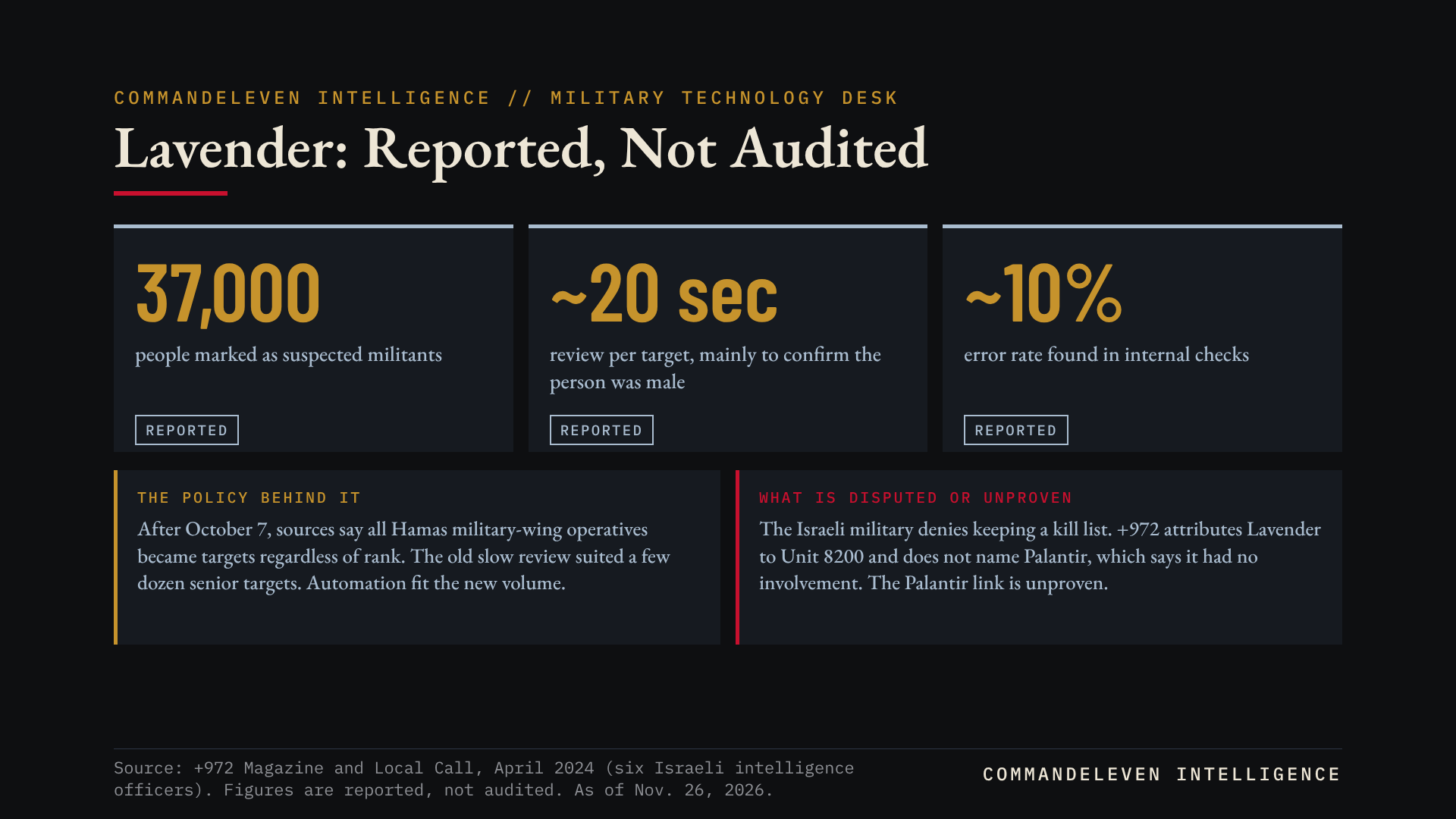
- REPORTED. Lavender, as described by +972 Magazine and Local Call in April 2024, rated almost every person in Gaza on a scale of 1 to 100 for likelihood of belonging to the military wing of Hamas or Palestinian Islamic Jihad, based on surveillance data. Six Israeli intelligence officers told the outlets that the system marked as many as 37,000 people as suspected militants, that officers often spent about 20 seconds on a target, mainly to confirm the person was male, and that internal checks showed errors in about 10 percent of cases. The sources also said the army authorized adopting the lists after a manual check of a sample of several hundred targets. The Israeli military’s spokesperson denied that such a kill list exists. We carry these figures as reported and unaudited. The European Parliament workshop paper repeats the same two figures, with the same attribution (Goussac, pp. 10 and 18).
- REPORTED. The same investigation describes a policy decision as much as a technical one. After October 7, according to its sources, the army designated all operatives of Hamas’s military wing as targets regardless of rank. That removed the old, slow “incrimination” process that suited a few dozen senior targets and made automation attractive. One officer is quoted as saying: “Once you go automatic, target generation goes crazy.” If the sources are right, the tool was adopted because a permissive target policy created a volume problem, not the other way around. Gospel, a companion system said to mark buildings and structures, was described in earlier reporting by the same outlets.
- ASSESSED. “Human in the loop” can be formally satisfied and practically empty. The European Parliament paper warns that tools which merely recommend can leave the human step as a “rubber stamp” under tempo pressure, and that errors then carry through each following judgment (Goussac, pp. 17 to 18). The Army paper makes the structural version of the point: speed and scale are built in upstream, during acquisition, and then carried into operations, where compressed decision cycles leave less time for the judgment the loop is supposed to supply (Assaad and Hepworth, pp. 12 to 13 and 20).
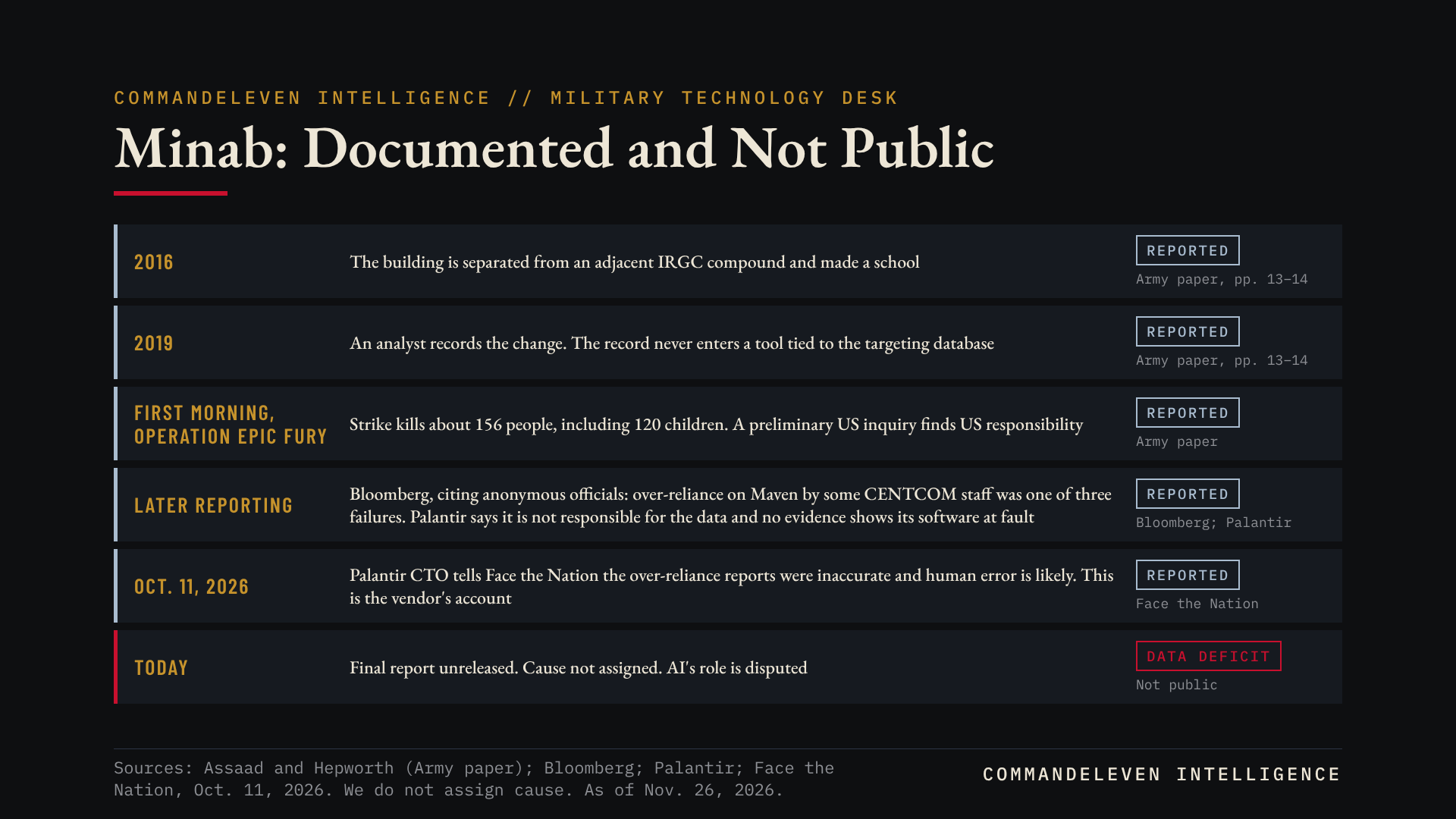
- REPORTED, with a DATA DEFICIT. The Minab school strike on the first morning of Operation Epic Fury killed approximately 156 people, including 120 children, according to the Army paper, which says a preliminary US military investigation determined US responsibility. The paper says it was widely reported that two AI systems were used, Palantir’s Maven Smart System and Anthropic’s Claude, and quotes US Central Command’s commander saying humans make the final decisions. Its account of the failure is a data one: the building was separated from an adjacent Islamic Revolutionary Guard Corps compound and made a school in 2016, an analyst recorded the change in 2019, and that record never entered a tool connected to the targeting database. A subsequent investigation, it says, found repeated decision-making failures over several years (Assaad and Hepworth, pp. 13 to 14). Bloomberg later reported, citing anonymous officials involved in the internal Pentagon review, that over-reliance on Maven by some Central Command personnel was one of three failures, alongside bad intelligence and outdated satellite imagery. Palantir told Bloomberg it is not responsible for the underlying data and that there is no evidence its software was at fault. Palantir’s chief technology officer, Shyam Sankar, told Face the Nation on October 11 that the likely cause was human error, that the over-reliance reporting was inaccurate, and that Palantir has since built additional AI checking outside the process it owns. His account comes from the company that sells the system. The Central Command commander said in May that the inquiry was nearing its conclusion (Reuters, May 19), but no final report has been released. We report the dispute and do not assign cause.
- ASSESSED. The Army papers argue that this is a lifecycle problem. Their claim is that AI-DSS quality depends on technical integrity (testing, evaluation, verification and validation), that accelerated development tends to compress those steps, and that the absence of AI-specific technical regulation leaves a gap (Assaad and Hepworth, p. 11). The legal counterpart is the review of new weapons and methods of warfare required by Article 36 of Additional Protocol I. Copeland argues that Article 36 is not confined to a one-off late check, that it cannot replace technical testing, and that it should also identify when a system should be redesigned, constrained or retired (pp. 66 to 85, especially pp. 74 and 85). That is an argument from the papers. It does not show that any state’s review is working.
- ASSESSED. States are building targeting into the plumbing. A RUSI paper of November 3, 2026 describes the UK’s Digital Targeting Web as a “targeting superstructure” linking sensors, deciders and effectors, with a first capability promised for 2027 and more than a billion pounds pledged in the 2025 Strategic Defence Review. Its recommendations include balancing assurance with operational pace and testing integration at realistic scale (Sylvia). The paper is about organization, architecture and trust, and says little about civilian-harm review. That gap is itself a finding.
Why the Tool Did Not Fail Alone
Set the three cases side by side.
| What the sources say | Where the failure sits | |
|---|---|---|
| Lavender (Gaza), reported | Broad target definition, a known error rate, and about 20 seconds of review per name | Policy and review time, as much as the model |
| Minab (Iran), unresolved | A 2019 record never reached the targeting database; officials reportedly cite over-reliance on Maven | Data pipeline, process and human reliance on a tool, with AI’s role disputed |
| UK Digital Targeting Web (design stage) | Speed and scale are the stated aims | Assurance has to be balanced against pace by design |
In none of these does a model act alone. In each, a decision about what counts as a target, what data feeds the system, or how long a person gets to look has already been made by people. That is the working thesis of the series, and it cuts both ways. It is not a reason to relax about the technology, because the same systems make the volume and tempo that stress the human steps. It is a reason to aim accountability at acquisition, testing, data stewardship and command.
What We Do Not Know
- How much the Maven Smart System contributed to the Minab strike. Anonymous officials cite over-reliance on it. Palantir and its chief technology officer dispute that. The final report is unreleased.
- How accurate the Lavender reporting is. It rests on six anonymous officers, and the Israeli military denies the existence of a kill list. The 37,000, 20-second and 10 percent figures are reported, not audited.
- How often reviewers reject or alter machine recommendations in any US, Israeli or allied system.
- How many targets were processed in the opening hours of Epic Fury, and how. Palantir’s chief technology officer, Shyam Sankar, told Face the Nation on October 11, 2026 that a thousand strikes in a day would once have taken 50 people two weeks of planning and can now be done by one person in four hours. That is a vendor’s account of its own product, not an audited figure.
- How states apply legal weapons reviews to decision-support tools that do not themselves fire.
What to Watch
- The final public findings on the Minab strike.
- Publication of the UK Digital Targeting Web reference architecture and standards, which RUSI recommends.
- Any public disclosure of how recommendations are reviewed before US or allied strikes.
- The UN expert group’s next rolling text on human judgment and control, and the Fourth REAIM Summit in Nairobi in April 2027 (covered in Part 8).
Frequently Asked Questions
What is an AI decision-support system?
It is software that collects and analyzes large datasets and produces outputs to support a decision. The Army paper sorts these into describing, predicting and recommending (Assaad and Hepworth, p. 4). Whether a tool recommends or merely describes changes how much weight a human reviewer gives it.
What is Lavender?
Lavender is a system that +972 Magazine and Local Call reported the Israeli military used in Gaza to rate people on their likelihood of belonging to Hamas’s or Islamic Jihad’s military wing. The Israeli military denies that it kept a kill list. Our figures are those the outlets reported.
Is Lavender a Palantir product?
The +972 investigation attributes Lavender to the Israeli military’s Unit 8200 and does not name Palantir. Palantir has said it has no involvement with Lavender. Palantir has a separate agreement with Israel’s Defense Ministry. We treat the Palantir link as unproven.
Is Project Maven the same as Lavender?
No. Maven is a US program, begun in 2017, for machine-learning analysis of imagery and other data. Lavender is a reported Israeli system that ranks people. The two are often named together because they sit in the same layer of the targeting process. Do not read one as a description of the other.
Did AI cause the Minab strike?
We do not know. The Army paper describes a data failure. Bloomberg reported that officials cited over-reliance on the Maven Smart System as one of three failures. Palantir disputes that, and the final report has not been released.
Does a human always make the final decision?
Officials in several countries say so. What matters is how much time, information and authority the human has. That is the question Parts 2 and 3 take up.
Related Reading
- AI in Warfare: Who Answers When the Machine Is Wrong?
- Palantir AI Architecture: Intelligence & Surveillance Capabilities
- Rules of the Modern Battlefield: Series Introduction
- Adversarial Machine Learning and Data Corruption
- Project Meridian Meets Fort Irwin: The Pentagon’s Technology Bet and the Field Test It Already Failed
Sources
- Zena Assaad and Adam Hepworth, “AI-DSS and the Erosion of Technical Integrity: Rethinking Human Decision-Making in Modern Warfare,” in Safety, Legal and Ethical Implications of Artificial Intelligence in the Military Domain, Australian Army Research Centre, Australian Army Occasional Papers, 2026.
- Damian Copeland, “The Role of Article 36 Legal Reviews Across the Military AI Assurance Lifecycle,” same volume.
- Yuval Abraham, “‘Lavender’: The AI machine directing Israel’s bombing spree in Gaza,” +972 Magazine and Local Call, April 3, 2024.
- Netta Goussac, Human control and AI-enabled military systems, European Parliament DROI workshop, PE 783.623, September 2026.
- Noah Sylvia, “The UK’s Digital Targeting Web: Implementing a Targeting Superstructure,” RUSI, November 3, 2026.
- Frederic Wehrey and Andrew Bonney, “The Middle East’s AI Warfare Laboratory,” Carnegie Endowment for International Peace, April 28, 2025, as published at War on the Rocks.
- Bloomberg graphic on the Minab strike investigation, about Sept. 18, 2026.
- Katrina Manson, “An Analyst’s Missed Remark Surfaced in Deadly Iran School Strike Probe,” Bloomberg, June 26, 2026.
- Kevin T. Baker, “AI Got the Blame for the Iran School Bombing. The Truth Is Far More Worrying,” The Guardian, March 26, 2026.
- “US probe into strike on Iran girls’ school near conclusion, US admiral says,” Reuters, May 19, 2026.
- Shyam Sankar, interview, Face the Nation, CBS, October 11, 2026.