
CommandEleven Intelligence // Europe Desk. Flash Assessment, status as of November 1, 2026. This follows our October 31 assessment of what happened and why it is contested. This one covers the consultations and the forward position. Reports still conflict on several points, and we say where.
Bottom Line Up Front
President Karol Nawrocki held his consultations on Saturday, October 31, and no agreement has been reported. Attendance was the news. His guests were mostly opposition parties, plus two members of the ruling coalition: the Polish People’s Party (PSL) and Poland 2050. Prime Minister Donald Tusk’s Civic Platform did not attend, and the coalition’s Left party refused. That evening Tusk gave a televised address that held to his line that there can be “no compromise” on the rule of law and offered no procedure for the judges’ oaths.
The suspension of Tribunal president Bogdan Święczkowski and vice-president Bartłomiej Sochański, ordered by Judge Anna Korwin-Piotrowska on October 30, runs to about the end of November. Nothing reported so far shows how the rival claims to the Tribunal’s leadership are resolved. Our assessment is that the most likely path is a prolonged standoff. The variable to watch is the ruling coalition: two partners have shown they will talk to the President, and Tusk has shown he will not move.
Key Judgments
KJ1: The consultations produced no reported agreement. No joint statement, proposal or follow-up date has been published in anything we could read as of this morning. We found no statement from Nawrocki after the meetings. [CONFIRMED on attendance; no outcome REPORTED]
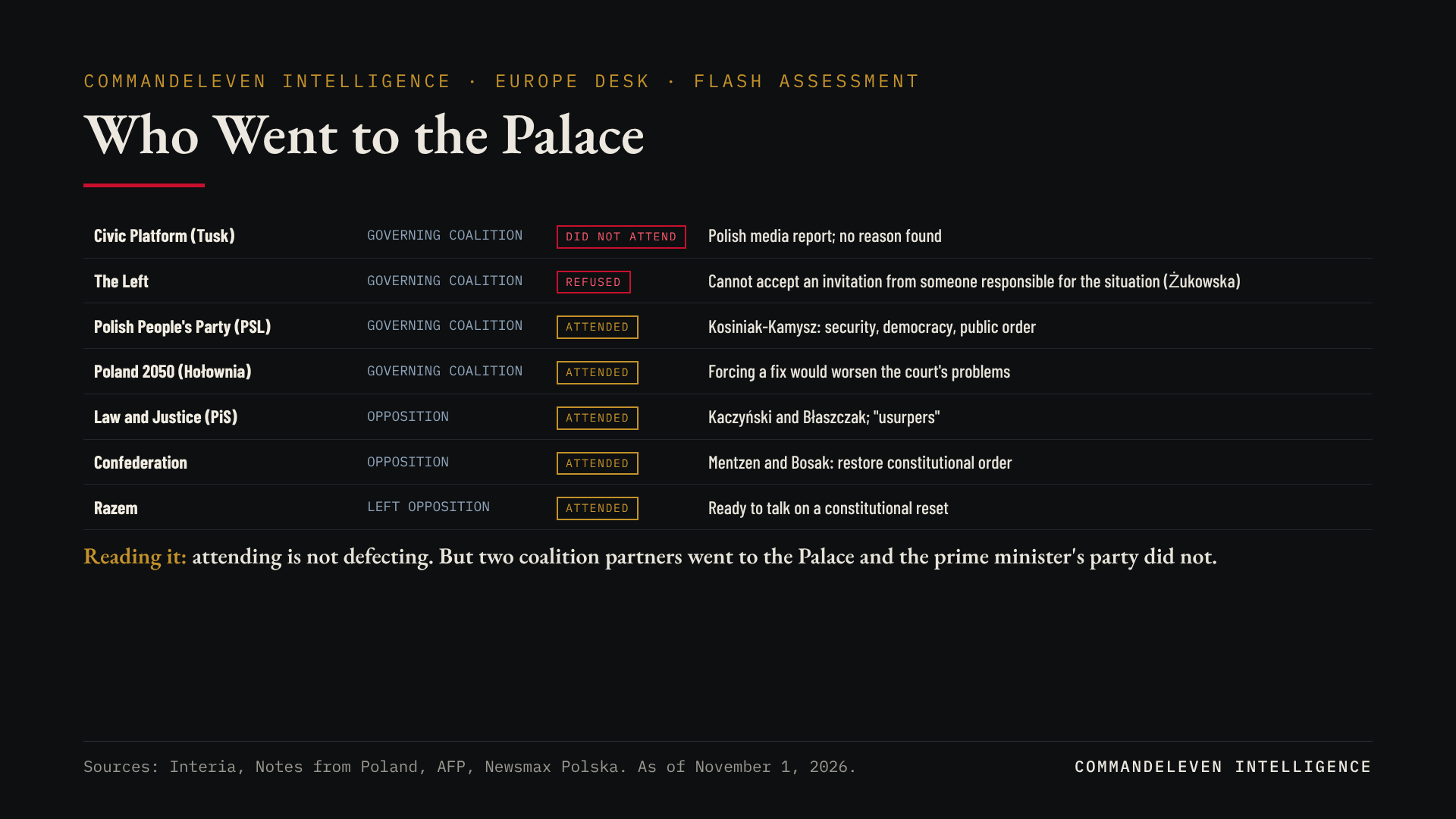
KJ2: The ruling coalition did not respond as one. PSL leader Władysław Kosiniak-Kamysz and Poland 2050’s Szymon Hołownia met the President. The Left refused, and Civic Platform did not attend. Attending a meeting is not breaking with the government, and Hołownia’s public line was that a forced fix will make the Tribunal’s problems worse. It is still the first visible difference between partners in this crisis. [CONFIRMED on attendance; ASSESSED on what it means]
KJ3: Tusk has set a firm line and no way out. His address called the events “scandalous” and said no politician, the President included, may enter a court, instruct judges or intimidate them. It described the Sejm’s judges as legally appointed. It did not offer a way to settle the oath dispute. [CONFIRMED]
KJ4: The dispute over who leads the Tribunal is unchanged. Korwin-Piotrowska acts as head and police guard the building. Święczkowski, Nawrocki and PiS say he is still president. No court can settle it, because the court is the dispute. [CONFIRMED]
KJ5: Outside pressure has started, and we still find no foreign hand. The European Commission reportedly urged Nawrocki to accept the judges chosen by parliament, and the US ambassador urged all sides to avoid violence. Tusk warned that pro-Russian groups, including online bots, could exploit the conflict. We repeat our earlier finding: nothing we could read shows the EU, Russia or Ukraine caused or directed this. [REPORTED; ASSESSED, low confidence, on exploitation]
KJ6: Three dated calls are set here. They are listed below and will be scored on the Foresight Record. [METHOD]
What Happened Since October 31
Our first assessment left the consultations as an open item. Here is what is now on the record.
- The overnight confrontation, in more detail. Notes from Poland reports video showing Nawrocki pushing past Korwin-Piotrowska at the Tribunal entrance. Presidential aide Marcin Przydacz said the judges had violated the President’s inviolability. Judge Maciej Berek, a Tusk ally, said Nawrocki forced his way past her. Both accounts are partisan, and we treat the physical details as [DISPUTED]. The President’s own statement called the night a “forcible takeover of a constitutional body.”
- The immunity track. Justice Minister Waldemar Żurek is seeking to lift Święczkowski’s immunity and said he hoped prosecutors would act on the President’s conduct, arguing immunity should not cover it. [REPORTED]
- The street. AP reports hundreds of protesters outside the Tribunal for a second night, including PiS leader Jarosław Kaczyński and far-right politicians. Police detained three people on Friday night after objects were thrown and a fence was breached. CGTN also reports several hundred. We have no count above that. [REPORTED]
- The consultations. Nawrocki invited all parliamentary groups to the Palace. The attendees are covered in the next section. As of this morning, no agreement or next meeting has been reported.
Who Went to the Palace
- Polish People’s Party (PSL, governing coalition). Deputy Prime Minister and Defense Minister Kosiniak-Kamysz and Deputy Sejm Marshal Piotr Zgorzelski met the President. Kosiniak-Kamysz said before the meeting that state security, democracy, social peace and public order were fundamental values and that he would raise them. [REPORTED]
- Poland 2050 (governing coalition). Hołownia confirmed his party would attend. He said the night’s events brought shame on Poland and that forcibly fixing the Tribunal would make its problems worse. He urged Tusk to meet Nawrocki. [REPORTED]
- The Left (governing coalition). Refused. Club chair Anna Maria Żukowska said one cannot accept an invitation from someone who is himself responsible for the situation, and asked Nawrocki to confirm the judges’ oaths sent to his chancellery. One wire report says instead that the Left was not invited and would not have come. We use the Polish outlet’s direct quote. [REPORTED; accounts differ]
- Civic Platform (Tusk’s party). Did not attend, according to Polish media cited by AFP. We found no reason given. [REPORTED]
- Opposition. Law and Justice (Kaczyński and Mariusz Błaszczak, whose spokesman called the judges who entered “usurpers”), Confederation (Sławomir Mentzen and Krzysztof Bosak), the left-wing Razem party, and former prime minister Mateusz Morawiecki with Marcin Horała, listed by Interia as Rozwój Plus. The attendance of the last four rests on pre-meeting schedules, not confirmed arrivals. [REPORTED]
[ASSESSED] The President invited everyone and got the people he expected, plus two government partners. For Nawrocki that is a small gain: he can say he sought a solution and that part of the coalition listened. For Tusk the cost is limited so far. His partners have not criticized the suspension, and the Left’s refusal backs his line. The risk to him is a slow one: PSL and Poland 2050 are the partners with the most to lose in next year’s parliamentary election, and a long crisis makes their distance from him more valuable.
What Tusk Said
- On compromise. “In certain matters there can be no compromise,” and force, aggression and party interests must not decide who is right.
- On the President. No politician, the President included, has the right to enter a court, instruct judges or intimidate them.
- On the judges. The Sejm elected new judges who took their oaths, and the President did not receive them. They are legally appointed and were attacked. His government’s proposals were blocked by PiS and the President, and the majority waited for the terms of PiS-appointed judges to expire.
- On the Tribunal. It will act under the constitution and independently of the executive, and the government will provide its security and working conditions.
- On Russia. Pro-Russian groups, including bots, could exploit the conflict.
Euronews notes that the speech offered no concrete agreement with Nawrocki and no detailed plan. [REPORTED]
The Polish Public: What We Can and Cannot Say
We found no poll taken since the events of October 30, and we do not infer opinion from the crowd outside the Tribunal. Two earlier polls give context, and neither measures this crisis. A July SW Research poll for Onet asked who is right in the rule-of-law dispute: 25.5 percent said Żurek, 16.1 percent said Święczkowski, 19.4 percent said neither, and 39 percent either could not say or did not know the case. A September 2025 Opinia24 poll for RMF FM, on the wider conflict between the President and the government, found 38 percent wanted a compromise, 23 percent wanted the government to yield and 21 percent wanted the President to yield. [REPORTED; neither poll covers the suspension]
[ASSESSED] The pattern in both polls is a large middle that is undecided or wants a settlement. That is consistent with the partners who went to the Palace, and it is the audience both camps are trying to reach.
The Forward Position
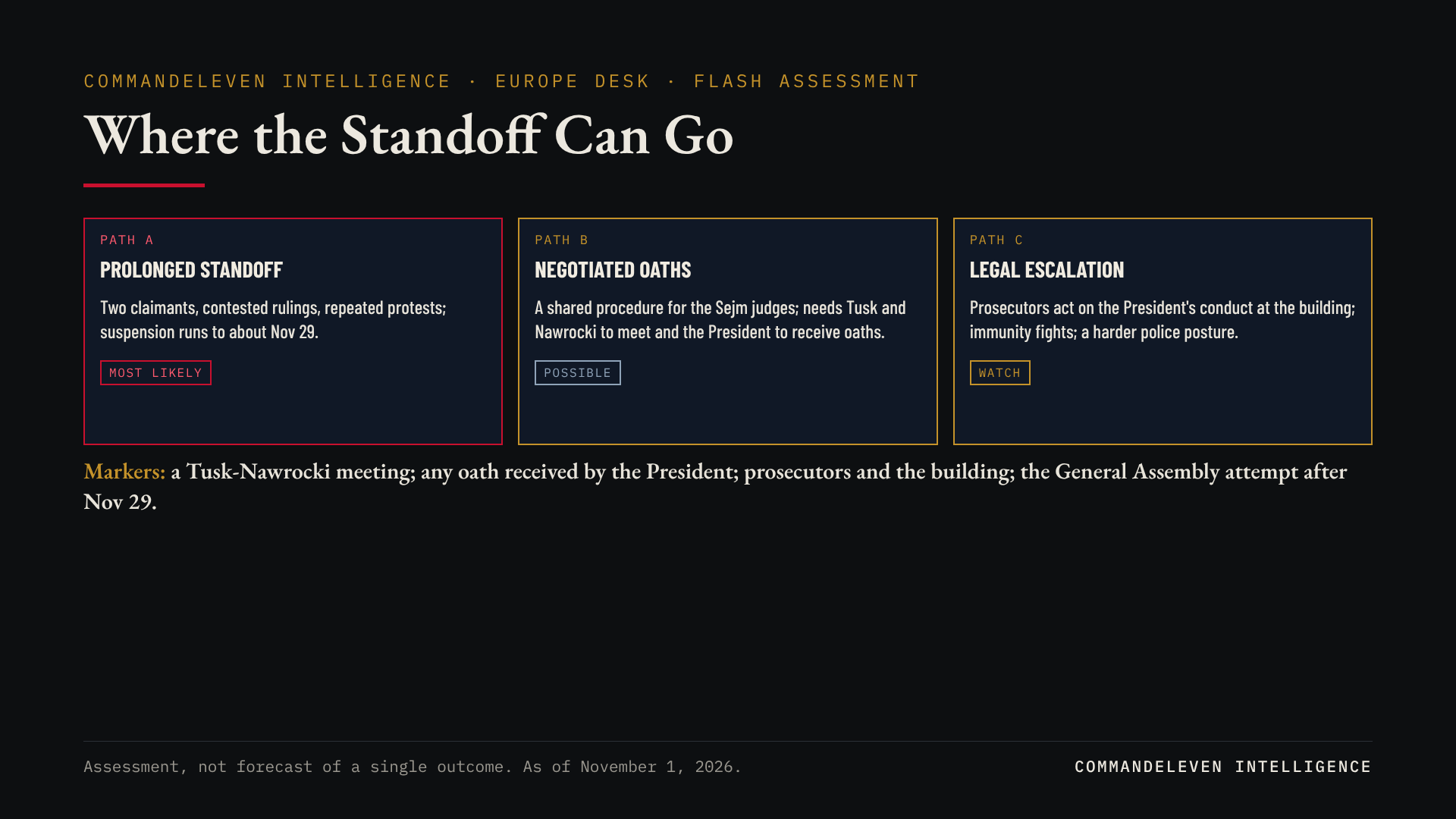
[ASSESSED] We see three paths. Each has markers we can check.
- Path A, a prolonged standoff (most likely). Two claimants to the Tribunal’s leadership, contested rulings, repeated protests, and a General Assembly attempt after the suspension ends about November 29 that PiS is expected to boycott. Neither Tusk nor Nawrocki has a reason to move before the election, and the Tribunal cannot arbitrate itself.
- Path B, negotiated oaths (possible, but not on current evidence). A shared procedure for the Sejm judges, which needs Tusk and Nawrocki to meet and the President to receive oaths. The partners who attended have called for talks, but we saw no sign that either principal is ready.
- Path C, legal escalation (watch). Prosecutors act on the President’s conduct at the building, immunity fights widen, and police take a firmer posture. On our reading of Article 145 of the constitution, a sitting president can be held to account only through the State Tribunal, which requires a two-thirds vote of the National Assembly, so we see little practical prospect of formal charges. That reading is ours and is not reported anywhere. The Tribunal’s own immunity votes need at least 10 of 15 judges, as reported, and the government cannot reach that while the dispute over who sits remains open.
What to Watch
- A Tusk-Nawrocki meeting. Hołownia has publicly urged it. A meeting would be the first sign of Path B.
- Any oath received by the President. Even one would change the dispute.
- The building. Who controls access, the website and case assignment, and whether riot police stay.
- The partners. Whether PSL and Poland 2050 criticize the suspension itself, not only the violence around it.
- Brussels. Whether the European Commission statement is repeated on the record and whether it is followed by a formal step.
- Late November. The end of the suspension and the General Assembly attempt.
Calls We Will Score
- By November 30, 2026, President Nawrocki will not have received the oath of any Sejm-elected Tribunal judge he has so far declined.
- By November 30, 2026, Tusk and Nawrocki will not have held a meeting on the Tribunal dispute.
- By December 31, 2026, the Tribunal’s General Assembly will not have voted to lift Święczkowski’s immunity.
Each is scored confirmed, partly confirmed or missed on the Foresight Record’s method, with the date and sources in the entry.
What This Assessment Does and Doesn’t Establish
It establishes who attended or refused the consultations, what Tusk said, and what the main actors and outside bodies have said since October 31, as reported through the morning of November 1. It does not establish what was said inside the meetings, whether any agreement is being prepared, who is legally right, or how Poles as a whole feel. Several attendance details come from pre-meeting reports, the Commission statement comes from a single wire report, and most Polish-language sources were read through summaries. Al Jazeera, France 24, CNN and NPR could not be retrieved. We have not read the Venice Commission opinion or the full text of the suspension order.
Frequently Asked Questions
What came of the President’s consultations?
No agreement has been reported. The President met opposition parties and two coalition partners, PSL and Poland 2050. Civic Platform did not attend, and the Left refused.
Is Tusk’s coalition splitting?
Not on this evidence. Two partners talked to the President, which is a visible difference from Tusk. Neither has called for the suspension to be reversed in anything we read.
Who controls the Constitutional Tribunal now?
Judge Anna Korwin-Piotrowska acts as head with the government’s backing and a police guard on the building. The President, PiS and Święczkowski say Święczkowski remains president. Both claims are in force at once.
Is Russia behind it?
We found no reporting that says so. Tusk warned that pro-Russian groups could exploit the conflict, which is a risk, not a finding.
What happens next?
The suspension runs to about November 29. After that the acting head plans a General Assembly of judges that PiS is expected to boycott. Our most likely path is a prolonged standoff.
Sources
- Notes from Poland, Polish president in physical confrontation with judges amid power struggle at constitutional court
- News4Jax (AP), Tusk defends suspension of Poland’s Constitutional Tribunal president as protesters gather again
- Yahoo News, Polish president discusses Constitutional Court row with politicians
- Yahoo News Singapore (AFP), Polish president holds crisis talks in court standoff
- Euronews, Poland crisis: Donald Tusk strikes defiant tone vowing ‘no compromise’ on rule of law after Tribunal clash
- CGTN, Poland’s PM, president clash over control of top court
- Interia, Trybunał Konstytucyjny. Spotkania z prezydentem Nawrockim. Lewica odmówiła (Polish; who refused and who attended)
- Newsmax Polska, Trwa spotkanie w Pałacu. Prezydent Nawrocki rozmawia z koalicjantami Tuska (Polish; PSL attendance)
- Wprost, Szef TK ma rację ws. sporu o praworządność? Polacy zabrali głos w sondażu (Polish; SW Research poll for Onet)
- money.pl, Konflikt na linii Nawrocki-rząd. Kto powinien ustąpić? Polacy wskazują (Polish; Opinia24 poll for RMF FM, September 2025)