
CommandEleven Intelligence // Europe Desk. Flash Assessment, status as of October 31, 2026. This is a fast-moving story. Reports conflict on several points, and we say where. It will be updated.
Bottom Line Up Front
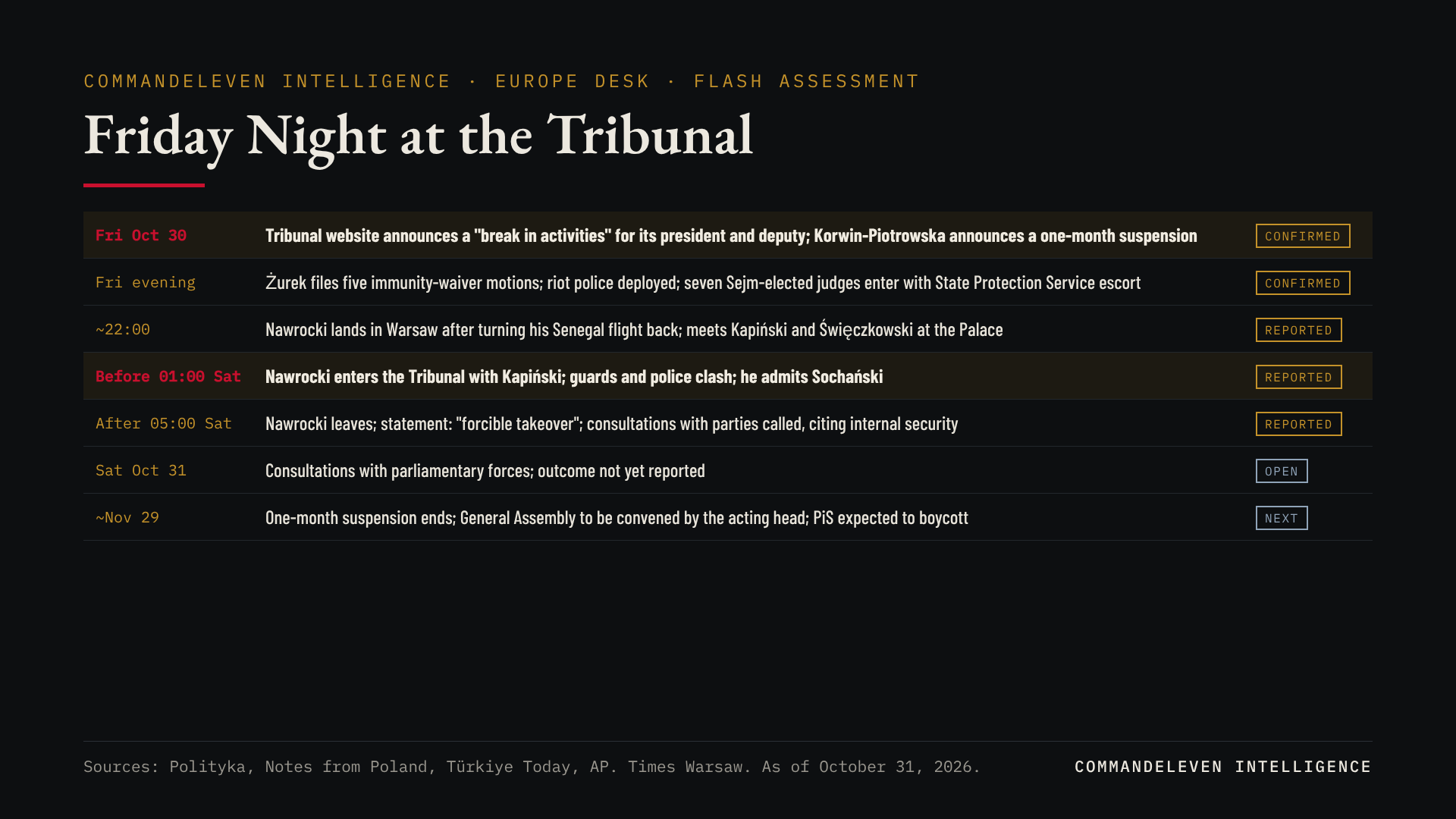
On the evening of Friday, October 30, Judge Anna Korwin-Piotrowska ordered a one-month suspension of the Constitutional Tribunal’s president, Bogdan Święczkowski, and its vice-president, Bartłomiej Sochański, and declared herself the Tribunal’s acting head. Riot police surrounded the building. Seven judges elected by the current Sejm majority were escorted inside by State Protection Service officers. President Karol Nawrocki turned his plane back from Senegal, landed in Warsaw around 22:00, and entered the Tribunal before 01:00. He left a little after 05:00 and called urgent consultations with parliamentary parties for Saturday, citing a threat to internal security.
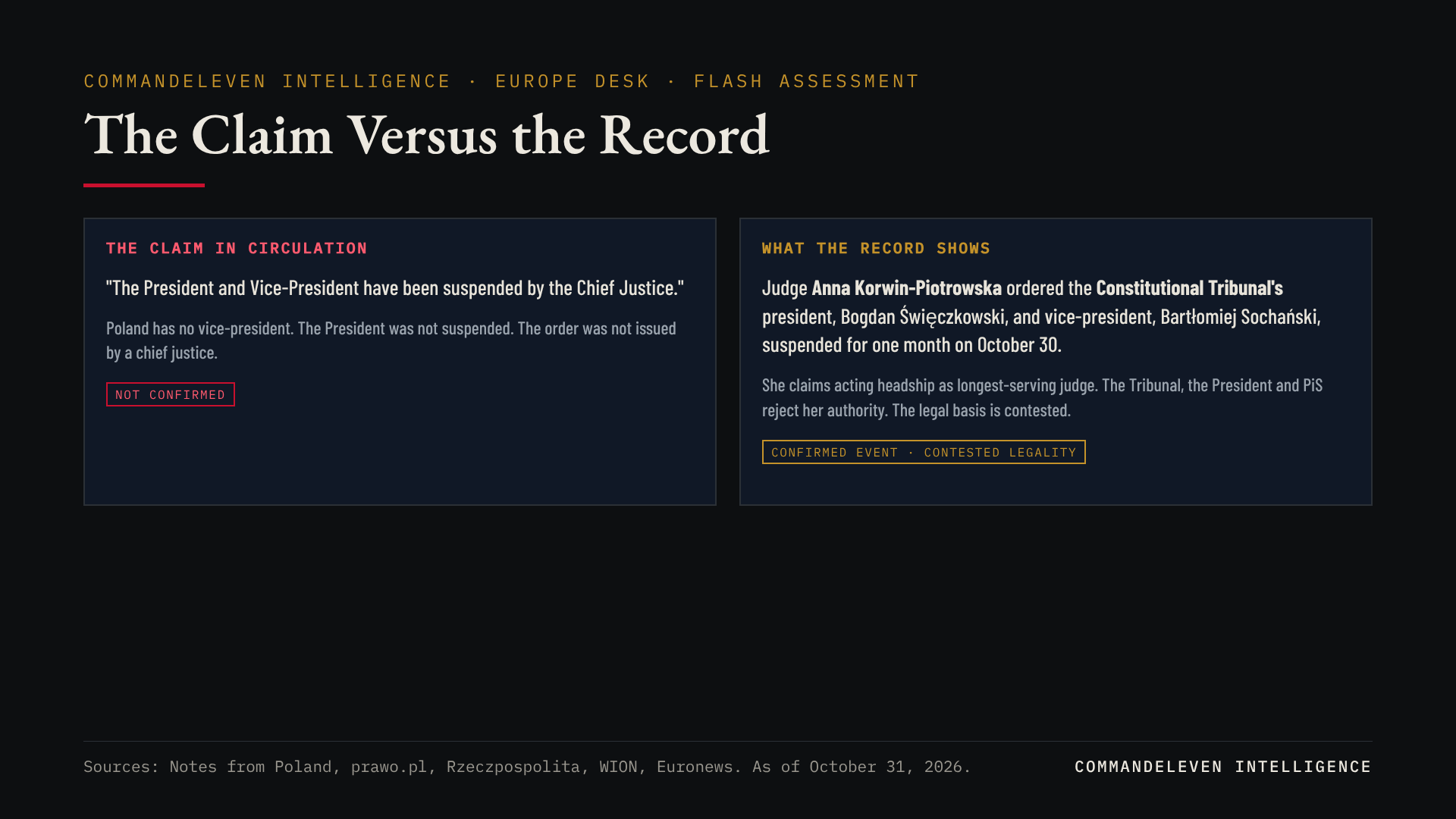
A correction to how this has circulated. It has been described as the President and Vice-President being suspended by the Chief Justice. That is not what happened. The President of Poland was not suspended, Poland has no vice-president, and the person who issued the order is not a chief justice. The two men suspended are the president and vice-president of the Constitutional Tribunal. The Tribunal is a separate body from the Supreme Court, whose First President, Zbigniew Kapiński, sided with Nawrocki.
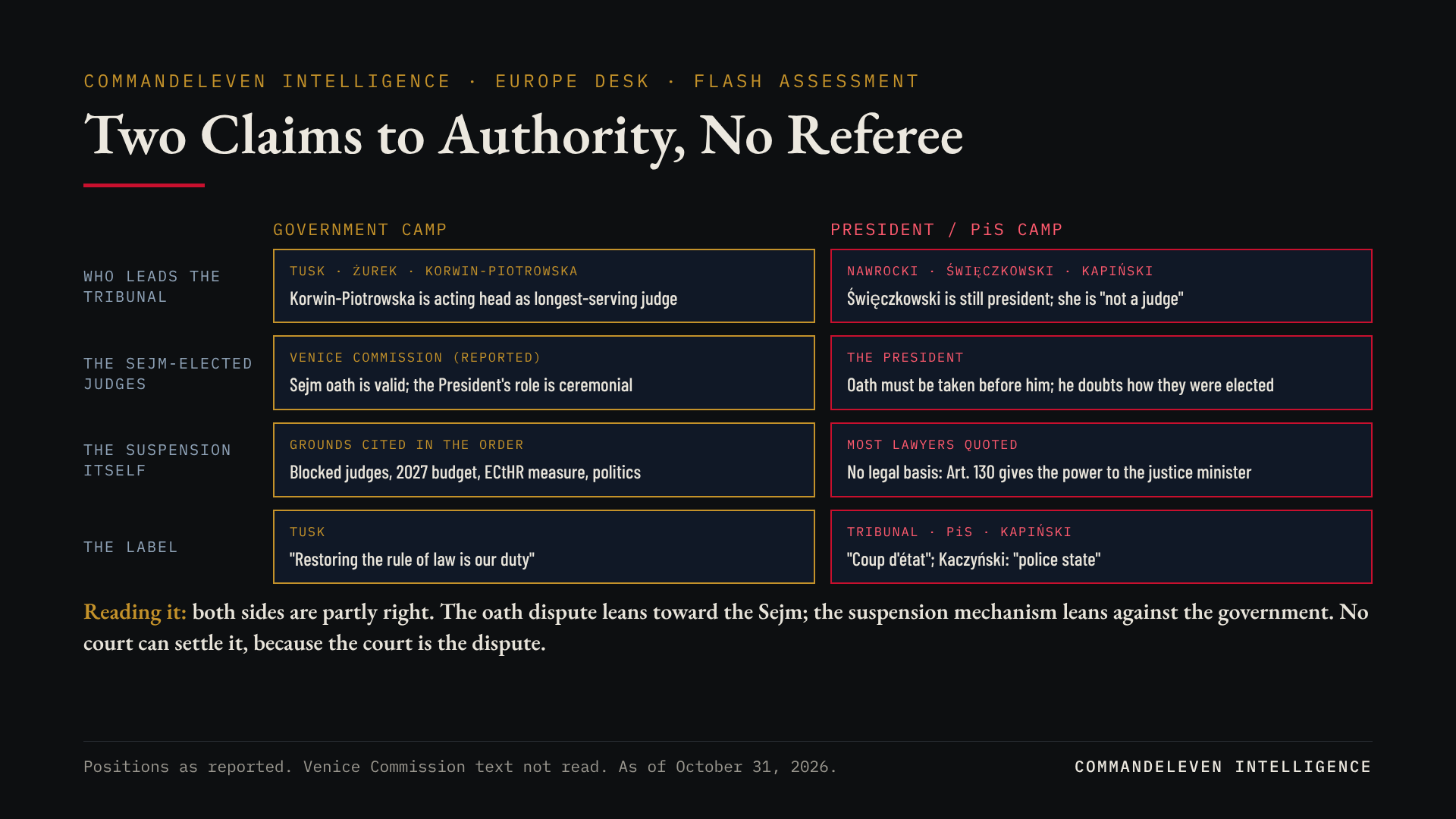
This is a real constitutional crisis, but a different one from the claim. Two camps each say the other is acting unlawfully, and both have a point. The government and its judges have a strong case that the Sejm’s appointees were validly elected. Most of the constitutional lawyers quoted say the suspension order itself has no sound legal basis. CommandEleven Intelligence is publishing this as an assessment of a live dispute, not a verdict on who is right.
Key Judgments
KJ1: The core events are well established. The suspension order, the police deployment, the entry of the Sejm-elected judges, the President’s return and overnight visit, and the immunity motions are reported consistently by Polish and international outlets. [CONFIRMED]
KJ2: The legal basis of the suspension is weak, and the dispute behind it is not one-sided. The order relies on provisions that give the suspension power to the justice minister, not to a fellow judge, and the minister does not supervise the Tribunal. One of the Tribunal’s own critics, Prof. Marcin Matczak, says the basis does not exist. The underlying grievance is stronger: the President has declined to receive oaths from judges the Sejm elected, and the Venice Commission reportedly found the Sejm oath valid. [ASSESSED, moderate confidence]
KJ3: Poland now has two claimants to authority over the Tribunal, and no referee. The President and Święczkowski say Święczkowski is still in office. Korwin-Piotrowska and the government say she is acting head. Courts, police and the Tribunal’s own website are on opposite sides of the line. Nothing reported so far shows how this is resolved. [ASSESSED]
KJ4: The immunity motions are unlikely to succeed on their own. Lifting a Tribunal judge’s immunity needs a resolution of the General Assembly with at least two-thirds of the judges present, reported as at least 10 of the 15. The government cannot get there without winning the dispute over who sits on the Tribunal. [ASSESSED, moderate confidence]
KJ5: We found no evidence that the EU, Russia or Ukraine caused or directed this. It is a domestic dispute over the Tribunal that has run since 2015. Russian information operations may exploit it, which is a standing risk, not an observation. [ASSESSED, low confidence on the information-operations risk]
KJ6: Nothing here is registered on the Foresight Record. The story is hours old, and the numbers and sequence are still being reported. [METHOD]
What Happened, in Order
- Friday evening, October 30. A notice on the Tribunal’s website announced a “break in activities” for Święczkowski and Sochański without saying who ordered it. Korwin-Piotrowska then announced that she had suspended both for one month as the longest-serving judge. The Tribunal’s own X account called it an unlawful takeover of its website and said she is not a Tribunal judge. [CONFIRMED]
- The same evening. Justice Minister and Prosecutor General Waldemar Żurek said he had filed five motions to lift the immunity of the two men, four against Święczkowski and one against Sochański, and had sent 50 volumes of case files. [CONFIRMED]
- Police and the building. Riot police were deployed. Seven judges elected this year entered the building escorted by State Protection Service officers, through a gate from the prime minister’s chancellery, according to the Tribunal’s spokeswoman. Protesters cut through a fence, objects were thrown at officers, and three people were detained. Reports conflict on whether police entered the building or only the grounds. [CONFIRMED on the deployment; DISPUTED on the police entry]
- The President. Nawrocki ordered his plane back mid-flight, saying the president “must be in Poland.” He landed shortly before 22:00, met Kapiński and Święczkowski at the Presidential Palace, then went to the Tribunal with Kapiński before 01:00. A video posted by Judge Maciej Berek reportedly shows presidential guards clashing with police. Nawrocki said he enabled Sochański, “the legally serving vice president,” to enter. [CONFIRMED on the visit; REPORTED on the clash]
- Saturday morning, October 31. Nawrocki left shortly after 05:00. A statement read outside by presidential minister Paweł Szefernaker called the events a “forcible takeover,” demanded that the “coercive forces” sent by the government leave, and announced consultations with parliamentary forces, citing a threat to internal security. The government says the situation is stabilizing and that those who entered have been removed or left. The consultations are set for Saturday, and no outcome has been reported yet. [REPORTED]
Why It Was Done: The Grounds Given
The order gives three reasons. [REPORTED, from the text of the order as summarized by Polish legal press]
- The budget. Święczkowski did not convene the General Assembly of judges, so the Tribunal’s 2027 budget draft could not be adopted in time for the state budget.
- Blocking judges. He kept the Sejm-elected judges from taking part in the Tribunal’s work and did not comply with an interim measure issued by the European Court of Human Rights on May 5, 2026. That court belongs to the Council of Europe, not the EU.
- Politics. He allowed politicians into the Tribunal, including at the October 14 oath of Judge Maciej Berek, and made openly political public statements.
Żurek put the government’s wider position in one line: the court “has become private property” and must be returned to proper functioning. The government has long treated parts of the Tribunal as illegitimate because of judges it says were unlawfully appointed under the previous Law and Justice (PiS) government, and it has declined to publish some of the Tribunal’s rulings.
The Background That Explains the Date
The Tribunal has 15 seats, and a bench needs at least 11 judges to sit validly. For most of Tusk’s term the government declined to nominate judges. In March 2026 the coalition began filling vacancies, and the Sejm has elected eight judges this year. Under Polish law new judges take their oath before the President. Nawrocki, an ally of PiS, swore in some and refused others, citing how they were chosen or their qualifications. Anna Korwin-Piotrowska was among those not sworn in. They held their own oath ceremonies in the Sejm, and Święczkowski, chosen Tribunal president in December 2024, refused to admit them to the bench. [CONFIRMED]
Outlets give different counts of how many were refused: three of six, four of six, and five of eight all appear in the reporting. We use none of them as settled. The direction is consistent. A group of Sejm-elected judges has been shut out for months, and the Tribunal has been close to paralyzed. In October the Venice Commission, the Council of Europe’s constitutional advisory body, reportedly published an opinion that a Sejm oath is valid and that the President’s role in the oath is ceremonial. We have not read the opinion itself and rely on Polish press for its content. [REPORTED]
The Legal Dispute
Korwin-Piotrowska’s order cites Articles 11(2) and 12(4) of the Tribunal Act, which say that when the presidency is vacant the longest-serving judge directs the Tribunal, plus Article 130 of the common-courts law on temporary suspension of a judge for up to one month. She counts her service from September 1, 1995, when her court apprenticeship began.
- Against the order. Prof. Marcin Matczak, who has criticized PiS-era court changes and called Święczkowski a poor choice for president, says the basis is absent. Article 130 gives the power to the justice minister, who does not supervise the Tribunal, and Tribunal judges answer only to the Constitution. Prof. Jacek Zaleśny says only the General Assembly can decide a suspension, and that someone not properly seated as a judge cannot. [REPORTED]
- Leaving it open. Jerzy Stępień, a former Tribunal president, sees formal grounds in theory for a longest-serving judge to issue such an order but declined to reach a firm conclusion. [REPORTED]
- The step before it. Many legal experts argue that if the President accepted two of the Sejm’s appointees, he had to accept all of them. PiS suspended one of its own MPs, a legal scholar, who held that view. The Venice Commission reportedly sides with the Sejm on the oath. [REPORTED]
[ASSESSED] The government’s case is stronger on why it is angry than on how it acted. A dispute over the oath is a real legal question with reasonable support on the Sejm’s side. The route the government’s judges chose, a single judge suspending the president and vice-president and entering with police and security officers, is the part that most legal commentators in the record will not defend. The President’s overnight entry into the building is itself contested: the acting head says she did not consent to anyone entering.
Reactions
- Prime Minister Donald Tusk: restoring the rule of law is a duty, “there is no other way,” though the process is sometimes painful.
- Interior Minister Marcin Kierwiński: police acted professionally and did not escalate.
- President Nawrocki: a “forcible takeover” that violates the constitutional order, and a threat to internal security.
- Jarosław Kaczyński (PiS): Poland is becoming a “police state”; he urged supporters to continue the protest. Former prime minister Mateusz Morawiecki condemned the “forceful takeover.” Former justice minister Zbigniew Ziobro called it a coup and urged “resistance.”
- Zbigniew Kapiński, First President of the Supreme Court: appalled, “undoubtedly a coup d’etat,” and opposed to using police for a constitutional dispute. Note that Nawrocki appointed him in May 2026.
- Piotr Duda, head of the Solidarity union: “Do you want a war? Then you shall have one.”
- US Ambassador Tom Rose: “very serious,” urged all sides to avoid violence, and said Washington will not interfere. He warned that the crowds made the situation more volatile.
The Polish public. The evidence so far is thin. PiS supporters had camped outside the Tribunal for weeks to stop the Sejm’s judges being introduced by force. Polityka put the crowd at the Tribunal that evening at about 100, mostly readers and backers of the right-wing weekly Gazeta Polska, with the former PiS-era Tribunal president Julia Przyłębska present. Protesters chanted “Tusk traitor,” and some prayed with rosaries outside. No outlet we could read gave a larger count, and we found no poll taken since the events. A national picture of public opinion is not yet available, and we do not infer one from the crowd outside the building. [REPORTED; public opinion UNVERIFIED]
Claims in Circulation, Tested
- “The President and Vice-President were suspended by the Chief Justice.” Not supported. See the correction above. [NOT CONFIRMED]
- “Poland is the only EU nation that refused the asylum wave.” Not supported as stated. Poland has resisted EU relocation quotas, and Tusk said in October 2025 that Poland would take none, though that exemption was still unofficial when he said it. Poland also suspended asylum applications at its Belarus border in 2025 and says it hosts nearly a million Ukrainian refugees. It is not the only member state to resist relocation, and the link to this crisis is not established. The Tribunal dispute concerns judicial appointments, not migration. [PARTLY CONFIRMED on policy; NOT CONFIRMED as a cause or as unique]
- “Poland is a target for the EU and Russia, for Ukraine.” We found no reporting tying this event to Brussels, Moscow or Kyiv. The EU institutions have not been quoted in anything we could read, and the one European body on the record, the Council of Europe’s human-rights court, acted before this week. Poland’s foreign minister warned in June that Russia is waging a “cognitive war” against Poland, so amplification of this story by Russian channels is plausible. A related controversy sits next to it: on October 29, Kaczyński floated treaty-exit negotiations at the Krynica Forum and then denied wanting to leave the EU, and Tusk’s camp is framing PiS as heading toward a Polexit. [UNVERIFIED as a driver; ASSESSED, low confidence, on information-operations risk]
What Happens Next
The reporting offers only a few fixed points. The one-month suspension runs to about the end of November. Korwin-Piotrowska plans to convene a General Assembly of Tribunal judges after it to decide the two men’s fate, and Święczkowski and PiS are expected to boycott it and call it illegal. The immunity motions sit with a Tribunal that cannot easily vote on them. Parliamentary elections are due next year, and both camps are already using the crisis in that campaign. [REPORTED]
[ASSESSED] The most likely path is a prolonged standoff with two rival claims to the Tribunal’s leadership, contested rulings, and repeated rounds of protest, rather than a quick settlement. Three markers will show whether it is hardening or easing.
- The consultations. Whether the ruling parties attend, and whether Nawrocki and Tusk set any shared procedure for the Sejm judges’ oaths.
- The building. Who controls access, the website and the case-assignment system in the coming days, and whether police remain in place.
- Prosecutors and the President. Żurek said he hoped prosecutors would act on the President’s own conduct at the building. Any step against Nawrocki would move this from a dispute over a court to a clash between the presidency and the government.
- Late November. The end of the suspension and the General Assembly attempt.
What This Assessment Does and Doesn’t Establish
It establishes what was done, by whom, on what stated grounds, and how the main actors responded, using outlets from the government and opposition sides and wire services. It does not establish who is legally right, whether the Sejm’s judges are validly seated, how large the protests were or how Poles as a whole feel. It does not rest on the Venice Commission’s text, which we have not read, or on the full text of the order, which we know through Polish legal press. It treats the migration and foreign-power framings as claims, not findings.
Frequently Asked Questions
Who was suspended in Poland?
The president and vice-president of the Constitutional Tribunal, Bogdan Święczkowski and Bartłomiej Sochański, for one month, by order of Tribunal judge Anna Korwin-Piotrowska on October 30. The country’s President, Karol Nawrocki, was not suspended.
Is the suspension legal?
Disputed. Most constitutional lawyers quoted say the provisions cited do not let a single judge suspend the Tribunal’s leadership. No court has ruled, and the Tribunal itself is the body in dispute.
Is this a coup?
The Tribunal, PiS, the President and the Supreme Court’s First President use that word. The government says it is restoring the rule of law. We describe the act as a contested takeover of a court’s leadership and leave the label to the legal process.
Why did this happen now?
Months of standoff over the oaths of Sejm-elected judges, a stalled 2027 Tribunal budget, and a European Court of Human Rights interim measure the Tribunal’s president did not follow, with parliamentary elections due next year.
Are the EU or Russia behind it?
We found no reporting that says so. It is a domestic dispute with a long history, though foreign actors may try to exploit it.
Will CommandEleven Intelligence score this?
Not yet. No dated calls are set, and nothing here is counted on the Foresight Record.
Sources
- Notes from Poland, Chaos at Poland’s constitutional court as government-backed judges seek to oust chief justice
- Polityka, Bój o Trybunał Konstytucyjny. Bogdan Święczkowski odsunięty, PiS mówi o zamachu stanu (Polish)
- prawo.pl, Spór o Trybunał Konstytucyjny: Anna Korwin-Piotrowska zawiesza w czynnościach Święczkowskiego (Polish; the order’s grounds and the immunity rules)
- Rzeczpospolita, Odsunięcie prezesa TK bez podstawy prawnej? Prawnicy są podzieleni (Polish; the lawyers’ split)
- WION, Poland in political turmoil as Karol Nawrocki returns mid-flight
- Türkiye Today, Nawrocki says “forcible takeover” of Poland’s Constitutional Tribunal, calls crisis talks
- Euronews, Polish president turns back mid-flight amid court “coup d’état” claims
- i24NEWS, Polish president rushes home as court showdown sparks clashes, “coup” accusations
- TRT World, Poland’s opposition rallies against removal of constitutional court chief
- Fox News (AP), Polish president turns plane around after “coup” at nation’s top court
- Notes from Poland, Polish constitutional court rejects four new judges amid standoff between government and president (background)
- Notes from Poland, Polish opposition leader sparks controversy with speech on potential EU exit talks
- Notes from Poland, Poland says it will be exempted from EU migrant relocations
- Notes from Poland, Russia waging “full-scale cognitive war” against us, warns Poland’s foreign minister