A watch brief following CommandEleven Intelligence’s October 20 brief, Acte II: The October 24 Mobilization and the 101-Group Claim. Status as of October 26, 2026.
Bottom Line Up Front
The second weekend of protest is over, and the unrest no longer belongs to France alone. On October 24, France saw a smaller but still national turnout, Barcelona had a night of looting, Italy arrested the man it says founded its “October 17 Movement” on suspicion of terrorism-related offenses, Albania saw its worst clashes of the month, and Portugal cleared protest camps in two cities. Germany is next. A new youth initiative has called demonstrations in 21 cities for October 31, the same day France holds “Acte III,” and Germany’s Central Council of Jews has warned its communities of a heightened threat.
What links these countries is a shared grievance, the cost of living and of education, and a shared model, France. Barcelona protesters borrowed the name of a French high-school movement. Italy’s movement is named for the date of the French riots. Germany’s organizers cite France as their example. What the public record does not yet show is a single organizer or a single source of money. The organizing that has been documented is national, fast and online.
Key Judgments
- [CONFIRMED] The French model has spread. Movements in Spain, Italy and Germany explicitly cite France, and violent unrest on October 24 hit Barcelona, Rome, Turin, Bologna, Florence and Tirana as well as Paris.
- [CONFIRMED] Italy has made the first terrorism-linked arrest of the wave. Milan prosecutors detained Youssef Siher, 30, on October 24 on suspicion of aggravated incitement with terrorist aims and organized violence. Italy’s Interior Ministry says he created the chat group behind the “October 17 Movement” and wrote its manifesto. He has not been charged or convicted.
- [ASSESSED, moderate confidence] October 31 is the highest-risk date so far. It combines Acte III in France, the first nationwide youth protests in Germany, Halloween, and Shabbat. The Central Council of Jews in Germany has warned of a “significant risk” of antisemitic violence.
- [ASSESSED] There is still no evidence of central, cross-border command. Each national movement has its own organizers, and police in Barcelona and Italy describe coordination through social media rather than an organization. What travels across borders is the model, the slogans and the timing.
- [ASSESSED] The violent core is young. More than half of those arrested in Barcelona were minors, as were 110 of the 371 people taken in for checks in Italy. That shapes how governments can respond, and how hard the movement is to negotiate with.
Country by Country
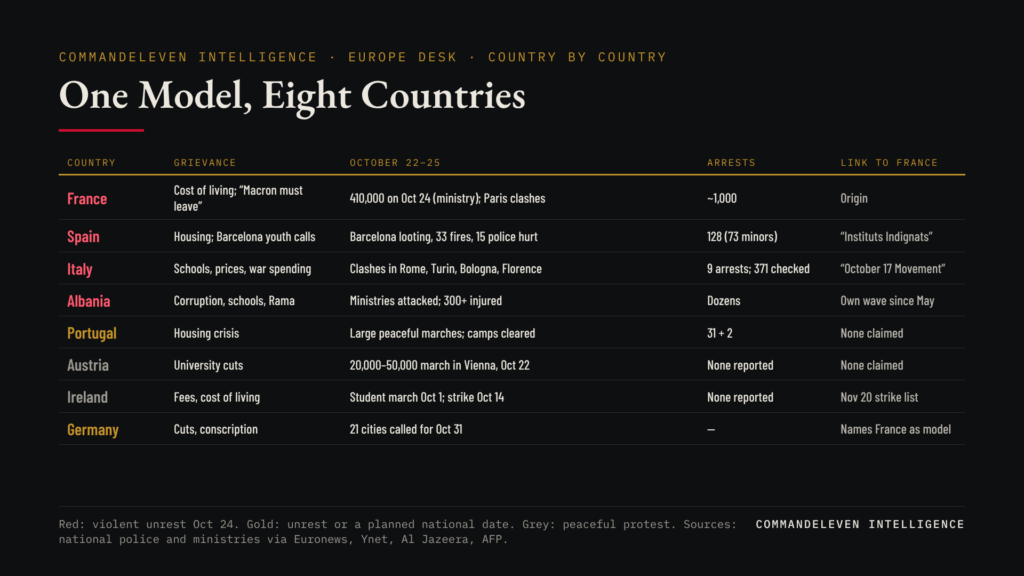
France
Acte II drew about 410,000 people on October 24, according to the Interior Ministry; the CGT counted 800,000. That is below the Interior Ministry’s October 17 count of about 550,000. Interior Minister Laurent Nuñez reported about 1,000 arrests but said the day had gone well, and the widespread looting of October 17 was not repeated. Clashes broke out in Paris in the evening.
The Gilets jaunes have called Acte III for Saturday, October 31, with rallies and sit-ins outside town halls and the National Assembly in Paris, under the theme “the defense of public freedoms.”
[SINGLE-SOURCE] Prime Minister Sébastien Lecornu reportedly wrote to France’s four mobile operators asking them to be ready to block TikTok, Instagram, Snapchat and X if violence broke out. The letter was first reported by the French outlet Blast; the government has not confirmed it, and no block has taken place.
Italy
Thousands marched in Italy’s main cities on October 24. The day was mostly peaceful, but clashes broke out in Rome, Turin, Bologna and Florence, and a group entered the Colosseum before being escorted out. Nine people were arrested nationwide and 371 taken to police stations for checks, 110 of them minors. The government deployed 500 soldiers to Milan after the previous weekend’s looting.
That morning, police carried out more than 150 searches in Milan and 20 other cities, following a WhatsApp group found on a suspect’s phone in which messages discussed attacking police, taking their weapons and setting buildings on fire. Hours later, Milan prosecutors ordered the detention of Youssef Siher. Investigators tracked the movement’s Instagram page through an IP address supplied by Meta. Italian reporting says domestic intelligence first flagged him in 2024, after he founded a group accused of spreading Hamas- and PFLP-linked propaganda.
[ASSESSED] The Siher case is the most important development of the weekend, and it needs to be read carefully. Italian investigators themselves say they have not established that he directed the original rioters. What they allege is that he built the channel that turned one weekend’s violence into the next weekend’s mobilization.
Spain
In Barcelona, hundreds of young people gathered at Plaça de Catalunya on the evening of October 24 after calls on social media. Police made 128 arrests, 73 of them minors. Twenty-three businesses were looted or vandalized, firefighters dealt with 33 fires, and 15 officers were injured, four of them seriously. Shoppers were trapped in stores, including El Corte Inglés, when shutters came down. The Catalan police chief called it “violence for its own sake.”
Barcelona police said those arrested did not appear to belong to one organization. The calls used the slogan “Instituts Indignats,” a direct borrowing from France’s “Lycéens Indignés.” Separately, a housing protest camp has occupied Madrid’s Puerta del Sol since September 26, and Spain goes to a snap general election on November 29.
Albania
Albania’s protests began in May over a resort plan on Sazan Island and grew into a movement against Prime Minister Edi Rama. A student-led wave began in mid-October. On October 24, protesters in Tirana attacked the Education Ministry and other government buildings with stones and burning bins, and police answered with tear gas, water cannon and rubber bullets. Authorities say more than 300 protesters and police were injured. Dozens were arrested.
[SINGLE-SOURCE] Rama blamed “foreign actors” for the violence and accused Russia and Iran of driving online misinformation. He has not published evidence.
Portugal
Portugal’s protests are about housing, and they have stayed largely peaceful. Large marches took place on October 24. Police then cleared protest camps in Lisbon’s Rossio Square and in Porto, the third consecutive night of operations. Police reported 31 arrests for disobedience; the Porto camp reported 37 minor injuries and two arrests. Police had cleared the Lisbon camp once before, on October 20, arresting 55.
Austria
Between 20,000 and 50,000 students marched in Vienna on October 22 against university funding cuts, according to organizer and media estimates. The march was called by the national students’ union and was peaceful.
Ireland
More than 1,500 students marched in Dublin on October 1 over fees and the cost of living, and about 300,000 public-sector workers struck on October 14. Irish youth and student groups are listed among the organizers of the November 20 International Youth Strike. [DATA DEFICIT] We have found no public reporting of riots in Ireland tied to this wave so far.
Germany
Covered in full below.
Germany: October 31
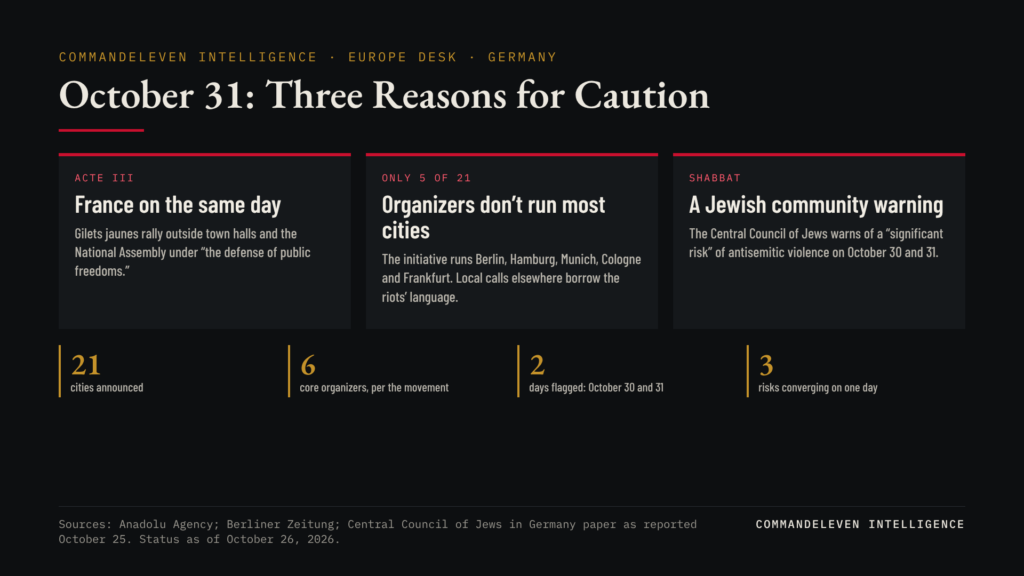
A new initiative, “Gen Z steht auf,” also known as “Gen Z regelt,” has called demonstrations in 21 German cities for Saturday, October 31. Its demands are investment in education, health and affordable living, and an end to military conscription. Its website names France, Belgium and Spain as models and promises protests that are “100% peaceful, democratic and nonviolent.” It also advises participants to use false names and not to speak to police if arrested.
Who is behind it. The website’s legal notice names Akram Selo as the person responsible. He has told reporters that he built the site himself with help from AI, that the organizers found each other on TikTok, and that the protests will be peaceful. Gianni Matheja, a Berlin student and newspaper columnist, is the movement’s best-known public face and says six people make up the core team. The initiative organizes the protests in Berlin, Hamburg, Munich, Cologne and Frankfurt itself. In the other cities, the organizers are not clear. Local media link an account in Münster to Trotskyist groups, and calls in Bielefeld and Augsburg reference France and Gaza.
What the authorities say. Berlin police say radical groups may try to exploit the protests, set fires or clash with police, and that “we will not allow that.” North Rhine-Westphalia’s domestic intelligence service reportedly sees mobilization by people with left-wing and foreign-related extremist ties. Germany’s police union has warned that reserves are thin.
The Jewish community warning. A confidential paper from the Central Council of Jews in Germany, posted publicly on October 25, describes October 30 and 31 as a “heightened threat situation.” It points to mobilization slogans such as “Purge,” “like in France” and “No rules,” and warns of a “significant risk” of antisemitic violence. It notes that October 31 falls on Shabbat. It cites indications of links between pro-Palestinian actors in Germany and criminal groups in France, and advises Jewish institutions to contact state security police and stay “extremely alert.” It also notes that France’s Jewish security service found the French riots were not mainly aimed at Jewish sites.
[ASSESSED, moderate confidence] Most of the October 31 turnout will be what it says it is: students protesting cuts and conscription. The risk sits at the edges. The initiative does not control the protests in most of the 21 cities, the anonymous local calls borrow the language of the French riots, and police resources are stretched. The Central Council’s warning should be read as a precaution from the organization responsible for Jewish communities’ safety, not as evidence of a plot. [SINGLE-SOURCE] The links it cites between German pro-Palestinian actors and French criminal groups have not been described by any police or government source.
Excluded: The claim that the movement’s logo uses the colors of the Russian St. George ribbon. The logo is an orange squirrel; the comparison rests on color alone.
What Connects the Eight Countries
| What travels | Evidence | Our read |
|---|---|---|
| The grievance | Education cuts, housing, fuel and the cost of living in every country | [CONFIRMED] Real, national and long-running |
| The model | Spain’s “Instituts Indignats,” Italy’s “October 17 Movement,” Germany’s website all cite France | [CONFIRMED] Explicit and deliberate |
| The timing | Germany chose October 31, the date of Acte III; a youth strike is called in six countries for November 20 | [CONFIRMED] Coordinated dates, at least |
| The organizers | Separate national networks; Italian and Spanish police describe social-media coordination, not an organization | [ASSESSED] No single command so far |
| The money | No published evidence of foreign funding reaching organizers in any country | [DATA DEFICIT] |
| Extremist infiltration | Italy’s Siher case; WhatsApp plans to attack police in Italy; Münster account linked to Trotskyist groups | [ASSESSED] Present at the edges; central in Italy’s case only if the allegations hold |
[ASSESSED] The pattern is contagion, not conspiracy, so far. A movement that spreads by imitation is harder to stop than one with a headquarters, because there is no single organizer to arrest. Italy’s case shows the other side: where a single channel does drive mobilization, it can be found and shut down.
Dated Calls
These calls will be registered on the Foresight Record and scored on the dates given.
- October 31, Germany: Demonstrations take place in at least 15 of the 21 announced cities, and violent incidents (arson, looting or attacks on police) are reported in at least one of Berlin, Hamburg, Cologne or Frankfurt. [ASSESSED] Scored November 2, 2026.
- October 31, France: The Interior Ministry’s Acte III count is below its Acte II count of about 410,000. [ASSESSED] Scored November 2, 2026.
- By November 20: At least one more country makes an arrest on terrorism-related grounds linked to the protest wave. [ASSESSED] Scored November 21, 2026.
- November 20: The International Youth Strike produces demonstrations in at least four of the six countries named by organizers (Belgium, Germany, Italy, the UK, Ireland and Spain). [ASSESSED] Scored November 21, 2026.
Our five Acte II calls and the October 14 indicators are scored on November 02, to include the October 31 protests.
What to Watch
- Germany, October 30 and 31: Turnout against the 21-city list, any violence outside the five cities the initiative runs itself, and any antisemitic incident.
- Italy: Whether prosecutors charge Siher, and whether the WhatsApp group leads to further arrests.
- France: Acte III turnout and any decision on social-media restrictions or emergency powers.
- Spain: Whether the November 29 election campaign absorbs or inflames the Barcelona unrest.
- Money: Any court filing, police statement or financial-intelligence report tracing funding to organizers in any country.
What This Brief Does and Doesn’t Establish
- It establishes that the unrest has spread beyond France, that several national movements explicitly copy the French model, and that Italy has made a terrorism-linked arrest.
- It does not establish that any single person, group or state directs the wave, or that foreign money funds it.
- It does not identify private individuals beyond those named in official statements, court actions or their own public statements. Naming people as organizers is not an accusation of wrongdoing.
Frequently Asked Questions
Which countries have seen protests linked to France’s movement?
France, Belgium, Spain, Italy, Portugal, Greece, Albania, Austria and Ireland have all seen protests during this wave. Germany’s first nationwide protests are called for October 31.
Who was arrested in Italy?
Youssef Siher, 30, an Italian citizen, detained in Milan on October 24 on suspicion of aggravated incitement with terrorist aims and organized violence. Italy’s Interior Ministry says he created the chat group behind the “October 17 Movement.” He has not been charged or convicted.
What is happening in Germany on October 31?
A youth initiative called “Gen Z steht auf” has called demonstrations in 21 cities against education cuts and conscription. Police have warned that radical groups may exploit them, and the Central Council of Jews in Germany has warned of a heightened threat.
Is one group coordinating the protests across Europe?
There is no public evidence of that. Each country has its own organizers. The movements share grievances, slogans and dates, and they copy France openly.
Related Reading
- France Through October 31: Scoring Acte II and Acte III
- Historical Reference
- Influencing International Diplomacy: Changing India’s Diplomatic Discourse
- Acte II: The October 24 Mobilization and the 101-Group Claim
Sources
- Israel Hayom, Italy riots suspect arrested, October 25, 2026
- Euronews, Thousands march across Italy as protests bring isolated clashes with police, October 25, 2026
- Ynet, 128 arrested in Barcelona riots as Italy detains activist, October 25, 2026
- Connexion France, France protests: 410,000 march as nearly 1,000 arrested, October 25, 2026
- Yahoo Actualités (AFP), Les “Gilets jaunes” fixent un acte III au samedi 31 octobre, October 2026
- Al Jazeera, Thousands gather at new Albanian antigovernment rally, October 24, 2026
- Euronews, Demonstrators wounded as police break up Lisbon and Porto housing protest camps, October 25, 2026
- Anadolu Agency, Thousands protest in Vienna over education budget cuts, October 2026
- RTÉ, Students hold protest over higher education funding, October 1, 2026
- CIVICUS Monitor, Ireland: Nationwide protests over rising fuel prices, October 20, 2026
- Anadolu Agency, German student initiative calls for nationwide protests as police warn of radicals, October 2026
- Berliner Zeitung, Gen-Z-Proteste: Polizei warnt vor knappen Reserven, October 24, 2026
- Apollo News, Wer steckt hinter der deutschen Protestbewegung “Gen Z regelt”?, October 2026 (facts used; the outlet’s framing not adopted)
- Apollo News, Zentralrat der Juden befürchtet antisemitische Gewalt bei Halloween-Protesten, October 25, 2026
- Tech Insider, France social media blackout: four telcos, four apps, October 2026 (single-source claim, reported as such)