
This is Part 5 of The Global Food Security Crisis, CommandEleven Intelligence’s region-by-region assessment of the 2026–27 food shock.
Bottom Line Up Front
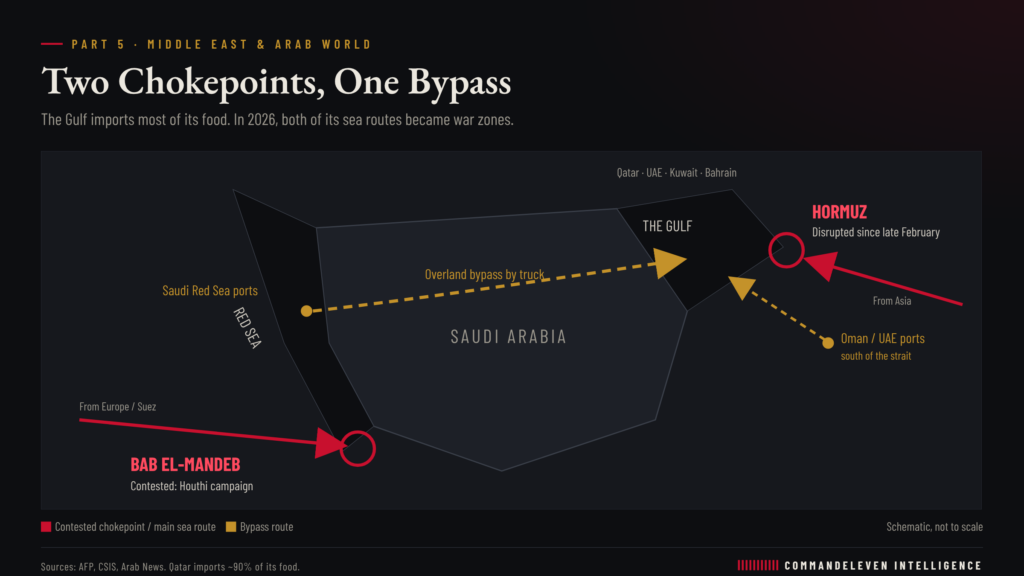
The Middle East is the region where the 2026 food shock is most visibly a security problem. The Gulf states are wealthy, but they import the great majority of their food, and in 2026 the two sea routes it travels through, the Strait of Hormuz and the Bab el-Mandeb, both became war zones. When Hormuz closed in late February, Gulf ports from Jebel Ali to Dammam became almost inaccessible, meat and fish prices in Kuwait jumped more than 30%, and retailers airlifted fresh produce. Saudi Arabia’s Red Sea ports became the region’s lifeline, and those are now within range of the Houthi campaign.
Beyond the Gulf, the picture is grimmer. Yemen has about 18 million people in acute food insecurity; Lebanon, with a fifth of its population displaced, was added to the UN’s hunger hotspots list; Gaza remains fragile after famine was confirmed there in 2025. Egypt, the world’s largest wheat importer, has watched the Black Sea, its traditional source, effectively close. The Arab League’s call on October 5 for a regional early-warning system is the right instinct, but it is still a proposal.
Key Judgments
KJ1: Gulf food security is a logistics problem, not a money problem. The Gulf states can afford food; their risk is getting it delivered through contested waters. [ASSESSED]
KJ2: The Houthi campaign has turned Saudi Arabia’s Red Sea coast into a single point of failure. With Hormuz disrupted, the Gulf leans on Saudi Red Sea ports and overland trucking, and the Houthis have declared Saudi infrastructure a target. [ASSESSED]
KJ3: The region’s hunger is concentrated in its war zones. Yemen, Gaza, Lebanon and Syria carry most of the acute food insecurity. [CONFIRMED]
KJ4: Egypt is the region’s largest latent risk. Bread is politically explosive in Egypt, and the country faces higher energy costs, lost Black Sea supply and reduced Suez Canal revenue at once. [ASSESSED]
Scorecard
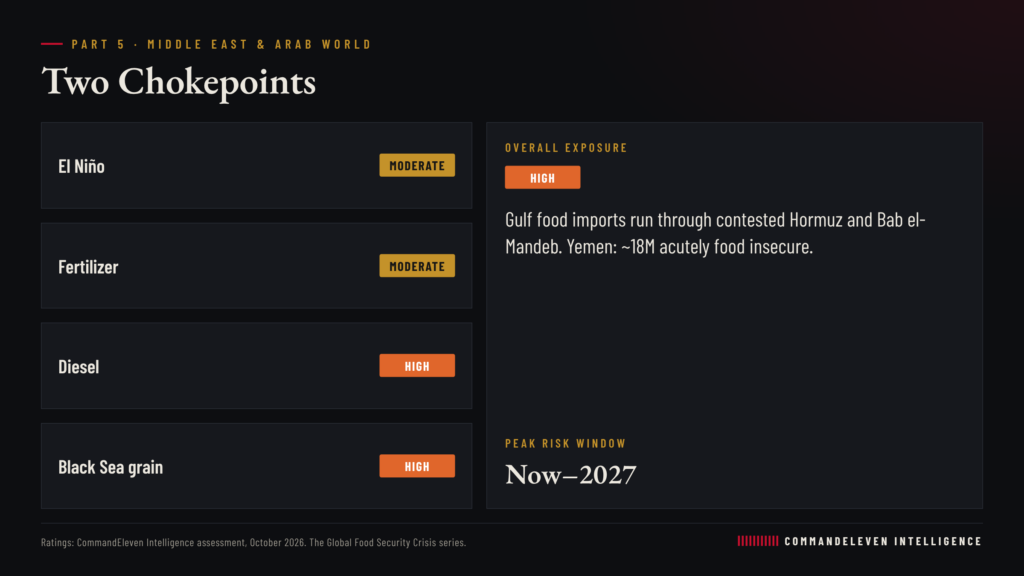
| Driver | Exposure | Why |
|---|---|---|
| El Niño | Moderate | Above-normal heat on the Arabian Peninsula; chronic water scarcity |
| Fertilizer | Moderate | The Gulf exports fertilizer; importers such as Yemen, Syria and Lebanon are exposed |
| Diesel | High | Fuel import bills up sharply for non-producers such as Jordan, Lebanon and Egypt |
| Black Sea grain | High | Egypt and much of the Levant rely on Russian and Ukrainian wheat |
| Overall | High | Severe in Yemen, Gaza and Lebanon |
The Four Drivers
El Niño. The WMO expects above-normal temperatures across the Arabian Peninsula. The deeper problem is water: the Arab Thought Foundation’s new report, Arab Food and Water Security: Accumulated Crises and Promising Initiatives, finds that half the Arab world lives with chronic water scarcity. [CONFIRMED]
Fertilizer. The Gulf is a fertilizer exporter, so the Hormuz closure hit its export revenues rather than its farms. The region’s poorer importers are exposed to higher world prices like everyone else. [ASSESSED]
Diesel. For the region’s non-producers, fuel is the biggest shock. Jordan imports 95% of its fuel and paid an extra $200 million for fuel imports in March alone. Egypt raised energy prices by 31% in April and ordered shops to close early to save power. [CONFIRMED]
The Black Sea. Egypt is the world’s largest wheat importer and has long relied on Russian and Ukrainian grain, as have Lebanon, Syria and Yemen. With Russian wheat shipments down to about 1 million tonnes in September from 5.7 million a year earlier, importers are competing for wheat from the EU, Australia and the Americas at higher prices. [CONFIRMED on shipments; ASSESSED on importer impact]
Import Dependence
Qatar imports about 90% of its food; the rest of the Gulf is not far behind. When Hormuz closed, ships diverted to ports in Oman and the UAE south of the strait, Saudi Arabia shifted cargo to its Red Sea ports and trucked goods across to Qatar, and the Lulu retail chain chartered 37 flights to bring in more than 6,000 tonnes of fresh produce. Shoppers in Bahrain reported meat prices almost doubling; Kuwait reported increases of more than 30% for meat and fish after Gulf fishing stopped and imports from Iran, India and Pakistan were suspended. Gulf planners now worry about a new dependency: on Saudi Arabia itself as the region’s overland gateway. [CONFIRMED]
How Governments Are Responding
- Subsidies and price controls: Qatar’s food subsidies held price increases to 5% to 10%.
- Export bans: Kuwait temporarily banned exports of rice, cooking oil and wheat flour.
- Rerouting: Saudi Red Sea ports and new overland corridors into the Gulf, plus routes to the Mediterranean through Jordan and Syria.
- Regional planning: On October 5, Arab League Secretary-General Nabil Fahmy urged members to move from reacting to crises to anticipating them, and said the Secretariat is building an early-warning system for water, food and climate security. He also said that “water and food must not be used as weapons or instruments of political pressure.”
The Gulf’s years of investment in strategic food reserves and overseas farmland softened the first shock. What the region still lacks is a joint plan for the scenario it now faces: both chokepoints contested at once. [ASSESSED]
Flashpoints
- Yemen. About 18.3 million people in acute food insecurity, 41,000 in catastrophe in Houthi-held areas, and wheat flour stocks in besieged Taiz “nearly exhausted” according to WFP as fighting intensifies under Operation Yemen Dawn. [CONFIRMED]
- The Saudi Red Sea corridor. Houthi strikes have already hit Saudi airports and Aramco offices, and the East-West Pipeline was attacked on September 11. A strike on Red Sea port infrastructure would hit the Gulf’s main food bypass. See The First Test, Tested. [CONFIRMED on attacks; ASSESSED on risk]
- Lebanon. About 20% of the population displaced since the late-February escalation; the IPC projected 1.24 million people in high acute food insecurity for April to August. [CONFIRMED]
- Gaza. About 1.6 million people acutely food insecure, more than 500,000 in Emergency; conditions improved after the October 2025 ceasefire but remain fragile. [CONFIRMED]
- Egypt’s bread. Bread price rises triggered riots in 1977. Egypt raised the subsidized bread price in 2024 for the first time since 1989. Any further increase under current pressures carries real political risk. [CONFIRMED on history; ASSESSED on risk]
The 12-Month Outlook
CommandEleven Intelligence expects the Gulf states to keep shelves stocked at a high cost, while food insecurity deepens in Yemen and stays at crisis levels in Lebanon, Syria and Gaza. Egypt is the country to watch: a combination of wheat import costs, energy prices and foreign-currency pressure could force hard choices on bread subsidies in 2027. [ASSESSED]
Indicators to watch:
- Houthi attacks on Saudi Red Sea ports or shipping serving them.
- Commercial traffic through Hormuz and the Bab el-Mandeb.
- Egypt’s wheat tenders: volumes, origins and prices.
- Progress on the Arab League’s early-warning system.
Frequently Asked Questions
How does the Strait of Hormuz affect Gulf food supplies?
Gulf states import most of their food, much of it through Hormuz. When the strait closed, major Gulf ports became almost inaccessible, and food had to be rerouted through Oman, Saudi Red Sea ports, overland trucking and air freight.
What did the Arab League propose on food security?
On October 5, 2026, Secretary-General Nabil Fahmy called for closer cooperation on food and water security and said the League is building an early-warning system to assess water, food and climate risks alongside political, economic and security factors.
Sources
- Strait of Hormuz blockage drives up Gulf food bills, AFP via Yahoo News
- Subsidies, Stockpiles, and Shortages, CSIS, June 18, 2026
- GCC states ‘face reliance on Saudi Arabia for food imports’, Arab News
- Qatar attends launch of report on Arab food, water security, Gulf Times, October 5, 2026
- Half the Arab world lives with lack of water, report says, Al-Fanar Media, August 2026
- New FAO-WFP report warns worsening hunger puts 13 hotspots at significant risk, FAO, June 17, 2026
- Fighting in Yemen intensifies: What’s the latest on the battlefield?, Al Jazeera, October 15, 2026
- Diesel shortage to persist into 2027 as Iran war disrupts supply, IEA warns, The National, October 14, 2026
- Egypt increases price of subsidized bread for the first time since 1989, CGIAR
The Global Food Security Series
Start with the United States baseline: Food Chain Reaction Revisited and The 12-Month Fuse.
- Global Food Security: North America – Part 1
- Global Food Security: Central America and the Caribbean – Part 2
- Global Food Security: South America – Part 3
- Global Food Security: Europe – Part 4
- Global Food Security: The Middle East and Arab World – Part 5 (you are here)
- Global Food Security: Africa – Part 6
- Global Food Security: East and Southeast Asia – Part 7
- Global Food Security: The Indian Subcontinent – Part 8
- Global Food Security: Australia and the Pacific – Part 9

