
This is Part 9 of The Global Food Security Crisis, CommandEleven Intelligence’s region-by-region assessment of the 2026–27 food shock.
Bottom Line Up Front
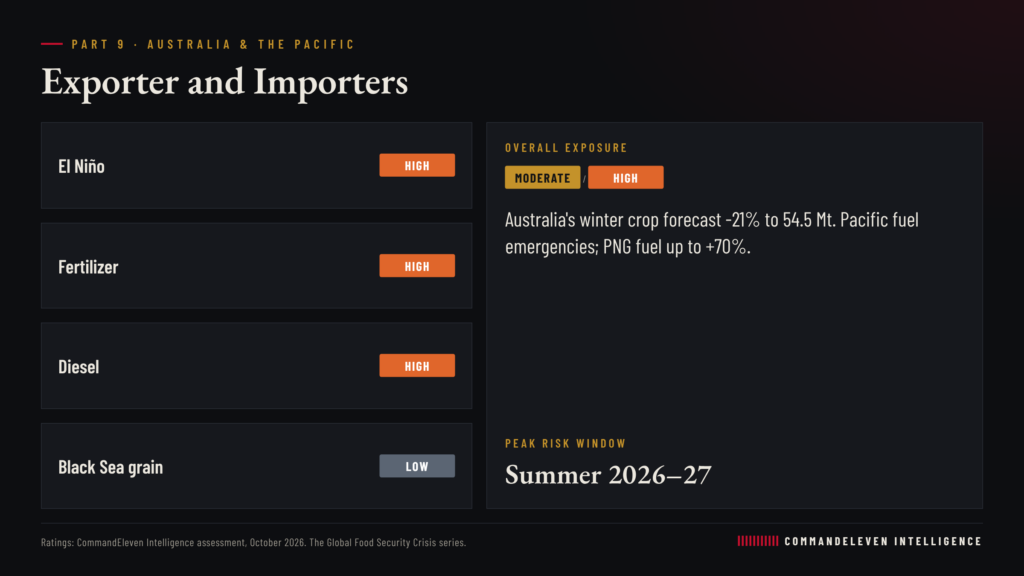
Australia and the Pacific islands sit at opposite ends of the food system and are exposed in opposite ways. Australia is one of the world’s great grain exporters, normally supplying 10% to 15% of the global wheat market. This year ABARES forecasts its winter crop down 21% to 54.5 million tonnes, on the smallest planted area in six years, after farmers facing fertilizer costs, squeezed margins and dry conditions held back. El Niño now threatens severe drought across northern and eastern Australia and possibly the hottest spring on record. At a time when Black Sea exports are blocked and the US wheat crop is the smallest since 1972, a smaller Australian crop matters to every wheat importer in Asia and the Middle East.
The Pacific islands are among the most import-dependent places on earth. Diesel generates most of their electricity, moves their food by boat between islands and costs 8% to 11% of GDP in many countries. In PNG, fuel prices rose by as much as 70% after the Iran war began. Tuvalu and the Marshall Islands declared states of emergency, and the Pacific Islands Forum invoked its regional emergency mechanism for the first time since COVID-19.
Key Judgments
KJ1: Australia faces a farm-income shock, not a food shortage. ABARES says the war’s main effect has been “significantly higher input costs rather than physical shortages.” [CONFIRMED]
KJ2: Australia’s smaller crop is a global supply problem. It removes export supply at the moment importers have lost the Black Sea. [ASSESSED]
KJ3: Australia’s fuel security is thin. Reserves of about 29 to 36 days, and diesel supplied mainly by refineries in Asia, leave the farm and freight sectors exposed to any further disruption. [CONFIRMED]
KJ4: The Pacific islands are the region’s most vulnerable people. Fuel, food and El Niño drought hit them together, and Australia has said its own supplies come first. [CONFIRMED on statements; ASSESSED on vulnerability]
Scorecard
| Driver | Exposure | Why |
|---|---|---|
| El Niño | High | Drought forecast for northern, eastern and southern Australia and the South Pacific islands |
| Fertilizer | High | Almost all of Australia’s fertilizer is imported from the Middle East |
| Diesel | High | Australian diesel up more than 45% in a year; Pacific islands run on imported diesel |
| Black Sea grain | Low | Australia gains as an alternative supplier |
| Overall | Moderate (Australia), High (Pacific islands) | Income shock in Australia; survival-level risk in parts of the Pacific |
The Four Drivers
El Niño. The WMO forecasts drier-than-normal conditions over southern and eastern Australia, and forecasters list the South Pacific islands among areas at risk of drought. El Niño is expected to bring severe drought to much of northern and eastern Australia, threatening summer crops such as sorghum and rice and next year’s winter crop. In Papua New Guinea, past strong El Niños in 1997 and 2015 brought drought and highland frosts that destroyed sweet potato and other food gardens, and authorities have urged the country to prepare. [CONFIRMED on forecasts; ASSESSED on PNG risk]
Fertilizer. Almost all of Australia’s fertilizer is imported from the Middle East, and the Strait of Hormuz was closed for much of the year. That, combined with squeezed margins and dry northern conditions, is why some farmers chose not to plant, and why the planted area fell 12% to 10.9 million hectares. [CONFIRMED]
Diesel. Australian diesel prices are up more than 45% in a year. Australia depends mainly on refineries in Singapore, South Korea, Malaysia, Taiwan and India, and holds about 29 to 36 days of reserves. The government cut fuel excise by half for three months in March and paused road-user charges for trucks; the Liquid Fuel Emergency Act, which allows rationing, has not been triggered. Pacific countries imported about 2.2 million tonnes of fuel in 2025, mostly from Singapore and South Korea; in the first half of April, deliveries ran at a quarter of the March rate. [CONFIRMED]
The Black Sea. Australia benefits as an alternative wheat supplier, but this year it has less to sell. [ASSESSED]
Import Dependence
Australia produces far more food than it consumes, but imports almost all its fertilizer and most of its refined fuel. The Pacific islands import much of their food, including rice from Asia and processed foods from Australia and New Zealand, and depend on diesel for more than half their electricity in most countries outside Fiji. Fuel imports are worth 8% to 11% of GDP in many Pacific countries, and 27% in Tuvalu. [CONFIRMED]
How Governments Are Responding
- Australia: a 50% fuel excise cut for three months, a pause on road-user charges for trucks, and free public transport in Victoria and Tasmania for limited periods.
- The Pacific: states of emergency in Tuvalu and the Marshall Islands; fuel subsidies or price caps in the Cook Islands, Nauru and PNG; purchase limits to stop panic buying; and in Fiji, ministers agreed to a 20% pay cut to help offset fuel costs.
- Regional: the Pacific Islands Forum invoked its emergency response mechanism; New Zealand asked Washington to look at fuel deliveries for the Pacific; Australia said it is looking at ways to help but domestic supplies come first.
Flashpoints
- Papua New Guinea. Nearly 40% of people live below the poverty line, boats are the main way food moves, and an El Niño drought or highland frost would hit food gardens directly. [CONFIRMED on poverty and transport; ASSESSED on risk]
- Atoll nations. Tuvalu, Kiribati and the Marshall Islands depend almost entirely on imported fuel and food, with drought adding pressure on rainwater supplies. [ASSESSED]
- Geopolitics. China has said it is willing to help safeguard energy security. A Pacific fuel crisis in which Australia puts itself first opens room for Beijing to offer help. [ASSESSED]
The 12-Month Outlook
CommandEleven Intelligence expects a smaller Australian harvest, lower farm incomes and some upward pressure on Australian food prices through the summer, without shortages. The 2027 winter crop is the next risk if El Niño’s drought extends into autumn planting. For the Pacific islands, the next six months are the most dangerous, combining El Niño’s peak with expensive, unreliable fuel supplies. [ASSESSED]
Indicators to watch:
- ABARES’s December crop report and final winter-crop harvest figures.
- Australian fuel reserve days and any move to trigger emergency fuel powers.
- Drought and frost reports from PNG’s highlands.
- Fuel deliveries to Pacific island states and any new emergency declarations.
Frequently Asked Questions
How much will Australia’s grain harvest fall?
ABARES forecasts the 2026–27 winter crop down 21% to 54.5 million tonnes, on a planted area 12% smaller than last year.
Why are Pacific island countries in a fuel emergency?
They import almost all their fuel, mostly via Asian refineries hit by the Iran war’s supply disruption. Fuel prices in PNG rose up to 70%, and several countries declared emergencies.
Sources
- Climate, wars and fuel shortages foster famine fears, ABC News (Australia), August 25, 2026
- Australian Crop Report, June 2026, ABARES
- Tiny Pacific nations face tough choices on food, fuel posed by Iran war, Reuters via WTVB, April 21, 2026
- Papua New Guinea urged to prepare for El Niño and potential food security crisis, RNZ, June 2026
- 2026 Iran war fuel crisis, Wikipedia (compilation of national measures)
- Strong El Niño expected to intensify, World Meteorological Organization
- Super El Niño set to peak in December, with impacts expected well into 2027, Down To Earth
The Global Food Security Series
Start with the United States baseline: Food Chain Reaction Revisited and The 12-Month Fuse.
- Global Food Security: North America – Part 1
- Global Food Security: Central America and the Caribbean – Part 2
- Global Food Security: South America – Part 3
- Global Food Security: Europe – Part 4
- Global Food Security: The Middle East and Arab World – Part 5
- Global Food Security: Africa – Part 6
- Global Food Security: East and Southeast Asia – Part 7
- Global Food Security: The Indian Subcontinent – Part 8
- Global Food Security: Australia and the Pacific – Part 9 (you are here)

