
This is Part 1 of The Global Food Security Crisis, CommandEleven Intelligence’s region-by-region assessment of the 2026–27 food shock. The United States is covered in our earlier series, Food Chain Reaction Revisited.
Bottom Line Up Front
Canada and Mexico sit next to the world’s largest food producer and are among the best-placed countries on earth to ride out this crisis. That does not make them safe. Canada’s exposure runs through diesel, which was up 75% year on year in August, and through a grocery bill already 29% higher than five years ago. Mexico’s exposure runs through corn: it now imports more corn than it grows, about 26.8 million tonnes against 24.5 million of its own, and more than 99% of those imports come from the United States, which is harvesting its smallest wheat crop since 1972 and watching its corn yields closely.
Neither country faces hunger on the scale of the regions later in this series. The risk is a squeeze on household budgets through the winter, and for Mexico, a dependence on a single supplier at a time of strained trade relations and rising migration from the south.
Key Judgments
KJ1: For Canada, this is a cost shock, not a supply shock. Canada is a major food exporter and the world’s leading potash producer. Its problem is the cost of moving food across a vast country on diesel. [ASSESSED]
KJ2: Mexico’s corn dependence is its single biggest vulnerability. Domestic production is falling because farmgate prices sit below the cost of growing, while imports rise. [CONFIRMED on figures; ASSESSED on risk]
KJ3: Food inflation in both countries is about to turn up. Canadian food inflation was 2.8% in August, below headline inflation, but economists expect diesel costs to push it higher after Thanksgiving. Mexican fruit and vegetable prices are already up 8.78% in a year. [CONFIRMED on data; ASSESSED on direction]
KJ4: Mexico’s real food-security flashpoint is on its southern border. El Niño crop failures in Central America’s Dry Corridor are likely to push more people north through Mexico in 2027. [ASSESSED]
Scorecard
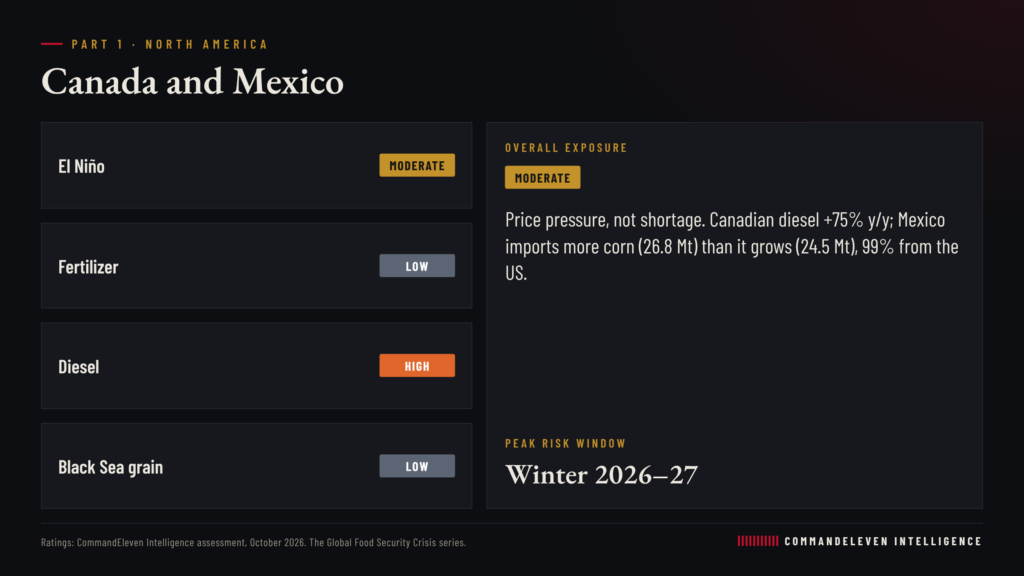
| Driver | Exposure | Why |
|---|---|---|
| El Niño | Moderate | Canada faces drought risk; southern Mexico borders the hardest-hit Dry Corridor |
| Fertilizer | Low | Canada produces its own nitrogen and leads the world in potash; Mexico imports more but has US supply nearby |
| Diesel | High | Canadian diesel up 75% year on year; long trucking distances in both countries |
| Black Sea grain | Low | Both buy grain mainly from the US; Canada gains as an exporter |
| Overall | Moderate | Price pressure, not shortage |
The Four Drivers
El Niño. The WMO expects wetter-than-normal conditions in western North America south of 45°N, and forecasters list Canada among the areas at risk of drought. Strong El Niño winters usually bring milder, drier conditions to western Canada, which means less snowpack and a weaker start to the 2027 prairie growing season. In the south, Mexico borders Central America, where the WMO forecasts drier conditions and where crops have already failed. [CONFIRMED on forecasts; ASSESSED on Canadian impact]
Fertilizer. Canada is the region’s advantage. It mines more potash than any other country and makes much of its own nitrogen fertilizer from domestic natural gas, so the Hormuz shock reaches Canadian farmers mostly through higher world prices rather than physical shortage. Mexico relies more on imported fertilizer, but its proximity to US suppliers keeps it out of the worst of the shortage. [ASSESSED]
Diesel. This is where North America feels the crisis. Statistics Canada’s supply-chain data show diesel up 75% year on year in August. US pump prices passed $6 a gallon in September, about 70% higher than before the Iran war. Food in both countries moves by truck over long distances, and fresh vegetables, which carry the highest transport share, are the first items economists expect to rise. [CONFIRMED]
The Black Sea. Neither country depends on Black Sea grain. Canada, as a major wheat exporter, stands to gain market share while Russian and Ukrainian exports are blocked. [ASSESSED]
Import Dependence
The two countries could hardly be more different. Canada is a net food exporter of wheat, canola, pulses, pork and beef, though it imports much of its fresh produce from the US and Mexico in winter.
Mexico has become structurally dependent on US corn. USDA forecasts Mexican corn production falling 3% in 2026–27 to 24.5 million tonnes, 7% below the ten-year average, because rising input costs and low crop prices have pushed farmgate prices below the cost of production. Imports are forecast at 26.8 million tonnes, with the United States supplying more than 99%. Most imports are yellow corn for animal feed, while white corn for tortillas is still largely grown at home, but the feed dependence runs straight into the price of meat, eggs and dairy. [CONFIRMED]
How Governments Are Responding
- Canada has so far treated food prices as a market issue. There is no national response targeted at the diesel-to-food pass-through that economists are now warning about. [ASSESSED]
- Mexico has relied in recent years on voluntary price agreements with retailers and producers on a basic food basket, and on agreements to cap pump prices. These tools manage prices in the short term but do nothing for the falling domestic corn harvest. [ASSESSED]
Flashpoints
- Trade leverage. A country that imports more corn than it grows, almost all from one supplier, is exposed to any breakdown in US-Mexico trade relations. [ASSESSED]
- The southern border. FEWS NET expects the worst El Niño-driven hunger in Guatemala and Honduras between March and August 2027. Crop failure in the Dry Corridor has historically been a driver of migration north through Mexico. [ASSESSED]
- Cartels and food. Mexican criminal groups already extort lime and avocado producers. Rising food prices increase the value of controlling food supply chains. See our white paper, Mexico’s Cartels in 2026. [ASSESSED]
The 12-Month Outlook
CommandEleven Intelligence expects Canadian food inflation to climb back above headline inflation this winter as diesel costs pass through, led by fresh produce. Mexico is likely to see continued pressure on fruit, vegetable and processed food prices, with meat prices tied to the cost of US feed corn. Neither country faces food shortages. [ASSESSED]
Indicators to watch:
- Canada’s monthly food inflation figure crossing back above headline inflation.
- Prairie snowpack and soil moisture through the winter.
- US corn export prices and any trade measures affecting US-Mexico agricultural trade.
- Migration numbers at Mexico’s southern border in early 2027.
Frequently Asked Questions
Will food prices in Canada rise this winter?
Economists expect so. Diesel was up 75% year on year in August, and fresh vegetables, which depend most on trucking, are likely to rise first.
How dependent is Mexico on US corn?
Mexico is forecast to import about 26.8 million tonnes of corn in 2026–27, more than its own production of 24.5 million tonnes, with over 99% of imports coming from the United States.
Sources
- Diesel-fuelled price hikes could stoke food inflation this fall, experts warn, CP24 (The Canadian Press), October 9, 2026
- Mexico’s corn production seen slipping in 2026-27, World Grain, March 17, 2026
- Mexico’s fruit and vegetable prices rise 8.78% in September, FreshPlaza, October 9, 2026
- Strong El Niño expected to intensify, World Meteorological Organization
- Diesel shortage to persist into 2027 as Iran war disrupts supply, IEA warns, The National, October 14, 2026
- 2026–2027 El Niño food security impacts, FEWS NET, October 6, 2026
The Global Food Security Series
Start with the United States baseline: Food Chain Reaction Revisited and The 12-Month Fuse.
- Global Food Security: North America – Part 1 (you are here)
- Global Food Security: Central America and the Caribbean – Part 2
- Global Food Security: South America – Part 3
- Global Food Security: Europe – Part 4
- Global Food Security: The Middle East and Arab World – Part 5
- Global Food Security: Africa – Part 6
- Global Food Security: East and Southeast Asia – Part 7
- Global Food Security: The Indian Subcontinent – Part 8
- Global Food Security: Australia and the Pacific – Part 9

