
This is Part 7 of The Global Food Security Crisis, CommandEleven Intelligence’s region-by-region assessment of the 2026–27 food shock.
Bottom Line Up Front
Rice is the story in East and Southeast Asia. Analysts estimate that a strong El Niño combined with a positive Indian Ocean Dipole could cut Southeast Asia’s rice output by 2% to 8%. The midpoint, about 5%, equals roughly 7 to 8 million tonnes, about as much as Thailand, one of the world’s largest rice exporters, ships in an entire year. Bangkok’s export price was already up 27.5% for the year by the end of June, and Thai prices are at 18-month highs.
The fuel shock hit this region early and hard. The Philippines declared a national energy emergency in March and moved government offices to a four-day week; its development think tank estimates 1.3 million to 3.1 million Filipinos could fall into poverty. Thai diesel briefly rose by two-thirds. Northeast Asia’s wealthy importers, China, Japan and South Korea, are buffered by reserves and buying power, but China’s appetite for imports, including about 108 million tonnes of soybeans this season, competes with poorer buyers for the same supplies.
Key Judgments
KJ1: The region’s risk window is now through March 2027. August to October was the critical period for Thailand’s main rice crop and the Mekong’s low-flow season, and El Niño peaks around December. [CONFIRMED on forecasts]
KJ2: The Philippines is the most exposed major economy. It is a large rice importer, highly fuel-import dependent, and faces losses of up to 700,000 tonnes of rice. [CONFIRMED on figures; ASSESSED on ranking]
KJ3: Rice export restrictions are the key contagion risk. If Thailand or Vietnam tighten exports, the shock spreads to rice-importing Africa and the Pacific. [ASSESSED]
KJ4: Palm oil is the second commodity to watch. Indonesia and Malaysia supply about 90% of the world’s palm oil, and past strong El Niños have cut output sharply. [CONFIRMED on share; ASSESSED on risk]
Scorecard
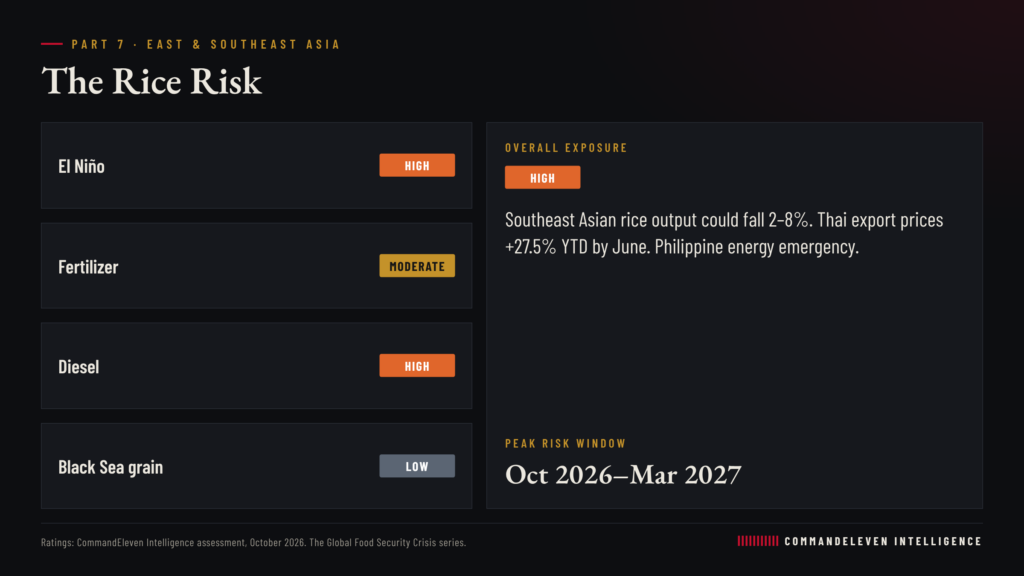
| Driver | Exposure | Why |
|---|---|---|
| El Niño | High | Drought across the rice belt; low Mekong flows; fire and haze risk |
| Fertilizer | Moderate | Several countries produce urea; China reopened exports in June |
| Diesel | High | Philippine energy emergency; Thai diesel up by two-thirds at its peak |
| Black Sea grain | Low | Wheat importers such as Indonesia and the Philippines face higher prices, but rice is the staple |
| Overall | High | Severe in Myanmar; high for the Philippines |
The Four Drivers
El Niño. The ASEAN Specialised Meteorological Centre forecast below-normal rainfall and above-average temperatures across southern ASEAN from August to October. Indonesia’s weather agency calls the event strong and possibly very strong. Thailand’s rainfall from January to April was about 60% below normal, and lower Mekong levels threaten Vietnam’s Mekong Delta rice. FAO notes that global rice yields typically run 1% to 1.5% below trend in El Niño years, and that dry weather in Southeast Asia is already pushing palm oil prices up. Widespread drought is forecast for Indonesia, Malaysia, the Philippines, Thailand, Myanmar, Timor-Leste and Papua New Guinea, and the number of people exposed to haze could rise from 25 million to 70 million at the peak. [CONFIRMED]
Fertilizer. Southeast Asia is less dependent on Gulf fertilizer than South Asia; Indonesia and Malaysia produce urea. China’s decision in June to reopen urea exports, with a price floor of $660 a tonne, added supply. Smallholder rice farmers still face higher prices than before the war. [CONFIRMED on China; ASSESSED on exposure]
Diesel. The Philippines declared a national energy emergency on March 24. Thailand’s diesel price rose from 29.94 baht a liter in February to a peak of 50.54 in April. Myanmar restricted private vehicles to alternate days. Japan released 80 million barrels from reserves. Diesel runs fishing fleets, irrigation and the inter-island shipping that feeds archipelagos like the Philippines and Indonesia. [CONFIRMED]
The Black Sea. Rice is the staple, but wheat demand for noodles and bread has grown fast in Indonesia and the Philippines. Indonesia has agreed to buy up to 2 million tonnes of US wheat a year under a trade deal, which reduces its Black Sea exposure. [CONFIRMED]
Import Dependence
The region splits into exporters and importers. Thailand and Vietnam are two of the world’s largest rice exporters; the Philippines is one of the largest importers, buying most of its imported rice from Vietnam. Indonesia says it plans no rice imports in 2026, betting on its stocks. In the north, China is the world’s largest importer of soybeans and a major buyer of grain, while Japan and South Korea import most of their grain and energy. [CONFIRMED]
How Governments Are Responding
- The Philippines: a national energy emergency, a four-day week for government offices and a revived agriculture task force to manage El Niño’s impact on rice and corn.
- Indonesia: cloud seeding, water-reserve and fire-mitigation measures, and a decision to rely on domestic stocks rather than imports.
- Thailand: has signaled it may tighten export management if the October outlook confirms the El Niño damage.
- Japan and South Korea: oil reserve releases and energy-saving campaigns.
- FAO: a $202 million appeal in June covering 8.8 million people in 22 high-risk countries, including in the region.
Flashpoints
- Rice export controls. Thailand’s hint at tighter export management is the single biggest risk to rice importers worldwide. A Thai or Vietnamese restriction on top of a weak Indian harvest would recreate the 2008 rice crisis. [ASSESSED]
- Myanmar. Listed by FAO and WFP as a hunger hotspot, with conflict, economic collapse and climate shocks combined. See Myanmar PDF Riverine Networks in Sagaing. [CONFIRMED]
- The Philippines. Fuel costs and a transport strike led to a state of emergency in March. A weak rice harvest this winter would test the government again. [CONFIRMED on March events; ASSESSED on outlook]
- Haze. Indonesian fires can close schools and airports across the region and strain relations with Singapore and Malaysia. [ASSESSED]
The 12-Month Outlook
CommandEleven Intelligence expects rice prices in Southeast Asia to stay high through the first quarter of 2027 as El Niño losses become clear, with palm oil and sugar also under pressure. Northeast Asia will absorb the shock through reserves and higher import bills. The poorest households in the Philippines, Myanmar and Timor-Leste face the greatest hardship. [ASSESSED]
Indicators to watch:
- Thai and Vietnamese rice export prices and any export restrictions.
- Philippine rice import volumes and retail prices.
- Malaysian and Indonesian palm oil output data.
- Mekong River levels through the dry season.
Frequently Asked Questions
How will El Niño affect rice prices in Asia?
Analysts estimate Southeast Asian rice output could fall 2% to 8%. Thai rice prices are already at 18-month highs, and further rises are likely if harvests disappoint or exporters restrict sales.
Why did the Philippines declare an energy emergency?
The Iran war and the Hormuz closure cut fuel supplies and raised prices. The government declared a national energy emergency on March 24, 2026.
Sources
- Southeast Asia’s rice belt faces its driest months as El Niño strengthens, Indoneo, August 2026
- How a Super El Niño is Threatening ASEAN Economies, Thailand Business News, September 3, 2026
- FAO Food Price Index rises in September, FAO, October 2, 2026
- 2026 Philippine energy crisis, Wikipedia
- 2026 Iran war fuel crisis, Wikipedia (compilation of national measures)
- WTO data confirms Strait of Hormuz fertilizer trade disruption is easing, Fertilizer Daily, July 24, 2026
- China expected to import more soybeans in 2026-27, World Grain, March 23, 2026
- Climate, wars and fuel shortages foster famine fears, ABC News (Australia), August 25, 2026
The Global Food Security Series
Start with the United States baseline: Food Chain Reaction Revisited and The 12-Month Fuse.
- Global Food Security: North America – Part 1
- Global Food Security: Central America and the Caribbean – Part 2
- Global Food Security: South America – Part 3
- Global Food Security: Europe – Part 4
- Global Food Security: The Middle East and Arab World – Part 5
- Global Food Security: Africa – Part 6
- Global Food Security: East and Southeast Asia – Part 7 (you are here)
- Global Food Security: The Indian Subcontinent – Part 8
- Global Food Security: Australia and the Pacific – Part 9

