
This is Part 3 of The Global Food Security Crisis, CommandEleven Intelligence’s region-by-region assessment of the 2026–27 food shock.
Bottom Line Up Front
South America matters to this series less for its own hunger than for everyone else’s. Brazil and Argentina are the world’s swing suppliers of soybeans, corn, beef and sugar, and with Black Sea grain blocked and the US wheat crop the smallest since 1972, the world is leaning on them harder than ever. Their weak point is fertilizer: Brazil is almost entirely dependent on imports, and IFPRI estimates about 40% of them pass through the Strait of Hormuz. Local fertilizer prices jumped more than 35% in the first two weeks of the war.
The second risk is El Niño. Southern Brazil and Argentina are likely to get good rain, but central and northern Brazil, including Mato Grosso, the heart of the soybean belt, face prolonged dryness and heat above 40°C during the critical pod-filling months of December and January. A hit there would be felt in feed and food prices from China to the Middle East.
Key Judgments
KJ1: South America’s food security risk is mainly a risk to the world. The region produces far more than it eats; a weak 2026–27 crop would tighten global supply more than it would cause local hunger. [ASSESSED]
KJ2: Fertilizer is Brazil’s Achilles’ heel. One scenario estimate finds Brazil’s urea imports falling by almost a fifth over the season if Hormuz disruption ran through July, and more than a quarter if it lasts through year-end. [CONFIRMED on estimates]
KJ3: El Niño splits the region. It favors the south and threatens the center and north. The decisive window is December 2026 to March 2027. [CONFIRMED on forecasts]
KJ4: Farmers are squeezed even as prices rise. High world prices help exporters, but input costs and tight credit are eating into margins and planting decisions. [ASSESSED]
Scorecard
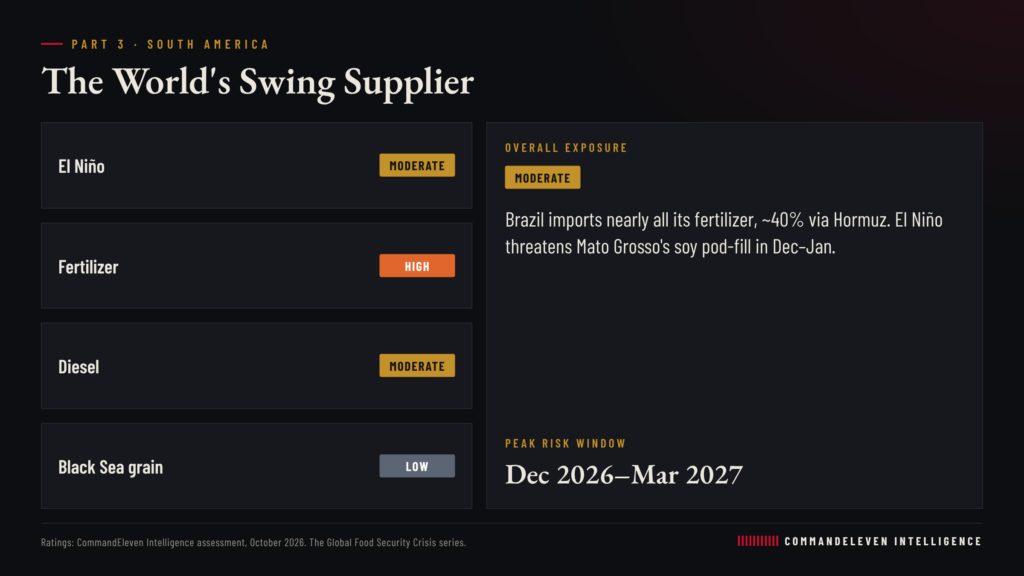
| Driver | Exposure | Why |
|---|---|---|
| El Niño | Moderate | Good for the south; dryness risk for central and northern Brazil, Colombia’s La Guajira and Peru’s floods |
| Fertilizer | High | Brazil almost fully import-dependent, about 40% via Hormuz |
| Diesel | Moderate | Long truck haul from farm to port; reliance on imported diesel |
| Black Sea grain | Low | The region benefits as an alternative supplier |
| Overall | Moderate | Local hunger limited; global supply risk high |
The Four Drivers
El Niño. The WMO forecasts wetter-than-normal conditions in southeastern South America and drier conditions in the northwest. For Brazil, DTN’s seasonal outlook sees generally favorable conditions in the south, with some flood risk, and a higher risk of prolonged dryness and temperatures above 40°C in Mato Grosso and the northeast. Soybean pod fill in December and January is the most vulnerable stage, and dryness could also hurt the second-crop (safrinha) corn. In the 2023–24 El Niño, yields of both fell. Argentina had a cool, dry winter, and frosts in La Pampa and Buenos Aires may delay planting, though the season overall looks favorable. FEWS NET flags Colombia’s La Guajira as the area hardest hit by El Niño in Colombia, and the Joint Research Centre warns of flood threats in Peru. [CONFIRMED]
Fertilizer. Brazil’s dependence on imported fertilizer is among the highest in the world. The Persian Gulf supplied 28% of its nitrogen fertilizer imports in 2023, according to IFPRI, and the institute’s broader estimate is that 40% of Brazil’s fertilizer imports pass through Hormuz. A scenario analysis cited by IFPRI found Brazil’s urea imports for April 2026 to March 2027 would fall 18.7% if the strait stayed closed through July, and 27.3% if it stayed closed to the end of 2026. Argentina is less exposed: only 9% of its nitrogen imports came from the Gulf. [CONFIRMED]
Diesel. Brazilian grain moves to port by truck over very long distances. Brazil had come to rely heavily on imported diesel, much of it from Russia in recent years; with Russian refineries under Ukrainian drone attack and global diesel stocks at historic lows, that cushion is gone. [ASSESSED]
The Black Sea. The closure helps South American exporters by removing competitors. FAO noted in September that reduced Brazilian export availability was one of the factors pushing world maize prices up. [CONFIRMED]
Import Dependence
South America imports inputs and exports food. Brazil and Argentina are net exporters on a massive scale; China alone expects to import about 108 million tonnes of soybeans in 2026–27, much of it from Brazil. The region’s dependence runs the other way: on imported fertilizer, diesel and, for the Andean and northern countries, on imported wheat. [CONFIRMED on China; ASSESSED on the pattern]
How Governments Are Responding
Brazil’s long-term answer, a national fertilizer plan launched after the 2022 shock to cut import dependence, has not yet changed the numbers in a meaningful way. In the short term, farmers have adjusted by cutting application rates, as they did in 2022, when Brazil’s phosphate use fell 12.4% and potash 9.8%. That protects this season’s margins at the cost of next season’s yields. [CONFIRMED on 2022 data; ASSESSED on current response]
Flashpoints
- Mato Grosso in January. A dry, hot pod-fill would cut the soybean harvest that feeds China’s pigs and the world’s feed markets. [ASSESSED]
- Export restrictions. If domestic food prices climb, governments in the region have used export taxes and limits before, most notably Argentina. Any move like that would tighten world markets further. [ASSESSED]
- Venezuela and Colombia’s north. FEWS NET finds El Niño’s impact limited in Venezuela, but economic fragility and conflict in border areas leave households with little buffer. [CONFIRMED on FEWS NET; ASSESSED on fragility]
The 12-Month Outlook
CommandEleven Intelligence expects a large but below-potential 2026–27 crop in Brazil, with the size of the shortfall depending on December-January weather in the center-west and on how much fertilizer farmers applied. Argentina’s season looks better. Local food insecurity will remain limited outside pockets in the Andes and the north, but the region’s harvest will be one of the main factors deciding world grain and oilseed prices in the first half of 2027. [ASSESSED]
Indicators to watch:
- Rainfall and temperatures in Mato Grosso during December and January.
- Brazilian fertilizer import volumes for the 2026–27 season.
- Argentine planting progress and any change in export taxes.
- Brazilian diesel availability during the harvest and export peak.
Frequently Asked Questions
How does the Strait of Hormuz affect Brazilian farming?
Brazil imports nearly all its fertilizer, and IFPRI estimates about 40% of those imports pass through Hormuz. The closure raised local fertilizer prices by more than 35% in two weeks.
Will El Niño hurt Brazil’s soybean crop?
It could. Southern Brazil is expected to get good rain, but central and northern areas such as Mato Grosso face a risk of dryness and extreme heat during pod fill in December and January.
Sources
- Iran war: From fertilizer to food crisis?, IFPRI, July 2, 2026
- The Iran war: Farmers in Brazil and Argentina face rising fertilizer and energy prices, IFPRI, May 4, 2026
- South America Preview: El Nino to Play Big Role During the 2026-2027 Season, DTN Progressive Farmer, September 1, 2026
- FAO Food Price Index rises in September, FAO, October 2, 2026
- China expected to import more soybeans in 2026-27, World Grain, March 23, 2026
- 2026–2027 El Niño food security impacts, FEWS NET, October 6, 2026
- El Niño drives crop failure in Central America and East Africa, European Commission Joint Research Centre, September 3, 2026
The Global Food Security Series
Start with the United States baseline: Food Chain Reaction Revisited and The 12-Month Fuse.
- Global Food Security: North America – Part 1
- Global Food Security: Central America and the Caribbean – Part 2
- Global Food Security: South America – Part 3 (you are here)
- Global Food Security: Europe – Part 4
- Global Food Security: The Middle East and Arab World – Part 5
- Global Food Security: Africa – Part 6
- Global Food Security: East and Southeast Asia – Part 7
- Global Food Security: The Indian Subcontinent – Part 8
- Global Food Security: Australia and the Pacific – Part 9

