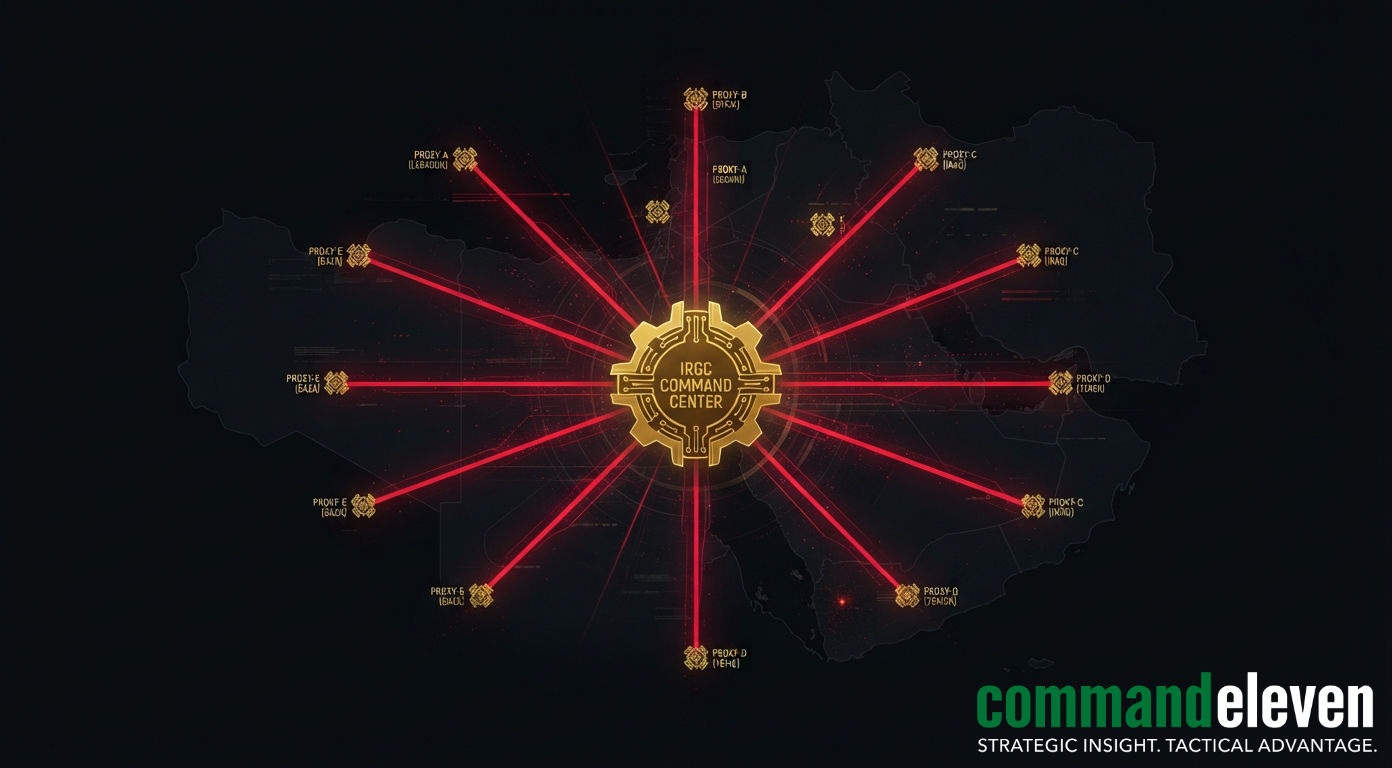
IRGC Deconstructed – Mapping Tehran’s Asymmetric Continuum
The strategic landscape of the Middle East is not shaped by conventional military parity, but by the precise execution of asymmetric defiance. For decades, the Islamic Revolutionary Guard Corps (IRGC) has operated as a parallel military state, systematically bypassing traditional diplomatic channels to construct a multi-axis theater of war that extends from the subterranean launch complexes of western Iran to the maritime choke points of the Bab-el-Mandeb Strait. Understanding this apparatus requires moving past reactive crisis commentary and executing a cold, clinical mapping of its institutional, logistical, and financial engines.
This consolidated volume delivers a comprehensive, doctrine-level audit of the IRGC’s operational footprint.
Long before the outbreak of open kinetic hostilities with Iran, CommandEleven had already deconstructed the structural mechanics of the Quds Force and the Al-Ghadir Missile Command across Iran, Yemen, and the wider Levant. This deep-dive framework was built upon the analytical foundation laid in our preceding four-part dossier series, which meticulously tracked Iran’s long-range influence operations, document fraud networks, and trade-based money laundering channels inside Venezuela. Together, these assessments expose a transregional network that seamlessly fuses state sovereignty with transnational organized crime and cyber-kinetic sabotage.
The scope of this intelligence assessment spans six distinct operational axes:
- Institutional – Command Chains & Parallel State Architecture
- Logistical – Unit 190 Marine Trans-Shipment & Networks
- Financial – Front Companies, Shadow Banking, & Crime-Terror
- Cyber-Kinetic – SCADA Sabotage & PLC Ingress Methodology
- Grand Strategic – Dafa-e-Mozaik (Mosaic Defense) & Multi-Theater Deterence
- Core Analysis and Strategic Recommendations
By stripping the IRGC of its layers of deniability—whether through the containerized camouflage of its maritime supply lines or the hacktivist personas masking its offensive cyber units—this document provides defense practitioners and national security decision-makers with the raw, unclassified structural blueprints required to model, intercept, and neutralize Tehran’s asymmetric continuum. The analysis contained herein stands as a definitive reference asset for navigating a conflict environment where the boundaries of the battlespace have been permanently erased.
IRGC Deconstructed: Mapping Tehran
- The Architecture of Regional Defiance – Part 1 (you are here)
- Command Hierarchy and Institutional Architecture of the IRGC – Part 2
- Technical Audit of IRGC Transshipment Corridors: Red Sea & Bab-el-Mandeb Axes – Part 3
- The Financial Engine — Front Companies, Smuggling Cartels, and Sanction-Evasion Infrastructure – Part 4
- Cyber-Kinetic Operations — IRGC Electronic Warfare Units and SCADA System Target Selection – Part 5
- Defa-e Mozaik (Mosaic Defense) and the Asymmetric Deterrence Continuum – Part 6
- Core Analysis and Strategic Recommendations – Part 7