CommandEleven Intelligence · Middle East Desk. Status as of October 27, 2026.
Why This Series
In two years, Hezbollah has lost Hassan Nasrallah, two generations of military commanders, most of its long-range arsenal and its access to Lebanon’s banks. It went to war for Iran in March 2026 and suffered heavy losses again. Israel occupies a strip of southern Lebanon, and Lebanon’s government has outlawed Hezbollah’s military activity.
And yet Hezbollah is still armed, still funded by Iran, still active from the Gulf to the Americas, and still in control of its own community.
This series examines Hezbollah from every side to answer one question: what is Hezbollah now, and what will it do next?
Bottom Line Up Front
[ASSESSED] Hezbollah is weaker than at any time since the 1990s, but it is not collapsing. It is rebuilding with cheaper, locally made weapons, surviving financially on Iranian cash moved outside the banks, and relying on networks abroad that Israel has barely touched. Its decisions on war and peace now follow Tehran’s needs more closely than Lebanon’s. The most likely path over the next year is managed decline, not disarmament, with a new war possible if Iran is struck again.
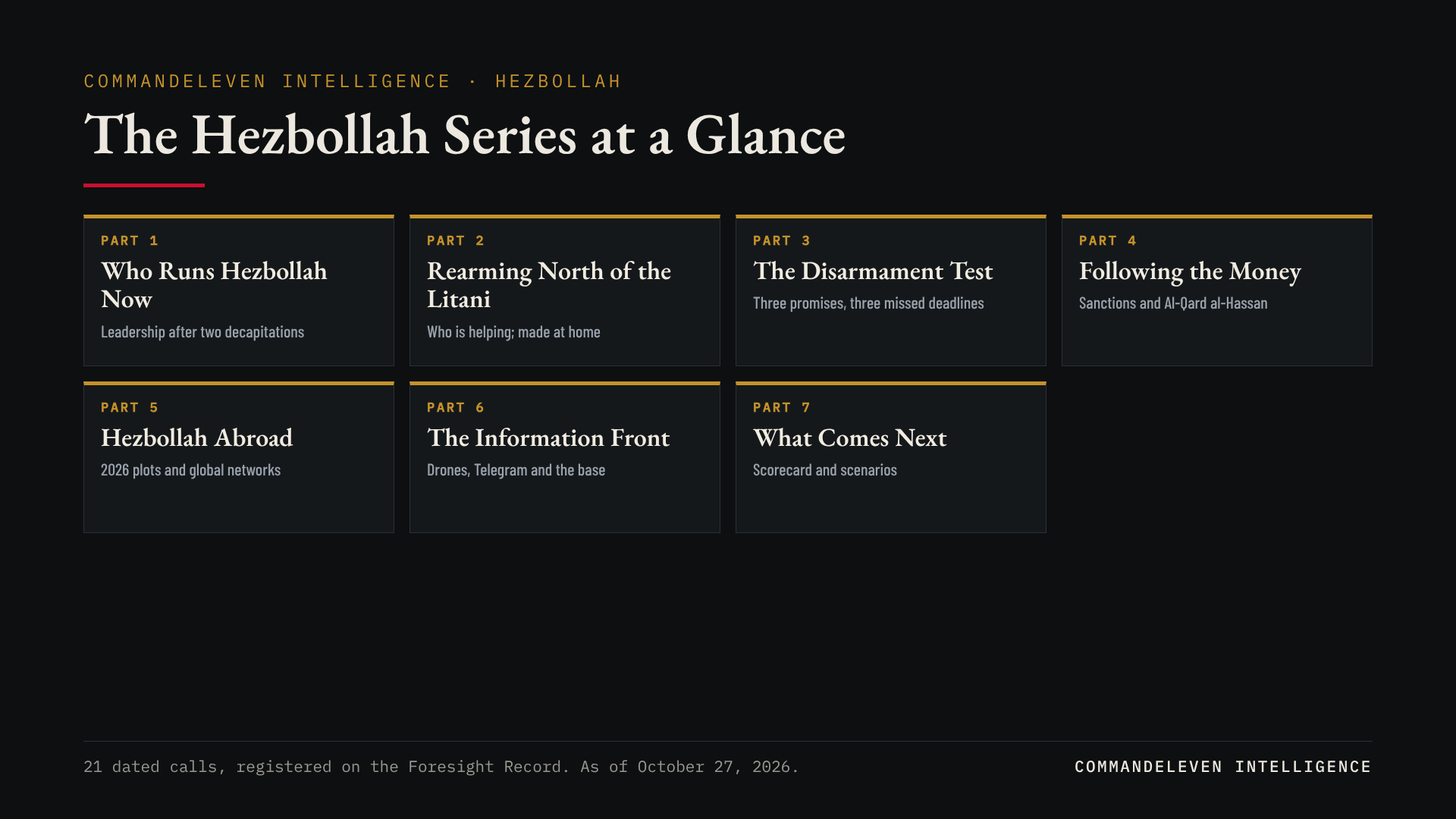
The Series
Part 1: Who Runs Hezbollah Now. Two decapitations, a secretary-general who was never meant to lead, a leadership rebuilt around politicians, an unnamed military chief and a group more openly loyal to Iran than ever.
Part 2: Rearming North of the Litani. How Hezbollah is rebuilding after losing Syria’s land bridge, who is helping, and why it now makes more of its own weapons.
Part 3: The Disarmament Test. Three promises, three missed deadlines: why the Lebanese army will not disarm Hezbollah by force, and how Israel and Washington are responding.
Part 4: Following the Money. How sanctions hammered Al-Qard al-Hassan, pushed Hezbollah out of the banks and left its money moving through exchangers, gold and couriers.
Part 5: Hezbollah Abroad. The network beyond Lebanon: the 2026 plots and cells in the Gulf, Syria and the United States, and the money and supply networks behind them.
Part 6: The Information Front. From Nasrallah’s regional megaphone to drone footage and Telegram, and how Hezbollah’s supporters now turn on its Lebanese critics.
Part 7: What Comes Next. The six dimensions in one scorecard, three scenarios to late 2027 and what to watch.
How We Built It
- Every claim carries a confidence tag: CONFIRMED, ASSESSED, REPORTED, SINGLE-SOURCE or DATA DEFICIT.
- Every part names its sources and links to them, and states what it does not claim.
- Hezbollah’s denials are recorded where it has made them.
- Each part ends with three dated calls, 21 in all, registered on our Foresight Record and scored when they fall due, misses included.
- The series gives no technical or production detail on weapons.