
This dossier delivers a technical and geographical audit of the maritime and aerial transshipment corridors managed by the Islamic Revolutionary Guard Corps (IRGC) to sustain the operational capabilities of Ansar Allah (the Houthi movement) in Yemen. Despite a dense footprint of international maritime interdiction task forces, the IRGC,primarily through Unit 190 (the Quds Force Logistics Directorate) and Unit 6000 (the IRGC Aerospace Force Counter-Smuggling Org),maintains a highly resilient supply chain.
This analysis maps the physical pathways, concealment mechanics, and technical components flowing through the Bab-el-Mandeb and Red Sea axes.
By utilizing dual-use commercial shipping front companies, floating forward logistics bases, and unmonitored overland smuggling vectors, the IRGC has successfully transferred advanced anti-ship cruise missiles (ASCMs), anti-ship ballistic missiles (ASBMs), and loitering munitions into the Yemeni theater, directly altering the maritime security economics of global shipping choke points.
The Architecture of Unit 190 and the Maritime Layer
The cross-border movement of sensitive military hardware is centrally coordinated by Unit 190, the specialized logistics wing of the IRGC-QF. Unit 190 exploits the highly dense commercial maritime traffic transiting the Indian Ocean, Arabian Sea, and Gulf of Aden, turning global trade mechanics into an asymmetric concealment vector.
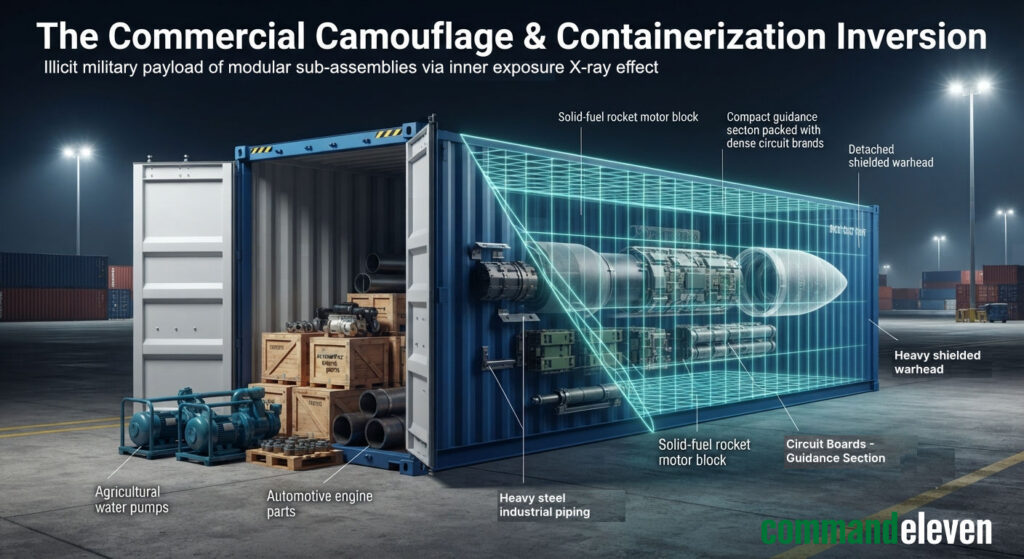
Commercial Shipping Disguise and Containerization
The maritime pipeline avoids direct Iranian state signatures, using a multi-layered system of corporate front companies and flag-of-convenience vessels:
- Corporate Shell Frameworks: Unit 190 leverages subsidiaries and chartered vessels linked to the Islamic Republic of Iran Shipping Lines (IRISL) and state-backed transport firms. Shipments are processed through complex cargo manifests that misdeclare military components as industrial equipment, automotive parts, or agricultural machinery (e.g., water pumps, steel pipes, or commercial lubricants).
- The Containerization Method: Military components are systematically broken down into modular sub-assemblies. Heavy missile bodies are disassembled into separate engine blocks, guidance sections, and warheads, then distributed across standard commercial shipping containers mixed with legitimate consumer goods. This structural noise ensures that standard container scanning and physical customs inspections at regional transshipment hubs fail to identify the illicit cargo.
Deep-Sea Offloading and Coastal Infiltration Mechanics
The critical transition phase,moving cargo from large, ocean-going commercial carriers into Houthi-controlled territory,is executed through a highly coordinated maritime offloading network.

Floating Forward Logistics Bases (FFLBs)
The IRGC positions intelligence-collection and logistics-coordination assets directly within the theater of operations. Vessels like the Behshad,a converted commercial bulk carrier operating ostensibly as a civilian merchant ship,function as active FFLBs.
Stationed at strategic anchorages in the Red Sea and Gulf of Aden, these vessels provide real-time signals intelligence (SIGINT), track Western naval task forces, and serve as deep-sea coordination hubs matching inbound transport vessels with Houthi maritime reception teams.
The Dhow Transshipment Network
Once a cargo vessel reaches the international waters of the Arabian Sea or Gulf of Oman, it executes deep-sea ship-to-ship offloading onto traditional wooden dhows. These small, low-signature wooden vessels are common throughout the regional fishing economy and possess negligible radar cross-sections.
- Tactical Route Profiles: The dhows navigate along the rugged Yemeni coastline, using jagged coastal features and heavy local fishing traffic to mask their transit. They frequently disable their Automatic Identification Systems (AIS) or spoof standard regional identities.
- Coastal Reception Slipways: Inbound dhows make land along unmonitored inlets or secure, Houthi-controlled ports on the Red Sea coast, primarily Hodeidah and Salif. The cargo is offloaded under armed guard under cover of darkness, then immediately moved inland to subterranean assembly depots.
Technical Audit of Transferred Weapon Systems
The primary objective of this logistical network is the distribution of precision systems configured to deny access to the Bab-el-Mandeb Strait. The IRGC has successfully transitioned Houthi forces from unguided rockets to an advanced asymmetric arsenal.
| Iranian System (Origin) | Houthi Designation | Technical Specifications & Components |
| Ghadir / Ghader | Al-Mandeb 2 | Solid-fuel, radar-homing Anti-Ship Cruise Missile (ASCM). Range: ~300km. Transferred via Unit 190 in separate guidance and propulsion modules. |
| Quds-3 / Quds-4 | Quds Family | Land-Attack Cruise Missile (LACM) adapted for maritime land-base targeting. Features small turbojet engines smuggled via European corporate front fronts. |
| Fateh-110 | Asef | Anti-Ship Ballistic Missile (ASBM) equipped with electro-optical/infrared terminal homing seekers. Designed to hit moving naval targets from land bases. |
| Shahed-136 | Wa’id | Delta-wing loitering munition. Range: ~2,000km. Uses commercial-grade GPS components and mass-market internal combustion engines. |
Strategic Vulnerabilities and Countermeasures
The IRGC’s transshipment network across the Red Sea and Bab-el-Mandeb axes demonstrates a high capacity to bypass international sanctions through civilian infrastructure integration. By modularizing its cargo and leveraging low-signature dhow networks, Unit 190 maintains continuous supply velocity to the Yemeni theater.
Targeted Exploitation Parameters
To neutralize this logistics architecture, defensive national security operations must target the physical and digital interfaces where the network transitions from commercial to military visibility:
- Targeted Corporate and Flag Disruption: The reliance on civilian commercial front companies and flag-of-convenience vessels represents a major legal and economic vulnerability. International intelligence coalitions must focus on the persistent declassification and public exposure of the specific maritime shell registries, hull numbers, and shell companies tied to Unit 190. Forcing the sudden cancellation of maritime insurance policies and flag registries for these specific commercial assets strands the cargo hulls at port, severing the high-volume foundation of the supply chain before it reaches international waters.
- FFLB Isolation and Electronic Neutralization: Floating forward bases like the Behshad represent the critical operational link coordinating the dhow transshipment network. Rather than executing highly visible kinetic strikes that carry diplomatic risks, international naval forces must deploy targeted cyber, electronic, and acoustic countermeasures. Disruption operations should saturate the Behshad’s satellite uplink arrays and radar tracking systems, injecting false telemetry into their databases. Blinding these floating hubs isolates the dhow network from real-time intelligence, breaking their capacity to match inbound cargo ships with local Houthi reception teams.
- Component-Level Supply Chain Interdiction: Because advanced systems like the Asef ASBM and Quds cruise missiles rely heavily on illicitly acquired, Western-produced dual-use microelectronics, guidance sensors, and specialized turbojet bearings, their production chains are highly vulnerable to targeted intervention. International export control organs must launch proactive supply chain sting operations, inserting tracked or deliberately altered micro-components into the black-market procurement networks used by the IRGC. Ingesting faulty or corrupted guidance microchips into the assembly pipeline ensures the final assembled missiles fail during operational targeting sequences, rendering the Houthi precision arsenal unreliable without requiring active kinetic interdiction at sea.