
This dossier delivers a structural analysis of the command hierarchy and institutional architecture governing the Islamic Revolutionary Guard Corps (IRGC) (Sepah-e Pasdaran-e Enqelab-e Eslami). Established under Article 150 of the Islamic Republic of Iran’s constitution, the IRGC functions as a highly autonomous parallel military organization. Its constitutional mandate is not the defense of geographic borders, but the preservation and expansion of the Islamic Revolution.
This analysis maps the dual-track command lines connecting the IRGC directly to the Office of the Supreme Leader (Rahbar), detailing the structural mechanics of the Quds Force (IRGC-QF) and the Al-Ghadir Missile Command.
Rather than functioning as isolated military units, these components operate as an integrated bureaucratic and operational engine. By controlling a vast network of transnational proxies and long-range asymmetric precision strike capabilities, the IRGC institutional architecture bypasses traditional state administration to execute Iran’s grand strategy of regional deterrence, forward defense, and asymmetric power projection.
The Parallel Military State: Sovereign Command Channels
The IRGC’s position within the Iranian state apparatus is explicitly designed to prevent internal military coups and insulate the ruling clerical establishment from domestic or external vulnerabilities. It operates completely independent of Iran’s conventional armed forces (Artesh), maintaining its own separate army, navy, air force, intelligence apparatus, and economic infrastructure.
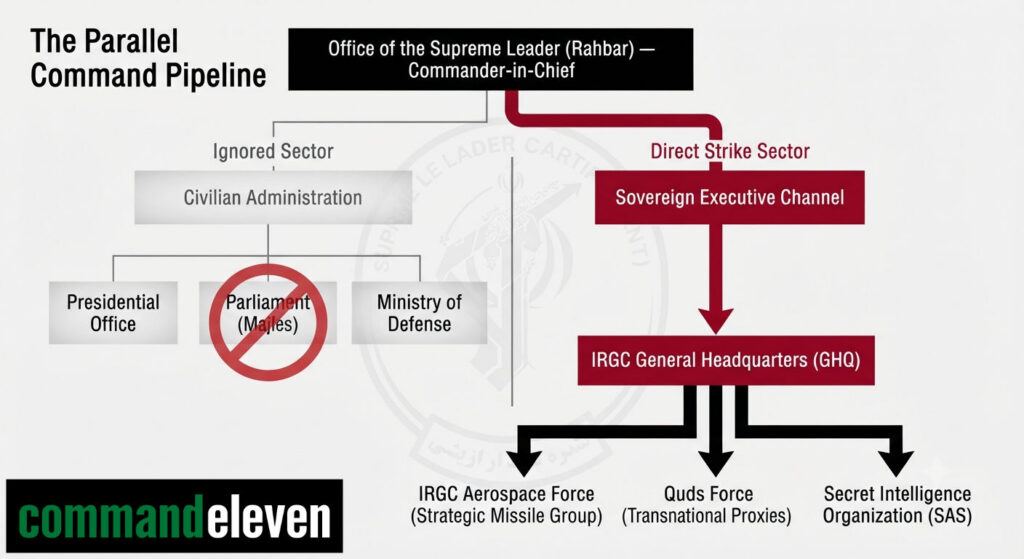
The Direct Line of Command
The chain of command skips the civilian presidential administration and the Ministry of Defense. It connects directly from the Supreme Leader, Ayatollah Ali Khamenei, down to the senior IRGC leadership tier.
- The Supreme Leader (Rahbar): As the Commander-in-Chief, the Supreme Leader holds absolute authority over all strategic decisions, senior officer appointments, and cross-border deployments. He exercises control through a personal network of clerical representatives embedded within every echelon of the IRGC, ensuring ideological alignment and absolute regime loyalty.
- The Joint Staff of the Armed Forces: While the Armed Forces General Staff (AFGS) ostensibly coordinates between the Artesh and the IRGC, the IRGC General Headquarters (GHQ) maintains an independent line of communication to the Supreme Leader. Strategic operational planning is driven by the IRGC Commander-in-Chief and his inner circle of generals, who bypass civilian parliamentary oversight.
The Quds Force (IRGC-QF): Transnational Proxy Integration
The IRGC-QF functions as the primary instrument for Iran’s external security policy and regional power projection. It is a highly specialized, elite unconventional warfare and intelligence service structured to implement the doctrine of Forward Defense,contesting geopolitical threats outside Iran’s geographic borders to prevent domestic instability.
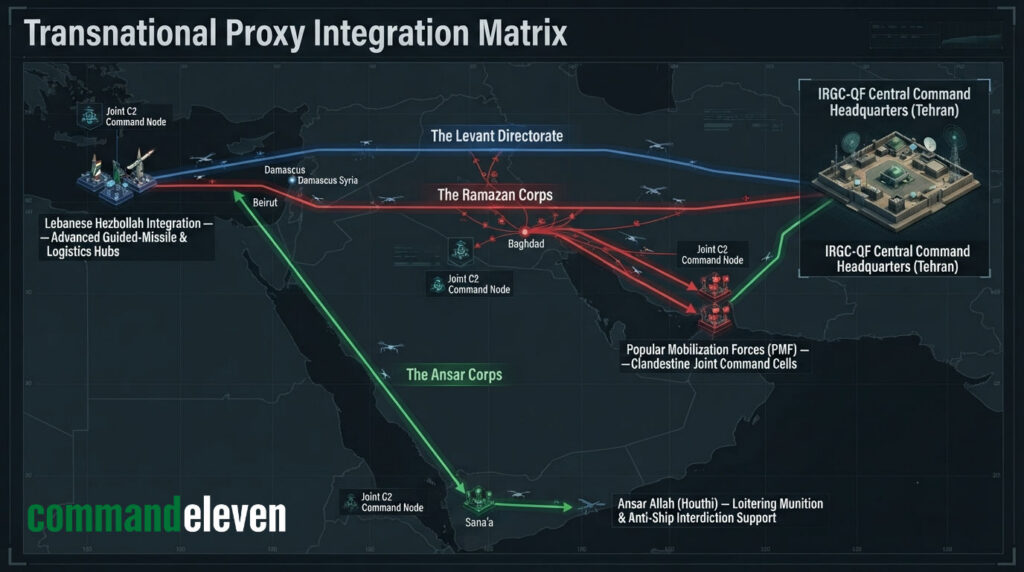
Bureaucratic Subdivisions of the Quds Force
The IRGC-QF is organized into geographic and functional directorates, known as “Corps” (Parand), which manage specific sectors of the regional Axis of Resistance:
- The Levant Directorate (The Lebanon/Syria Axis): Manages the strategic relationship with Lebanese Hezbollah and oversees the complex logistics pipelines feeding advanced weaponry to the Syrian Arab Army and affiliated foreign Shia militias operating within the Levant.
- The Iraq Directorate (The Ramazan Corps): Exercises political and military influence within Iraq. It manages the training, funding, and tactical deployment of the Popular Mobilization Forces (PMF), specifically Kata’ib Hezbollah, Asa’ib Ahl al-Haq, and Harakat Hezbollah al-Nujaba.
- The Arabian Peninsula Directorate (The Ansar Corps): Coordinates the intelligence exchange, financial transfers, and advanced missile/UAV technology transshipment directly to the Ansar Allah (Houthi) movement in Yemen.
The Operational Integration Framework
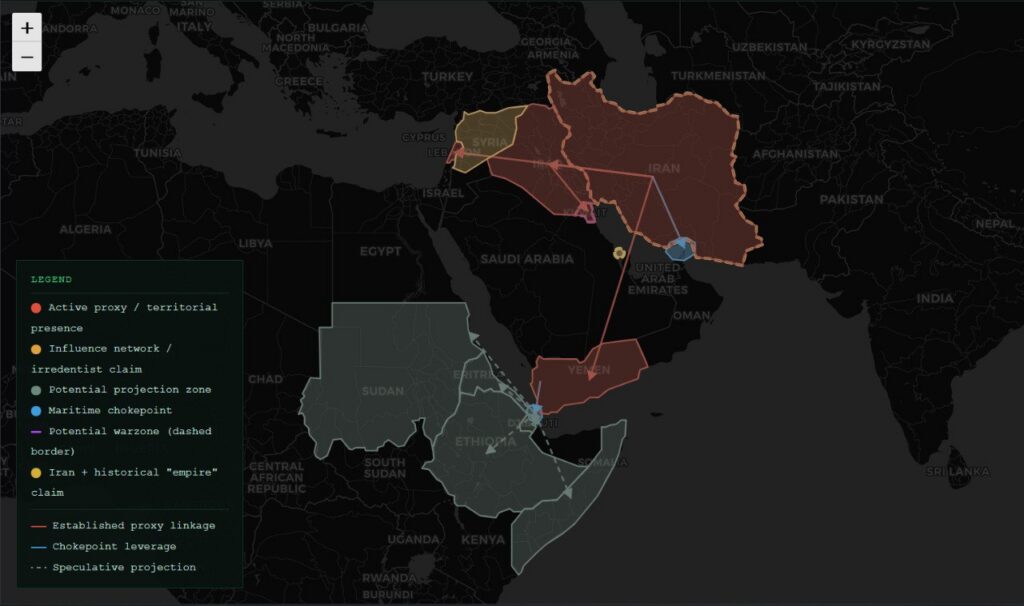
The IRGC-QF does not treat regional proxies as mere mercenary forces. It utilizes a deep integration framework that binds these non-state actors into a unified strategic alliance:
- Ideological and Institutional Mirroring: The Quds Force replicates its own institutional structures within target groups. By establishing dedicated intelligence bureaus, media wings, and social service organizations within entities like Hezbollah or the PMF, it builds self-sustaining parallel governance structures that slowly capture the state host apparatus from within.
- Joint Operations Command Cells: The IRGC-QF establishes clandestine joint command nodes across regional hubs (such as Damascus, Baghdad, and Sana’a). These command centers allow Iranian intelligence officers to directly coordinate drone flights, maritime interdictions, and localized rocket strikes alongside proxy commanders in real time.
The Al-Ghadir Missile Command: The Strategic Deterrence Core
Operating out of the IRGC Aerospace Force (Niru-ye Havafaza-ye Sepah), the Al-Ghadir Missile Command acts as the absolute core of Iran’s strategic deterrence posture. Given Iran’s lack of a modern conventional air force due to decades of international embargoes, the missile command functions as a substitute capability for long-range power projection.
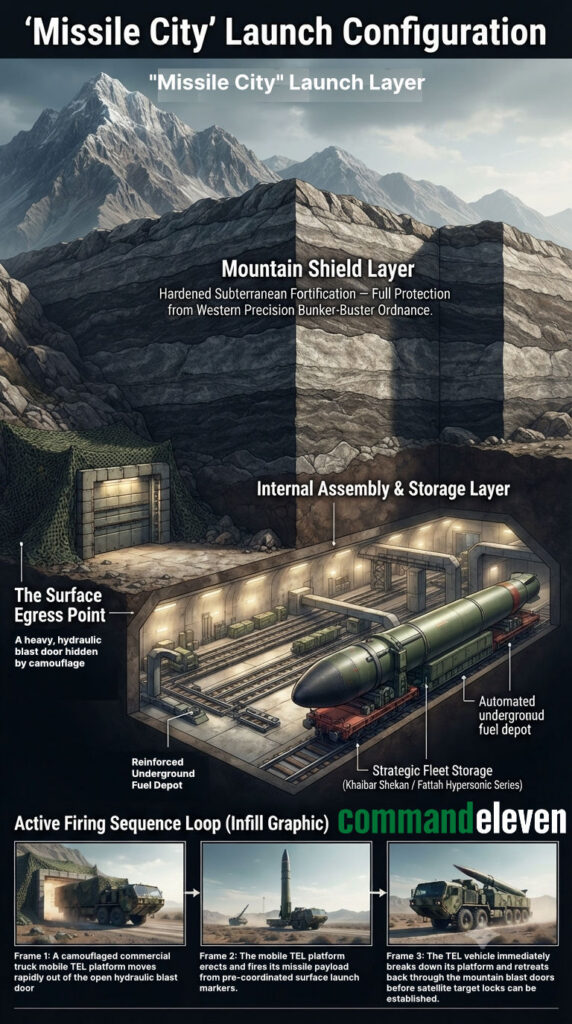
Fleet Capabilities and Tactical Deployment
The Al-Ghadir Command oversees Iran’s extensive ballistic missile, cruise missile, and loitering munition arsenals. Its tactical doctrine relies on high-mobility deployment configurations to survive potential Western or regional pre-emptive air strikes:
- Deep-Underground Missile Complexes (“Missile Cities”): The command has constructed massive networks of tunneled infrastructure carved deep inside mountain ranges across western and southern Iran (such as Kermanshah, Fars, and Hormozgan provinces). These subterranean fortresses house fully automated launch bays, fuel depots, assembly tracks, and transport railways, allowing the IRGC to store, prep, and fire heavy ballistic missiles (such as the Khaibar Shekan, Sejzil, and Fattah hypersonic series) while completely insulated from satellite surveillance and precision-guided bunker-buster ordnance.
- Transporter-Erector-Launcher (TEL) Mobility: Surface deployments are optimized via commercial truck-camouflaged mobile TEL platforms. These units operate along complex highway loops, moving rapidly out of hardened tunnels to designated firing coordinates, launching their payloads, and immediately retreating back underground before adversarial reconnaissance-strike assets can establish target locks.
Systemic Fragility and Exploitation Parameters
The parallel institutional architecture of the IRGC grants the Iranian state a high degree of regional deniability, asymmetric resilience, and deep-strike deterrence. By bypassing standard bureaucratic channels, the corps can mobilize resources and execute operations with high speed.
Strategic Defensive Countermeasures
Despite its highly centralized command authority, this architecture exhibits critical institutional vulnerabilities that defensive counter-strategies must exploit:
- The Command Succession Chokepoint: The highly personalized nature of the IRGC-QF operational framework represents a profound vulnerability. The field execution of the Axis of Resistance relies heavily on personal loyalty networks, face-to-face negotiations, and individual relationships between Iranian generals and non-state proxy leaders. Eliminating key regional coordinators disrupts this personal glue, introducing severe communication delays, factional infighting, and ideological divergence among proxy elements who resist taking direct orders from secondary bureaucratic replacements.
- Exploitation of Artesh-IRGC Institutional Friction: The parallel military structure creates permanent, deep-seated institutional friction between the privileged IRGC and the conventionally starved Artesh. The conventional military suffers from a lack of high-grade equipment, reduced funding, and secondary political status within the state apparatus. Western psychological and information operations should intentionally target this fault line, exposing the massive wealth accumulation of IRGC commanders while highlighting the sacrifices and operational neglect endured by Artesh regular forces. Exacerbating this rivalry degrades internal security cohesion during active regional crises.
- Subterranean Logistical Ingress Interdiction: While “missile cities” are insulated from direct surface air strikes, they remain completely dependent on a highly specific, vulnerable external network of ventilation shafts, fuel transport channels, power grids, and access portals. Rather than attempting to penetrate deep mountain rock with physical ordnance, defensive cyber and electronic warfare operations must focus on the precision interdiction of the automated control systems governing these external dependencies. Corrupting the digital systems that regulate tunnel ventilation, power sub-stations, and hydraulic blast doors can isolate the missile payloads underground, transforming their fortresses into tactical storage tombs.