
This dossier delivers a structural evaluation of the transnational financial architecture and shadow banking networks used by the Islamic Revolutionary Guard Corps (IRGC) to fund its operations and sustain the regional Axis of Resistance. Despite a continuous matrix of international designations, the IRGC,operating through specialized internal financial bureaus, military-linked foundations (Bonyads), and state-directed oil smuggling hubs,has built a highly resilient, multi-jurisdictional sanctions-evasion framework.
This analysis details how the IRGC converts physical commodities, primarily crude oil, into liquid capital through overseas front networks.
By exploiting corporate registries in permissive jurisdictions, integrating traditional Hawala money-exchange systems with modern digital asset infrastructures, and utilizing state-supported “shadow banking” nodes (Rahbar companies), the IRGC injects billions of dollars annually into global financial streams, completely bypassing Western interdiction architectures.
The Oil Smuggling Core and the Dark Fleet
The primary source of the IRGC’s independent operational budget is the illicit extraction, blending, and international sale of Iranian crude oil. The management of this commodity pipeline is driven by specialized state organs, specifically the IRGC Shahid Purja’fari Oil Headquarters, which bypasses standard Ministry of Petroleum oversight to orchestrate global energy smuggling.

The Dark Fleet Operational Profiling
To move millions of barrels of crude oil to international markets, the IRGC relies on a vast, decentralized “Dark Fleet” (or Shadow Fleet) consisting of aging, poorly maintained supertankers (VLCCs) operating entirely outside international maritime safety frameworks:
- Identity and Flag Manipulation: Dark fleet vessels systematically alter their digital profiles. They routinely execute flag-of-convenience hopping,frequently cycling through registries in open jurisdictions,while utilizing fabricated International Maritime Organization (IMO) registrations to obscure their true ownership history.
- AIS Masking and Ghost Voyages: During active smuggling runs, vessels enter total electronic blackout by disabling their Automatic Identification Systems (AIS) before entering Iranian loading terminals like Kharg Island. Alternatively, they employ advanced electronic spoofing, transmitting falsified positional data that places the vessel thousands of miles away in international anchorage zones while it is actively loading crude oil within Iranian sovereign waters.
- Deep-Sea Ship-to-Ship (STS) Inversion: Once loaded, the tankers transit to transshipment zones in the South China Sea, the Gulf of Oman, or the UAE coast. There, they execute complex midnight STS transfers to compliant carriers. During this phase, the Iranian crude is physically blended with alternative regional crudes and legally re-documented under fraudulent bills of lading as “Malaysian Blend” or “Omani Crude” before its final ingestion by independent refineries in East Asia.
The Shadow Banking Network (Rahbar Structures)
The liquidation of smuggled commodities generates massive foreign currency reserves that cannot be directly repatriated to Iran due to SWIFT banking exclusions. To exploit these proceeds, Iranian state banking entities have engineered a highly sophisticated, multi-jurisdictional “Shadow Banking” architecture based on Rahbar (Leader) companies.
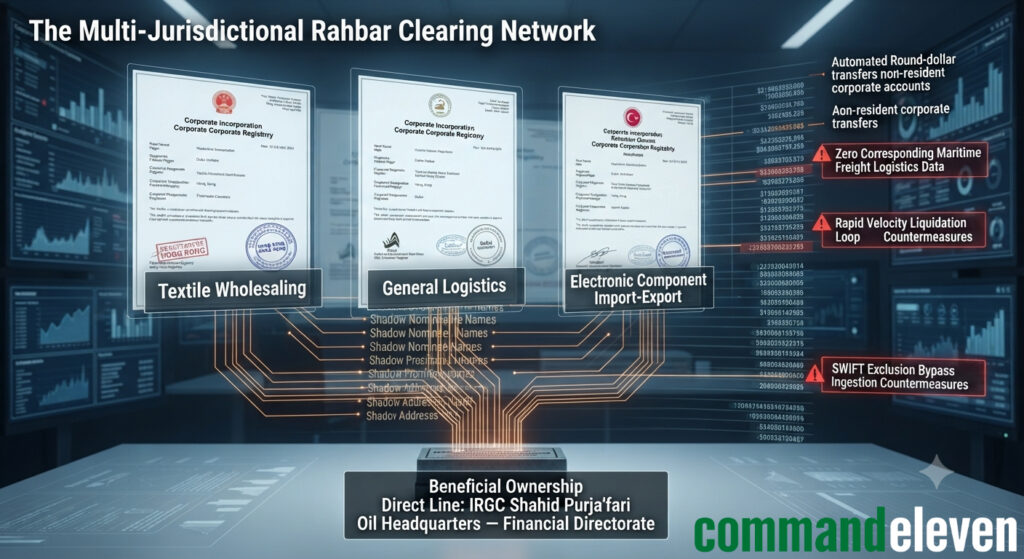
Institutional Mechanics of the Front Matrix
The shadow banking system functions by outsourcing traditional banking operations to a dense web of overseas commercial corporate fronts, primarily concentrated within the financial ecosystems of Hong Kong, Dubai, and Istanbul:
- The Sarafi (Exchange House) Pivot: Major Iranian state banks utilize domestic exchange houses (Sarafi) to manage international transaction liquidity. These exchange houses incorporate hundreds of anonymous, short-lived trading and logistics front companies within permissive corporate registries overseas.
- Corporate Layering: These front entities,such as Golden Globe Demir Celik, Hong Kong Blue Ocean Limited, and Universal Fortune Trading,are registered under nominee owners with zero visible ties to the Iranian state. They share physical addresses, lack any legitimate public web presence, and are cataloged under broad commercial lines (e.g., textile wholesaling, electronic component trading, or general logistics).
- Non-Resident Account Ingestion: Once incorporated, these front companies open multi-tiered corporate bank accounts as non-resident entities within major regional banking institutions. Inbound payments from oil buyers are routed directly into these accounts. The funds are then rapidly moved through a continuous loop of round-dollar transactions between seemingly unrelated front companies across multiple jurisdictions. This extensive corporate layering completely severs the audit trail, allowing the IRGC to use these accounts to settle international weapons procurement invoices and remit cash to regional proxies without the capital ever returning to Iranian soil.
Financial Migration: Cryptographic Assets and Hawala Integration
As Western financial monitoring agencies increase tracking pressure on traditional shadow banking nodes, the IRGC has systematically integrated decentralized financial architectures with traditional informal value transfer systems.
The Stablecoin Ledger Loop
The premier cryptographic tool utilized by the IRGC financial intelligence units is the high-volume deployment of fiat-backed stablecoins, specifically Tether (USDT) operating on the TRON network. TRON’s low transaction fees and high processing speeds make it an ideal mechanism for large-scale illicit capital flight:
- Anonymized Asset Swaps: IRGC financial facilitators move fiat currency accumulated in regional front accounts into dedicated digital asset service providers (DASPs) and clandestine OTC (Over-the-Counter) crypto exchanges operating across permissive jurisdictions. These funds are immediately converted into massive blocks of USDT.
- The Hawala Convergence: The digital stablecoins are transferred across un-hosted wallets directly to localized money changers (Hawaladars) operating within terminal proxy theaters,such as Beirut, Baghdad, or Sana’a. The Hawaladar accepts the cryptographic transfer on the decentralized ledger and immediately liquidates the equivalent value in local physical fiat currency or hard USD cash directly to field commanders of Lebanese Hezbollah, Hamas, or Ansar Allah. This synthesis completely eliminates the need for correspondent banking lines, rendering the last-mile financing of regional conflict invisible to standard compliance tracking.
The Trans-Regional Crime-Terror Nexus: The Caracas-Beirut Pipeline
To insulate its external operations from Western banking freezes, the IRGC-QF relies on a transactional relationship with Lebanese Hezbollah’s specialized criminal wings and the Venezuelan state apparatus. This axis shifts the financial strategy from sanctions evasion to active, transnational organized crime.
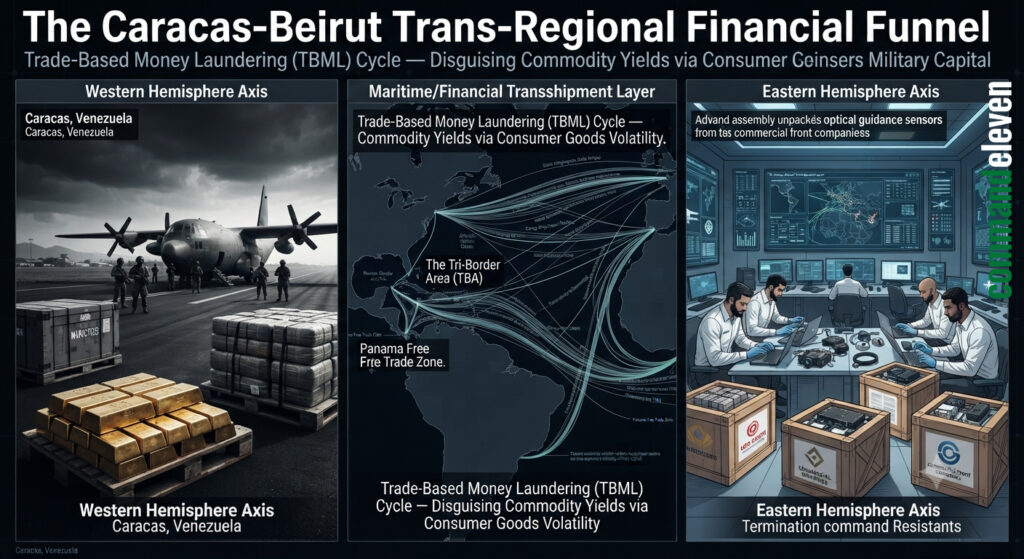
The Maduro-Hezbollah Sovereign Nexus
Under the protective umbrella of the Venezuelan state, the traditional boundaries between international terrorism and transnational organized crime have been erased. The Maduro regime grants Hezbollah operatives diplomatic cover, administrative access, and legal immunity to construct a continental operations base:
- Document Fraud and Identity Inversion: The Venezuelan Ministry of Interior,specifically through corrupt echelons within the Saime (Administrative Service for Identification, Migration, and Foreigners),has systematically issued legitimate Venezuelan passports, national ID cards, and birth certificates to Middle Eastern operatives. This structural compromise allows IRGC-QF and Hezbollah agents to transit international borders, establish foreign corporate bank accounts, and manage logistics hubs throughout Europe and the Americas completely undetected by Western counter-terrorism screening filters.
- The Oil-for-Gold Scheme: As Western sanctions restrict Venezuela’s domestic refining capabilities and isolate Iran’s banking systems, the two pariah states operate a direct commodity swap. Iranian tankers transport gasoline and condensate to Venezuelan ports, bypassing standard commercial clearing mechanisms. Payment is extracted directly in physical Venezuelan sovereign gold blocks mined from the Orinoco Mining Arc. This untraceable gold bullion is flown directly back to Tehran via illicit transport loops, immediately providing the IRGC with a hard-asset reserve to fund regional operations.
The Narcotics and Trade-Based Money Laundering (TBML) Engine
The execution of the Western Hemisphere financial pipeline is managed by Hezbollah’s envoy to Iran, Abdallah Safieddine, and Adham Hussein Tabaja, who coordinate the group’s global criminal portfolio alongside regional drug cartels:
- The Cartel Interface: Operating out of storage and transit hubs in Venezuela (such as Margarita Island and the Guajira Peninsula), Hezbollah’s BAC coordinates multi-ton shipments of high-purity cocaine to North American and European markets. The BAC interfaces directly with major South American syndicates, functioning as a primary transnational logistics corridor and charging a structured “tax” on transit volumes passing through secured zones.
- The Free Trade Zone (FTZ) Layering Loop: The cash generated from international narcotics sales undergoes extensive Trade-Based Money Laundering (TBML) to decouple the capital from its criminal origin. Funds are integrated into cash-intensive commercial business sectors,such as textile wholesaling, electronics distribution, and charcoal exporting,operating out of lax regional hubs like the Tri-Border Area (TBA) of Argentina, Brazil, and Paraguay, alongside Free Trade Zones in Panama and Iquique.
- The Capital Return Loop: Legitimate consumer goods are purchased using the dirty narcotics cash, shipped globally, and sold in secondary markets. The final liquidated proceeds are routed into seemingly legitimate engineering and construction front companies (such as Al-Inmaa Engineering and Contracting) operating across Lebanon and Iraq. This structure completes the financial loop, transforming South American narcotics metadata into clean corporate line items that the IRGC-QF directly draws upon to sustain Axis of Resistance operations.
Strategic Vulnerabilities and Countermeasures
Transregional Countermeasures
- Decoupling of the Latin American Diaspora Trust Net: Hezbollah’s criminal financing relies heavily on exploiting familial, cultural, and religious trust networks within the Lebanese diaspora throughout Latin America and West Africa. International intelligence coalitions must move past macro-level entity designations to execute hyper-targeted, public attribution campaigns. Exposing how specific prominent diaspora business leaders, commercial trade clearinghouses, and free trade zone shell entities are directly funding regional conflict and weapon systems systematically destroys their local social and commercial standing. Forcing legitimate compliance banks to close their non-resident accounts breaks the TBML infrastructure.
- Biometric Invalidation of Venezuelan State Identity Assets: The systemic weaponization of Venezuelan passports by the Maduro-Hezbollah nexus represents a major international border security gap. Allied intelligence agencies must establish a centralized, biometric verification architecture targeting all passport sequences issued within verified periods of institutional corruption in Venezuela. Implementing strict secondary biometric and psychographic screening protocols for any traveler operating on these specific state documents neutralizes the operational value of the falsified identities, trapping IRGC-QF and Hezbollah logistics agents within restricted geographic borders and exposing their true profiles to international enforcement.
Strategic Vulnerabilities and Countermeasures
The IRGC’s financial engine represents a highly adaptive, multi-layered synthesis of maritime smuggling, shadow corporate administration, and cryptographic value movement. By operating through decentralized front networks, the corps effectively insulates its revenue pipelines from direct interdiction.
Targeted Exploitation Parameters
To degrade this economic framework, defensive counter-strategies must exploit the critical systemic dependencies inherent in running a global shadow banking network:
- Algorithmic Anomaly Targeting of Rahbar Nodes: While Rahbar front companies are highly effective at masking beneficial ownership, their transaction behavior exhibits a rigid, repetitive mathematical footprint. These entities are characterized by rapid, high-volume, round-dollar transfers executing between vastly different commercial business sectors without any underlying trade logistics records. International financial intelligence units must deploy advanced machine-learning algorithms across cross-border clearing networks to automatically identify and isolate non-resident accounts matching these specific transaction anomalies. Freezing these nodal ingestion accounts breaks the shadow banking loop, inducing sudden capital liquidity crises for IRGC procurement networks.
- Systemic Decoupling of the Dark Fleet Ecosystem: The Dark Fleet relies heavily on a permissive secondary network of maritime service providers,including classification societies, flag registries, P&I insurance clubs, and deep-water bunkering hubs operating in regional free trade zones. Western and allied maritime authorities must launch an aggressive policy of systemic decoupling. By implementing secondary sanctions that automatically ban any maritime registry, port terminal, or fueling operator that services verified dark fleet hulls, international coalitions can strip these smuggling tankers of their basic operational infrastructure, forcing them to remain at anchor and choking off the IRGC’s primary physical revenue stream.
- Ledger Infiltration and OTC Liquidity Choking: The IRGC’s reliance on USDT on the TRON network represents a concentrated technical vulnerability. While individual transfers are decentralized, the transition from digital tokens back into physical cash depends entirely on a localized network of high-volume OTC brokers and Hawala clearing houses. Allied cyber commands must execute proactive ledger intelligence operations, mapping the specific cryptographic cluster addresses tied to IRGC procurement agents. Collaborating with stablecoin issuers to black-list these verified smart contracts, combined with targeted law enforcement sweeps against regional OTC liquidity hubs, can lock up millions in cryptographic assets simultaneously, freezing the last-mile funding pipelines driving regional proxy conflict.