This strategic white paper delivers a doctrine-level evaluation of the Islamic Republic of Iran’s overarching military master plan: The Asymmetric Deterrence Continuum, structurally anchored by the doctrine of Defa-e Mozaik (Mosaic Defense). Codified by the IRGC senior command structure following intensive assessments of Western operations in Iraq and Afghanistan, this doctrine has moved past legacy territorial defense parameters. Today, it serves as the foundational grand strategy guiding the integration of Iran’s unconventional, multi-axis capabilities against technologically superior adversaries.
The core premise of Defa-e Mozaik is the total decentralization of military and political command structures during a major external intervention, transforming the Iranian state into a highly resilient, self-sustaining unconventional network.
By eliminating reliance on vulnerable, centralized command-and-control (C2) pipelines, this doctrine integrates three core pillars—transnational proxy warfare (San Zhan adaptation), long-range precision-strike arrays, and aggressive cyber-kinetic sabotage.
The ultimate strategic objective is to secure regime survival through Retaliatory Deterrence: shifting the calculus of foreign decision-makers by demonstrating that any kinetic intervention targeting the Iranian homeland will trigger an automated, multi-theater economic and physical catastrophe capable of shutting down global energy supply lines and paralyzing regional adversary states.
The Doctrinal Genesis: The Shift to Total Asymmetry
The development of the modern Iranian defense matrix was catalyzed by a stark acknowledgment of conventional inferiority. The 1991 and 2003 Western-led campaigns in the region demonstrated that standard, centralized conventional armed forces (Artesh models) were rapidly destroyed by modern precision-guided ordnance, total electronic suppression, and rapid network-centric strike frameworks.
The IRGC Command responded by systematically abandoning the concept of symmetrical, platform-versus-platform warfare.
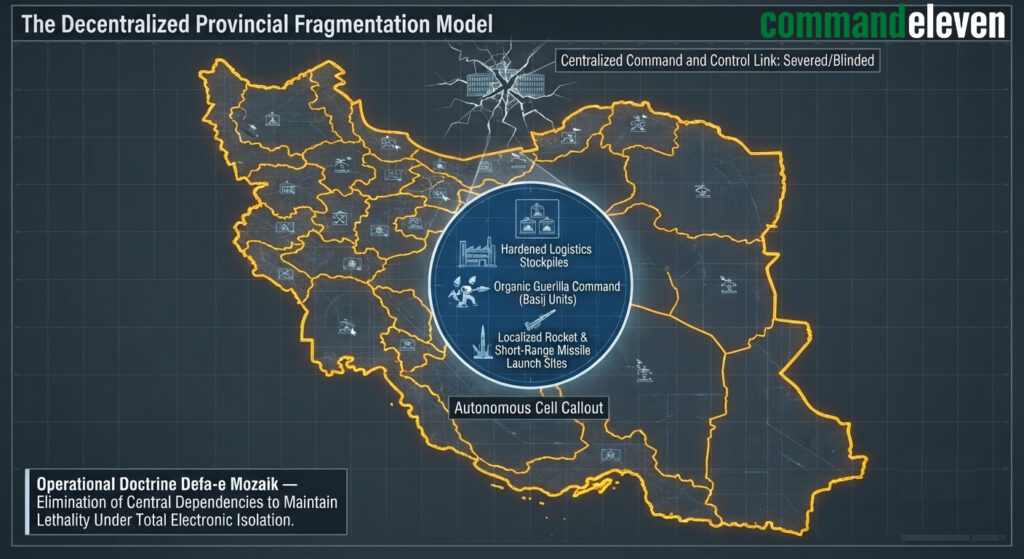
This structural shift established the core tenets of Defa-e Mozaik:
- The Fragmented Theater Model: Under the Mosaic framework, Iran’s sovereign territory is divided into independent operational zones matching provincial boundaries. If the central command architecture in Tehran is blinded or destroyed during a pre-emptive strike, the command loop automatically splits. Every single province transforms into an autonomous war-fighting entity led by local IRGC-Basij command structures.
- The Independence of the Cell: These localized commands possess pre-delegated authority to execute asymmetric warfare without requiring horizontal synchronization or central confirmation. They maintain independent, hardened logistics stockpiles, localized intelligence assets, and organic rocket and guerrilla units, ensuring that the state remains operationally lethal even under total electronic isolation.
- The Continuum Frame: The doctrine deliberately erases the line between domestic security and external power projection. Internal regime preservation, regional proxy integration, and long-range ballistic missile strikes are treated as a singular, fluid operational spectrum managed under a flattened command interface.
Deconstructing the Asymmetric Deterrence Continuum
The implementation of Defa-e Mozaik relies on the precise calibration of three distinct non-kinetic and kinetic axes, coordinated to execute asymmetric retaliation across the regional theater.
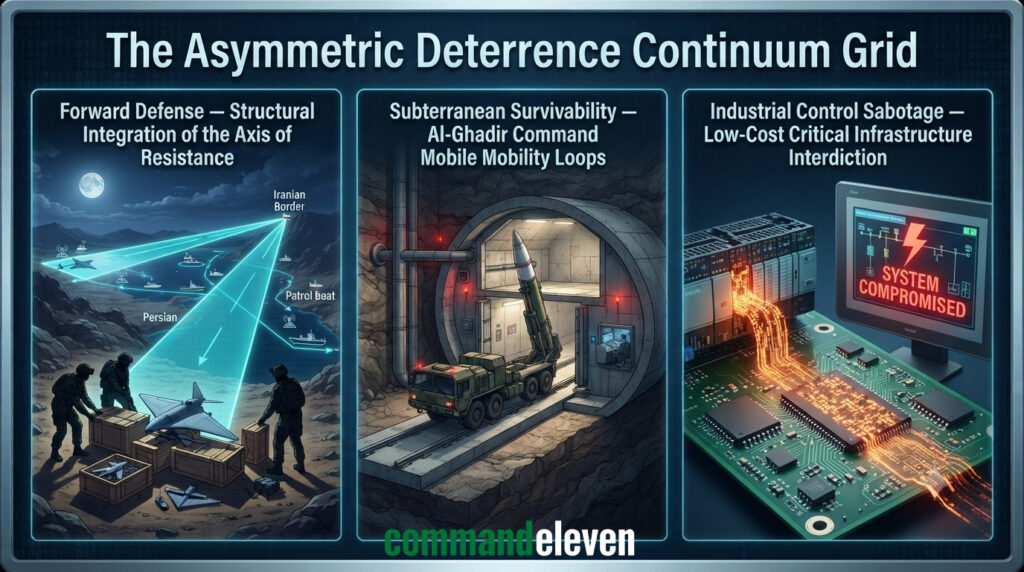
Transnational Proxy Warfare (The Unconventional Forward Defense)
The external element of the mosaic architecture is the institutional integration of non-state actors into the Axis of Resistance. Managed directly by the Quds Force, this vector shifts the front lines of conflict hundreds of miles away from Iran’s geographic borders.
- Operational Execution: Rather than operating as classic proxies, entities like Lebanese Hezbollah, the Popular Mobilization Forces (PMF) in Iraq, and Ansar Allah in Yemen function as integrated regional commands. By providing these groups with domestic manufacturing capabilities for loitering munitions and anti-ship missiles, the IRGC builds permanent tactical flexibility. This setup forces adversaries to fight multiple, self-sustaining localized wars simultaneously, exhausting their military assets before they can approach the Iranian heartland.
Deep Subterranean Precision-Strike Arrays
Because Iran lacks a modern conventional air force, long-range ballistic missiles, cruise missiles, and uncrewed aerial vehicles (UAVs) function as its primary strategic strike asset.
- Operational Execution: The protection of this capability is achieved through the construction of the “Missile Cities”—sprawling, multi-kilometer tunneled installations built deep within mountain ranges controlled by the Al-Ghadir Missile Command. By utilizing commercial truck-camouflaged Transporter-Erector-Launcher (TEL) mobility loops, these units survive initial pre-emptive air campaigns, ensuring the regime maintains the capacity to execute sustained, high-volume retaliatory salvos targeting regional oil infrastructure, maritime choke points, and forward adversary bases.
Cyber-Kinetic Operational Technology Sabotage
The digital arm of the continuum moves past traditional cyber espionage, focusing entirely on Industrial Control System (ICS) and SCADA platform manipulation to inflict physical damage.
- Operational Execution: Operating through deniable personas like CyberAv3ngers and Handala Hack, the IRGC Cyber-Electronic Command targets vulnerable, internet-exposed edge devices regulating foreign critical infrastructure. By manipulating the ladder logic of programmable logic controllers (PLCs) while blinding human operators through telemetry spoofing, these cells execute low-cost, deniable sabotage against municipal water systems and utility grids, proving that critical infrastructure access functions as a powerful form of strategic non-kinetic power projection.
The Institutional Engine: The Passive Defense Organization
The multi-axis capabilities of the IRGC are protected internally by a specialized state bureaucratic architecture: The Passive Defense Organization (Sazman-e Defa-e Gheyr-e Amel). Operating under the direct oversight of the Armed Forces General Staff, this entity manages the structural hardening of the state against high-intensity Western campaigns.
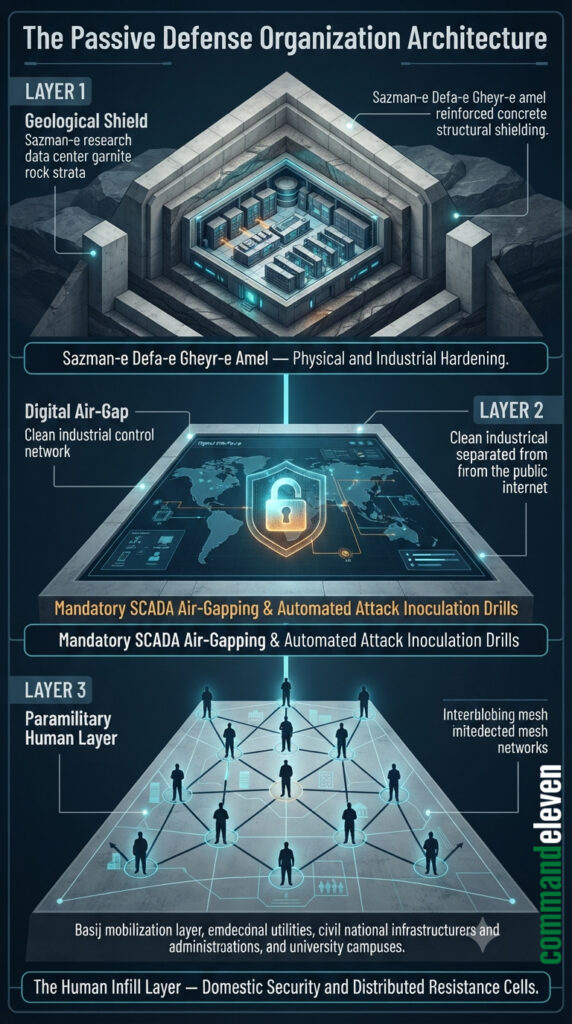
The organization functions across three core defensive axes:
- Industrial and Subterranean Hardening: The Passive Defense Organization directs the structural architecture of all national critical infrastructure. It ensures that nuclear enrichment facilities, data centers, oil refineries, and communication hubs are built either inside deep-mountain bunker systems or protected by heavy concrete shielding, making them highly resilient against conventional kinetic strikes.
- The Cyber Defense Command Integration: This body directly coordinates with the IRGC Cyber-Electronic Command to mitigate external vulnerabilities. Following incidents like the Stuxnet campaign, the organization has implemented strict national software protocols, mandating the air-gapping of critical SCADA nodes, the systematic mapping of internet-exposed municipal assets, and the execution of continuous digital attack drills to inoculate state networks against Western cyber interdiction.
- The Mobilization Layer (The Basij Network): The domestic execution of the Mosaic Defense is sustained by the Basij paramilitary network. Embedded within universities, civil services, and industrial sectors, the Basij functions as both an internal security force to suppress domestic instability and a massive, localized guerrilla pool. During an intervention, the Basij provides the raw human resource base required to sustain thousands of autonomous provincial defense cells, ensuring that an occupying force faces permanent asymmetrical resistance.
Strategic Defensive Countermeasures
The decentralized, multi-axis nature of the Defa-e Mozaik framework means that Western national security architectures cannot rely on traditional, centralized kinetic response models. Treating proxy strikes, cyber-kinetic Sabotage, and ballistic deployments as isolated events creates structural blind spots that ensure a steady erosion of regional stability.
To blunt and neutralize this asymmetric continuum, defensive grand strategies must implement three targeted counter-measures:
Targeted Command Layer Elimination and Communication Air-Gapping
Because the execution of the transnational proxy layer relies heavily on personal loyalty networks and direct coordination between IRGC-QF officers and non-state commanders, it features a concentrated human vulnerability.
Defensive networks must maintain a proactive, persistent interdiction campaign targeting mid-tier and senior field coordinators. Simultaneously, electronic warfare and cyber assets must focus on the complete saturation and blinding of the secure satellite communication lines linking Tehran to regional joint command hubs, breaking their operational synchronization and forcing decentralized units into premature, uncoordinated actions.
Digital and Physical Choking of the Automated Sabotage Engine
The IRGC’s capacity to execute long-range SCADA and infrastructure sabotage is structurally dependent on the public visibility of industrial protocols and the illicit procurement of Western dual-use components. Western cyber defense organs must enforce the absolute removal of all critical infrastructure components from public IP ranges, mandating the mechanical switching of PLCs to physical “RUN” configurations.
Concurrently, strict export control operations must insert tracked or altered micro-components into the black-market procurement networks used by the Shahid Kaveh Research Group, ensuring that smuggled guidance systems fail during operational deployment.
Exploitation of Internal Institutional Fault Lines
The extreme resource concentration within the IRGC creates deep systemic friction with both the conventionally starved regular military (Artesh) and a domestic population enduring severe economic strain.
Allied information operations must aggressively expose the massive wealth accumulation, real estate networks, and front companies managed by senior IRGC generals while highlighting the operational neglect endured by conventional forces and the economic sacrifices forced onto the civilian population.
Flooding domestic information environments with verified telemetry regarding elite corruption destroys the regime’s myth of ideological purity, fueling internal polarization and forcing Tehran to divert its technical, intelligence, and financial resources inward to ensure regime survival, effectively neutralizing its capacity to project power externally across the regional continuum.
IRGC Deconstructed: Mapping Tehran
- The Architecture of Regional Defiance – Part 1
- Command Hierarchy and Institutional Architecture of the IRGC – Part 2
- Technical Audit of IRGC Transshipment Corridors: Red Sea & Bab-el-Mandeb Axes – Part 3
- The Financial Engine — Front Companies, Smuggling Cartels, and Sanction-Evasion Infrastructure – Part 4
- Cyber-Kinetic Operations — IRGC Electronic Warfare Units and SCADA System Target Selection – Part 5
- Defa-e Mozaik (Mosaic Defense) and the Asymmetric Deterrence Continuum – Part 6 (you are here)
- Core Analysis and Strategic Recommendations – Part 7