
Why This Series, Why Now
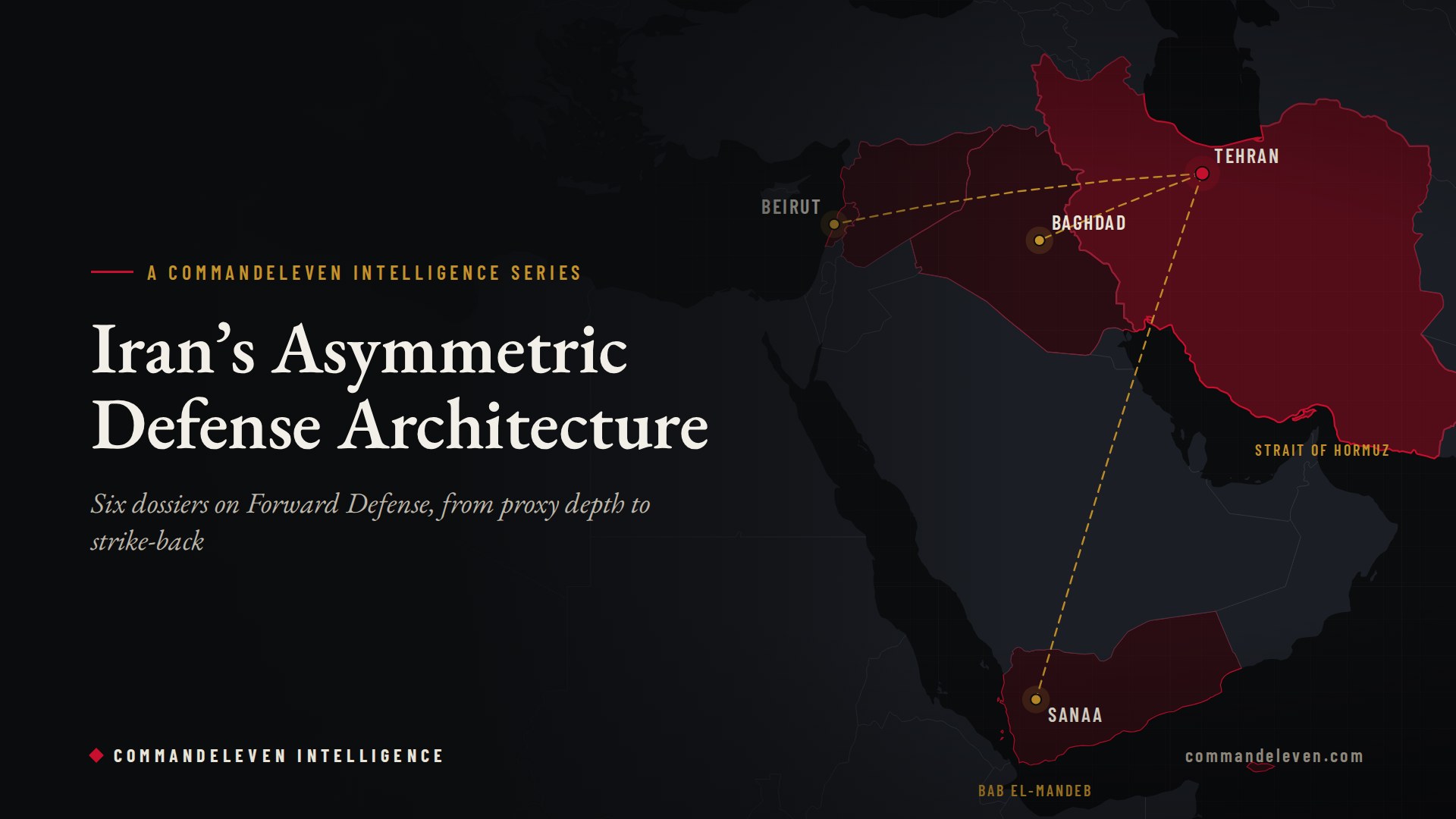
Iran cannot match its adversaries plane for plane, ship for ship or radar for radar, and its military planners stopped trying long ago. What Tehran has built instead is a defense architecture designed to make conventional superiority expensive, slow and politically costly to use. Under the IRGC Quds Force, the old doctrine of holding territory gave way to “Forward Defense”: a distributed network of proxies, supply routes, information operations and missile and drone forces that pushes the fight away from Iranian soil and spreads an adversary’s attention across many fronts at once.
This six-part series, published in July 2026, takes that architecture apart one layer at a time. Each dossier asks the same practical questions: how the layer actually works, where it is resilient, where it is exposed, and what that means for anyone trying to deter, interdict or out-last it.
What This Series Covers
- Part 1: Strategic Depth and Asymmetric Attrition – the shift from territorial defense to Forward Defense, and how a modular proxy network is used to degrade adversary surveillance and impose an unsustainable cost-exchange ratio.
- Part 2: The Logistics of Resilience – the maritime and overland “shadow” supply chain that keeps the IRGC’s regional project supplied under interdiction pressure, and where it is most exposed.
- Part 3: Asymmetric Network Integration: Lebanon and Yemen – how the Quds Force synchronizes two geographically distant proxy theaters through shared command, training and logistics to stretch its adversaries.
- Part 4: The Information War – why Tehran’s fast, decentralized narrative operations often outpace slower, institutionally constrained US messaging.
- Part 5: EW and RF Spectrum Contention – the jamming, deception and spectrum-denial methods used to protect mobile launchers and degrade adversary fire-control and early-warning radar.
- Part 6: Strike Back Capabilities and Escalation Potential – Iran’s three-tier missile and drone strike-back architecture, the saturation limits of regional air and missile defense, and the thresholds where engagement turns into regional escalation.
How to Read It
The parts stand alone, but they are written as one system. Parts 1 and 3 describe the network, Part 2 the logistics that feed it, Parts 4 and 5 the information and electromagnetic layers that shield it, and Part 6 the punishment capability that makes attacking it costly.
These six dossiers are doctrinal assessments, written in July 2026 to explain how the architecture was designed to behave under sustained pressure. Their evidence-based counterpart is Iran War Doctrine & Strategy (September 2026), which tests the same architecture against six months of documented war, from the Strait of Hormuz spoofing campaign to the war-of-exhaustion record. Read side by side, the two series show what the doctrine predicted and what the war actually delivered. The Axis of Resistance and The Garrison State complete the picture.
A Note on Method
Every substantive claim in this series is confidence-tiered as CONFIRMED, ASSESSED or SPECULATIVE. The series stays at the strategic and operational level: it explains how Iran’s defense architecture functions and where it is vulnerable, not how to build or employ any of its components.

