Executive Summary and Technical Scope
This technical forensic deconstruction analyzes the evolution of Electronic Warfare (EW) architectures and radar-guided countermeasures currently observed within the operational theater. The ongoing Iran-led conflict has catalyzed a rapid maturation of RF (Radio Frequency) spectrum contention strategies, forcing a departure from legacy electronic countermeasure (ECM) doctrine. The operational environment is currently defined by high-intensity spectrum denial, where the ability to maintain electromagnetic (EM) dominance is synonymous with kinetic survivability. This analysis examines the technical mechanisms of Iranian suppression and deception systems against adversarial Fire Control Radar (FCR) and Early Warning (EW) networks, evaluating how these architectures degrade sensor coherence to protect high-value mobile assets.
The RF Spectrum as a Contested Domain
The theater has transformed into a laboratory for sophisticated spectrum management. Adversary defensive grids utilize multi-band radar arrays to maintain a continuous “interrogation” of the battlespace. In response, Iranian forces have deployed a multi-layered spectrum contention architecture designed to obscure target acquisition and degrade the probability of kill (Pk) for incoming precision-guided munitions.
- Spectrum Dominance Strategy: Tehran’s approach is predicated on the exploitation of the “noise floor.” By saturating specific bandwidths with high-intensity broadband interference, Iranian EW systems attempt to mask the return signatures of mobile launchers and command-and-control (C2) nodes.
- Dynamic RF Management: Modern Iranian EW suites now utilize AI-augmented RF management, capable of identifying and responding to radar pulses in real-time. This capability reduces the reaction latency between the detection of an interrogation pulse and the initiation of a corrective countermeasure.
Forensic Breakdown: Suppression and Deception Mechanisms
The technical architecture of current Iranian countermeasures relies on a tripartite approach: signal suppression, ghost-target generation, and active emission modulation.
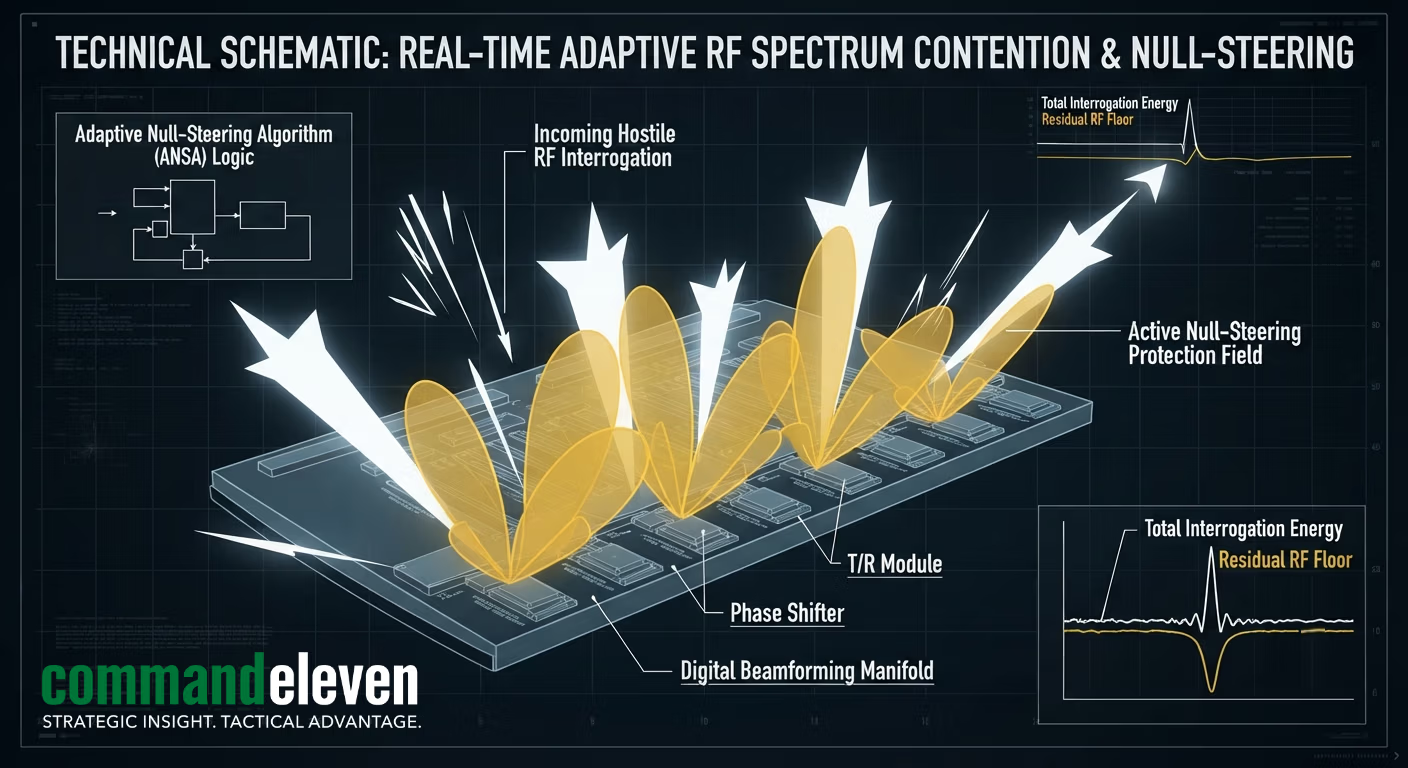
- Adaptive Null-Steering: This technique is foundational to maintaining link integrity during high-intensity jamming. By mathematically “nulling” the direction of the interfering signal, Iranian EW platforms can filter out adversarial electronic denial, allowing for sustained guidance lock on target sets even while under active suppression.
- Frequency Agility and Hopping Protocols: To evade localized denial, assets employ rapid, pseudo-random frequency hopping. The speed of these transitions—measured in microseconds—prevents adversary systems from locking onto a specific carrier frequency, thereby rendering simple notch-filtering techniques ineffective.
- Active Signature Masking (ASM): ASM protocols are designed to decouple the radar return from the physical reality of the asset. By modulating the phase and amplitude of the backscattered signal, these systems can generate “ghost targets” that mislead adversary FCR, effectively compelling defensive systems to engage false coordinates.
Kinetic Effectiveness and Sensor Coherence
The ultimate metric for these architectures is their impact on adversary sensor coherence. Coherence is the ability of a radar system to synthesize raw pulse data into a stable, actionable track. Iranian EW systems focus on the degradation of this synthesis.
- Dynamic Resonant Protection (DRP): DRP protocols synchronize emission patterns with local environmental noise, making it increasingly difficult for SAR (Synthetic Aperture Radar) and MTI (Moving Target Indicator) systems to differentiate between an actual asset and thermal/environmental background clutter.
- Sensor Saturation: When operating in tandem with kinetic saturation—using UAVs and asymmetric munitions—the EW architecture forces adversary defensive systems to prioritize signals. This saturation degrades the logic gates within C2 software, inducing processing lags that create brief windows of vulnerability for Iranian strike assets.
Escalation Potential and Technical Forecasting
As the theater matures, the trajectory of RF contention points toward increased automation and the integration of cognitive EW capabilities.
- Cognitive EW Integration: Future iterations of Iranian countermeasures are expected to feature cognitive architectures that “learn” adversary radar patterns, autonomously developing optimal jamming waveforms without human-in-the-loop intervention.
- Hard-Kill vs. Soft-Kill Interdependence: The technical analysis reveals a critical dependency between soft-kill (EW) and hard-kill (kinetic strike) systems. The EW architecture is not a standalone solution; it is a force-multiplier designed to degrade defensive efficacy to a point where kinetic strike assets can penetrate the terminal phase of the engagement.
- Long-Term Vulnerability: Despite the current effectiveness of these countermeasures, they remain susceptible to high-fidelity, wide-band spectral analysis by adversary signal intelligence (SIGINT) platforms. The continued evolution of these architectures will necessitate further investment in low-probability-of-intercept (LPI) communication protocols and further miniaturization of EW suites to ensure continued tactical agility.
The sophistication of Iran’s RF spectrum contention capabilities represents a significant shift in the operational risk profile of the region. By successfully degrading adversary sensor coherence, Tehran has established a resilient defensive capability that forces a re-evaluation of current suppression of enemy air defense (SEAD) doctrine. The ongoing development of ASM and DRP protocols ensures that the theater remains a high-friction environment, where technical mastery of the electromagnetic spectrum is the primary determinant of operational success.
Read the entire series:
- Strategic Depth and Asymmetric Attrition
- The Logistics of Resilience: Iran’s Shadow Supply Chain
- Asymmetric Network Integration: Lebanon and Yemen
- The Information War: US vs. Iran (Cognitive Warfare)
- EW and RF Spectrum Contention: Iranian Defensive Architectures
- Strike Back Capabilities and Escalation Potential
Additionally, CommandEleven Intelligence has published a 6 part Deconstruction of the IRGC breaking down their internal and external operations, as well as front companies, money laundering and trans-shipment structures.