Executive Summary and Strategic Context
The resilience of the Iranian state under kinetic and economic pressure is not a product of conventional industrial strength, but rather the result of a meticulously engineered logistical architecture designed for high-endurance evasion. Dossier 2 examines the maritime and land-based supply chains that sustain Iran’s strategic posture. As regional maritime interdiction efforts intensify, the Islamic Republic has transitioned from reliance on centralized, vulnerable logistical nodes to a decentralized, “shadow” supply chain model. This infrastructure, characterized by high-volume obfuscation and redundant transit vectors, functions as the economic and material lifeblood of the IRGC’s regional project. Understanding the mechanics of this logistical resilience is essential for assessing the limitations of current interdiction regimes and the viability of long-term economic statecraft in the theater.
The Maritime Obfuscation Matrix
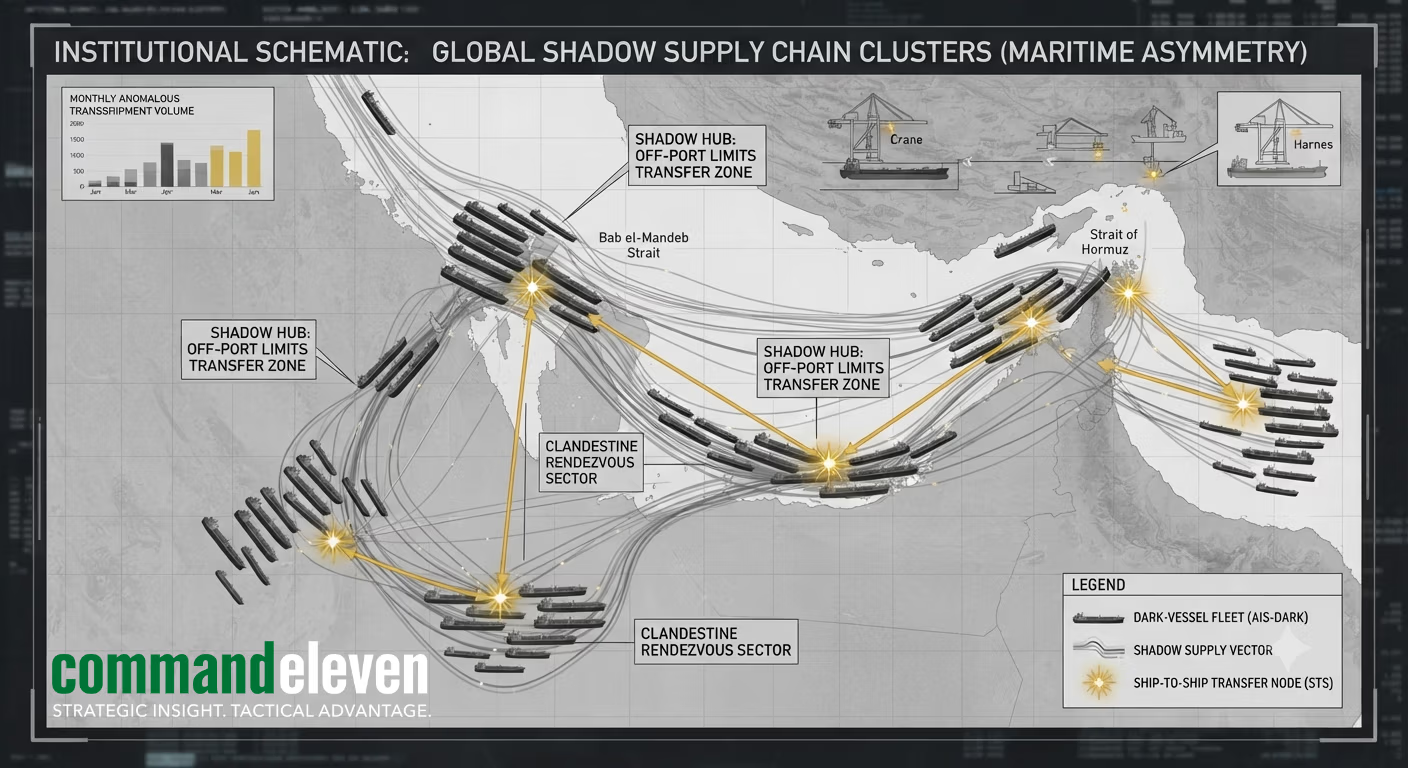
The Persian Gulf and the Strait of Hormuz represent the most contested maritime chokepoints globally. To mitigate the impact of blockade operations, Iranian logistical planners have matured a system of maritime camouflage that operates at the nexus of commercial chaos and technical evasion.
- Dark-Vessel Clustering: The primary methodology involves the strategic use of vessels that deactivate Automatic Identification Systems (AIS) or broadcast falsified positional data. These vessels operate within “clusters”—moving in proximity to legitimate commercial traffic to mask their identity and destination from conventional satellite and radar monitoring.
- Ship-to-Ship (STS) Transfer Protocols: STS transfers in international waters, specifically within the Gulf of Oman and the Arabian Sea, provide the flexibility required to break the chain of custody for sanctioned cargo. By utilizing modularized transfer hubs, the logistical network avoids docking at major, monitored port facilities, effectively neutralizing the efficacy of port-of-entry inspections.
- Non-Compliant Port Integration: The network leverages a tier of secondary and tertiary ports across the Indian Ocean and North Africa that lack the regulatory infrastructure for rigorous compliance. Cargo is cycled through these nodes, documentation is scrubbed, and the material is reintegrated into global supply chains under legitimate manifests.
Land-Based Logistical Resilience: The Interior Corridors
While maritime routes are heavily scrutinized, the land-based logistical corridors—stretching from the Iranian interior through Iraq, Syria, and into the Levant—represent the secondary pillar of resilience. This network is optimized for the movement of high-value, lower-volume items, such as guidance components, specialized sensors, and sensitive electronics.
- Modularized Transit: Logistics are broken down into discrete segments, with individual transporters responsible for only a specific geographic leg of the route. This “relay” approach ensures that even if one segment is compromised, the broader network architecture remains intact.
- Civil-Military Fusion: The transport fleet consists primarily of civilian-registered heavy haulers operating under the guise of cross-border trade. By co-mingling military-grade hardware with innocuous commercial goods, the network exploits the logistical difficulty of inspecting high-volume cross-border traffic without causing significant economic disruption in host nations.
Decentralized Financial Clearing and Settlement
Logistics cannot be separated from the financial mechanisms that facilitate them. The resilience of Iran’s physical supply chain is intrinsically linked to its ability to circumvent the international banking system.
- Informal Value Transfer Systems (IVTS): The use of traditional hawala-style clearing networks allows for the settlement of logistical contracts without the digital footprint of SWIFT transactions.
- Barter and Asset Swapping: To bypass currency sanctions, the logistical architecture increasingly incorporates barter-based exchanges, where material shipments are settled through the transfer of petroleum products, raw commodities, or even cross-regional service agreements. This decoupling from the USD-denominated global financial system provides a layer of insulation against even the most stringent economic sanctions regimes.
Forecasting, Vulnerabilities, and Interdiction Constraints
Despite its robustness, the shadow supply chain is not without latent vulnerabilities. The integration of high-volume military hardware into commercial channels imposes significant friction, and the network’s reliance on specific, semi-compliant intermediaries represents a potential focal point for intelligence-led disruption.
- The Compliance Gap: Increased pressure on the secondary ports and shipping agents utilized by Tehran could induce systemic fragility. Identifying these “bottleneck” entities—those that manage the interface between illicit and legitimate trade—offers the most effective avenue for interdiction.
- Technical Signal Intelligence (SIGINT): As the network relies on communication for the coordination of complex STS transfers and relay logistics, persistent SIGINT targeting of mid-level logistical coordinators may yield high-fidelity insights into the movement of critical materiel.
- Systemic Fragility: The logistical network is optimized for stability, not speed. Any kinetic disruption that forces the network into an “emergency” operational tempo risks exposing the underlying nodes that are usually masked by the volume of daily trade.
The Iran-led logistical architecture is a testament to the endurance of decentralized networks in the face of centralized state-level pressure. While current interdiction efforts have successfully increased the cost and complexity of these operations, they have not yet achieved the threshold of disruption necessary to trigger a systemic collapse of the network. Future stabilization efforts must account for the reality that the Iranian logistical model is designed to persist in a state of semi-permanent degradation, adapting to interdiction as a constant, rather than an existential, operational constraint.
Read the entire series:
- Strategic Depth and Asymmetric Attrition
- The Logistics of Resilience: Iran’s Shadow Supply Chain
- Asymmetric Network Integration: Lebanon and Yemen
- The Information War: US vs. Iran (Cognitive Warfare)
- EW and RF Spectrum Contention: Iranian Defensive Architectures
- Strike Back Capabilities and Escalation Potential
Additionally, CommandEleven Intelligence has published a 6 part Deconstruction of the IRGC breaking down their internal and external operations, as well as front companies, money laundering and trans-shipment structures.