
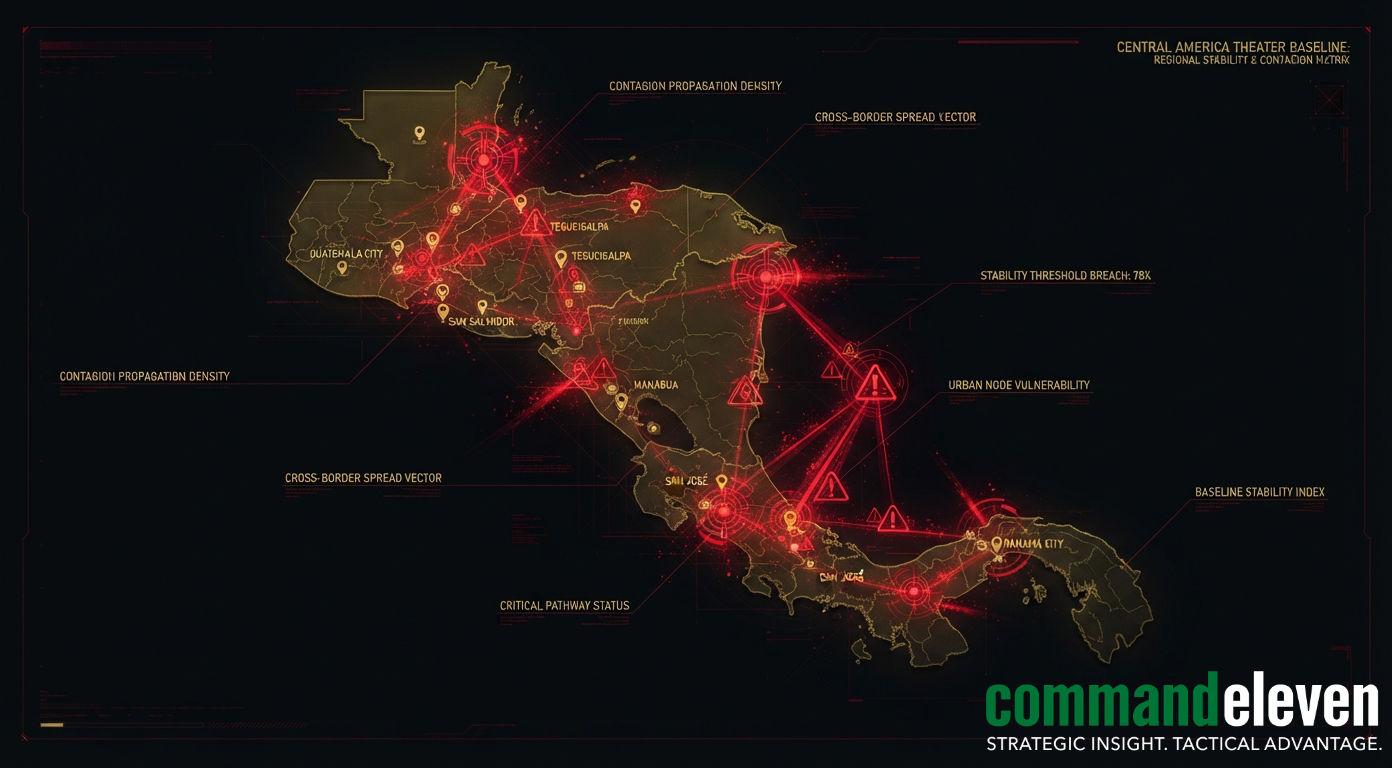
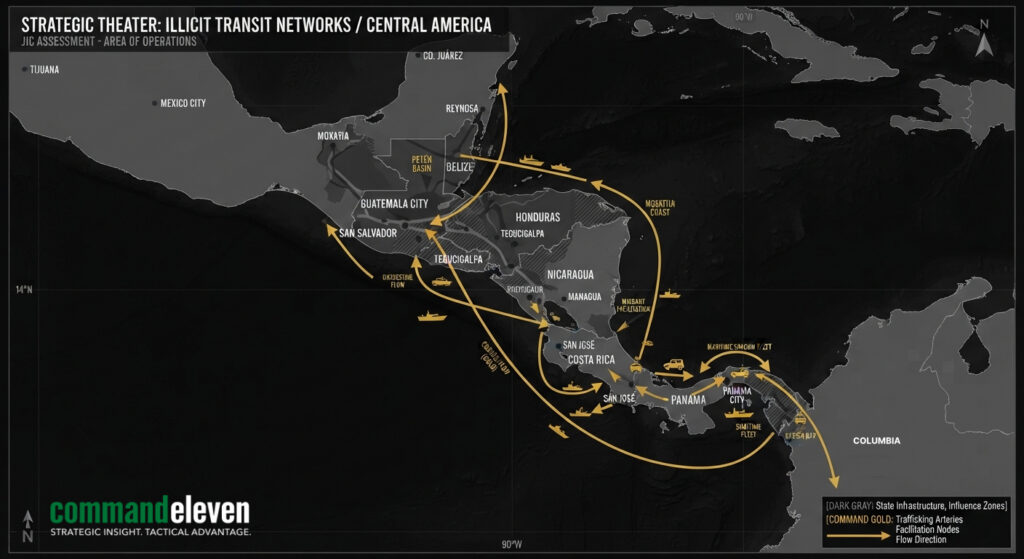
As of July 2026, the Central American isthmus—comprising the Northern Triangle (Guatemala, Honduras, El Salvador) and the broader regional corridors—has evolved into a theater of “transnational systemic instability.” The region is defined by the convergence of state-level institutional erosion and the aggressive expansion of transnational criminal organizations (TCOs) that function as de facto proto-states. This assessment identifies the theater as a critical vulnerability in the Western Hemisphere’s security architecture, where the fusion of migrant facilitation, narcotics trafficking, and the exploitation of political fragility creates a perpetual engine of regional disruption. Central America is no longer merely a transit point; it is a primary operational node for actors seeking to project influence and logistical disruption against North American security boundaries.
Overall Threat Indicators
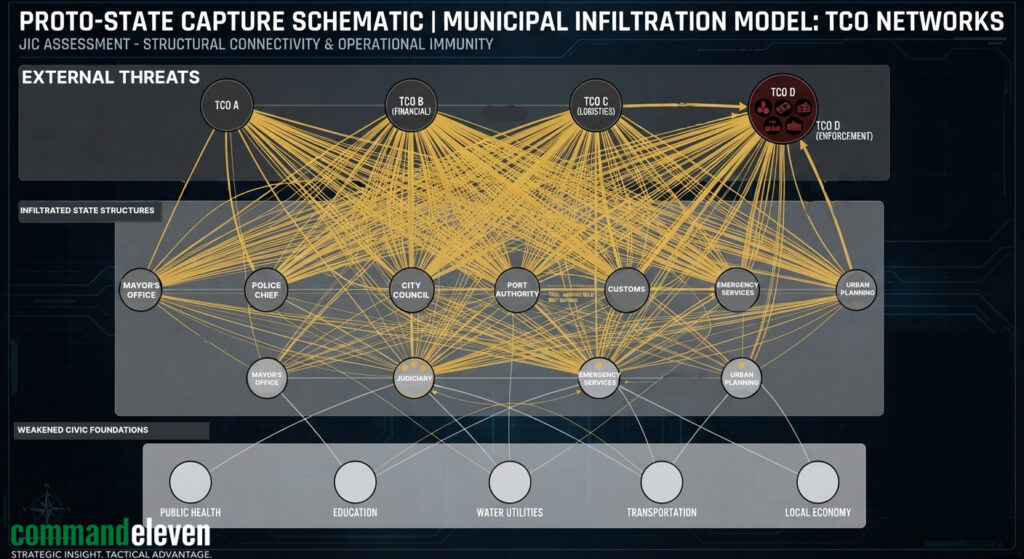
- The Proto-State Contagion: Criminal syndicates have moved beyond traditional illicit commerce, now exerting influence over local governance, judicial systems, and municipal security forces. This “capture” of the administrative state provides insurgent-level resilience and operational immunity, complicating traditional law enforcement and intelligence interdiction.
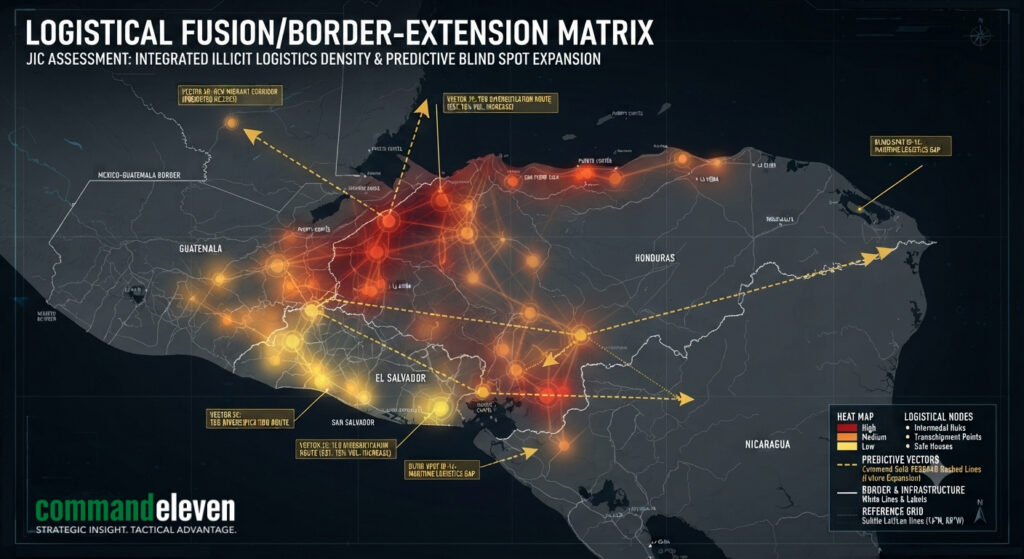
- Logistical Fusion: The integration of human smuggling, weapons proliferation, and synthetic narcotics trafficking into a single, unified logistics network is complete. This consolidation allows TCOs to mobilize resources across borders with near-total opacity, rendering conventional border control measures increasingly ineffective.
- External Hegemonic Interests: The region is witnessing an increase in non-hemispheric economic and infrastructure investment, particularly in strategic nodes such as deep-water ports and telecommunications. These investments carry significant dual-use potential, creating intelligence and logistical challenges for regional security stability.
Operational Topology: The Attrition Architecture
The “Attrition Architecture” in Central America is defined by its ability to neutralize state-level sovereignty:
- Subterranean and Porous Connectivity: Criminal corridors utilize a hybrid model of natural terrain exploitation (jungle/mountainous) and the infiltration of legal transit networks. The reliance on hardened, clandestine routes ensures the continuity of supply, regardless of external security posture.
- Human Capital Weaponization: Large-scale population displacement is systematically leveraged to overwhelm border-security grids. This “demographic pressure” forces state security apparatuses into reactionary stances, creating “blind spots” that are simultaneously exploited for the movement of high-value contraband.
- Localized Resource Capture: TCOs exercise control over local economies, from extortion of agricultural exports to the control of regional energy infrastructure. This ensures a consistent, untraceable revenue stream that finances long-term operational endurance against state-level interference.
Technical Integration and Asymmetric Warfare
- Encryption and SIGINT Suppression: The adoption of advanced, decentralized communication networks by TCOs has effectively countered state-level SIGINT monitoring. The use of commercial, end-to-end encrypted messaging platforms, paired with the physical disruption of monitoring infrastructure, creates a high-level “communications dark zone.”
- UAV Utilization: The deployment of small, commercial-grade UAVs for counter-surveillance—specifically to track law enforcement and military patrol movements—has shifted the tactical advantage to the TCOs. These assets provide near-real-time intelligence on state maneuvers.
- Digital Financial Obfuscation: The integration of decentralized financial systems and cryptocurrency for money laundering allows for the instantaneous movement of capital across borders, bypassing traditional banking-sector monitoring and complicating the disruption of criminal revenue streams.
Strategic Implications for Regional Stability
- Institutional Atrophy: The cycle of corruption and subsequent loss of public confidence in the rule of law is the primary driver of instability. This atrophy creates an environment where alternative, criminal-led governance models become the default for marginalized populations.
- The “Border-Extension” Phenomenon: As criminal networks optimize their logistics, the “front line” of security has been pushed significantly south of national boundaries. The inability of individual states to secure their borders has effectively created a regional security vacuum that requires a multi-national, synchronized response that is currently absent.
- Macroeconomic Vulnerability: The reliance on remittances—while stabilizing for households—often masks the structural fragility of local economies, making the region increasingly sensitive to external economic shocks and less able to invest in long-term security reform.
Forecasting and Baseline Indicators
Future stability in the Central American theater will be tracked through these indicators for the remainder of Q3 2026:
- Administrative Capture Velocity: Monitoring the frequency and scale of criminal infiltration into municipal-level security and administrative nodes.
- Transnational Logistics Saturation: Measuring the volume and efficiency of contraband flows through established high-frequency corridors.
- Governance-Recruitment Delta: Tracking the rate at which local populations pivot from seeking services from state institutions to those provided by criminal-led “community governance” structures.
Central America stands at a strategic pivot point. The theater’s baseline confirms that the region is transitioning from a localized criminal problem to a transnational security crisis. The future of the isthmus will be defined by the ability—or failure—to contain the proto-state encroachment before it solidifies into a permanent, resilient logistical backbone for global illicit networks.

