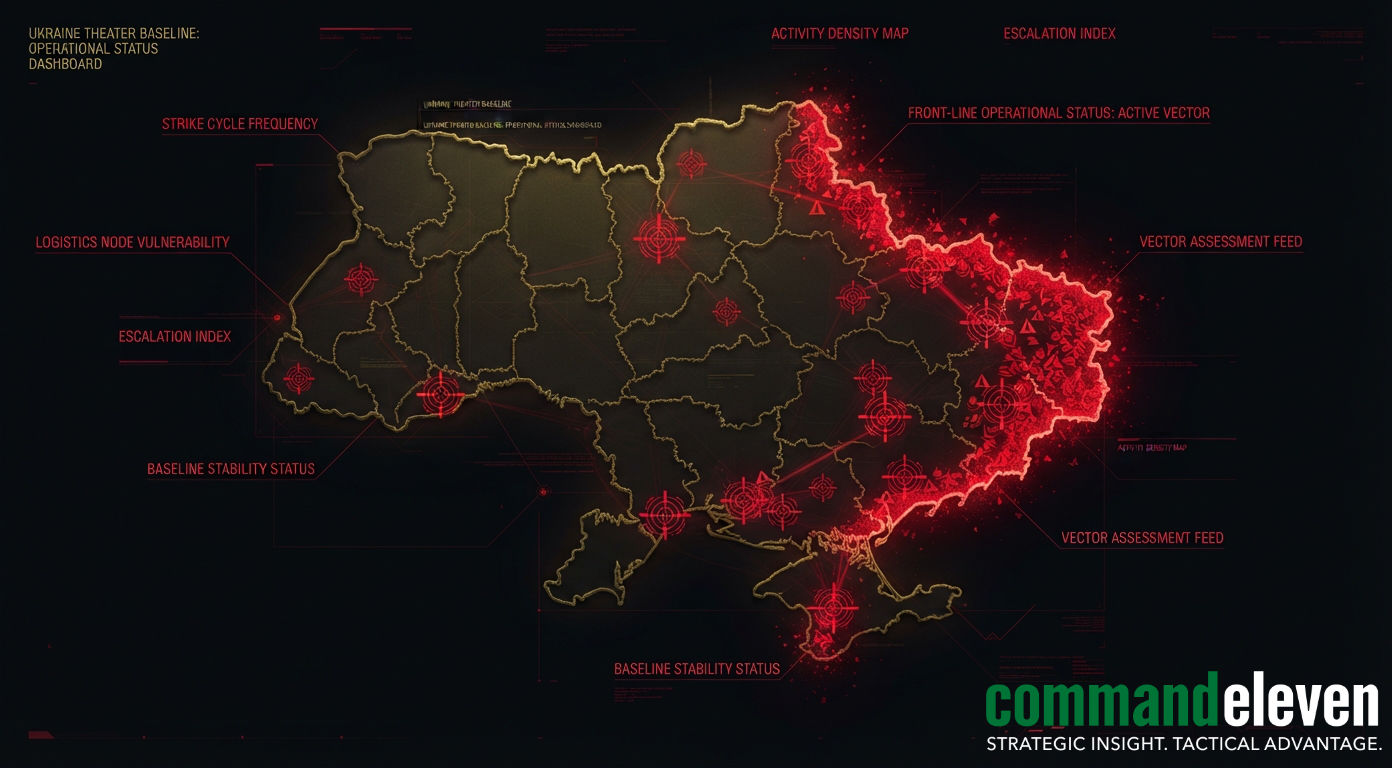
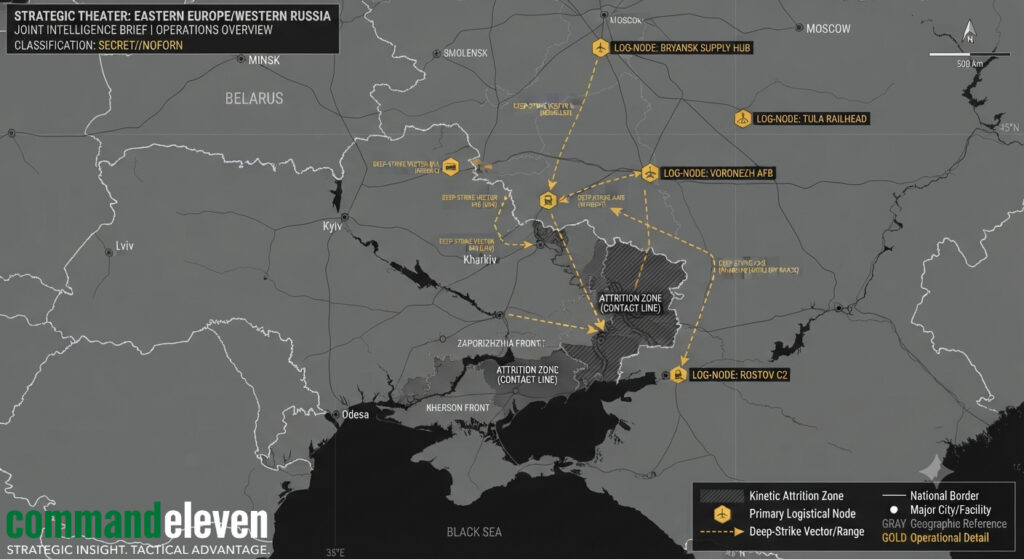
As of July 2026, the Ukraine theater has transitioned into a protracted “attrition-by-depth” paradigm. The operational environment is no longer defined by traditional linear maneuvers but by a symbiotic struggle between industrial-scale mobilization and localized, high-precision asymmetric strike cycles. Russia currently maintains control over approximately 20% of Ukrainian territory, yet its tactical gains—averaging roughly 15 square miles of net gain per month—are increasingly disproportionate to the mounting costs of sustainment. The central arena of competition has pivoted toward deep-strike logistics, where Ukraine’s innovation in autonomous systems is effectively eroding Russia’s capacity to maintain its war effort. This assessment confirms a structural stalemate on the front lines, juxtaposed against a highly dynamic and escalating war of logistics and infrastructure behind them.
Overall Threat Indicators
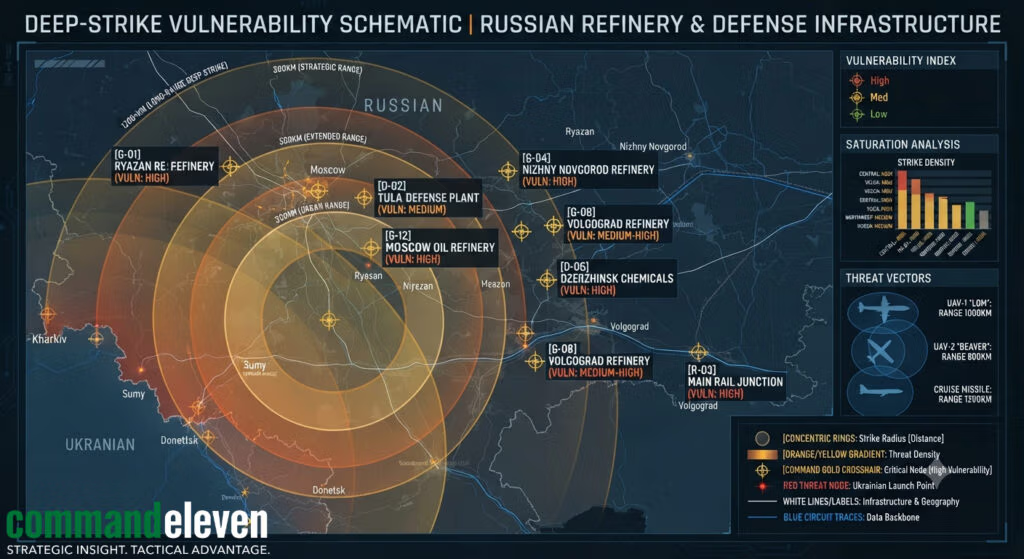
- Infrastructure Erosion: Ukraine’s deep-strike operations—targeting oil refineries, logistics hubs, and defense industrial facilities deep within Russia—are a primary indicator of tactical progress. With reports of reduced Russian refining capacity by ~33% and frequent strikes reaching beyond 700km, the ability of the Russian state to sustain high-intensity operations is under chronic pressure.
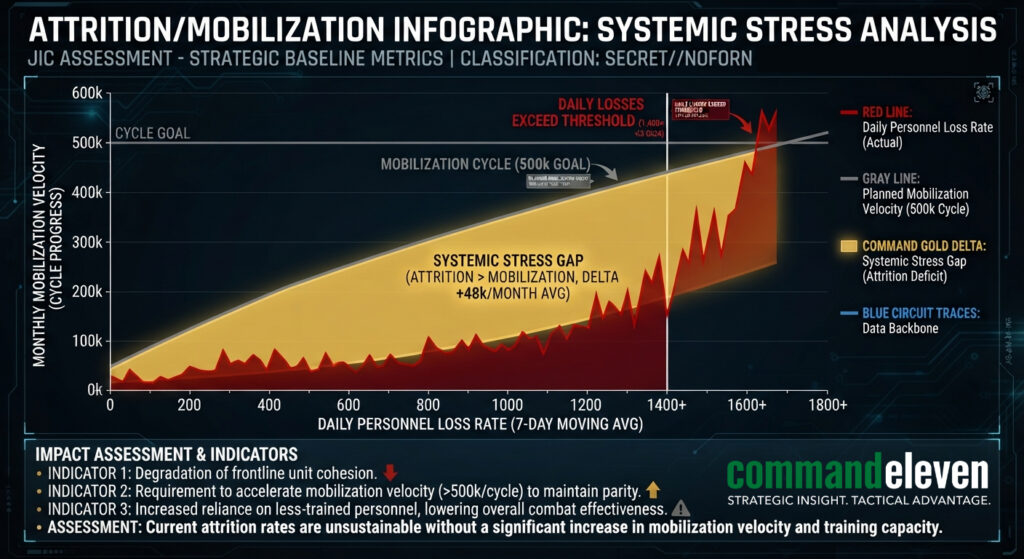
- Mobilization Dynamics: Russia is reportedly preparing for a mass mobilization of 500,000 personnel for an autumn cycle. The speed at which these forces are integrated into frontline operations, and their ability to withstand the current attrition rate (exceeding 1,400 personnel lost per day in mid-July 2026), remains a critical stability metric.
- Conflict Contagion: The escalation of drone strikes against Russia’s “shadow fleet” in the Black and Azov Seas signals a broadening of the theater, threatening to disrupt global maritime stability and forcing Russian military resources to re-allocate from the front lines to the defense of maritime logistics.
Operational Topology: The Attrition Architecture
The “Attrition Architecture” is now dominated by two opposing structural behaviors:
- Frontline Stasis: The contact line is a multi-layered, saturated defensive grid. Conventional breakthroughs have been replaced by “micro-attrition”—the slow, costly seizure of settlements (e.g., Oleksandrivka) that carry high symbolic and tactical value but minimal strategic depth.
- Logistical Decentralization: Russia is shifting toward a “high-tech, multi-domain” military model under Gerasimov’s direction. However, this is constrained by the necessity of defending its own rear areas, which are increasingly vulnerable to Ukraine’s burgeoning long-range drone network. Ukraine, conversely, operates under a “distributed resilience” model, relying on coalition intelligence support and a decentralized network of private-public drone production to bypass the vulnerabilities of traditional, centralized supply lines.
Technical Integration and Asymmetric Warfare
- The Drone Factor: UAVs have evolved from tactical reconnaissance assets to strategic force multipliers. Ukraine’s focus on drone-delivered, long-range precision strikes has forced Moscow to devote massive resources to IAMD (Integrated Air and Missile Defense) of its rear-area industrial nodes.
- RF Spectrum Contention: The battlespace is characterized by intense RF spectrum warfare. Adaptive null-steering, signature masking, and EW (Electronic Warfare) interference have created intermittent “dead zones.” The ability to navigate these zones while maintaining sensor-to-shooter connectivity is the primary driver of tactical success.
- Autonomous Systems: Russia’s monthly output of tactical drones has reached the “tens of thousands,” signaling an intent to institutionalize autonomous warfare into its permanent defense industrial base.
Strategic Implications for Regional Stability
- Alliance Cohesion: The conflict is sustained by the Ankara-framework assistance protocols (2026-27), which serve as the primary defensive anchor. Any fracture in the intelligence-sharing or logistical-supply chains poses an existential risk to Ukraine’s current attrition strategy.
- The Escalation Paradox: Both sides operate within a fragile equilibrium. Despite the technical reach of their strike assets, the avoidance of state-on-state escalation remains the primary constraint. However, as the threshold for “acceptable costs” rises, the time available for political leadership to vet kinetic strikes is shrinking, increasing the risk of accidental escalation via technical failure or misunderstood signal.
Forecasting and Baseline Indicators
The Ukraine conflict will be tracked through the following metrics for the remainder of Q3 2026:
- Refinery Throughput & Energy Logistics: Tracking the operational capacity of Russia’s remaining major refineries. A drop below the critical threshold (currently estimated at 50% capacity) will be a primary indicator of systemic collapse.
- Personnel Attrition vs. Mobilization Velocity: Assessing the delta between Russian loss rates (1,400+ per day) and the replenishment rate of the autumn mobilization cycle.
- Autonomous Systems Density: Measuring the saturation levels of tactical UAVs on the front lines to identify shifts from “supportive reconnaissance” to “autonomous dominance.”
The current baseline confirms that the conflict has evolved from a conventional war into a competition of resilience. Time is no longer an absolute advantage for either side; rather, it is a currency that must be bought through the constant, costly, and technologically driven degradation of the opponent’s industrial and logistical soul.