
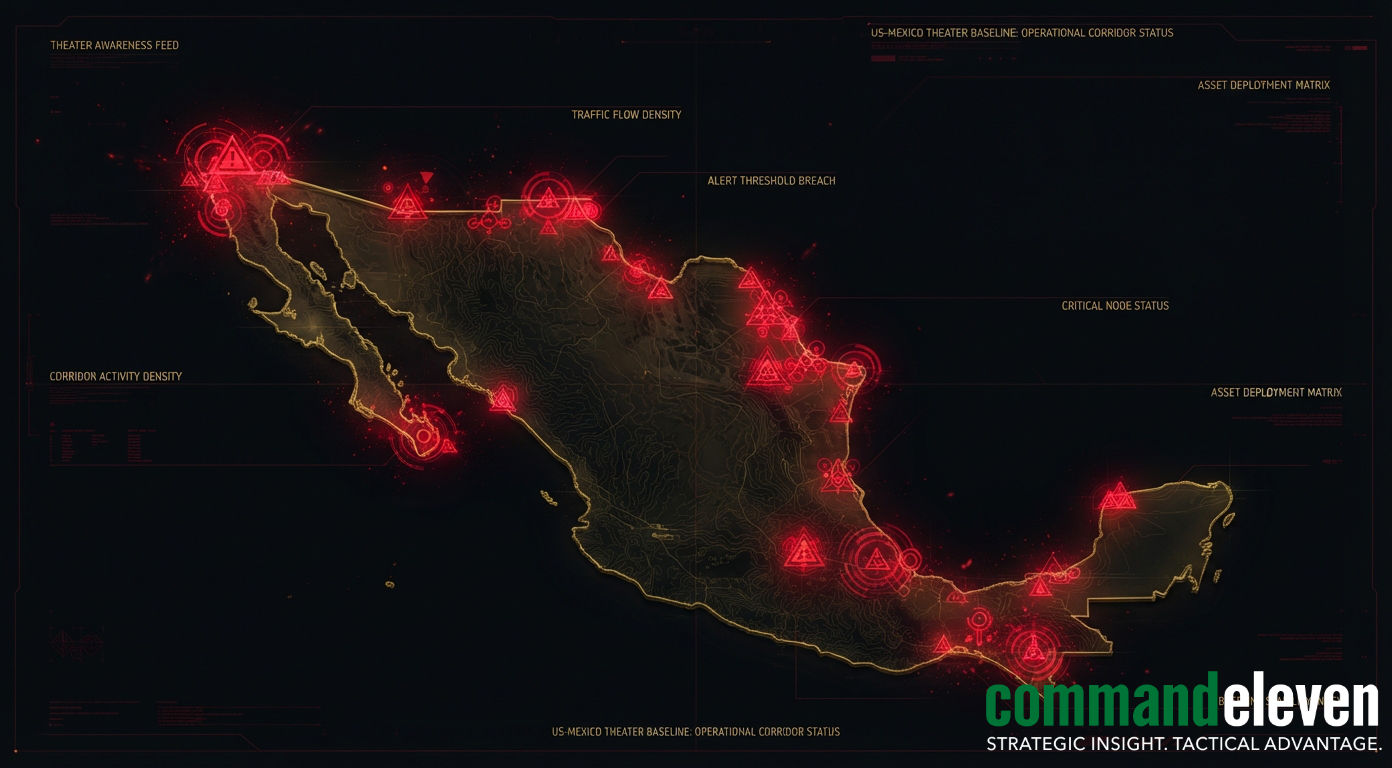
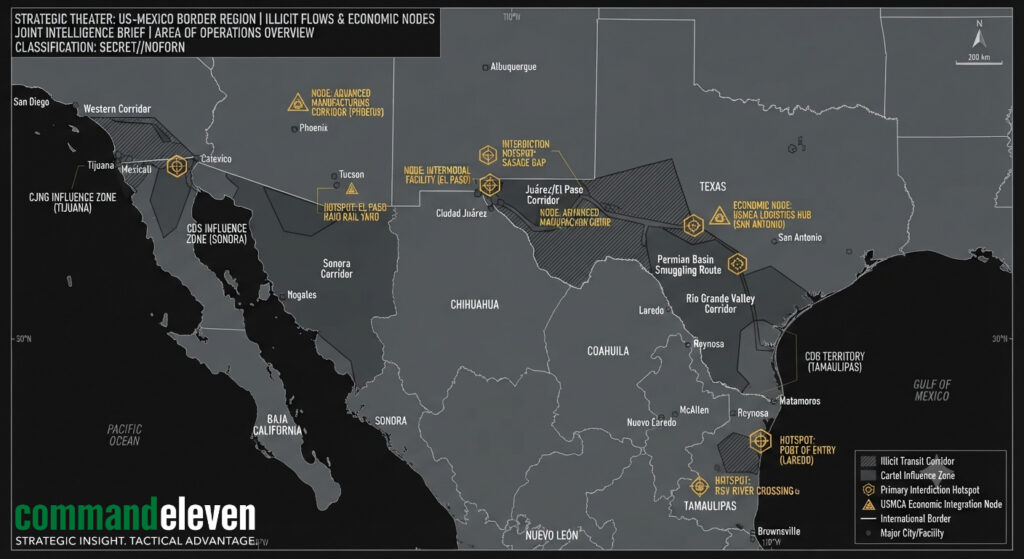
As of July 2026, the United States–Mexico security theater has entered a period of “aggressive bilateral recalibration.” The relationship is defined by the tension between the Trump administration’s designation of major Mexican cartels as Foreign Terrorist Organizations (FTOs) and the Sheinbaum administration’s efforts to maintain constitutional sovereignty while delivering tangible counternarcotics results. The theater is transitioning from a policy of managed cooperation to one of high-pressure, performance-based integration, where security outcomes—specifically the eradication of fentanyl supply chains—are inextricably linked to the ongoing USMCA statutory review.
Overall Threat Indicators
- Cartel-as-FTO Designation: The formal designation of six major cartels as FTOs has fundamentally altered the rules of engagement. It provides a legal framework for “focused, decisive action” by US military and intelligence assets, creating a permanent state of friction regarding potential unilateral operations on Mexican soil.
- Logistical Disruptions: The systematic pressure on cartel supply chains has yielded measurable results, including a 35% decline in U.S. overdose deaths by late 2025 and a 95% reduction in maritime drug trafficking. However, this has also triggered retaliatory violence, evidenced by the volatility following the elimination of high-value targets like “El Mencho.”
- Border Infrastructure Stability: Following rigorous enforcement cycles, illegal migration and border apprehensions are at historic lows. This success has shifted the primary focus of bilateral security from migrant processing to the disruption of transnational financial networks and arms trafficking.
Operational Topology: The Attrition Architecture
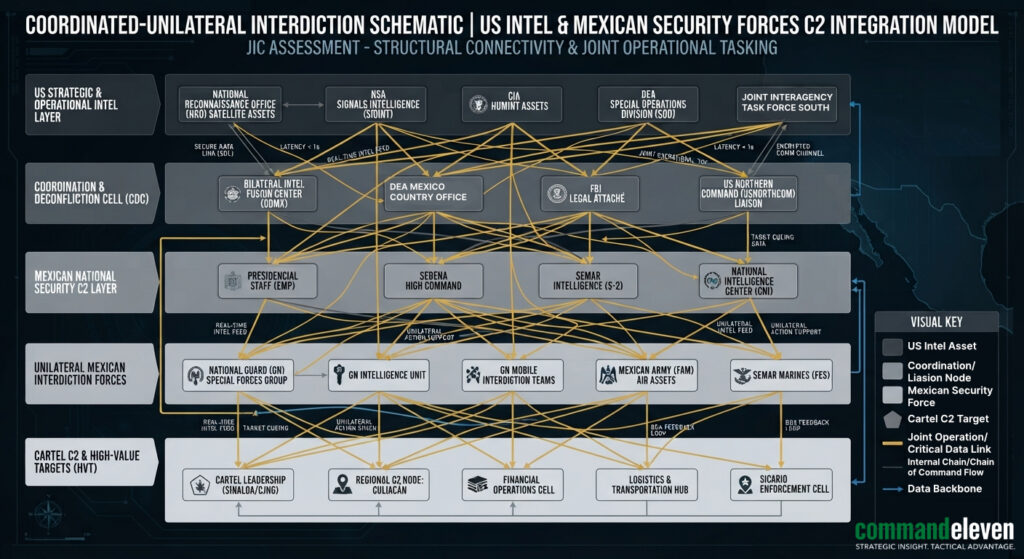
The “Attrition Architecture” is currently characterized by a “coordinated-unilateral” hybrid model:
- Intelligence-Driven Interdiction: US intelligence and law enforcement are increasingly embedded in high-level operations. The focus has moved beyond simple interdiction to the dismantling of “entire criminal networks,” targeting illicit finance, clandestine laboratory infrastructure, and high-value leadership.
- Sovereignty-Security Dilemma: Mexico continues to scale its National Guard presence and extradition protocols (90+ transfers to date) to prove that bilateral mechanisms are sufficient, thereby neutralizing the justification for direct U.S. kinetic intervention.
- Asymmetric Response: Criminal organizations are countering state pressure through decentralized, rapid-response violence and the exploitation of cyber-vulnerabilities, forcing security services to adopt more agile, tech-forward counter-insurgency tactics.
Technical Integration and Asymmetric Warfare
- Counter-UAS Initiatives: Bilateral cooperation has expanded to include robust initiatives to counter illicit Unmanned Aerial Systems (UAS), specifically targeting those used for smuggling and surveillance along critical logistical nodes.
- SIGINT and Intelligence Sharing: High-level implementation of the U.S.-Mexico Security Implementation Group (SIG) has deepened real-time data sharing, though this is occasionally complicated by concerns over covert CIA activity within Mexican borders.
- Supply Chain Resilience: The 2026 U.S.-Mexico Action Plan on Critical Minerals and broader trade reviews are serving as the economic engine for a more integrated, “hardened” North American supply chain that is increasingly resilient to external coercion.
Strategic Implications for Regional Stability
- USMCA as Strategic Lever: The July 2026 USMCA review serves as the primary platform for strategic bargaining. Security cooperation is now a core component of this trade review, ensuring that economic integration is contingent upon regional security performance.
- Escalation Thresholds: Despite the rhetoric of “unilateral strikes,” the threshold for kinetic action remains high. Both capitals understand that a breach of Mexican sovereignty would likely collapse the current cooperative framework, creating an unpredictable and high-risk security vacuum.
Forecasting and Baseline Indicators
Future stability in the US-Mexico theater will be tracked through these metrics for the remainder of Q3 2026:
- Extradition Velocity: Measuring the consistency of high-value target transfers to the U.S. as a metric of institutional trust.
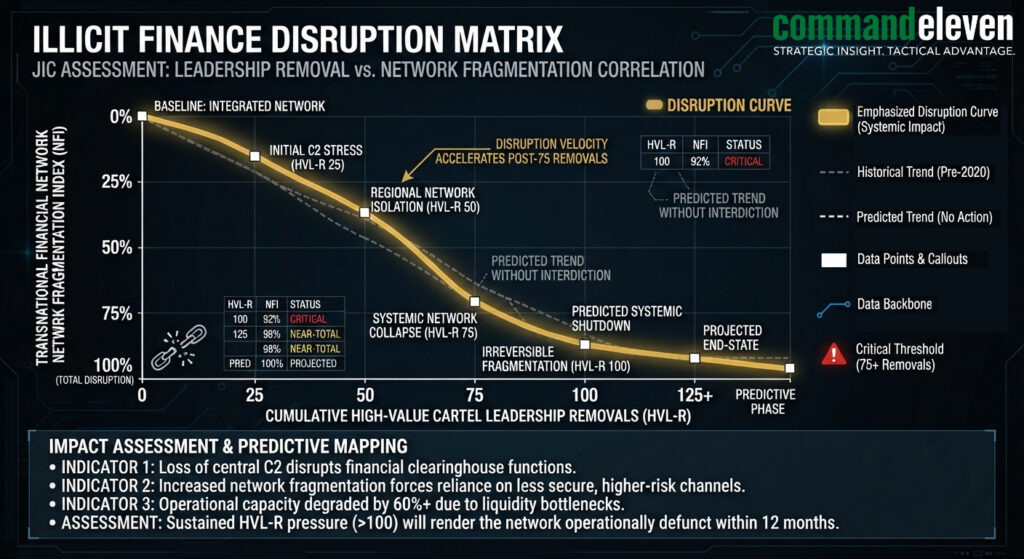
- Cartel Retaliatory Density: Tracking the frequency and scale of violence following high-value leadership removals.
- USMCA Bargaining Outcomes: Evaluating whether security commitments are codified into the long-term trade framework during the ongoing 2026 statutory review.
The US-Mexico relationship has evolved into a “high-consequence partnership.” The baseline confirms that while current tactical results are unprecedented, the long-term security of the region remains hostage to the fragile balance between sovereign autonomy and the operational necessity of crushing the cartel-based proto-state architecture.