
Key Judgments
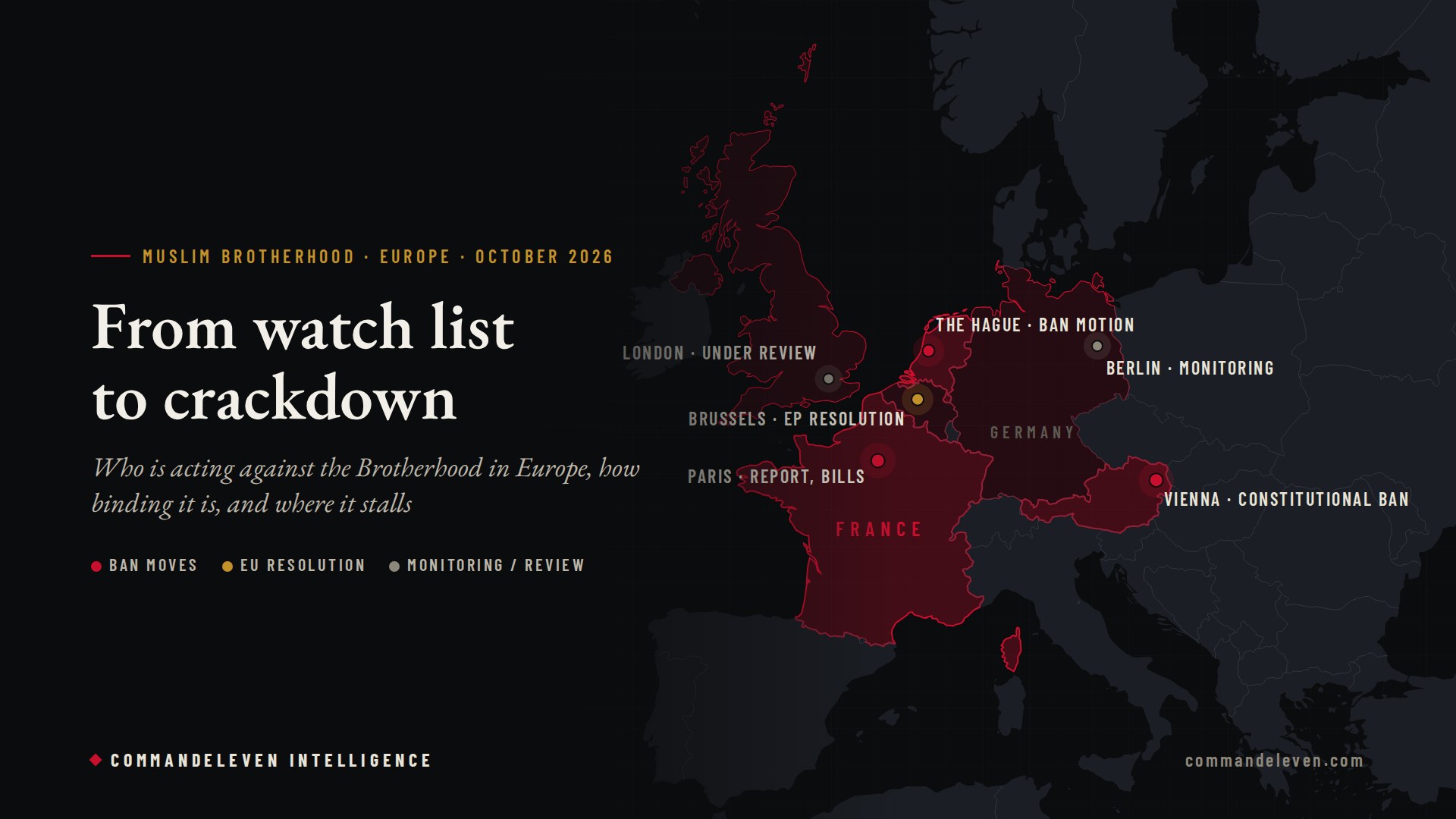
- [CONFIRMED] Between May 2025 and October 2026, Europe’s approach to the Muslim Brotherhood shifted from monitoring to action. France mapped the network in an official report. The Dutch parliament passed a motion calling for a ban. Austria’s government is drafting a constitutional ban on political Islam. On October 8, 2026, the European Parliament voted 381 to 167 for an EU strategy against Brotherhood “entryism.”
- [ASSESSED] The case Europe is building is about influence, not violence. The tools being used are therefore administrative: funding reviews, dissolutions, asset freezes and bans on gatherings. An EU-wide terrorist listing is unlikely in the next year, because the EU’s listing rules turn on terrorist acts that European authorities have not attributed to the Brotherhood in Europe.
- [ASSESSED] The crackdown is running into the courts and its own legislative calendar. A French court overturned the ban on the Musulmans de France annual gathering in April 2026, and France’s two “entryism” bills had not become law by October. Expect national measures to be contested case by case.
- [CONFIRMED] Europe’s Brotherhood debate is also a contest between Gulf states. A leak of files from a Swiss intelligence firm showed that the UAE paid for a campaign that profiled about 1,000 people and 400 organizations in 18 European countries as Qatar- or Brotherhood-linked. A separate leak showed that Qatar Charity funded 140 Islamic projects in Europe worth €71 million.
- [ASSESSED] Washington is now an active driver. The US designated the Egyptian, Jordanian and Lebanese chapters in January 2026 under an executive order that promises “sustained” action, and US pressure is likely to push more European governments toward national measures.
Bottom Line Up Front (BLUF)
For two decades, European governments treated the Muslim Brotherhood as something to watch rather than something to ban. Its European structures are legal, mostly non-violent and embedded in mosques, schools, charities and youth networks. That changed in 2025 and 2026. France’s government report described a strategy of “entryism” through local institutions. Washington designated three national chapters as terrorist entities. Austria, the Netherlands and the European Parliament then moved toward bans and funding controls. The pressure is real, but so are the limits: Europe has no legal basis for listing a movement as terrorist because of its ideology, courts are pushing back, and the evidence base is contested, partly because Gulf rivals have spent heavily to shape it. CommandEleven Intelligence’s base case is a tightening national patchwork rather than an EU-wide ban.
What Changed in 2025–2026
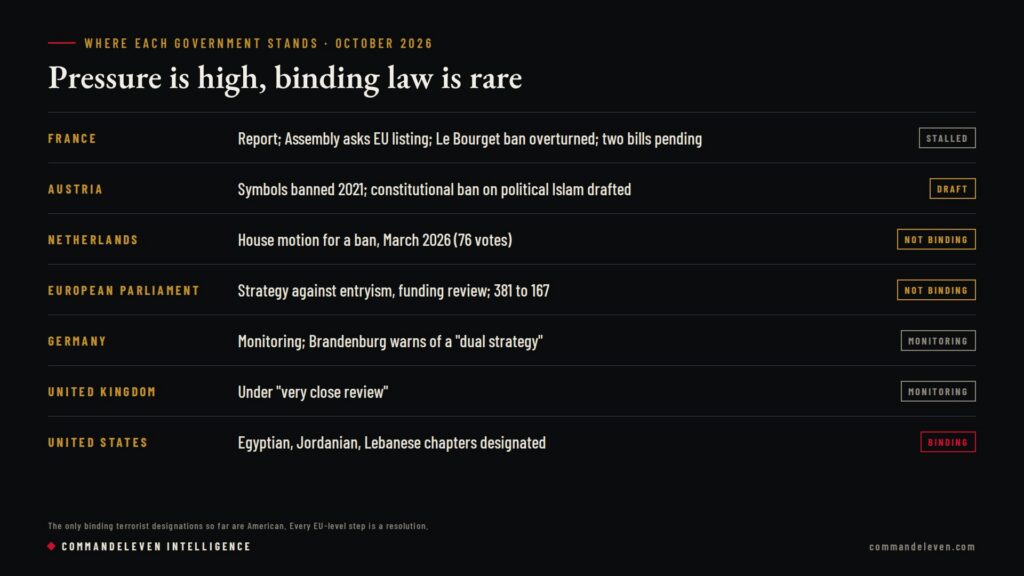
| Country or body | Measure | Date | Binding? |
|---|---|---|---|
| France | Government report Les Frères musulmans et islamisme politique en France | May 2025 | Report |
| France | National Assembly resolution asking the EU to list the Brotherhood as a terrorist organization (157 to 101) | January 22, 2026 | No |
| France | Ban on the Musulmans de France gathering at Le Bourget, overturned by an administrative court | April 2–3, 2026 | Overturned |
| France | Senate passes Bruno Retailleau’s anti-“entryism” bill (208 to 124); the government’s own bill is still pending | May 5, 2026 | Not yet law |
| United States | Executive Order 14362 orders the designation of Brotherhood chapters | November 24, 2025 | Yes (US) |
| United States | Lebanese chapter designated as a Foreign Terrorist Organization; Egyptian and Jordanian chapters designated as Specially Designated Global Terrorists | January 13, 2026 | Yes (US) |
| Netherlands | House of Representatives adopts a motion calling for a ban (76 votes) | March 17, 2026 | No: needs government action |
| Austria | Government announces a draft constitutional ban on political Islam. Austria already banned Brotherhood symbols in 2021 | September 2026 | Draft |
| European Parliament | Resolution for an EU strategy against Brotherhood “entryism” and a review of EU funding (381 to 167, 15 abstentions) | October 8, 2026 | No |
| Germany | Brandenburg’s interior minister warns of a “perfidious dual strategy”; federal and state agencies monitor “legalistic” Islamism | June 2026 | Monitoring |
| United Kingdom | Prime Minister says the Brotherhood is under “very close review” | December 2025 | Monitoring |
Three things stand out.
- The binding measures are national, administrative or American. Every EU-level step so far is a resolution.
- France is the engine. Its 2025 report supplies most of the evidence other governments cite, and its legislature has pushed hardest for an EU listing.
- The vote counts show a political shift. The European Parliament text passed with the center-right EPP and most of the liberal Renew group, not only the populist right.
The Case Europe Is Making: Entryism, Not Terrorism
The French report sets out the core of the case. It counted 139 Muslim places of worship linked to the Brotherhood and 68 more considered close to it, across 55 departments. That is about 7 percent of France’s roughly 2,800 mosques, but about 10 percent of those opened between 2010 and 2020. It also identified 280 associations and 21 private schools with about 4,200 pupils. It described Musulmans de France as the movement’s national branch, and the Council of European Muslims in Brussels as its European umbrella body.
The report’s charge is not violence. It is “entryism”: building networks that cover a believer’s life “from birth to death,” and using them to gain public funding and local political influence. Germany’s domestic intelligence agencies use a similar idea, “legalistic” or “strategic” Islamism, which pursues long-term political aims without relying on violence. Brandenburg’s interior minister called it a “perfidious dual strategy” in June 2026.
The United States made a different case. Its January 2026 designations rest on support for Hamas, which is a terrorism-finance argument, not an entryism one. That difference matters. The American case fits terrorism law, and the European case mostly does not.
The Limits: Law, Courts and Evidence
No terrorist listing without terrorist acts [ASSESSED]. The EU’s terrorist list requires a decision by a competent national authority about terrorist acts or their financing. The European Parliament asked the Council to list Brotherhood-linked entities “where existing rules allow.” For European structures that are legal and non-violent, the rules mostly do not allow it. France’s own interior minister, Laurent Nuñez, has said France prefers case-by-case action, even though the National Assembly backed an EU listing.
The courts are pushing back [CONFIRMED]. France banned the Musulmans de France annual gathering 48 hours before it opened in April 2026. An administrative judge suspended the ban the next day, and the event went ahead. Human Rights Watch warned in July that the government’s planned bill “would further erode the country’s already shrinking civic space.”
Legislation is stalling [CONFIRMED]. Retailleau’s bill passed the Senate in May but had not been scheduled in the National Assembly. The government’s own bill was still before the Conseil d’État in July. [DATA DEFICIT] CommandEleven Intelligence could not confirm that it has since been tabled. With France’s presidential election in April 2027, time is short.
The evidence is contested [ASSESSED]. Groups named in these debates, such as the European youth network FEMYSO, deny any Brotherhood link. The European Parliament text itself was amended to state that criticizing a political ideology is not an attack on a religion. The French presidency has also warned against conflating Islam with Islamism. Policy built on association rather than conduct is exposed to legal challenge, and to the charge that it targets ordinary Muslim civil society.
A Gulf Contest Over Europe’s Debate
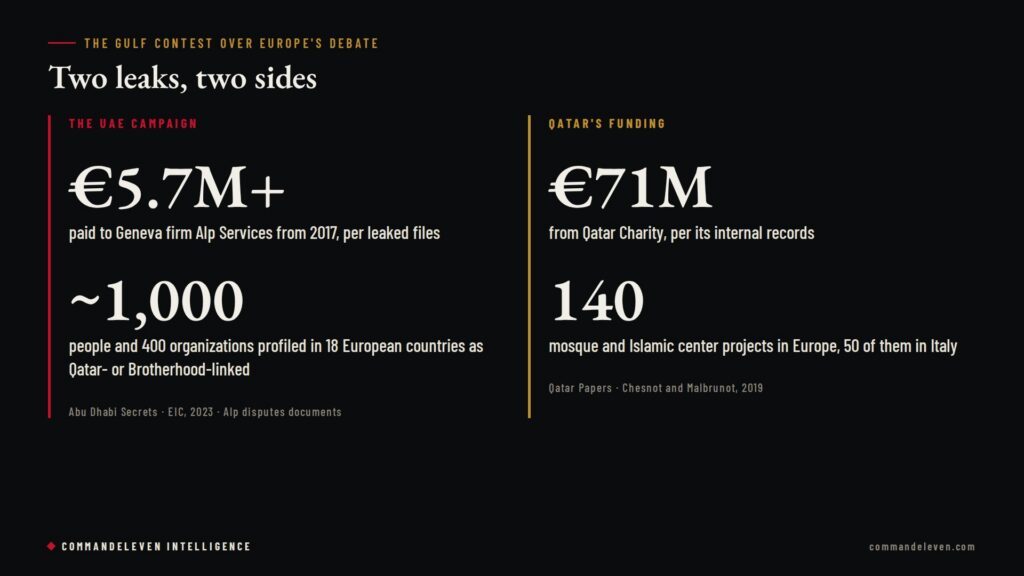
Europe’s Brotherhood question is also a proxy contest between Gulf states, and both sides’ money is on the record.
- The UAE campaign [CONFIRMED by leaked documents; contested by those named]. The “Abu Dhabi Secrets” investigation, published from 2023 by the European Investigative Collaborations network, drew on files hacked from Alp Services, a Geneva intelligence firm. According to those files, the UAE paid Alp at least €5.7 million from 2017 to discredit people and organizations it linked to Qatar or the Brotherhood. Alp compiled profiles of about 1,000 individuals and 400 organizations in 18 European countries, many on weak or false grounds. The leaked files and later reporting describe Alp’s cooperation with academics, most notably Lorenzo Vidino, director of George Washington University’s Program on Extremism and one of the most widely cited researchers on the Brotherhood in Europe. Hazim Nada, whose energy company collapsed after Alp’s campaign against him, has sued the UAE, Alp and Vidino in the United States, and three fellows at the GWU program resigned over the revelations. No court has ruled on the claims against Vidino. Alp’s lawyers say some documents were falsified. At least eight legal proceedings followed.
- Qatar’s funding [CONFIRMED by leaked documents]. Qatar Papers, a 2019 book by French journalists Christian Chesnot and Georges Malbrunot, drew on Qatar Charity’s internal records. They showed that the charity funded 140 mosque and Islamic center projects in Europe worth €71 million, 50 of them in Italy.
This matters for how Europe’s measures should be read. Some of the research and advocacy shaping European policy came from people the leaked files tie to a campaign paid for by a Gulf state with a direct interest in the outcome. Some of the infrastructure under scrutiny was paid for by another. CommandEleven Intelligence’s Gulf Split dossier identifies opposing bets on political Islam as one of the rivalries behind the Saudi-Emirati rupture. Europe’s debate is one of the places that rivalry plays out.
Outlook
Scenario A: An EU-level listing (low likelihood, next 12 months). The Council lists one or more Brotherhood-linked entities. This would most likely follow a national terrorism-finance case, probably linked to Hamas fundraising, rather than an entryism argument.
Scenario B: A tightening national patchwork (base case) [ASSESSED]. Austria passes its constitutional ban. France acts through dissolutions and funding cut-offs under existing law while its bills wait. The Netherlands and Germany act against specific organizations rather than the movement as a whole. The Commission tightens grant checks in response to the European Parliament without proposing new law. Brotherhood-linked structures relocate activity to jurisdictions under less pressure.
Scenario C: Legal rollback (moderate likelihood for individual measures). Courts overturn bans and dissolutions for lack of evidence of specific conduct, as at Le Bourget. Governments shift toward narrower, finance-based cases.
CommandEleven Intelligence assesses that Scenarios B and C will run together. The measures that survive will be those built on money and conduct, not affiliation.
Indicators to Watch
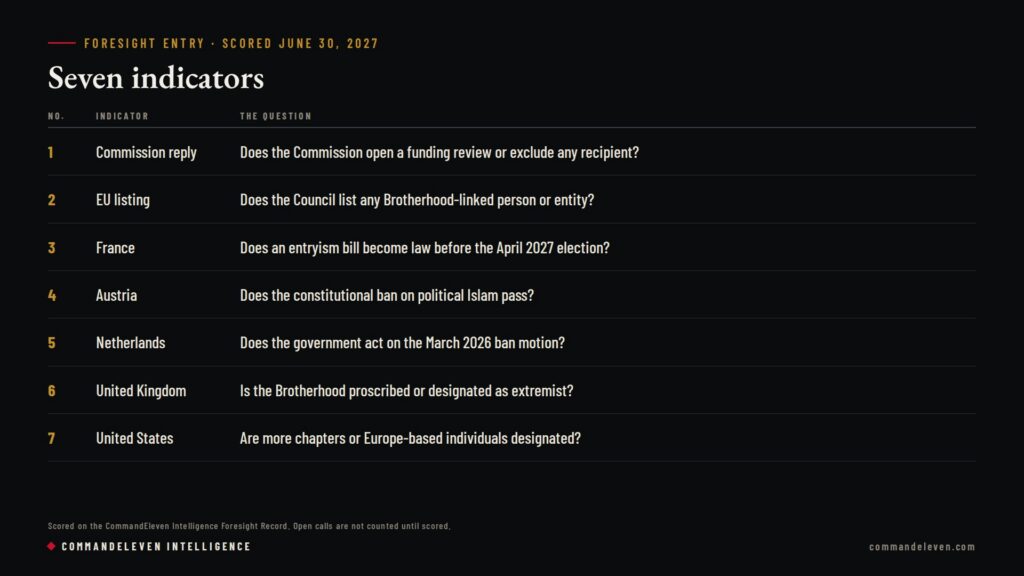
CommandEleven Intelligence will score these seven indicators on the Foresight Record on June 30, 2027:
- The Commission’s reply. Does the European Commission open a review of EU funding to Brotherhood-linked organizations, or exclude any recipient?
- An EU listing. Does the Council add any Brotherhood-linked person or entity to the EU terrorist list?
- France. Is the government’s entryism bill tabled, and does either it or the Retailleau bill become law before the April 2027 election?
- Austria. Does the constitutional ban on political Islam pass?
- The Netherlands. Does the government act on the March 2026 motion with a legal ban or dissolutions?
- The United Kingdom. Does the government proscribe the Brotherhood or designate it under a new extremism framework?
- The United States. Does Washington designate further chapters or Europe-based individuals under Executive Order 14362?
Frequently Asked Questions
Is the Muslim Brotherhood banned in Europe?
Not at the EU level. Austria banned its symbols in 2021 and is drafting a constitutional ban on political Islam. The Dutch parliament has voted for a ban, which the government has not yet implemented. Other countries act against individual organizations.
What is “entryism”?
The term European governments use for a strategy of gaining influence through local institutions, such as mosques, schools, charities and elected bodies, and shaping them from within, rather than through violence.
What did the European Parliament decide in October 2026?
It passed a non-binding resolution, 381 to 167, calling for an EU strategy against Brotherhood entryism and a review of EU funds that reached Brotherhood-linked groups. It does not ban any organization.
Did the United States designate the Muslim Brotherhood?
It designated three national chapters in January 2026: the Lebanese chapter as a Foreign Terrorist Organization, and the Egyptian and Jordanian chapters as Specially Designated Global Terrorists, citing support for Hamas. It has not designated any European structure.
Why do Gulf states matter to this?
The UAE and Qatar are on opposite sides of the Brotherhood question. Leaked records show the UAE paid for a campaign against Brotherhood-linked figures in Europe, and Qatar Charity funded Islamic projects there.
Sourcing Base (Confidence-Tiered, with Links)
CONFIRMED — Official and Primary Record:
- US Department of State, “Terrorist Designations of Muslim Brotherhood Chapters,” January 13, 2026
- The White House, “Designation of Certain Muslim Brotherhood Chapters as Foreign Terrorist Organizations and Specially Designated Global Terrorists,” November 24, 2025
- Assemblée nationale, record of the first sitting of January 22, 2026
- Sénat, Proposition de loi visant à lutter contre l’entrisme islamiste en France, 2026
- Ministry of the Interior and Communal Affairs, Brandenburg, “Perfide Doppelstrategie,” June 4, 2026
ASSESSED — Credible Reporting and Analysis:
- The National, “EU to increase monitoring of Muslim Brotherhood financial flows,” October 9, 2026
- EU Reporter, “European Parliament backs EU strategy against Muslim Brotherhood ‘entryism’,” October 12, 2026
- EU Reporter, “Beyond violence: Europe’s new focus on Muslim Brotherhood networks,” September 28, 2026
- Public Sénat, “Frères musulmans : ce que révèle le rapport commandé par l’exécutif,” May 20, 2025
- Le JDD, “Séparatisme : Laurent Nunez annonce une nouvelle loi et interdit un rassemblement lié aux Frères musulmans,” April 2, 2026
- Middle East Monitor, “French court lifts ban on Muslim gathering in Paris,” April 3, 2026
- LCP, “Associations dissoutes, avoirs gelés, livres interdits… ce que Laurent Nuñez prévoit dans le projet de loi contre l’entrisme,” May 4, 2026
- Middle East Forum, “French Senate Passes Sweeping Measures Against Islamist Infiltration,” May 7, 2026
- Il Foglio, “Austria wants to ‘ban political Islam’ (and the left is on board),” September 4, 2026
- ISGAP, “ISGAP Commends Dutch House of Representatives for Adopting Motion to Ban the Muslim Brotherhood,” March 18, 2026
- Jewish News, “UK keeping Muslim Brotherhood under ‘very close review’ amid calls for ban, says Starmer,” December 3, 2025
- Foundation for Defense of Democracies, “Time for Europe to Stop Funding Islamist Networks,” October 9, 2026
- Middle East Eye, “George Washington University and programme director sued over UAE ‘smear campaign’“
- Wikipedia, “Abu Dhabi Secrets” (compiled record of the EIC investigation and legal proceedings)
- Swissinfo, “Qatar said to be leading funder of mosques in Europe,” April 5, 2019
The Critical Case:
- Human Rights Watch, “Proposed Law in France Threatens Civic Space,” July 10, 2026
CommandEleven Intelligence Prior Work:
Excluded from this assessment: A figure of about 1,450 Brotherhood adherents in Germany, attributed to the 2025 federal domestic intelligence report, is not used because it could be found only secondhand. Germany’s November 2025 ban on Muslim Interaktiv is not counted as a Brotherhood measure, because the ban order as reported does not cite the Brotherhood.

