Why This Series, Why Now
State adversaries and their proxies now fight across domains that conventional defense planning still treats separately: what a population perceives, the utilities and cables a society runs on, the cities and tunnels where forces maneuver, and the ports and command networks that hold it together. The common thread is that each attack is cheap, deniable and aimed at the seams between institutions.
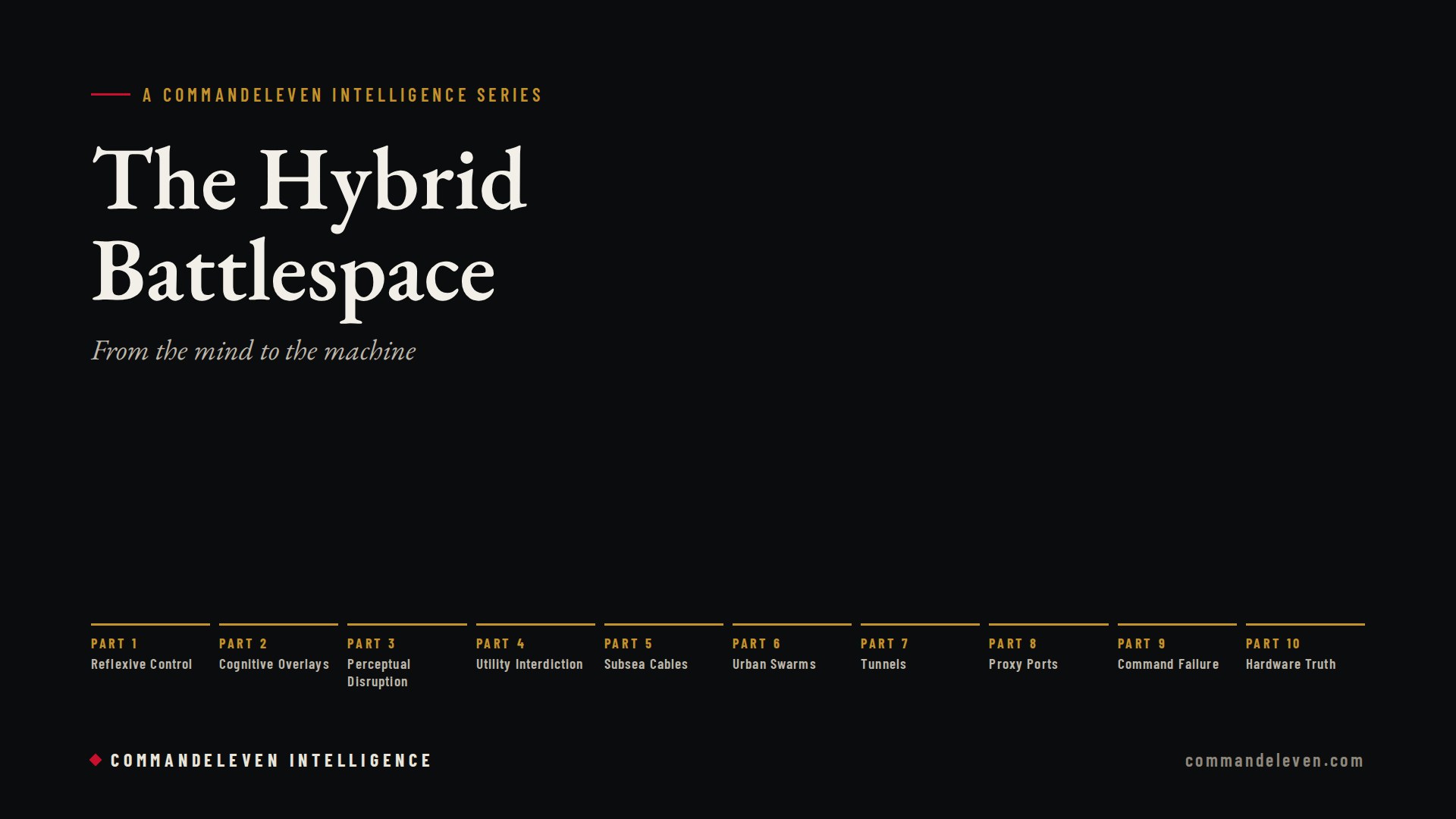
This series maps that battlespace from the mind to the machine, and closes with CommandEleven Intelligence’s answer: decentralized, verifiable command built on the Mosaic Defense model.
What This Series Covers
- Part 1: Sensory Rupture: The Russian Reflexive Control Matrix – how Russia shapes an adversary’s decisions by shaping what it believes.
- Part 2: The Silent Echo: Chinese Cognitive Overlays in the Gray Zone – algorithmic narrative conditioning and information saturation.
- Part 3: The Weaponization of Perceptual Disruption – electronic and administrative overload as weapons.
- Part 4: Utility Interdiction as a Strategic Weapon – power, water and fuel systems as targets.
- Part 5: Subsea Cable Vulnerability and the Data Interdiction Axis – the cables and landing stations that carry the world’s data.
- Part 6: UAV Swarm Convergence in Urban Defiles – drone swarms in cities.
- Part 7: Subterranean Asymmetry: Hardened Tunnel Networks – the underground battlespace and how hardened tunnel networks are found and closed.
- Part 8: Proxies and Port Ingress: The Eastern Mediterranean Axis – front companies and proxies in the region’s ports.
- Part 9: The Failure of Centralized Command in Proxy Theaters – why slow, centralized command loses to distributed networks.
- Part 10: The Victory of Hardware Truth: Insulating the Command Grid – verifiable data and decentralized command as the defense.
How to Read It
Parts 1 to 3 are the cognitive layer, Parts 4 and 5 the infrastructure layer, Parts 6 to 8 the physical battlespace, and Parts 9 and 10 the command problem and its solution. Readers who want the longer treatment of the cognitive layer should continue with Cognitive Warfare: The Battle for the Human Domain; the state-actor framework is in the Grey Zone Warfare series.
A Note on Method
Claims across the series are confidence-tiered as CONFIRMED, ASSESSED or SPECULATIVE. The series analyzes threats and defenses; it does not include technical detail that would help anyone carry out these attacks.