
3 Key Takeaways
- Modular Espionage Frameworks: The transition of Mustang Panda to the CoolClient platform highlights a shift toward modular architectures that utilize binary side-loading to remain undetected on host systems.
- Infrastructure-Level Targeting: Salt Typhoon’s focus on compromising core routing hardware, firmware supply chains, and space-based links demonstrates an intent to control communications lines rather than simple endpoints.
- Behavioral Tracking Advantages: Incorporating behavioral analytics that analyze directory path structures and memory page permissions allows security teams to identify advanced implants without relying on pre-existing malware signatures.
Executive Summary
State-sponsored cyber espionage operations across the Association of Southeast Asian Nations (ASEAN) have reached unprecedented levels of persistence. Moving away from traditional, high-volume data exfiltration methods, advanced threat actors have refined their methodologies to remain deeply embedded within sovereign infrastructure for extended periods.
This technical analysis explores the active Advanced Persistent Threat (APT) landscape in Southeast Asia as of July 2026, focusing on the refined operations of Mustang Panda and its modular CoolClient execution chain, alongside the telecommunications infrastructure compromises orchestrated by Salt Typhoon. This report dissects their initial access vectors, weaponization loops, privilege escalation techniques, and firmware manipulation exploits, provides a multi-variable mathematical model for detecting process anomalies, and outlines the defensive frameworks necessary to secure critical sovereign infrastructure.
Mustang Panda: Architectural Breakdown of the CoolClient Backdoor
The China-aligned cyber espionage group tracked as Mustang Panda has updated its primary toolset, transitioning from standard PlugX variants toward a highly modular espionage platform designated CoolClient. Telemetry analyzed in mid-2026 confirms that this platform is engineered for real-time user surveillance, credential harvesting, and persistent network access.
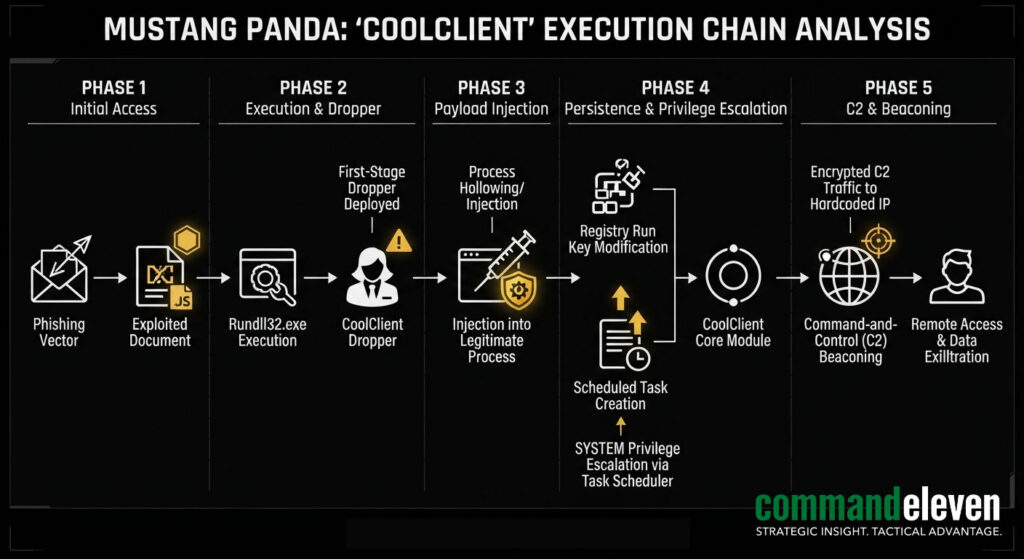
The Four-Stage Forensics Execution Chain
The execution model of the modern CoolClient backdoor relies on binary side-loading techniques to exploit trusted system processes, systematically evading detection by standard EDR solutions:
- libngs.dll (Initial Loader): Serves as the primary entry point. It is side-loaded by placing it within the same directory as a legitimate, digitally signed application from trusted security vendors (such as Sangfor or Bitdefender). Because the main application signature is valid, security tools permit the process to execute without triggering alerts.
- loader.dat (Second-Stage Orchestrator): Decrypted and executed in memory by the initial loader, this stage contains shellcode designed to perform environmental reconnaissance and inject subsequent code into legitimate system hosts.
- time.dat (Encrypted Configuration): Stores command-and-control (C2) server addresses, obfuscated domain structures, and randomized beaconing intervals. It remains encrypted on disk and is only decrypted directly within memory during the initialization phase to minimize its forensic footprint.
- main.dat (Third-Stage Core Engine): The final payload housing the primary espionage engine, keylogging utilities, and reverse proxy tools.
Privilege Escalation and Masquerading Vectors
If the compromised user context possesses administrative rights, CoolClient utilizes the passuac parameter to bypass User Account Control (UAC) entirely, exploiting the CMSTPLUA COM interface or the AppInfo RPC service.
Once elevated, the malware alters its runtime signature, spoofing the Process Environment Block (PEB) information to masquerade as a legitimate instance of svchost.exe. Long-term persistence is secured within the compromised environment by creating a scheduled task designated ComboxResetTask or adding malicious keys to the AdobelmdyU registry path.
Dedicated Espionage Sub-Plugins
The core engine dynamically loads specialized surveillance modules based on target characteristics:
- FileMgrS.dll: Handles file system interrogation, directory downloading, and target document harvesting.
- ServiceMgrS.dll: Monitors, suspends, or reconfigures system services to disable local host defenses.
- RemoteShellS.dll: Provides operators with an encrypted, interactive command-line interface into the target network.
To extract high-value political and military intelligence, the backdoor uses the GetWindowTextW and GetClipboardData APIs to capture user context, allowing it to log browser-stored passwords and copy sensitive document titles as they are accessed.
Salt Typhoon: Telecommunications and Infrastructure Intrusion Matrix
Operating parallel to these host-level espionage campaigns is Salt Typhoon, a highly specialized APT group attributed to China’s Ministry of State Security (MSS). Rather than focusing on individual user endpoints, Salt Typhoon targets global telecommunications infrastructure, core routing hardware, and space-based communication links.
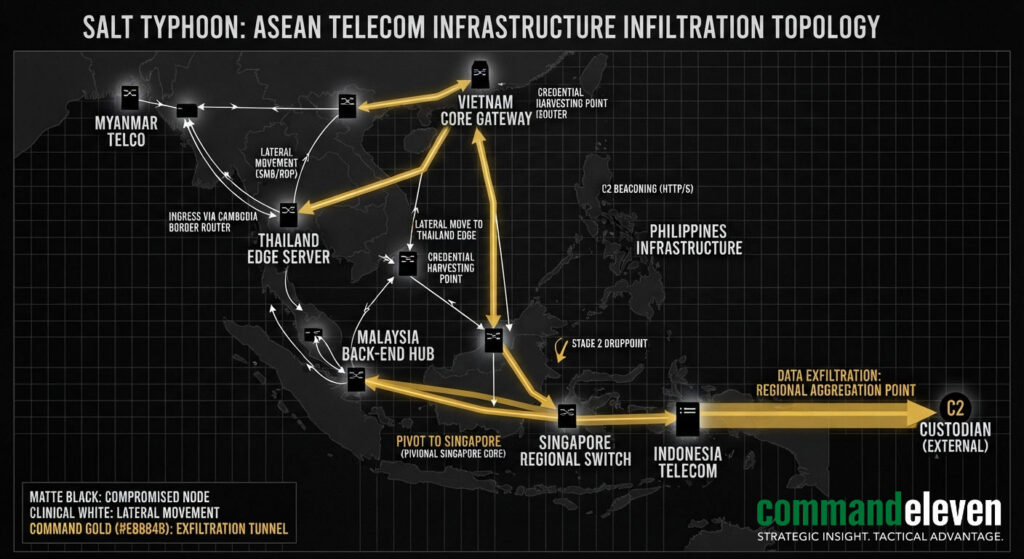
Supply Chain and Firmware Exploitation
Salt Typhoon infiltrates core hardware supply chains, embedding malicious payloads directly into firmware updates and network routing equipment.
By altering these foundational software layers, the group bypasses standard host-based security controls. This access allows them to reconfigure vital network protocols and establish a permanent foothold within regional internet service providers (ISPs).
Core Routing Interception and SS7 Exploitation
The group initiates its operations by using Signaling System 7 (SS7) endpoint vulnerabilities to perform targeted reconnaissance and map communications traffic.
Once inside a provider’s core network, Salt Typhoon modifies routing configurations to quietly intercept data streams, exfiltrate subscriber information, and harvest authentication tokens without causing service disruptions that would alert network administrators.
The strategic scope of this activity was demonstrated in their mid-2025 compromise of Viasat ground infrastructure, where they exploited remote management links to monitor satellite control data, highlighting a intent to map networks that military forces rely on for backup communications during operational crises.
Advanced Defensive Remediation and Threat Hunting Frameworks
Defending regional networks against coordinated espionage operations requires moving beyond traditional boundary defenses toward strict host isolation and hardware verification protocols.
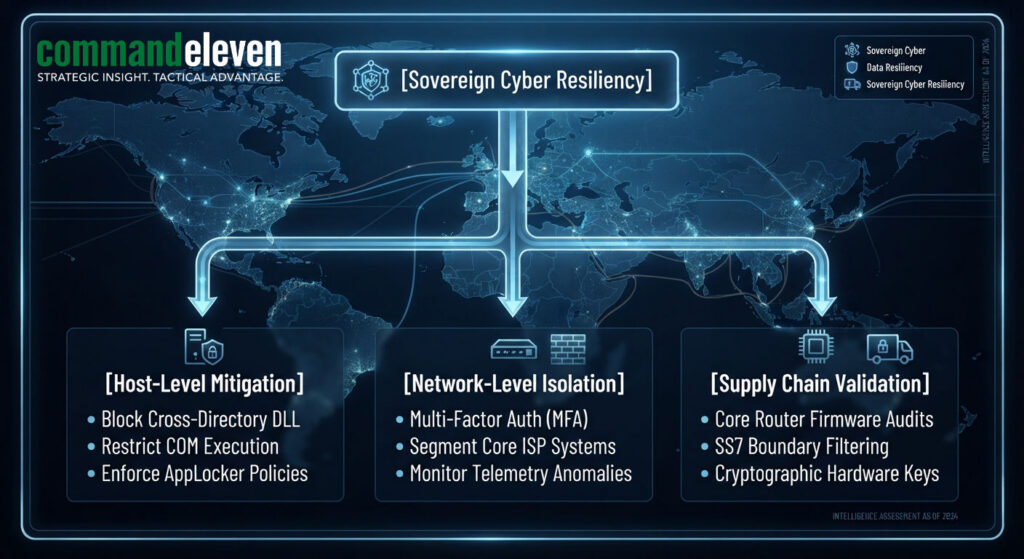
Host-Level Engineering Controls
To neutralize the side-loading mechanisms favored by groups like Mustang Panda, system administrators must implement strict directory containment rules:
- DLL Loading Restrictions: Enable secure DLL search order settings (SafeDllSearchMode) via group policy to prevent applications from loading arbitrary modules from their immediate current working directories.
- Application Whitelisting: Enforce rigid AppLocker or Windows Defender Application Control (WDAC) profiles to block unsigned binaries or scripts from running within user-writable paths like AppData or Temp.
- COM Interface Hardening: Restrict access to the CMSTPLUA COM interface using defensive access control lists (ACLs) to prevent unauthorized processes from bypassing UAC prompts.
Network and Carrier-Level Hardening
Securing infrastructure against deep network intrusions requires structural adjustments at the provider tier:
- Environment Segmentation: Divide core network operations systems from standard corporate directories, ensuring that a compromise at the user endpoint tier cannot easily pivot into critical routing infrastructure.
- Firmware Integrity Verification: Implement routine, cryptographic integrity checks on all border router and firewall firmware images to detect unauthorized modifications or unauthorized backdoors embedded during production or transit.
- SS7 Boundary Filtering: Deploy advanced firewall rules at Signaling System 7 endpoints to block unauthorized external mapping queries and prevent malicious network reconnaissance.
ASEAN Cyber Espionage Series
- ASEAN Cyber Espionage & Critical Infrastructure Penetration
- ASEAN Cyber Espionage Topologies & APT TTPs Analysis
- ORB Botnets & Edge Appliance Exploitation in ASEAN
- ASEAN Cyber Espionage Ecosystems & Sub-Sea Interception
- ASEAN Cyber Espionage Landscape: Cyber-Kinetic Convergence & Industrial Intrusion Vectors
- ASEAN Cyber Espionage & Intrusion Frameworks
- ASEAN Cyber Espionage Analysis | Mustang Panda & Salt Typhoon TTPs – Current Dossier