

Executive Summary & Threat Landscape Overview
Throughout 2025 and 2026, state-sponsored cyber espionage operations targeting Association of Southeast Asian Nations (ASEAN) member states, diplomatic missions, and maritime infrastructure undergo a major structural evolution. China-aligned Advanced Persistent Threat (APT) groups,primarily APT40 (Leviathan / Gingham Typhoon), Mustang Panda (TEMP.Hex / UNC6384), and associate threat clusters,have largely abandoned rented commercial Virtual Private Server (VPS) networks for initial Command and Control (C2) operations.
Instead, threat actors have deployed Operational Relay Box (ORB) networks built on compromised Small Office/Home Office (SOHO) routers, Internet of Things (IoT) devices, and legacy edge appliances. These ORB botnets allow adversary traffic to blend seamlessly into regional domestic IP spaces, bypassing traditional geofencing and perimeter telemetry.

This technical intelligence paper presents an operational analysis of Chinese state-aligned cyber operations within Southeast Asia, detailing threat actor targeting profiles, ORB network topologies, edge appliance zero-day exploitation, dynamic malware payload analysis (STATICPLUGIN, PlugX/SOGU.SEC, ShadowPad), and defensive detection engineering signatures.
Threat Actor Profiling & Strategic Targeting Matrix
China-aligned cyber espionage operations in Southeast Asia are organized along strategic and functional lines, aligned with Beijing’s foreign policy goals and maritime claims in the South China Sea.

APT40 (Leviathan / Gingham Typhoon)
- Operational Scope: Functioning as the primary maritime-focused cyber-reconnaissance element associated with the People’s Liberation Army Navy (PLAN) and Hainan State Security infrastructure, APT40 specializes in long-term persistence within defense and naval networks across Southeast Asia.
- Targeting Vector: Navy headquarters, commercial shipbuilders, deepwater port operators, and maritime research institutes in Vietnam, the Philippines, Malaysia, and Indonesia.
Mustang Panda (TEMP.Hex / UNC6384)
- Operational Scope: Mustang Panda executes political and diplomatic intelligence collection operations. The group targets diplomatic communications networks to gain advance access to ASEAN summits, bilateral trade agreements, and regional South China Sea code-of-conduct negotiations.
- Targeting Vector: Executive networks of the ASEAN Secretariat (Jakarta), Ministries of Foreign Affairs across member states, and diplomatic missions stationed in Beijing and Washington.
Operational Relay Box (ORB) Network Architecture & SOHO Botnets
To obscure C2 infrastructure, adversary groups utilize compromised edge infrastructure to construct Operational Relay Box (ORB) networks (e.g., Quad7 and associated SOHO proxy meshes).

Mechanics of ORB Mesh Networks
Instead of initiating a direct TCP/TLS connection from a victim’s network to an adversary-owned server, infected hosts are instructed to route beacon traffic through a multi-tiered network of compromised SOHO routers (Asus, Netgear, TP-Link, DrayTek) and EOL (End-of-Life) edge devices located within the target country:
- Access Nodes (Hop 1): Compromised domestic SOHO routers running custom lightweight proxy implants (e.g., TinyProxy or custom micro-SOCKS daemons). The victim network sees an outbound TLS connection to a local consumer IP address, circumventing traditional geofencing blocking rules.
- Entry Nodes (Hop 2): Intermediate nodes that multiplex proxy streams across encrypted SSH or custom XOR-encoded tunnels, continuously changing active port assignments.
- Exit Nodes (Hop 3): Transient relay nodes that forward decrypted payload commands to the threat actor’s core infrastructure.
Edge Appliance Exploitation & Initial Access Vectors
Targeted initial access across ASEAN networks relies on zero-day and n-day vulnerability exploitation of public-facing edge security appliances.

Edge Appliance Compromise Mechanics
- Authentication Bypass & Command Injection: Threat actors systematically monitor perimeter appliances used by ASEAN governments. By combining authentication bypass vulnerabilities with unauthenticated remote code execution (RCE) bugs, attackers execute arbitrary shell commands directly in memory on edge appliances, bypassing endpoint detection and response (EDR) software.
- Persistence via Appliance Implants: Once inside an appliance, actors drop webshells or modify system startup scripts (e.g., rc.local modifications) to maintain persistent access even across system firmware updates.
Adversary-in-the-Middle (AitM) and Code-Signing Hijacking
During campaigns targeting diplomatic missions, actors deploy AitM traffic redirection via compromised upstream ISP routers:
- Browser Traffic Redirection: Legitimate user HTTP request sessions to government update servers are intercepted and redirected to malicious drop servers.
- Signed Payload Delivery: The dropped installer binaries (e.g., STATICPLUGIN) are signed with valid, stolen code-signing certificates issued to third-party software vendors, allowing the payload to bypass Microsoft Defender SmartScreen and local operating system security checks.
In-Memory Execution, Persistence, and Dynamic Payload Analysis
Once initial execution is achieved on a target endpoint, threat actors deploy modular malware frameworks designed for in-memory execution, credential harvesting, and directory exfiltration.
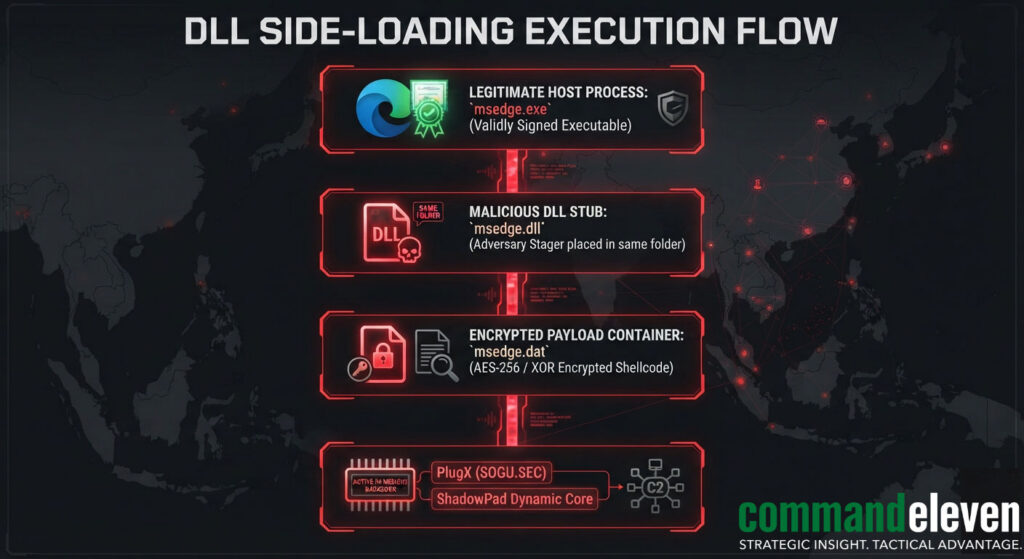
Reverse Engineering Breakdown: STATICPLUGIN Downloader
- Execution Vector: STATICPLUGIN acts as an initial lightweight downloader dropped during AitM browser hijacking operations.
- Anti-Analysis Capabilities:
- Checks for the presence of analysis sandboxes via IsDebuggerPresent() and API hooking detection.
- Resolves Windows API function addresses dynamically using hashing algorithms (e.g., ROR13 hash) to obstruct static disassembly analysis in IDA Pro or Ghidra.
- Payload Retrieval: Connects to an ORB relay node via HTTPS, retrieves an encrypted payload blob, decrypts it in memory using a hardcoded 32-byte key, and executes the shellcode directly via CreateThread or QueueUserAPC process injection.
In-Memory Backdoor Mechanics: PlugX (SOGU.SEC Variant)
The SOGU.SEC variant of PlugX remains a primary operational payload utilized by Chinese state-aligned clusters in ASEAN:
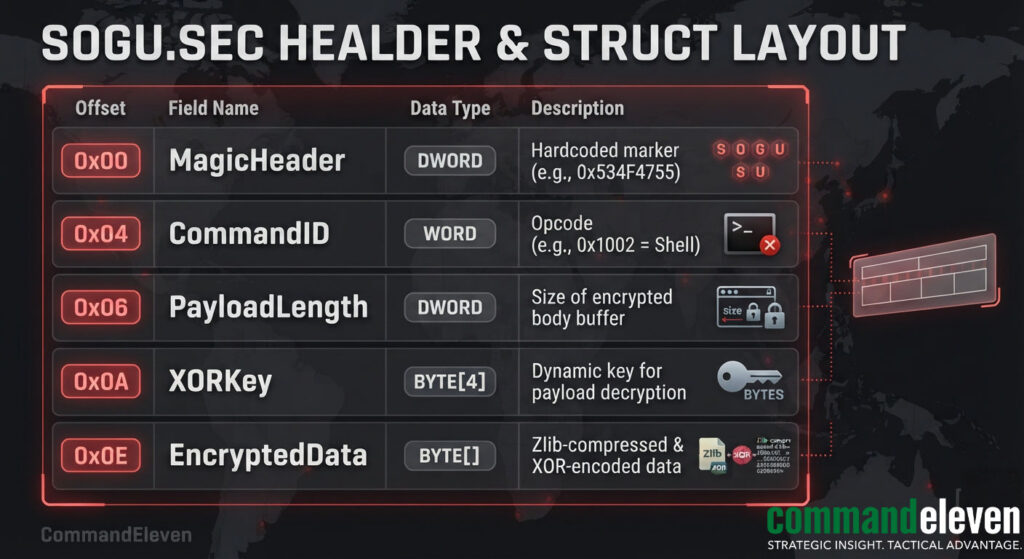
- Capabilities: Full interactive reverse shell access, keylogging via low-level Windows keyboard hooks (SetWindowsHookExW), credential dumping from LSASS memory, desktop screenshot capture, and automated USB drive propagation routines designed to cross air-gapped networks.
Defensive Mitigation Architecture for ASEAN Sovereign Infrastructure
To neutralize ORB botnet evasion and edge vulnerability exploitation, security teams must deploy a multi-layered Zero Trust Defense Architecture:
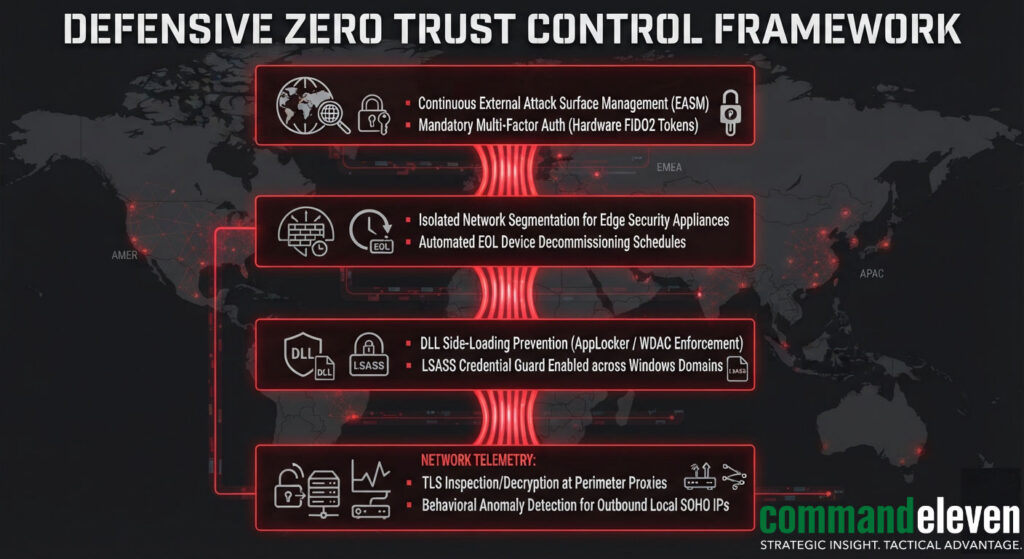
- Strict EASM and Edge Patching SLA: Enforce strict 24-hour vulnerability patch SLAs for all public-facing edge appliances (Ivanti, Fortinet, Citrix, Palo Alto). Decommission all End-of-Life (EOL) network hardware incapable of receiving active security updates.
- Application Control and DLL Lock-Down: Implement Microsoft Windows Defender Application Control (WDAC) or AppLocker policies in strict enforcement mode across government networks to prevent non-standard processes from loading unsigned dynamic-link libraries (.dll) from user-writable directories.
- Outbound SOHO Traffic Anomaly Hunting: Modernize Security Information and Event Management (SIEM) detection rules to flag outbound enterprise TLS connections routed to domestic consumer ISP IP ranges, identifying active ORB Hop-1 proxy nodes operating within target countries.
- Enforce Hardware-Bound Authentication: Migrate all diplomatic and government administrative portals from traditional SMS/App-based Multi-Factor Authentication (MFA) to hardware-bound FIDO2/WebAuthn security keys to prevent Adversary-in-the-Middle (AitM) credential interception and browser traffic hijacking.