Executive Summary & Macro-Technical Environment
The digital infrastructure of the Association of Southeast Asian Nations (ASEAN) has become a primary battlespace for advanced persistent threat (APT) groups conducting strategic cyber espionage. Driven by geopolitical friction over South China Sea sovereign claims, economic supply chain realignments, and diplomatic negotiations, state-sponsored intrusion sets maintain persistent footholds across regional government networks.
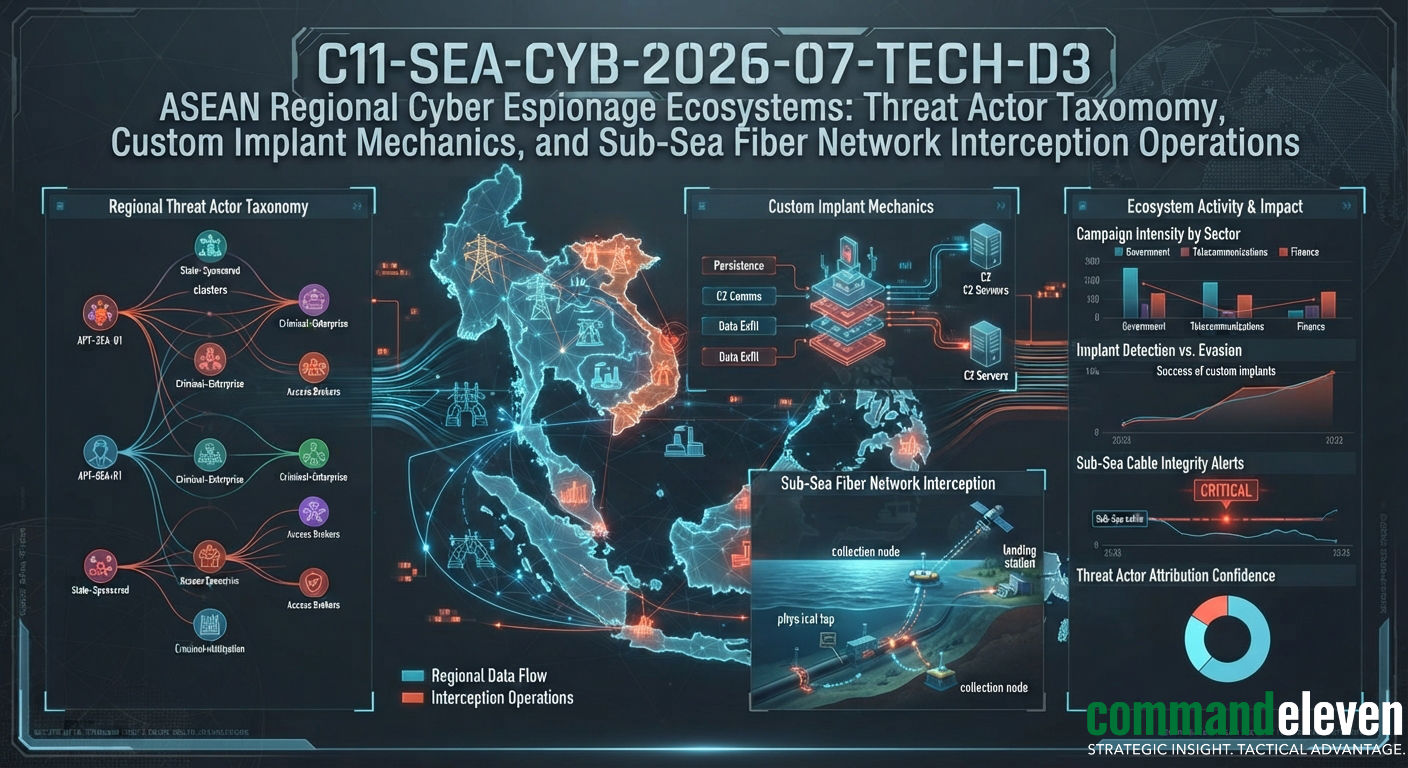
Target entities include Ministries of Foreign Affairs (MFAs), defense contractors, maritime port authorities, telecommunications providers, and subsea fiber-optic cable landing stations (CLS). This technical analysis provides an audit of active threat actor taxonomies, examines the technical mechanics of custom malware implants, evaluates living-off-the-land (LotL) execution chains, and provides a physical-layer mathematical analysis of optical signal tapping vulnerabilities in regional subsea telecom corridors.
Threat Actor Taxonomy & Regional Target Matrix
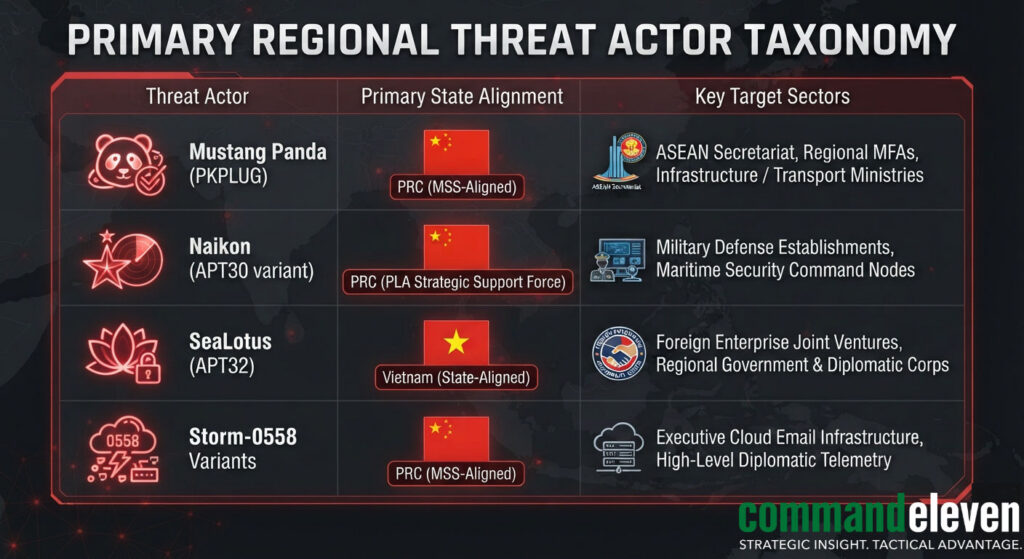
The cyber espionage ecosystem in Southeast Asia is dominated by advanced state-aligned operators characterized by deep operational patience, custom tool development, and long-term network dwell times.
Mustang Panda (PKPLUG / Earth Preta)
- Operational Focus: Mustang Panda focuses heavily on ASEAN multilateral summits, foreign policy institutions, and cross-border transport projects associated with regional infrastructure initiatives.
- Infrastructure Strategy: The group deploys extensive networks of compromised edge devices (SOHO routers, firewalls) acting as operational relay boxes (ORBs) to route malicious Command and Control (C2) traffic through domestic IP blocks inside target nations (e.g., Vietnam, Philippines, Indonesia), neutralizing geographic IP-blocking defenses.
Naikon (APT30 / Lotus Panda)
- Operational Focus: Naikon targets military command structures, maritime law enforcement agencies, and defense ministries of nations surrounding the South China Sea.
- Persistence Methodology: Specializes in deep-dwell infiltrations, remaining inside target military networks for years by abusing legitimate system binaries and deploying custom backdoors directly into volatile memory.
Malware Engineering: DLL Side-Loading & Custom Implant Mechanics
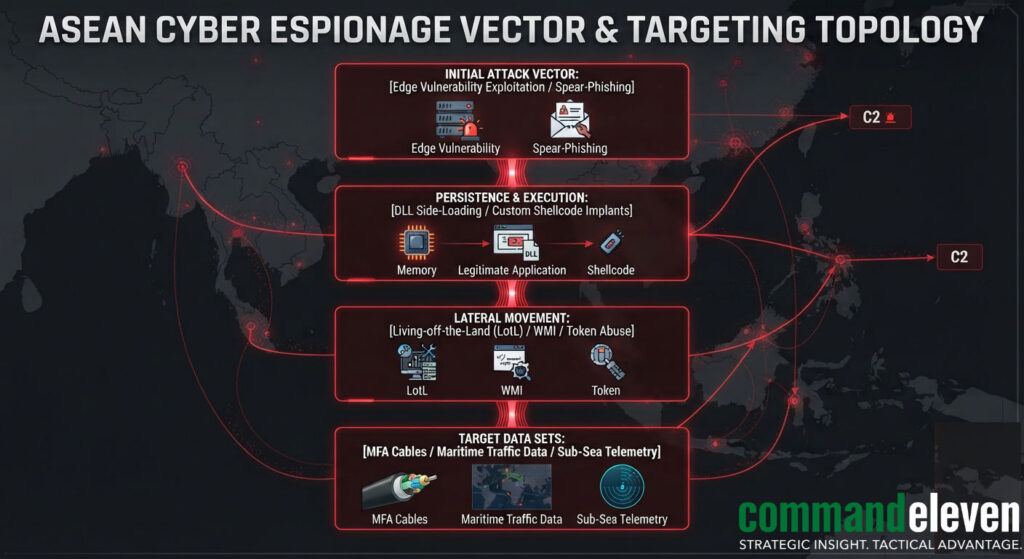
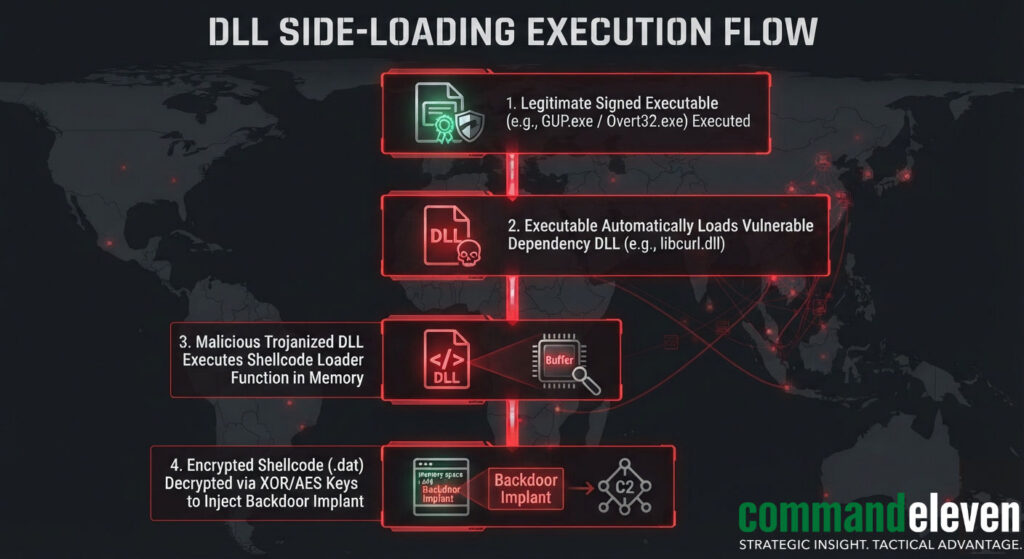
The primary initial execution vector utilized by threat actors targeting ASEAN networks is the exploitation of Dynamic Link Library (DLL) side-loading vulnerabilities in legitimately signed software applications.
Case Study Dissection: ToneShell & PlugX Variants
Recent campaigns targeting regional Ministries of Foreign Affairs feature advanced variants of the ToneShell and PlugX implant families.
Execution Sequence Analysis:
- Drop Stage: A self-extracting archive (SFX) or weaponized ISO image drops three core files into a hidden working directory:
- app.exe , A legitimately signed binary (e.g., Notepad++, GUP, or anti-virus updater).
- VERSION.dll , A malicious, custom-compiled DLL matching an export function expected by app.exe.
- data.dat , An encrypted payload blob containing the primary stage-2 shellcode.
- Side-Loading Mechanics: When app.exe launches, the Windows LoadLibrary function prioritizes searching the application’s current directory before system path directories. The legitimate binary loads the malicious VERSION.dll.
- In-Memory Injection: The decrypted shellcode locates the process environment block (PEB), resolves API functions dynamically (LoadLibraryA, GetProcAddress), and injects the core implant thread into a legitimate host process (e.g., svchost.exe or explorer.exe), hiding execution from standard task managers.

Living-off-the-Land (LotL) & Evasion Mechanics
To evade endpoint detection and response (EDR) sensors monitoring process creation trees, threat actors minimize disk footprint by executing commands using native Windows system tools.

Sub-Sea Fiber Network Exploitation & Physical-Layer Interception
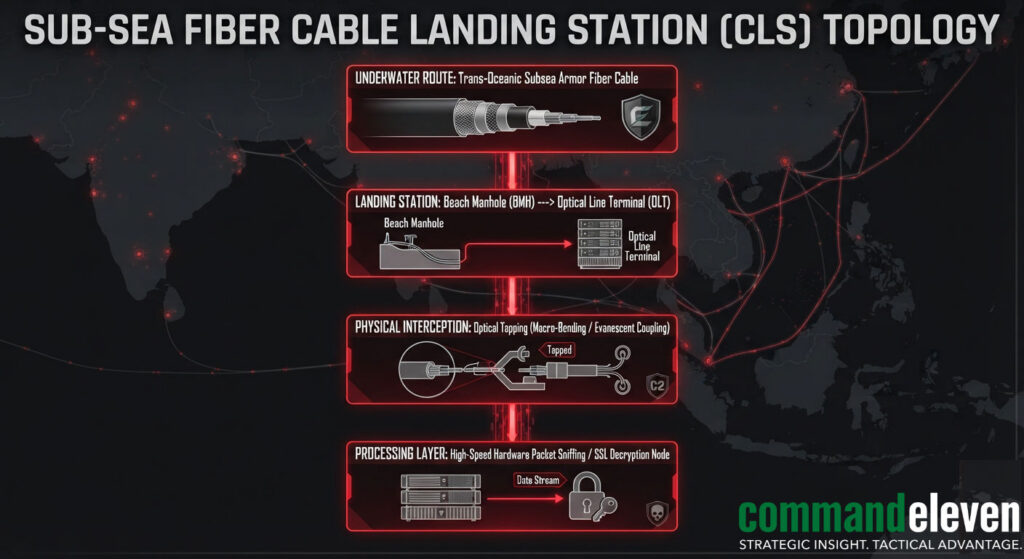
Beyond corporate and government local area networks (LANs), advanced cyber espionage capabilities target the physical trans-oceanic subsea fiber-optic cable landing stations (CLS) connecting ASEAN economies (e.g., SeaMeWe-5, AAG, APG networks).
Defensive Mitigation Frameworks & Zero-Trust Architecture
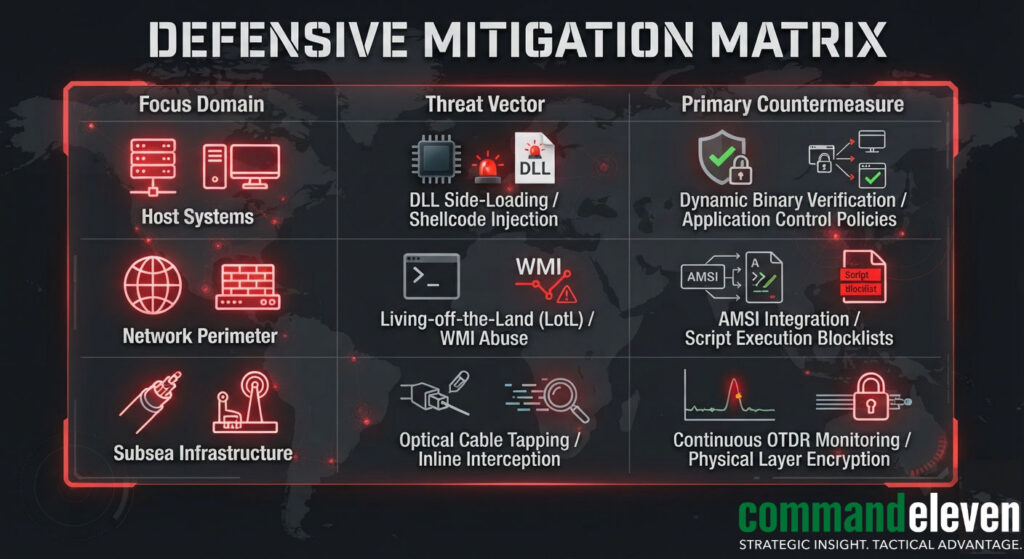
Mitigating advanced cyber espionage operations across ASEAN enterprise and critical infrastructure networks requires an integrated, multi-layer defensive strategy.
Technical Control Implementations
1. DLL Side-Loading Prevention:
- Application Whitelisting & WDAC: Enforce Windows Defender Application Control (WDAC) policies restricting execution to signed binaries audited for side-loading vulnerabilities.
- Directory Permissions Hardening: Block standard users from writing files to application directories residing within %PROGRAMFILES% or %APPDATA% paths.
2. Physical Optical Layer Security:
- Optical Time-Domain Reflectometry (OTDR) Monitoring: Deploy real-time, coherent OTDR systems operating on out-of-band supervisory wavelengths ($1625text{ nm} / 1650text{ nm}$) capable of detecting micro-reflections and localized signal attenuation anomalies down to $0.01text{ dB}$.
- Bulk Layer-1 MACsec Encryption: Enforce hardware-based IEEE 802.AE MACsec encryption directly on transceivers at optical line terminals (OLT), ensuring that tapped optical bits remain unreadable cipher text without valid hardware security keys.
Strategic Outlook & Baseline Indicators (H2 2026)
Cyber espionage campaigns across the ASEAN domain are projected to increase in velocity and technical complexity through the second half of 2026.
Key threat indicators to monitor include:
- Exploitation of Edge Appliances: The frequency of zero-day vulnerabilities released for enterprise edge appliances (firewalls, VPN gateways) targeting regional diplomatic networks.
- Proliferation of Modular Shellcode Loaders: The evolution of customized, multi-stage loaders utilizing dynamic API hashing and direct system calls (Syscalls) to bypass EDR kernel hooks.
- Physical Landing Station Security Incidents: Physical integrity alerts, unauthorized access incidents, or unexpected maintenance outages reported across regional subsea cable landing facilities.