
Executive Threat Landscape & Threat Actor Taxonomy
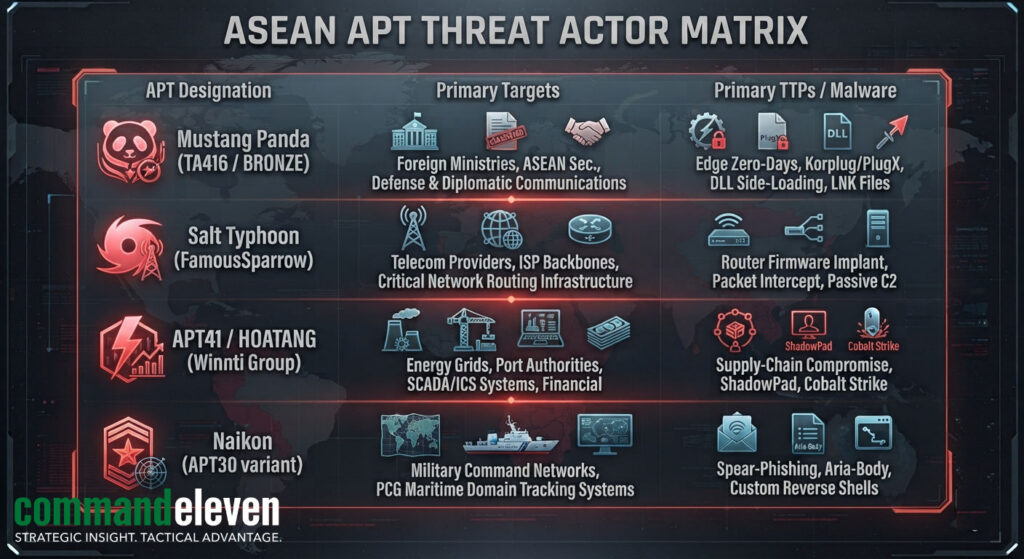
As of July 2026, the ASEAN cyber threat landscape is defined by continuous, state-sponsored Advanced Persistent Threat (APT) campaigns targeting critical national infrastructure (CNI), diplomatic networks, defense establishments, and maritime governance bodies across Southeast Asia. The primary strategic objective driving these operations is persistent intelligence collection, political espionage, and pre-positioning for destructive cyber-kinetic operations in the event of regional kinetic conflict.
The dominant threat actors active within the ASEAN theater are state-aligned groups primarily operating out of the People’s Republic of China, with secondary, highly targeted campaigns conducted by North Korean and regional proxy groups.
Initial Access Vectors & Edge Device Exploitation
The technical methodology for gaining initial access into ASEAN target networks has shifted away from traditional spear-phishing emails toward the automated, large-scale exploitation of edge-of-network perimeter devices, virtual private network (VPN) gateways, and enterprise security appliances.
Perimeter Vulnerability Exploitation
APT groups systematically weaponize zero-day and N-day vulnerabilities in perimeter infrastructure before target organizations can deploy patches:
- Ivanti Connect Secure / Policy Secure Zero-Days: Broadly exploited by Mustang Panda and APT41 to bypass multi-factor authentication (MFA), execute arbitrary commands with SYSTEM privileges, and drop web shells directly onto perimeter gateways servicing regional Ministries of Foreign Affairs (MFAs).
- Fortinet FortiGate & Palo Alto PAN-OS Exploitation: Custom exploits targeting memory corruption vulnerabilities (e.g., buffer overflows in SSL-VPN daemons) permit remote code execution (RCE). Adversaries overwrite device memory to insert persistent, un-auditable backdoors into network edge appliances without triggering syslog alerts.
- SOHO Router Harvesting for Proxy Networks: Threat actors compromise thousands of end-of-life Small Office/Home Office (SOHO) routers across Southeast Asia (e.g., MikroTik, TP-Link, ASUS) to build operational relay networks (ORB networks). Attacks against high-value CNI originate from IP addresses within the victim country’s domestic ISP space, bypassing geo-blocking and network anomaly detection rules.

Strategic Web Compromise (Watering Hole Attacks)
APT groups compromise regional government portals, maritime industry news sites, and ASEAN administrative forums. By embedding malicious JavaScript snippets into legitimate sites, the attackers profile visiting devices. If the visitor’s IP range matches a high-value government or CNI organization, the script delivers a browser exploit or prompts a trojanized software update (e.g., fake PDF readers or regional font packs).
Execution, Persistence, & Living-off-the-Land (LotL) Tactics
To evade Endpoint Detection and Response (EDR) platforms deployed across modernized enterprise networks, threat actors operating in the ASEAN theater rely heavily on Living-off-the-Land (LotL) binaries, scripts, and libraries (LOLBas).
DLL Side-Loading Architecture
DLL Side-Loading remains the primary mechanism for executing custom malware payloads within legitimate process memory spaces. Adversaries leverage digitally signed, trusted binaries from legitimate security vendors, operating system components, or common enterprise tools (e.g., GDFS.exe, vssvc.exe, 360TotalSecurity binaries).
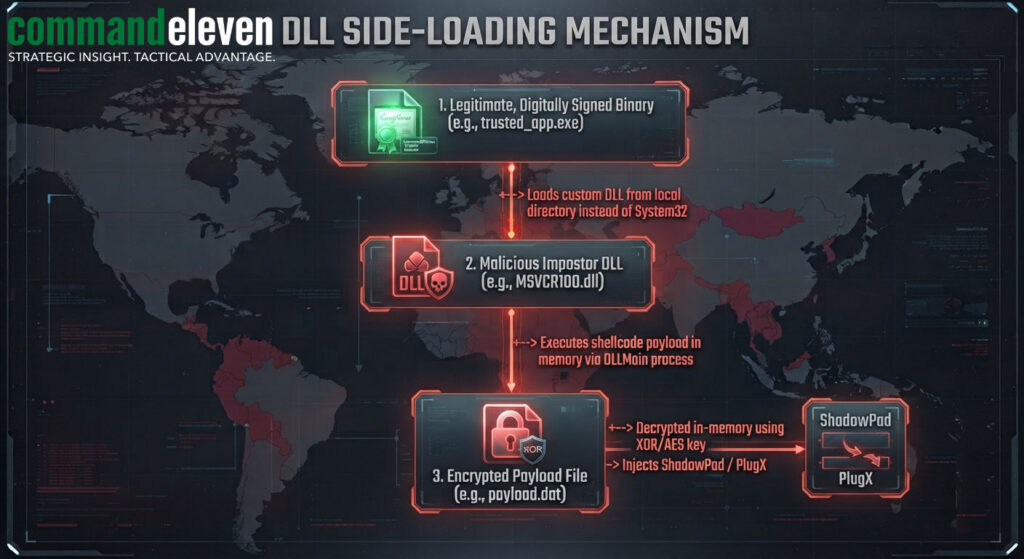
- Execution Flow:
- The attacker places a legitimate, signed executable (trusted_app.exe), a malicious DLL (impostor.dll sharing the exact export function names expected by the executable), and an encrypted payload file (data.dat) into the same file path.
- When trusted_app.exe executes, the Windows OS dynamic linker prioritizes loading impostor.dll located in the current working directory over the legitimate version in C:WindowsSystem32.
- impostor.dll reads data.dat from disk, decrypts the contents in memory using a simple XOR or AES-CBC routine, allocates executable memory (VirtualAlloc with PAGE_EXECUTE_READWRITE permissions), and transfers execution flow to the decrypted shellcode.
- The malicious code executes within the trusted context of trusted_app.exe, completely bypassing security controls that rely on process signature verification.
Persistence Protocols
- WMI Event Subscriptions: Threat actors construct Windows Management Instrumentation (WMI) event filters and consumers (__EventFilter, CommandLineEventConsumer). These execute malicious PowerShell scripts or binaries upon specific system events (e.g., system startup, user login, or at precise time intervals), leaving no registry run keys or startup folder artifacts behind.
- Scheduled Task Obfuscation: Scheduled tasks are registered using administrative privileges, with task XML configurations altered directly on disk to hide the task from standard management interfaces (schtasks /query or Task Scheduler GUI), preventing detection during basic forensic triage.
- Active Directory Persistence: Upon achieving Domain Admin privileges within target networks, APTs dump the Active Directory database (ntds.dit), extract the krbtgt account hash, and forge Golden Tickets (Kerberos Ticket Granting Tickets). This permits indefinite, elevated network access across the entire domain, surviving password resets and domain controller upgrades.
Forensic Payload Profiles & Custom Tooling
PlugX / Korplug Variants
PlugX remains the staple modular backdoor utilized by Chinese-aligned threat actors (particularly Mustang Panda) across ASEAN diplomatic and CNI targets.
- Technical Characteristics:
- Modular Architecture: Supports dynamic loading of plugins for keylogging, screen capture, file management, port scanning, process injection, and shell access.
- Network Protocol Versatility: Capable of dynamically switching C2 communication protocols between raw TCP, UDP, HTTP/HTTPS, and custom ICMP echo request packets to bypass strict outbound firewalls.
- Anti-Analysis Capabilities: Incorporates heavy code obfuscation, anti-disassembly instructions, dynamic API resolving, and checks for virtual machine (VM) artifacts (e.g., VMware, VirtualBox, Sandbox environments) prior to unpacking the core payload.
ShadowPad
ShadowPad is a sophisticated, highly modular payload used selectively by high-tier threat actors (APT41) against strategic targets such as power grid operators, telecommunication hubs, and port facilities.
- Technical Characteristics:
- Plugin Architecture: Core functionality is minimal; all capabilities (disk access, registry modification, process control, packet sniffing) are supplied as encrypted, self-contained plugins loaded on-demand via C2 commands.
- Config Encryption: Configuration data (C2 domains, fallback IPs, campaign IDs, execution timers) is encrypted using a combination of AES-256 and custom multi-byte XOR routines.
- Custom C2 Framing: Network traffic is encapsulated in custom binary structures that simulate legitimate HTTP headers, TLS handshakes, or DNS query packets, complicating automated signature-based detection.
Salt Typhoon Router Implants
Targeting telecommunications providers in ASEAN, Salt Typhoon utilizes specialized, kernel-level implants engineered specifically for enterprise routing hardware (Cisco IOS, Huawei VRP).
- Technical Capabilities:
- Passive Packet Interception: Intercepts raw network traffic passing through compromised core routers. Traffic containing specified keywords (e.g., government domain names, diplomatic communications, unencrypted credentials) is silently copied and exfiltrated to adversary-controlled C2 servers.
- Firmware Persistence: Modifies the system image in NVRAM, ensuring the backdoor survives physical device reboots, firmware updates, and standard administrative resets.
Command-and-Control (C2) Infrastructure & Exfiltration Methodology
C2 Obfuscation Architecture
Modern APT campaigns active in Southeast Asia deploy resilient, multi-tiered C2 topologies designed to hide the true location of the primary command servers and withstand infrastructure takedown efforts.

- Domain Fronting via Major CDNs: APTs route malicious C2 communications through major Content Delivery Networks (CDNs). The outgoing TLS connection specifies a legitimate, highly trusted domain in the Server Name Indication (SNI) header (e.g., trusted-cdn-service.com), while the internal HTTP Host header points to the adversary’s hidden C2 endpoint. Perimeter security filters view the connection as safe and allow it through.
- DNS Tunneling & Covert Channels: For high-security environments where direct outbound HTTP/HTTPS connections are blocked, malware utilizes custom DNS tunneling protocols. Commands and exfiltrated data are encoded into subdomains of attacker-controlled domains (e.g., [encoded_data].c2.attackerdomain.com). Local recursive DNS servers forward the requests out to the attacker’s authoritative name server, establishing a stealthy C2 channel.
- Cloud-Based Dead-Drop Resolvers: Malware leverages legitimate public platforms (GitHub repositories, Google Docs, Microsoft OneDrive, Telegram channels) as dead-drop resolvers. The malware periodically queries a public page where the attacker posts encrypted strings containing the IP address or domain of the active Tier 1 C2 server.
Data Staging & Exfiltration Techniques
- Targeted Data Collection: Automated scripts scan compromised internal networks for specific file extensions (.doc, .docx, .pdf, .xls, .xlsx, .ppt, .msg, .eml) containing strategic keywords (e.g., “South China Sea”, “ASEAN Summit”, “MFA”, “Maritime Security”, “Power Grid Topology”).
- Archiving & Encryption: Harvested files are staged in concealed directories (e.g., C:ProgramDataIntelLogs), compressed into password-protected RAR or ZIP archives using command-line utilities (7z.exe, rar.exe), and split into small, uniform chunks to avoid triggering large-file-transfer alerts.
- Covert Exfiltration: Archives are exfiltrated using legitimate Cloud Storage APIs (Rclone communicating with Mega, Dropbox, or OneDrive) or via HTTPS POST requests disguised as routine telemetry uploads to compromised local web servers.
Target Matrix: Critical National Infrastructure & Diplomatic Operations
ASEAN Secretariat & Foreign Ministries (MFAs)
- Strategic Objective: Political espionage, tracking diplomatic positioning ahead of international summits, monitoring bilateral negotiations regarding South China Sea territorial disputes, and intercepting sensitive economic policy drafts.
- Observed Tactics: Long-term, persistent access to internal Microsoft Exchange/Office 365 environments achieved through stolen OAuth tokens, compromised admin accounts, and custom web shells deployed on perimeter servers.
Maritime Domain Awareness & Port Authorities
- Strategic Objective: Monitoring commercial shipping manifests, naval supply movements, coast guard patrol schedules, and deep-water sonar mapping data across littoral states (Philippines, Vietnam, Malaysia, Indonesia).
- Observed Tactics: Compromise of Automated Information System (AIS) monitoring hubs, port management software systems, and maritime logistics databases via targeted supply-chain software compromises.
Energy Grids & SCADA/ICS Systems
- Strategic Objective: Pre-positioning cyber capabilities within regional power distribution networks, hydroelectric management facilities, and natural gas pipelines to enable operational disruption during a crisis.
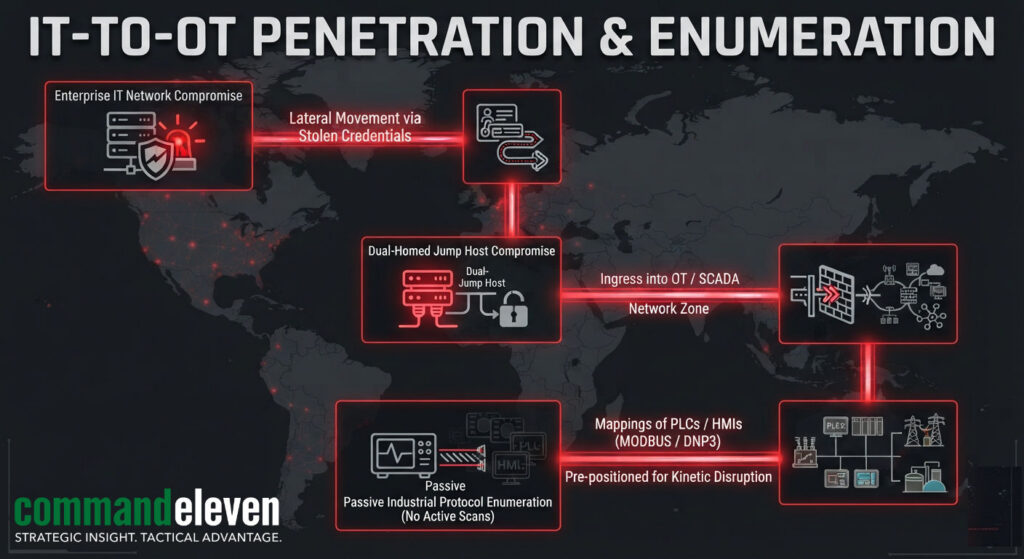
- Observed Tactics: Lateral movement from IT networks into Operational Technology (OT) zones through dual-homed jump hosts. Deployment of specialized enumeration scripts designed to map Industrial Control Systems (ICS) components, Programmable Logic Controllers (PLCs), and Human-Machine Interfaces (HMIs) using MODBUS, DNP3, and IEC 60870-5-104 protocols.
Technical Hardening Framework & Defensive Remediation Architecture
To mitigate the pervasive threat posed by state-sponsored cyber espionage across Southeast Asian enterprise and defense networks, organizations must transition from traditional perimeter defense models to a Zero Trust Architecture (ZTA) tailored for high-threat environments.
Perimeter Edge Hardening & Zero-Trust Access
- Eliminate Gateway Zero-Day Exposure: Deprecate legacy SSL-VPN appliances in favor of Zero Trust Network Access (ZTNA) solutions that enforce device health attestation, identity verification, and strict micro-segmentation prior to granting application-level access.
- Edge Device Auditing: Implement centralized syslog collection for all perimeter appliances, routers, and firewalls. Routinely audit device firmware integrity against vendor-provided cryptographic hashes to detect NVRAM implants or unauthorized modifications.
- Outbound Traffic Restraints: Enforce strict egress filtering rules at the perimeter firewall. Block all outbound traffic from servers and internal endpoints, permitting connections only to explicitly authorized domains and IP ranges over mandatory inspection proxies.
Endpoint & Active Directory Hardening
- Block DLL Side-Loading via Attack Surface Reduction (ASR): Enable Microsoft Defender ASR rules, specifically blocking executable files from running unless they meet strict reputation criteria, and blocking process creation originating from unsigned binaries residing in user-writable directories (AppData, Temp, ProgramData).
- Credential Guard & LSA Protection: Enable LSASS (Local Security Authority Subsystem Service) protection and Windows Defender Credential Guard to prevent memory-dumping tools (Mimikatz, LSASS dumps) from extracting plaintext credentials or Kerberos hashes from RAM.
- Active Directory Hardening: Restrict Domain Admin privileges. Implement Tiered Administration Models (Tier 0: Domain Control, Tier 1: Servers, Tier 2: Workstations). Frequently rotate the krbtgt account password twice sequentially to invalidate forged Golden Tickets.
Operational Technology (OT) & SCADA Isolation
- Strict Air-Gapping & Purdue Model Compliance: Ensure physical or strict logical network separation (Purdue Model Level 0–2 vs. Level 3–5) between enterprise IT environments and OT/ICS control networks. Unidirectional security gateways (data diodes) must be deployed where OT data feeds into corporate monitoring dashboards.
- Disable Unnecessary Remote Access: Eliminate persistent vendor or third-party remote desktop/VPN access directly into ICS environments. Require physical, on-site multi-factor authentication consoles for any control system maintenance operations.
- ICS Protocol Inspection: Deploy industrial-aware intrusion detection systems (IDS) configured to passively monitor OT networks, alerting on unauthorized write commands, PLC program downloads, or anomalous register modifications occurring across MODBUS, DNP3, or BACnet networks.