
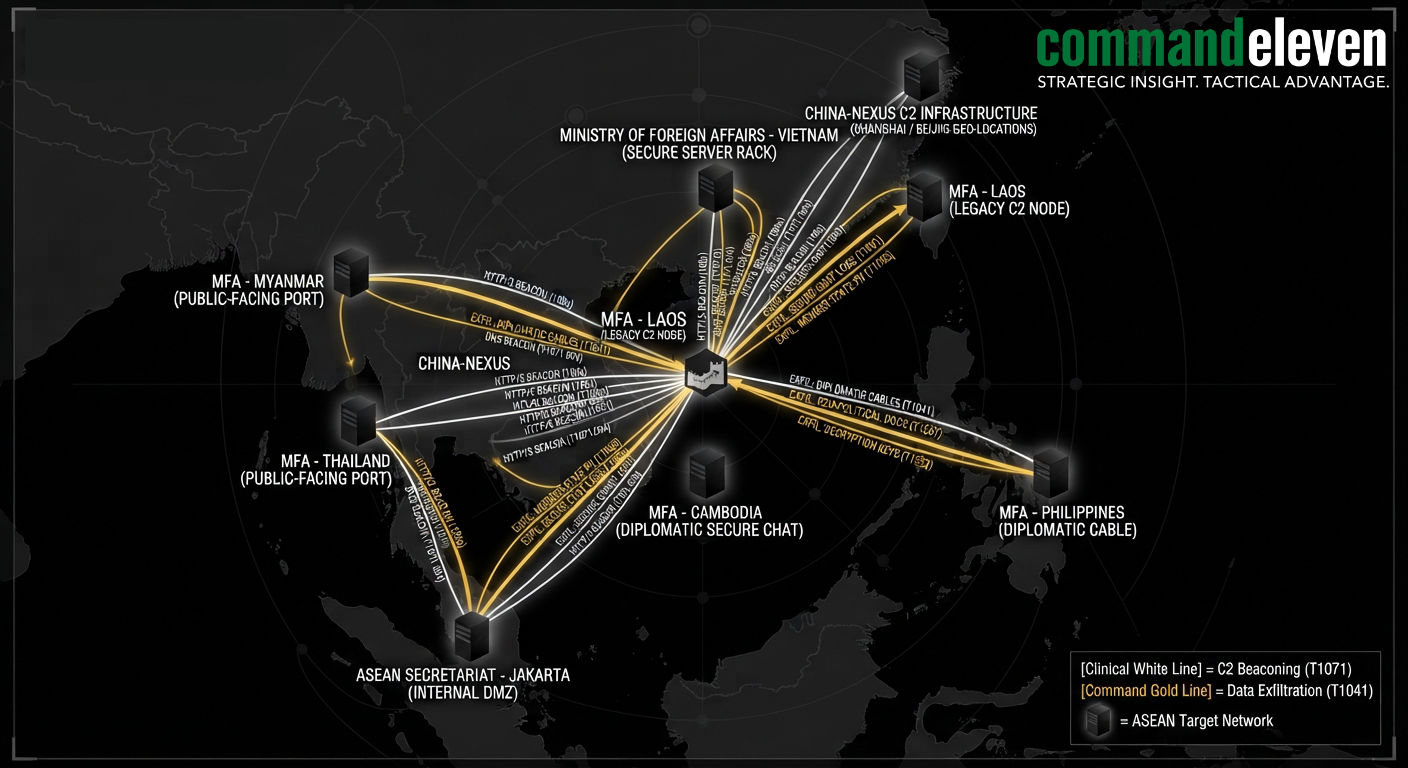
Executive Summary & Systemic Scope
Cyber espionage operations targeting Association of Southeast Asian Nations (ASEAN) diplomatic, economic, and defense networks have escalated in volume and technical complexity. Advanced Persistent Threat (APT) groups have transitioned from traditional spear-phishing strategies to the weaponization of perimeter edge devices, supply chain relationships, and customized single-use malware. This analysis evaluates the technical intrusion methodologies employed by state-aligned threat actors targeting ASEAN member states. It examines initial access mechanics via edge appliance exploitation, traffic redirection protocols, memory-only payload deployment, mathematical models for command-and-control (C2) detection, and threat-hunting frameworks.
Threat Actor Ecosystem and Regional Attribution
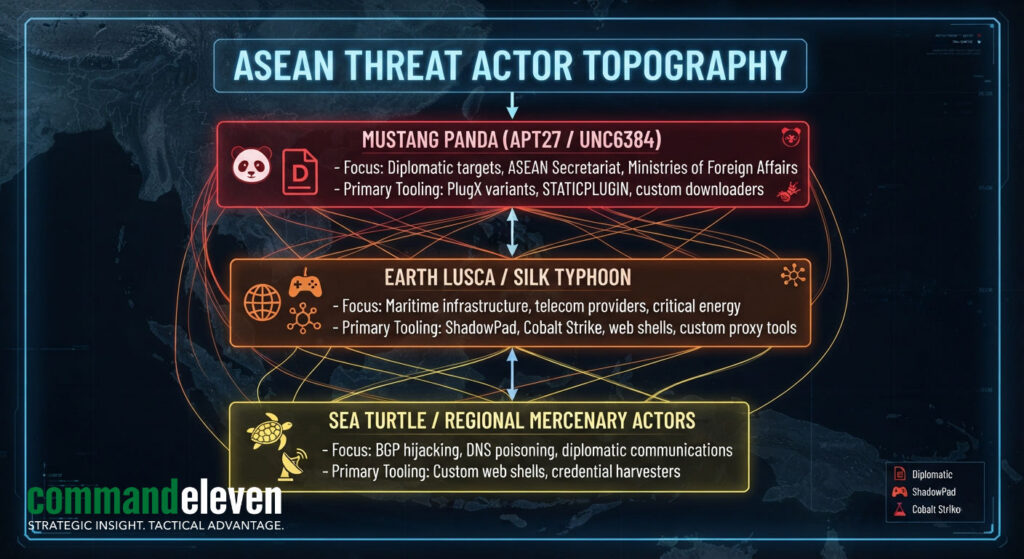
Cyber campaign telemetry across ASEAN diplomatic infrastructure reveals persistent activity from China-nexus threat groups.
Targeted Operational Verticals
The primary targets of these cyber espionage campaigns include:
- ASEAN Secretariat and Diplomatic Missions: Exfiltration of classified meeting minutes, draft communiqués, and bilateral territorial negotiation documents.
- Ministries of Foreign Affairs (MFAs) and Defence (MODs): Interception of diplomatic cable traffic and regional security assessments.
- Maritime Authority Infrastructure: Systemic monitoring of port management databases, maritime traffic tracking platforms, and naval logistics networks.
Edge Device Exploitation and Initial Access Mechanics
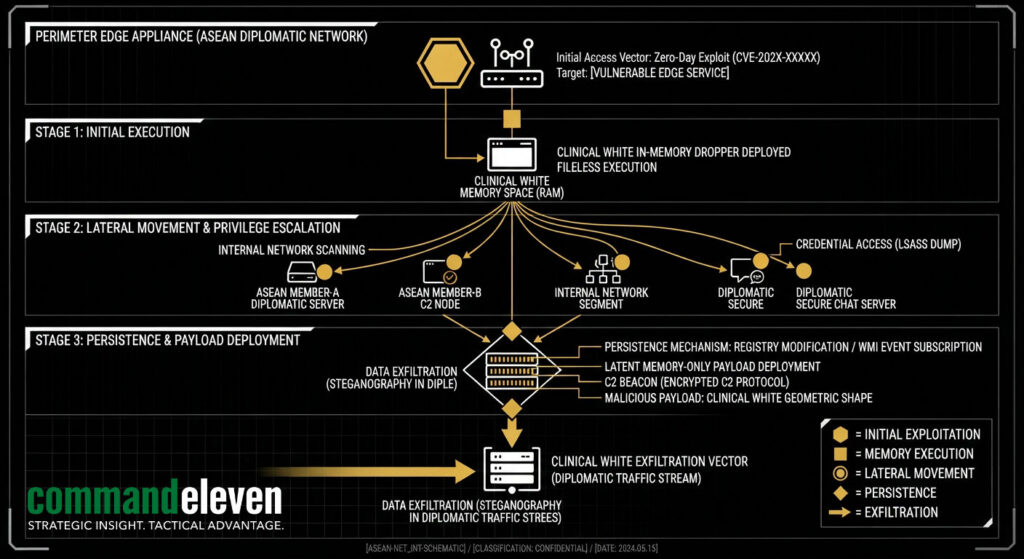
To bypass Endpoint Detection and Response (EDR) agents installed on internal workstations, threat actors focus initial exploitation efforts on edge infrastructure. Edge devices (such as perimeter firewalls, Virtual Private Network appliances, and secure email gateways) often lack embedded EDR telemetry, making them prime targets for zero-day exploitation.
Vulnerability Weaponization
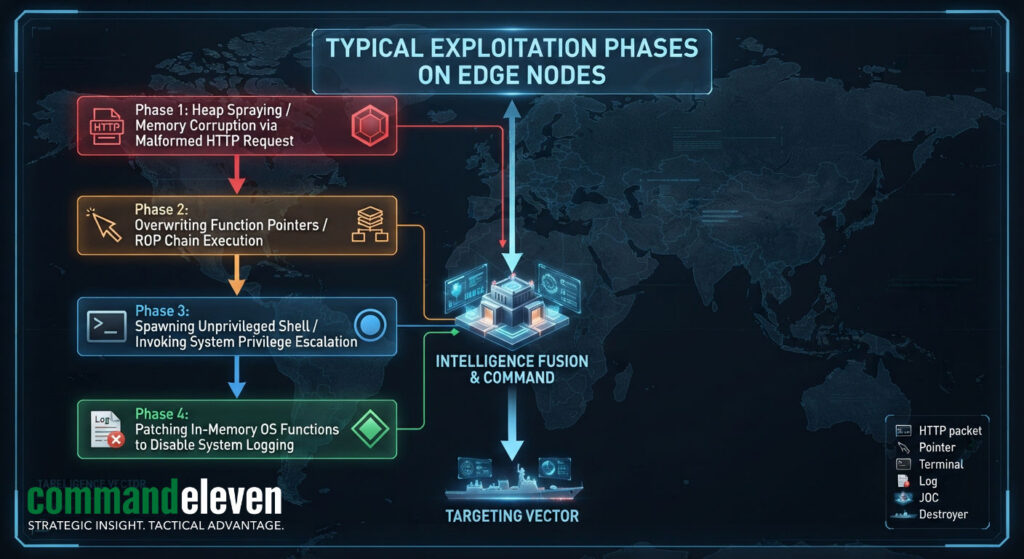
Threat actors systematically target memory corruption vulnerabilities (such as buffer overflows and remote code execution flaws) in edge appliances. A typical exploitation flow proceeds through specific stages:
- Reconnaissance: Automated scanning of targeted IP ranges to identify exposed management interfaces and software version strings.
- Crafted Payload Delivery: Transmitting malicious packets containing custom shellcode engineered to bypass Address Space Layout Randomization (ASLR).
- Execution and Privilege Escalation: Overwriting system memory pointers to execute arbitrary commands at root privilege.
- Persistence via Firmware Manipulation: Injecting malicious hooks into device operating system images to survive firmware updates and reboot cycles.
Traffic Redirection, In-Memory Injection, and Payload Execution
Following initial perimeter access, threat actors employ advanced execution tradecraft to maintain persistent, undetected access across target networks.
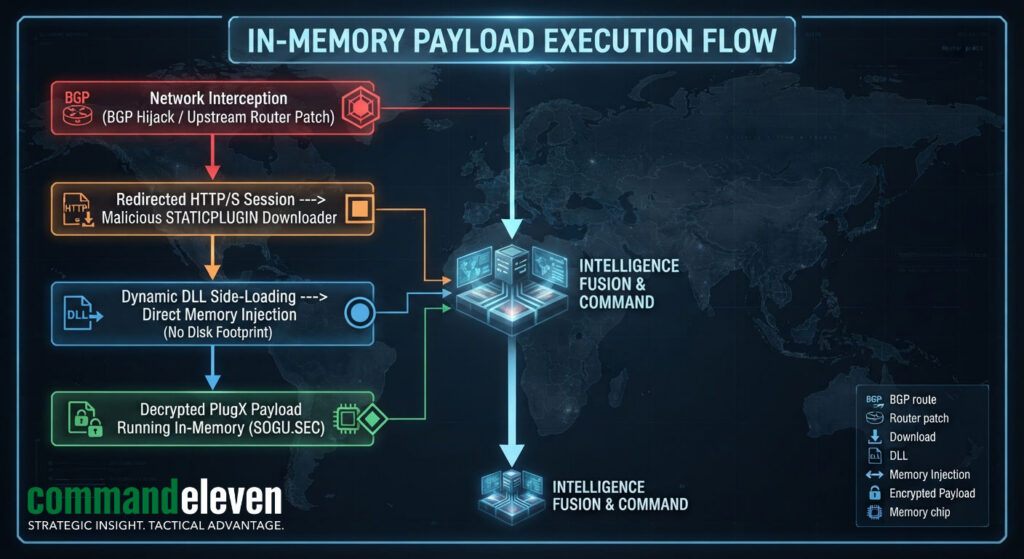
Traffic Interception Protocols
Threat actors hijack Border Gateway Protocol (BGP) routes or compromise upstream Internet Service Provider (ISP) routers to execute Man-in-the-Middle (MitM) attacks. By spoofing digital certificates or redirecting unencrypted HTTP traffic, the adversary injects malicious downspouts into legitimate user software update streams.
STATICPLUGIN and PlugX Execution Architecture
A widely deployed malware deployment chain involves the STATICPLUGIN loader delivering a memory-resident variant of the PlugX Trojan (cataloged as SOGU.SEC):
- Loader Deployment: The victim system executes a digitally signed, legitimate executable prone to DLL side-loading.
- DLL Side-Loading: The binary loads a malicious companion DLL file from its local directory, bypassing traditional execution protection policies.
- Memory Injection: The malicious DLL reads an encrypted payload file from disk, decrypts the shellcode in memory using a simple XOR / RC4 key structure, and allocates executable memory space via VirtualAlloc.
- In-Memory Execution: The payload is injected directly into legitimate host processes (such as svchost.exe or explorer.exe) using Thread Execution Hijacking. The original file on disk is purged, leaving no forensic traces on the file system.
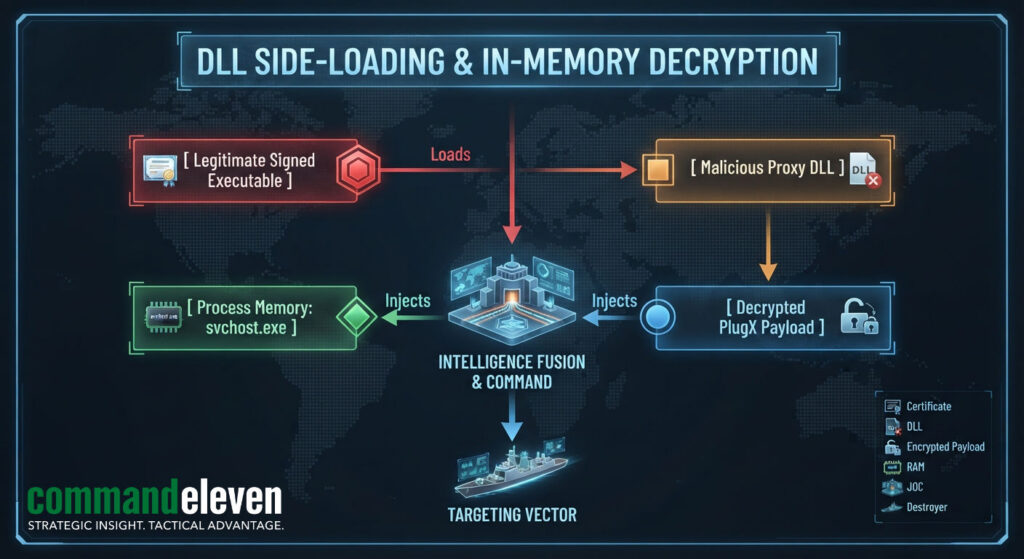
Disposable One-Time Loaders
To defeat signature-based static analysis, threat actors utilize disposable “one-time” malware variants. These loaders are compiled with unique encryption keys and custom structural configurations tailored for a single target host. Once the secondary stager executes, the initial loader wipes its operational memory space and self-deletes, preventing forensic extraction by incident response teams.
Mathematical Models for Command and Control (C2) Traffic Analysis
Detecting encrypted C2 channels operating across compromised networks requires advanced statistical models capable of identifying low-and-slow beaconing patterns and anomalous data transfers within regular web traffic.
Threat Hunting Protocols and Defense Architectures
Mitigating advanced cyber espionage across ASEAN networks requires moving away from implicit trust architectures toward hardened verification models.
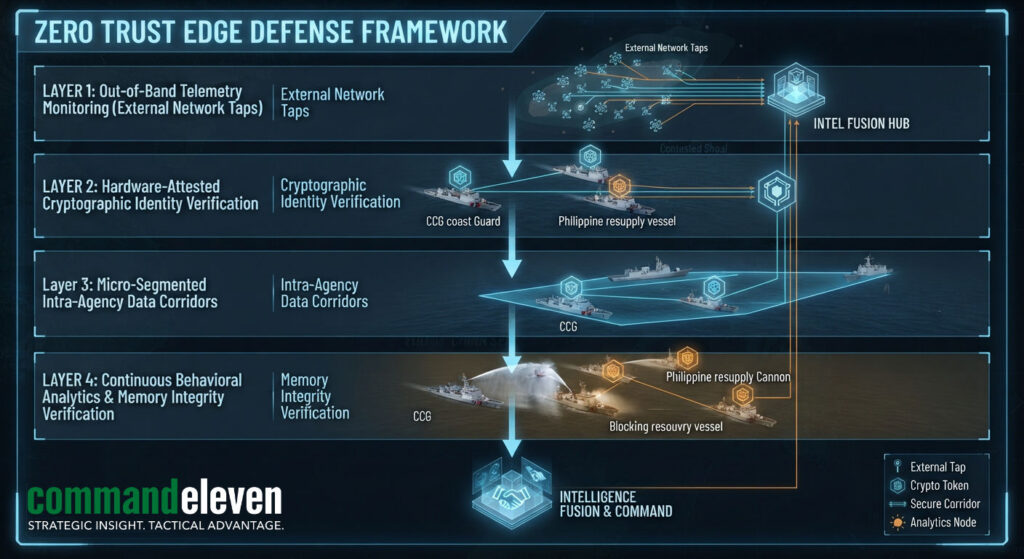
Out-of-Band Telemetry Collection
Because compromised edge devices can patch local logging services to suppress alerts, network security monitoring must rely on out-of-band network taps. Taps mirror raw traffic directly at the physical layer, routing packet captures to isolated Security Information and Event Management (SIEM) systems.
Practical Threat Hunting Playbook
Incident response teams hunting for China-nexus APT activity across government networks utilize specific operational protocols:
- Edge Appliance Firmware Validation: Compute cryptographic hashes of underlying device firmware images and compare them against official vendor baselines to identify unauthorized modifications.
- Volatile Memory Forensics: Execute memory acquisition tools across critical servers to scan for unmapped memory pages containing executable execution permissions (PAGE_EXECUTE_READWRITE).
- Anomalous Process Tree Identification: Search endpoint telemetry for instances where standard native binaries (such as cmd.exe or powershell.exe) are spawned as child processes of unexpected applications.
- Certificate Store Auditing: Audit system certificate stores across all endpoints to detect unauthorized root certificates installed during Man-in-the-Middle traffic interception operations.
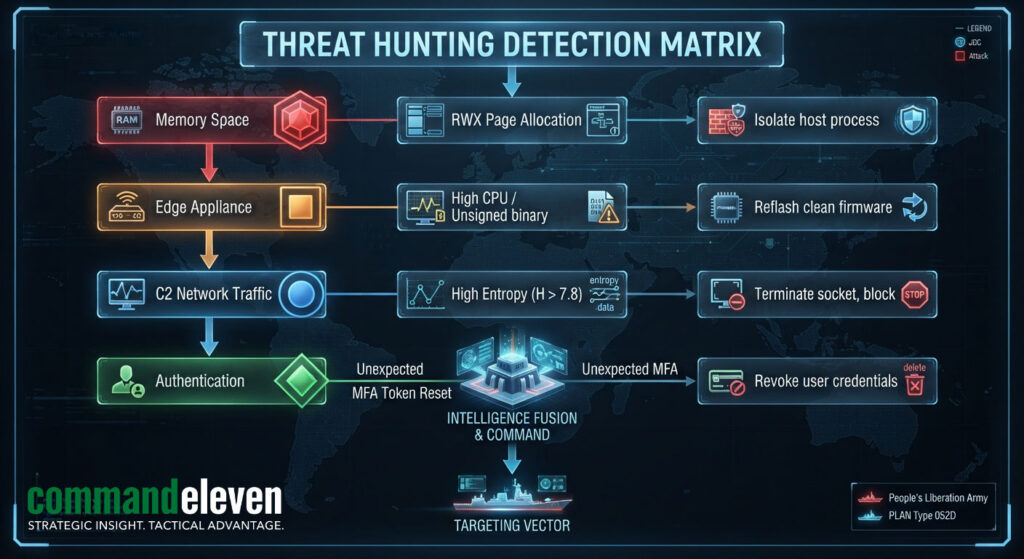
Adopting strict Zero Trust Architecture (ZTA), coupled with automated memory forensics and out-of-band traffic verification, remains essential to protecting sensitive diplomatic and military communication networks from sophisticated state-sponsored intrusions.
ASEAN Cyber Espionage Series
- ASEAN Cyber Espionage & Critical Infrastructure Penetration
- ASEAN Cyber Espionage Topologies & APT TTPs Analysis
- ORB Botnets & Edge Appliance Exploitation in ASEAN
- ASEAN Cyber Espionage Ecosystems & Sub-Sea Interception
- ASEAN Cyber Espionage Landscape: Cyber-Kinetic Convergence & Industrial Intrusion Vectors
- ASEAN Cyber Espionage & Intrusion Frameworks – Current Dossier