Executive Summary
The Association of Southeast Asian Nations (ASEAN) region presents a highly uneven cybersecurity landscape characterized by rapid digital infrastructure expansion alongside unequal institutional resilience. Throughout 2025 and into the first half of 2026, state-sponsored cyber espionage operations targeting ASEAN members have evolved in volume and sophistication. This shift is defined by the industrialization of the China-nexus Advanced Persistent Threat (APT) ecosystem, which has transitioned from individual group operations to a highly specialized, multi-layered cyber supply chain. This technical analysis details the operational shifts within this threat landscape, specifically the systemic targeting of edge routing devices, firewalls, and virtual private network (VPN) security appliances. It explores the weaponization of the “Fail-of-Trust” model targeting Information Technology (IT) service providers and telecommunications networks, and evaluates the deployment of customized, disposable malware families designed to bypass Endpoint Detection and Response (EDR) mechanisms across the region.
Industrialization of the China-Nexus APT Ecosystem
Historical intelligence models treating individual APT threat actors as isolated operational cells are obsolete. Telemetry, leaked technical documentation, and enforcement actions across 2025 and 2026 demonstrate a highly mature, modular “Whole-of-Nation” cyber ecosystem overseen by state intelligence organs. This industrialization mirrors a commercial software supply chain, dividing labor into specialized operational layers:
- Upstream Reconnaissance Detachments: Specialized entities performing automated, internet-wide scanning and deep target profiling across ASEAN public administration networks.
- Midstream Vulnerability Research and Exploit Developers: Engineering teams focused on identifying zero-day vulnerabilities and crafting weaponized exploits optimized for specific enterprise hardware architectures.
- Downstream Execution and Exfiltration Cells: Operational teams deployed to maintain persistence, execute credential harvesting, and orchestrate the exfiltration of sensitive diplomatic, economic, and maritime communications.
This service-layered model allows prominent groups like Salt Typhoon, Flax Typhoon, and Mustang Panda to scale operations efficiently. The boundary between state security services and private sector technology contractors is blurred, enabling an industrial pipeline capable of managing hundreds of concurrent, long-duration intrusions across multiple ASEAN member states simultaneously.
Tactical Pivot to Edge Infrastructure and VPN Vulnerabilities
As defenders across key ASEAN sectors have hardened traditional network endpoints using advanced EDR agents, adversary tradecraft has systematically shifted upward to layers with limited telemetry and weak detection coverage. This has resulted in targeted exploitation campaigns against perimeter edge hardware, including enterprise firewalls, core routers, and VPN gateways.
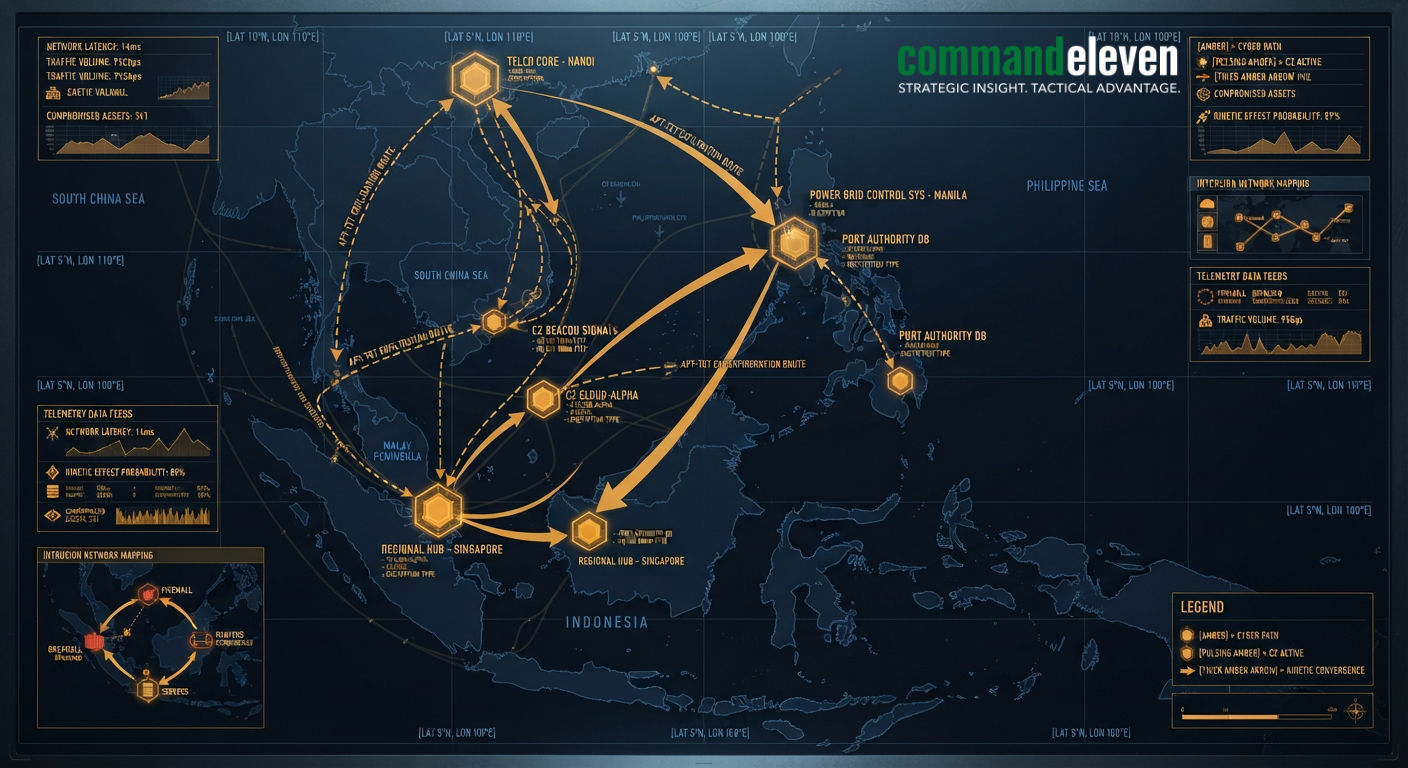
A critical example observed in recent tracking periods includes the deployment of the SPAWN toolset by actors designated as UNC5221. This group has successfully exploited vulnerabilities in Ivanti VPN appliances to inject a custom, highly covert implant known as PhiliKit. Operating directly within the memory space or unmonitored file directories of perimeter security appliances, these implants remain invisible to standard endpoint security tools. Concurrently, the activity cluster tracked as NegativeGlimmer has leveraged edge appliance compromises to secure unauthorized access into government networks within Cambodia and regional maritime logistics authorities. Once established on the edge device, threat actors extract configuration files, map internal network topologies, and establish persistent, encrypted tunnels that blend into routine, authorized network traffic flows.
The “Fail-of-Trust” Model: Exploiting Supply Chains and Telecommunications
A key operational trend across 2025 and 2026 is the weaponization of trusted relationships, known as the “Fail-of-Trust” model. Rather than attempting direct intrusions against hardened central government networks, threat actors prioritize compromises within regional IT service providers, system integrators, and third-party managed service providers (MSPs). By compromising an MSP that maintains privileged access to downstream government clients for software deployment or system administration, the adversary can leverage legitimate administrative access paths, bypassing perimeter defenses entirely.
In parallel, telecommunications infrastructure has emerged as a primary intelligence target. The group tracked as Salt Typhoon has demonstrated a clear preference for establishing long-term, passive presence within core telecommunications carrier environments. By compromising edge routing systems and provider-edge switches, Salt Typhoon avoids short-duration, disruptive actions in favor of deep traffic collection. This technique enables the indirect monitoring of diplomatic communications, political exchanges, and corporate data transfers across ASEAN networks dependent on those compromised carriers, providing strategic political intelligence with an exceptionally low operational signature.
Disposable Malware Frameworks and Multi-Tool Intrusion Stacks
Malware engineering tradecraft has evolved away from complex, multi-functional trojans toward lightweight, specialized, and inherently disposable “one-time” components. These malicious samples are frequently stripped-down loaders or downloaders engineered specifically for a single victim environment. By generating unique cryptographic signatures and randomized structural code for individual intrusion chains, threat actors render traditional signature-based security controls ineffective.
Furthermore, adversaries are increasingly deploying multi-tool intrusion stacks. These stacks combine a mixture of custom disposable malware alongside legitimate, living-off-the-land administrative binaries and open-source utility frameworks. By using standard system administration utilities for lateral movement and data staging, the threat actors ensure their malicious activity is obfuscated within routine operational noise, frustrating forensic reconstruction efforts during incident response.
Regional Infrastructure Threats: Infrastructure Botnets
Beyond targeted exploitation, threat actors maintain large-scale operational infrastructure within the ASEAN region. Flax Typhoon has been documented managing extensive botnets comprising hundreds of thousands of compromised consumer routers, Internet of Things (IoT) devices, and Small Office/Home Office (SOHO) appliances. This distributed, compromise-derived proxy infrastructure is used to route command-and-control (C2) traffic for highly sensitive espionage operations. By routing malicious data through a residential IP address located within the same city or country as the intended target, the adversary bypasses geo-fencing protections and ensures that malicious traffic matches routine consumer network noise.
Threat Actor and Vulnerability Mapping Matrix
The following analytical matrix correlates the primary threat actors active within the ASEAN theater with their preferred targeting vectors, structural tradecraft, and documented impacts across recent reporting cycles.
| Threat Actor | Primary Technical Focus | Key Exploitation Mechanics | Target Demographics within ASEAN |
| Salt Typhoon | Core telecommunications carrier environments. | Edge router configuration extraction, covert traffic interception tunnels. | Regional telecommunications grids, downstream diplomatic traffic. |
| Flax Typhoon | Large-scale proxy botnet infrastructure creation. | SOHO router and IoT device mass exploitation, automated credential harvesting. | Distributed across regional consumer and small business hardware nodes. |
| Mustang Panda | Foreign ministries, public administration bodies. | Advanced spearphishing, session hijacking, persistent credential reuse. | Ministries of Foreign Affairs, transport-adjacent state enterprises. |
| UNC5221 / SPAWN Cluster | Perimeter security and access appliances. | Exploitation of Ivanti VPN appliances, deployment of the PhiliKit implant. | Government ministries, critical regional defense infrastructure. |
| NegativeGlimmer | Targeted sovereign data harvesting. | Perimeter edge appliance compromise, custom web shell persistence. | Cambodian public administration, regional maritime logistics. |
Proactive Defensive Mitigations and Behavioral Threat Hunting
Traditional, reactive defensive paradigms relying on file hashes, known malicious IP addresses, and static indicators of compromise (IoCs) are insufficient to counter the industrialized threat landscape of 2026. Because adversaries utilize disposable malware tailored to single networks and route traffic through domestic SOHO proxy botnets, security teams across ASEAN must shift to proactive, hypothesis-driven threat hunting.
Defensive efforts must prioritize the following operational practices:
- Edge Telemetry Enrichment: Implementing specialized logging and telemetry generation directly on perimeter hardware, tracking internal configuration changes and anomalous process creation within firewalls and VPN gateways.
- Behavioral Analytics: Monitoring for unusual administrative account actions, particularly the execution of living-off-the-land commands outside normal maintenance windows or from non-standard source IPs.
- Supply Chain Audit Protocols: Instituting zero-trust architecture models for all third-party IT providers and MSPs, restricting their access windows and establishing strict monitoring over any connection originating from trusted vendor networks.
- Out-of-Band Integrity Verification: Conducting routine, mandatory out-of-band firmware integrity checks on all edge hardware to detect the presence of memory-resident implants that evade conventional on-box detection.
By transitioning from a signature-blocking posture to active tradecraft disruption, defenders can expose state-sponsored espionage activity during the early stages of network staging and lateral movement, neutralising the systemic advantage held by the industrialized adversary pipeline.
ASEAN Cyber Espionage Series
- ASEAN Cyber Espionage & Critical Infrastructure Penetration
- ASEAN Cyber Espionage Topologies & APT TTPs Analysis
- ORB Botnets & Edge Appliance Exploitation in ASEAN
- ASEAN Cyber Espionage Ecosystems & Sub-Sea Interception
- ASEAN Cyber Espionage Landscape: Cyber-Kinetic Convergence & Industrial Intrusion Vectors – Current Dossier
- ASEAN Cyber Espionage & Intrusion Frameworks