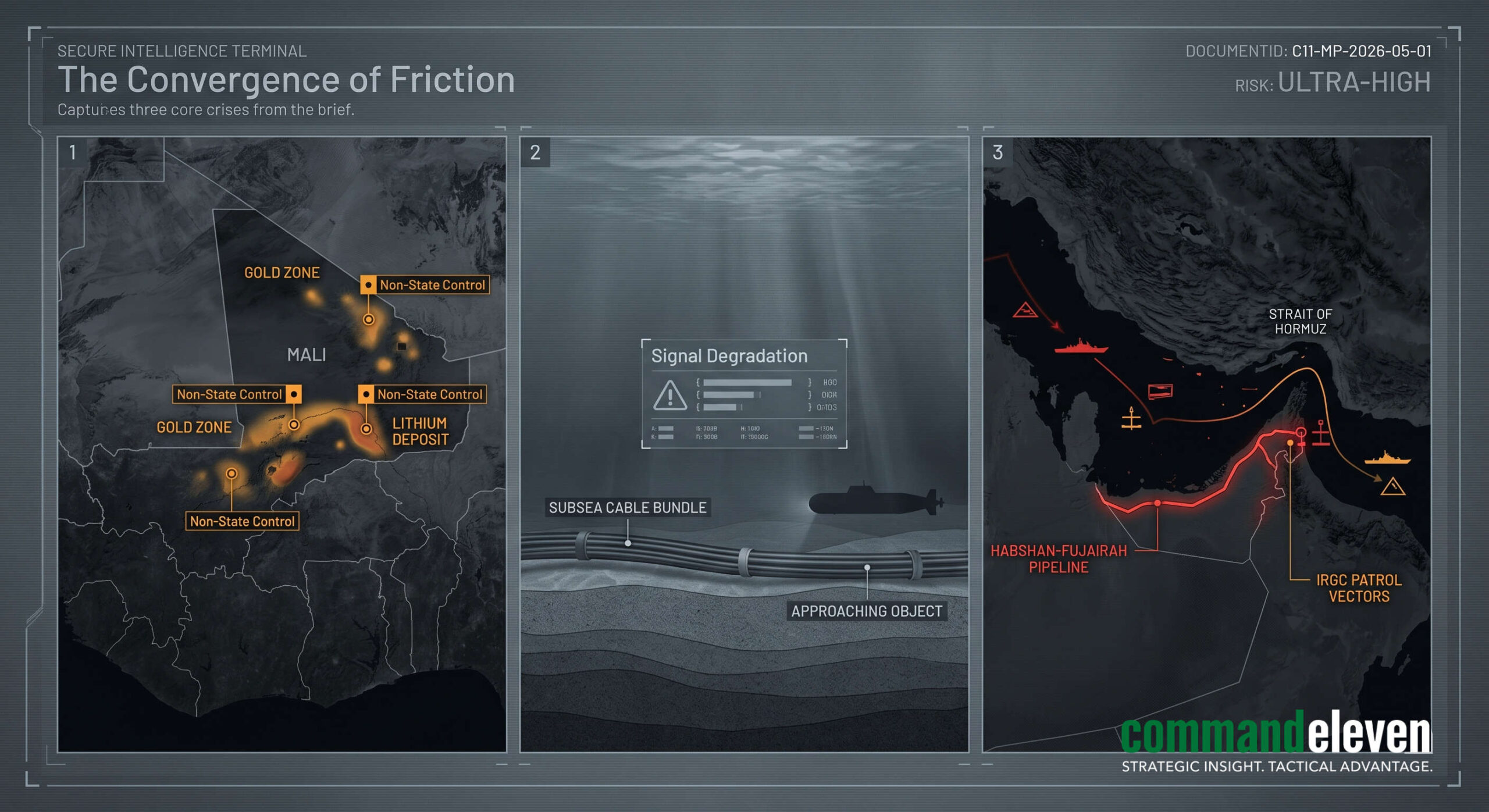
The Friday, May 1, 2026, Market Pulse brief addresses a synchronized collapse of traditional governance structures across West Africa and the Middle East, alongside the critical degradation of global data transit. This briefing is tailored for C-Suite decision-makers to calibrate risk for the Q2-2026 “Flash-Dark” environment.
Executive Summary
The global market enters May 2026 under the shadow of a double-state failure and a looming interdiction of the “digital silk road.” The JNIM (Jama’at Nusrat al-Islam wal-Muslimin) takeover of Mali represents the first time a non-state actor has achieved total administrative control over a Sahelian sovereign entity, threatening the extraction and transit of critical mineral resources. Simultaneously, the IRGC (Islamic Revolutionary Guard Corps) has formally dissolved the remnants of Iran’s civilian government, declaring absolute military control over the state’s kinetic and energy infrastructure.
These regional ruptures are compounded by a high-fidelity threat against the global subsea cable network. With the #72/48 Protocol still in early-stage adoption, the potential for a “Flash-Dark” interdiction of underwater internet cables creates an existential risk to global data liquidity and automated trading. Investors must prepare for a period of extreme volatility as the world’s most sensitive transit chokepoints – both physical and digital – are now under the influence of radical or military-first actors.
The Triad of Systematic Interdiction
The first Friday of May 2026 is defined by three converging crises that prioritize kinetic control over diplomatic or market stability.
JNIM’s Mali Takeover: The Sahelian Caliphate
The formal fall of Bamako to JNIM on April 28, 2026, has fundamentally altered the West African risk profile.
- Administrative Consolidation: JNIM has transitioned from an insurgency to a governing body, seizing control of the Central Bank of West African States (BCEAO) regional branch and the state-managed gold mining sector.
- Regional Contagion: The takeover serves as a “Force Multiplier” for regional terror entities, increasing the risk of spillover into neighboring littoral states and threatening the security of critical EU-bound mineral supply chains.
- Market Impact: The displacement of legitimate governance has led to a total cessation of foreign direct investment in the region, with gold prices experiencing a “conflict premium” spike as local extraction remains under militant control.
IRGC Military Declaration: The End of Iranian Civilian Governance
Following the kinetic exhaustion of the Iran War, the IRGC has issued a formal declaration of absolute military control over Iran.
- Total Command: The IRGC now maintains direct administrative oversight of the Ministry of Petroleum and the national banking system, effectively ending any pretense of civilian diplomacy.
- Hormuz Leverage: By centralizing kinetic control, the IRGC has established a “Single-Trigger” authority for maritime interdictions in the Strait of Hormuz, heightening the threat to the 1.5 million bpd flows currently bypassing the strait via the Fujairah pipeline.
- The “Siege Economy”: This declaration signals the intent to maintain a “Siege Economy,” prioritizing domestic military persistence over international energy market stability.
The Underwater Cable Threat: Digital Interdiction
The global data backbone is currently facing its most significant vulnerability as adversary actors pivot toward subsurface interdiction.
- The “Acoustic Handshake” Target: While Allied forces utilize the Bashi Channel IIZ for UDA (Underwater Domain Awareness), adversaries are targeting the physical landing stations and fiber-optic bundles that facilitate global financial clearing.
- Strategic Void: A synchronized strike on the subsea network would create a “Flash-Dark” event, neutralizing the ability of regional hubs to transmit real-time market data or coordinate maritime logistics.
- The #72/48 Imperative: This threat confirms the necessity of the #72/48 Protocol; without analog fallbacks for data synchronization, a “cable cut” could induce a weeks-long paralysis in global trade finance.
AI in Conflict and “Market Shockwaves”
The integration of Autonomous Weapon Systems (AWS) and AI-driven decision-making has transitioned from a tactical edge to a primary driver of market volatility. As of May 1, 2026, the “speed of battle” has outpaced human-centric financial risk assessment, creating a high-frequency “Market Shockwave” effect where kinetic escalations trigger immediate, automated geofinancial de-risking.
Algorithmic Escalation: The Feedback Loop
The use of AI in ongoing regional conflicts – specifically within the IRGC’s newly centralized military command – has introduced a “black box” element to regional security.
- Targeting at Machine Speed: AI-driven sensor fusion is now capable of identifying and prosecuting targets across the First Island Chain and the Persian Gulf with minimal human latency.
- The De-Risking Trigger: Global trading algorithms are now tuned to monitor “Kinetic Indicators” (e.g., satellite-detected SAM battery activation or subsea acoustic anomalies).
- Market Impact: When an AI system triggers a kinetic strike, financial algorithms execute “Limit Down” sell orders before human analysts can verify the strategic intent, leading to artificial liquidity vacuums.
Data Liquidity and the “Flash-Dark” Premium
The threat to underwater cables is not merely a communications risk; it is a direct threat to the plumbing of global capital.
- The Settlement Void: With 99% of international data transiting via subsea fiber, a synchronized interdiction would freeze the SWIFT and digital clearing systems.
- The #72/48 Hedge: Institutional investors are beginning to price in a “Resilience Premium” for entities compliant with the #72/48 Protocol, viewing analog fallbacks as the only viable hedge against a total data blackout.
- Market Shockwaves: A successful cable interdiction in the Bashi Channel or the Mediterranean would likely result in a 15–20% immediate drop in global indices as the “Digital Silk Road” is severed.
Narrative Warfare and Adversary Infrastructure
Adversaries are utilizing AI-generated narrative warfare to amplify these shockwaves, creating “synthetic panics”.
- Deepfake Volatility: AI-generated misinformation regarding the status of the Strait of Hormuz or the integrity of the Fujairah pipeline is being used to induce “Flash-Crashes” in energy futures.
- Infrastructure of Influence: Technical audits reveal that the IRGC and JNIM are utilizing bot-nets to flood sentiment-analysis algorithms, forcing defensive market moves based on fabricated kinetic reports.
Disruptive Intelligence Synthesis and Weekend Risk Calibration
This final synthesis consolidates the kinetic, digital, and geofinancial vectors into an actionable risk matrix for the weekend of May 2–3, 2026. The convergence of non-state governance in the Sahel, military consolidation in Iran, and subsea infrastructure vulnerabilities creates a high-entropy environment where traditional “wait-and-see” protocols are insufficient.
Disruptive Synthesis: The “Single-Point of Failure” Matrix
The current intelligence landscape identifies three “Single-Points of Failure” that could transition from regional crises to global market ruptures during the weekend low-liquidity window:
- The Data Liquidity Choke: A coordinated “cable cut” in the Bashi Channel or the Mediterranean. Without the #72/48 Protocol’s analog fallbacks, global financial clearing could face immediate paralysis.
- The Energy Continuity Gap: An IRGC-led interdiction of the Habshan-Fujairah pipeline. While the pipeline bypasses the Strait of Hormuz, its pumping stations remain vulnerable to the cyber-kinetic “HMI Ghosting” protocols identified in Section I.
- Mineral Supply Chain Contagion: JNIM’s consolidation in Mali leading to a synchronized “Nationalization” of gold and lithium mines across the Sahel, disrupting EU tech and energy sectors.
Weekend Risk Calibration (May 2–3, 2026)
CommandEleven maintains an “ULTRA-HIGH” risk rating for the upcoming 48-hour window. Senior leadership should calibrate defensive postures based on the following projections:
| Risk Vector | Probability | Impact Magnitude | Mitigation Requirement |
| Subsea Interdiction | High | Extreme (Market Freeze) | #72/48 Analog Synchronization |
| Hormuz Escalation | Moderate | High (Oil Volatility) | Fujairah Pipeline Manual Bypass |
| Sahelian Contagion | High | Moderate (Supply Chain) | Alternative Mineral Sourcing |
Actionable Intelligence Directives
For C-Suite and Strategic Subscribers, the following directives are issued for immediate implementation:
- Activate “Dark-Site” Protocols: Ensure all critical financial and operational nodes are in a state of 72-Hour Survival readiness with offline data backups.
- Verify Hardware Truth: Cross-reference all digital HMI status reports with physical analog sensors at critical infrastructure sites to mitigate “Ghosting” risks.
- Algorithmic Dampening: Calibrate automated trading suites to prevent “Synthetic Panic” sells triggered by adversary narrative warfare or AI-driven kinetic reports.