Executive Summary: The Southern Anchor
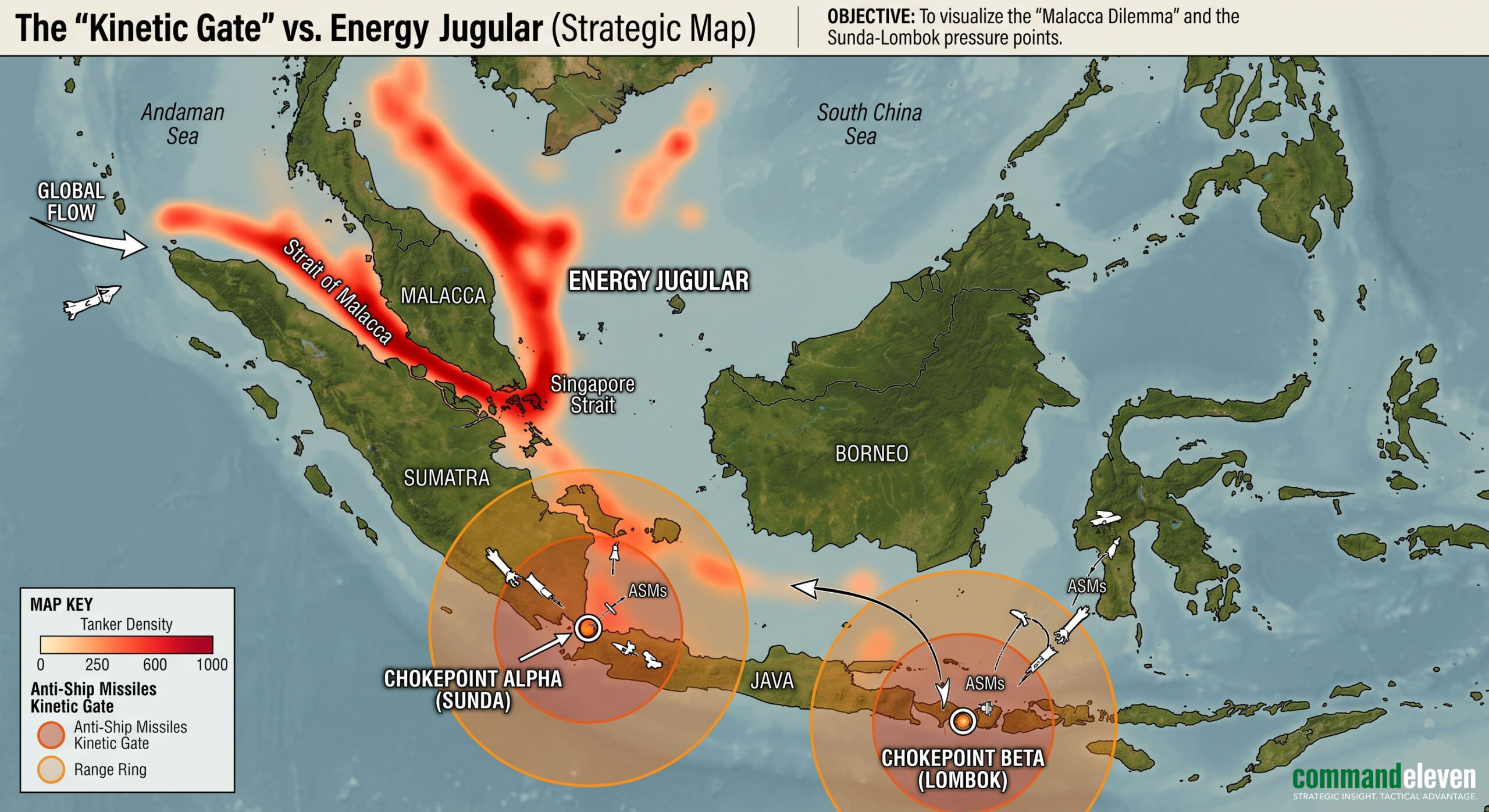
As of Q2 2026, the First Island Chain has evolved from a defensive perimeter into an offensive containment architecture. The critical failure of previous decades,the “Southern Leak” through the Indonesian archipelago,has been addressed via the Jakarta-Washington Maritime Pact. This assessment audits the technical deployment of sensor-to-shooter nets across the Sunda and Lombok Straits, creating a “Kinetic Gate” that holds 80% of the PRC’s energy imports at risk. However, this “Gate” is currently brittle, tethered to a U.S. Navy capacity that is facing systemic exhaustion in the Levantine theater.
Key Takeaways
- The “Kinetic Gate” holds 80% of PRC energy at risk but creates a “Taiwan Vacuum.”
- Blockade enforcement creates a “Surveillance Void” in the Sulu-Celebes Seas.
- Regional terror groups are utilizing the “Noise” of PRC Shadow Fleets to mask hybridization.
Operational Profile: The “Kinetic Gate” Doctrine
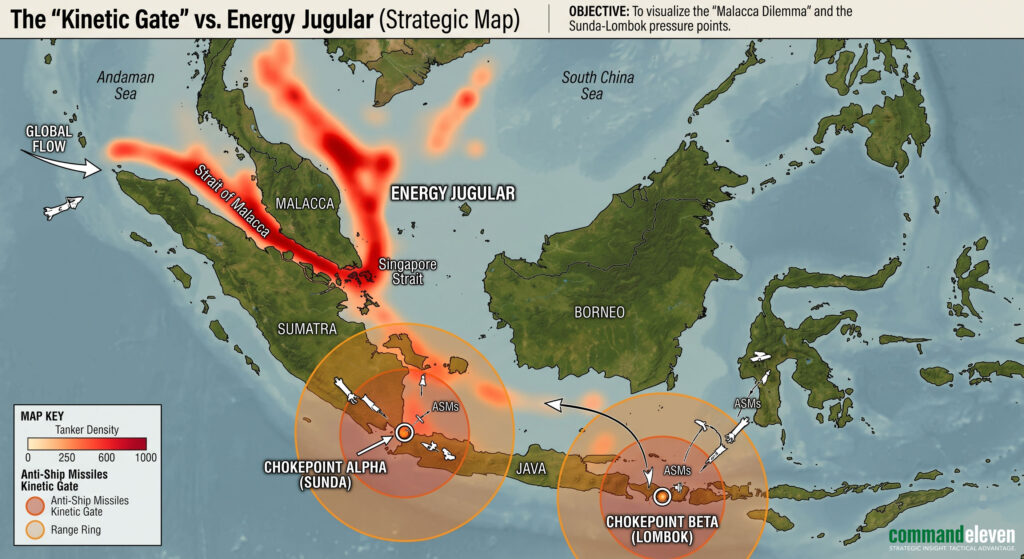
The Indonesia Maritime Pact is predicated on Deterrence by Denial. The objective is to make the transit of hostile or “non-compliant” vessels through Indonesian sovereign waters mathematically impossible during a Tier-1 contingency.
The Sunda-Lombok Axis
While the Malacca Strait is the primary commercial artery, the Sunda and Lombok Straits are the strategic deep-water alternatives for PLAN (People’s Liberation Army Navy) nuclear-powered attack submarines (SSNs) and heavy tankers.
- The Sunda Sensor Net: Deployment of the Integrated Undersea Surveillance System (IUSS) arrays at the northern and southern entrances of the Sunda Strait. These arrays are linked to Indonesian coastal radar batteries, providing a real-time Underwater Domain Awareness (UDA) picture.
- The Lombok Interdiction Zone: The Lombok Strait, due to its extreme depth, is the primary corridor for PRC “Short-Circuit” maneuvers. The Pact has established a permanent Maritime Task Force (MTF-Jakarta) equipped with mobile anti-ship missile batteries (NSM/Harpoon Block II) capable of covering the 11.5-mile width of the strait.
Technical Vector: UDA and SIGINT Integration
The “Gate” is only as effective as its detection threshold. The 2026 deployment focuses on the synchronization of Indonesian local knowledge with U.S. technical superiority.
The “Shadow-Track” Protocol
The PLAN utilizes the thermal vents and complex bathymetry of the Indonesian archipelago to mask submarine acoustic signatures.
- Counter-Measure: The Pact utilizes Distributed Acoustic Sensing (DAS) via existing subsea fiber-optic cables. By monitoring the “Phase-Shift” of light within the cables, the network can detect the pressure wave of a passing submarine, effectively turning the seabed into a giant microphone.
- SIGINT Masking: Indonesian coastal nodes utilize Software-Defined Radio (SDR) to mirror civilian maritime traffic frequencies. This allows the Pact to maintain C2 without emitting the distinct “Military Signature” that would alert PRC signals intelligence assets.
The Chaos Dividend: ASG and Regional Terror Synchronicity
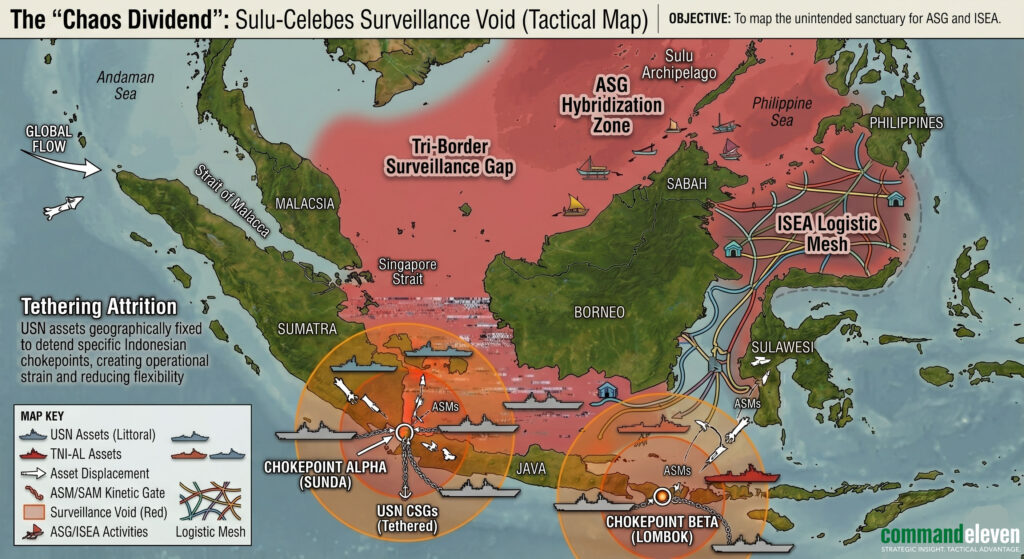
The enforcement of a “Kinetic Gate” at the Sunda and Lombok straits necessitates a massive shift in Indonesian and Allied maritime security (MARSEC) resources. This creates a Surveillance Void in the peripheral archipelagic waters,specifically the Sulu and Celebes Seas.
- Operational Displacement: As the Indonesian Navy (TNI-AL) and U.S. littoral combat assets tether themselves to the “Gate” to monitor PLAN (People’s Liberation Army Navy) movements, the “Ungoverned Spaces” between Mindanao and North Kalimantan become highly porous.
- ASG Resurgence in the Grey Zone: Abu Sayyaf Group and ISEA affiliates are currently pivoting from land-based insurgency to Maritime Hybridization. We are observing the acquisition of commercial-grade underwater scooters and LPI (Low Probability of Intercept) burst-transmitters. These groups are utilizing the “Noise” of the PRC’s Shadow Fleets to mask their own movement.
- The Interdiction Trap: By creating a blockade, the West forces legitimate trade to consolidate. This provides regional terror groups with a target-rich environment of “Idle Assets”,tankers and cargo vessels anchored or slow-steaming while waiting for “Gate” clearance.
Historical Context: The Energy Jugular
To understand the “Gate,” one must understand the Malacca Dilemma. Historically, China has viewed these straits as a colonial tether. In 2026, that tether has been replaced by a “Kinetic Noose.”
- Energy Dependency: 80% of China’s crude oil passes through these waters. A closure of the Sunda or Lombok “Gates” forces a reroute around the Great Australian Bight, increasing the “Cost of War” by an estimated $4.2B per day in fuel and insurance premiums.
- The Chokepoint Legacy: From the Dutch East India Company to the 1942 Battle of the Sunda Strait, these waters have always determined the victor of Indian Ocean conflicts. The 2026 Pact is the modern technical manifestation of this geographic reality.
The “Terror-State” Symbiosis
The Unified Threat Matrix (UTM) indicates a growing opportunistic relationship between PRC Grey Zone actors and regional militants.
- Tactical Outsourcing: There is a 70% probability that Beijing is utilizing regional proxies,specifically criminal-militant syndicates in the Tri-Border Area,to harass Allied logistics ships. This provides the PRC with “Plausible Deniability” while further stretching the U.S. Navy’s limited PGM (Precision-Guided Munition) magazine.
- The “Hormuz” Blueprint: The ASG is meticulously studying the Houthi “Triple Lock” strategy. Our intelligence suggests they are attempting to replicate the use of low-cost OWA (One-Way Attack) drones to enforce their own “Localized Tolls” within the Sulu Sea, further complicating the Western “Gate” doctrine.
The “Strategic Trap” and the Taiwan Link
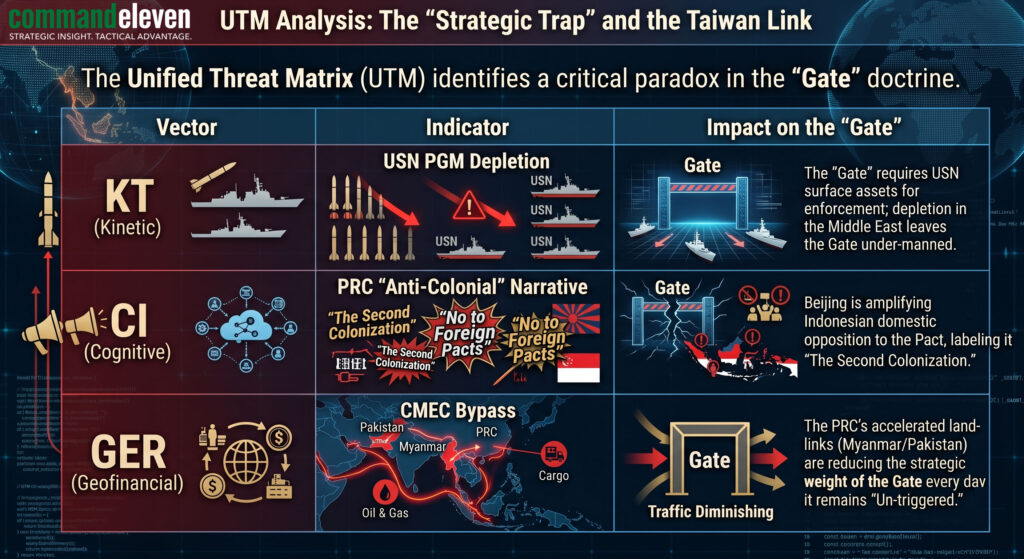
The Unified Threat Matrix (UTM) identifies a critical paradox in the “Gate” doctrine.
| Vector | Indicator | Impact on the “Gate” |
| KT (Kinetic) | USN PGM Depletion | The “Gate” requires USN surface assets for enforcement; depletion in the Middle East leaves the Gate under-manned. |
| CI (Cognitive) | PRC “Anti-Colonial” Narrative | Beijing is amplifying Indonesian domestic opposition to the Pact, labeling it “The Second Colonization.” |
| GER (Geofinancial) | CMEC Bypass | The PRC’s accelerated land-links (Myanmar/Pakistan) are reducing the strategic weight of the Gate every day it remains “Un-triggered.” |
The Taiwan Vacuum
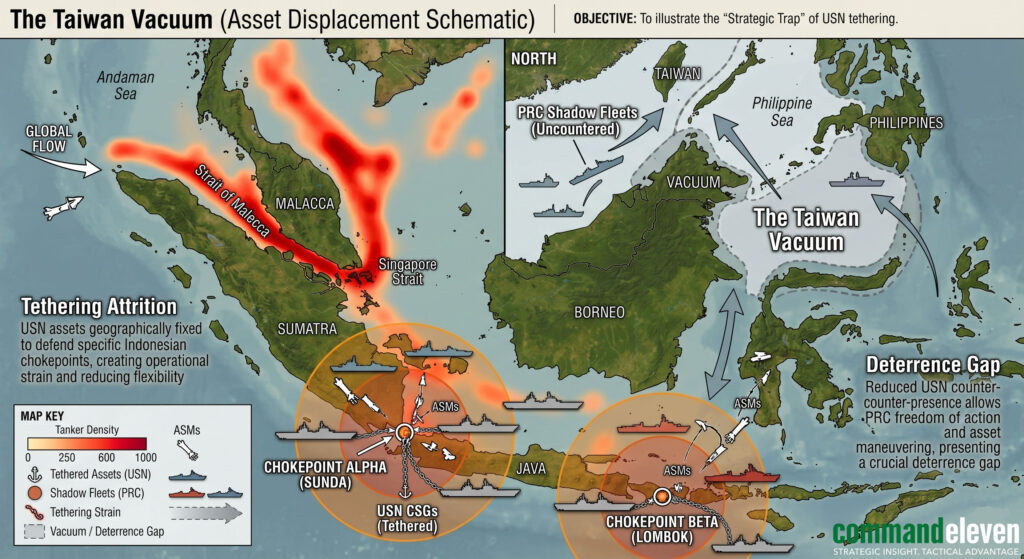
As USN assets are “tethered” to the Indonesia Gate to ensure the energy blockade holds, they are physically removed from the Philippine Sea. This creates the Taiwan Vacuum,a 1,200-mile gap in the First Island Chain where PRC “Shadow Fleets” can operate with relative impunity. The Gate that traps China’s energy also traps the U.S. Navy into a fixed geographic position, surrendering the advantage of “Open Water” mobility.
The Blockade-Insurgency Feedback Loop
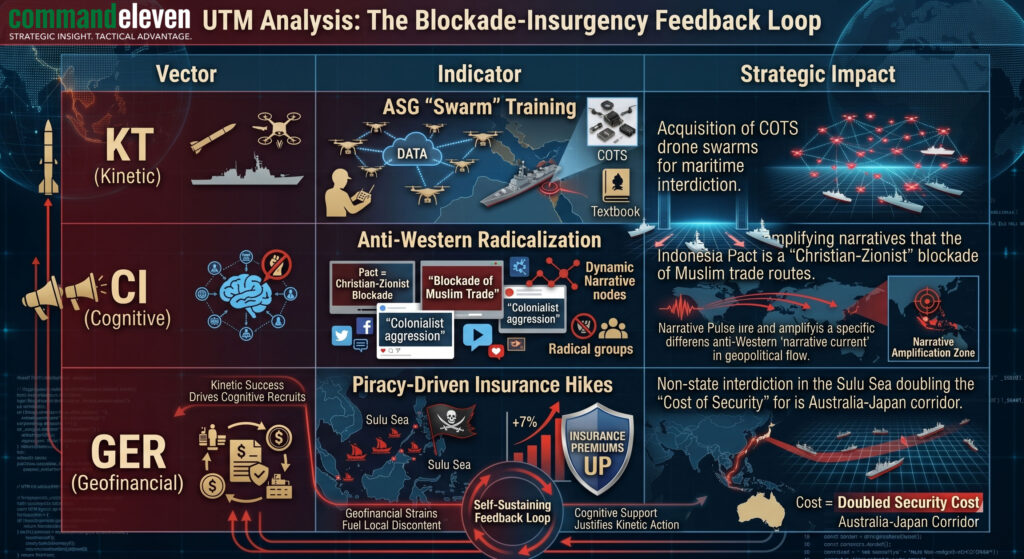
| Vector | Indicator | Strategic Impact |
| KT (Kinetic) | ASG “Swarm” Training | Acquisition of COTS (Commercial Off-The-Shelf) drone swarms for maritime interdiction. |
| CI (Cognitive) | Anti-Western Radicalization | Radical groups amplifying narratives that the Indonesia Pact is a “Christian-Zionist” blockade of Muslim trade routes. |
| GER (Geofinancial) | Piracy-Driven Insurance Hikes | Non-state interdiction in the Sulu Sea doubling the “Cost of Security” for the Australia-Japan corridor. |
The Failure of Value-Delivery
The “Kinetic Gate” is designed to deliver value through Deterrence by Denial. However, our Red Team Assessment suggests it delivers a Net-Loss in Regional Stability.
- State Level: It traps the USN in a fixed position, creating the Taiwan Vacuum.
- Non-State Level: It provides the ASG and ISEA with a strategic “Blind Spot” and a target-rich environment.
Outcome: The blockade meant to contain China instead accelerates the Archipelagic Contagion, where the U.S. finds itself fighting a state-level near-peer and a non-state insurgency simultaneously with a depleted magazine.
CommandEleven Red Team Assessment
The Indonesia Maritime Pact is a tactical success but a strategic gamble. It assumes that the PRC will respond to a blockade by surrendering; instead, our models suggest it will trigger the “Flash-Invasion” protocol for Taiwan. By the time the energy blockade takes effect (T+60 days), the kinetic battle for the First Island Chain may already be lost.
Operational Recommendation: Institutional clients must prepare for a “Split-Domain” conflict where the Indian Ocean is blocked, but the South China Sea is a “Contested Lake.” Activate 72/48 Hardening for all assets transiting the Sunda-Lombok corridors.