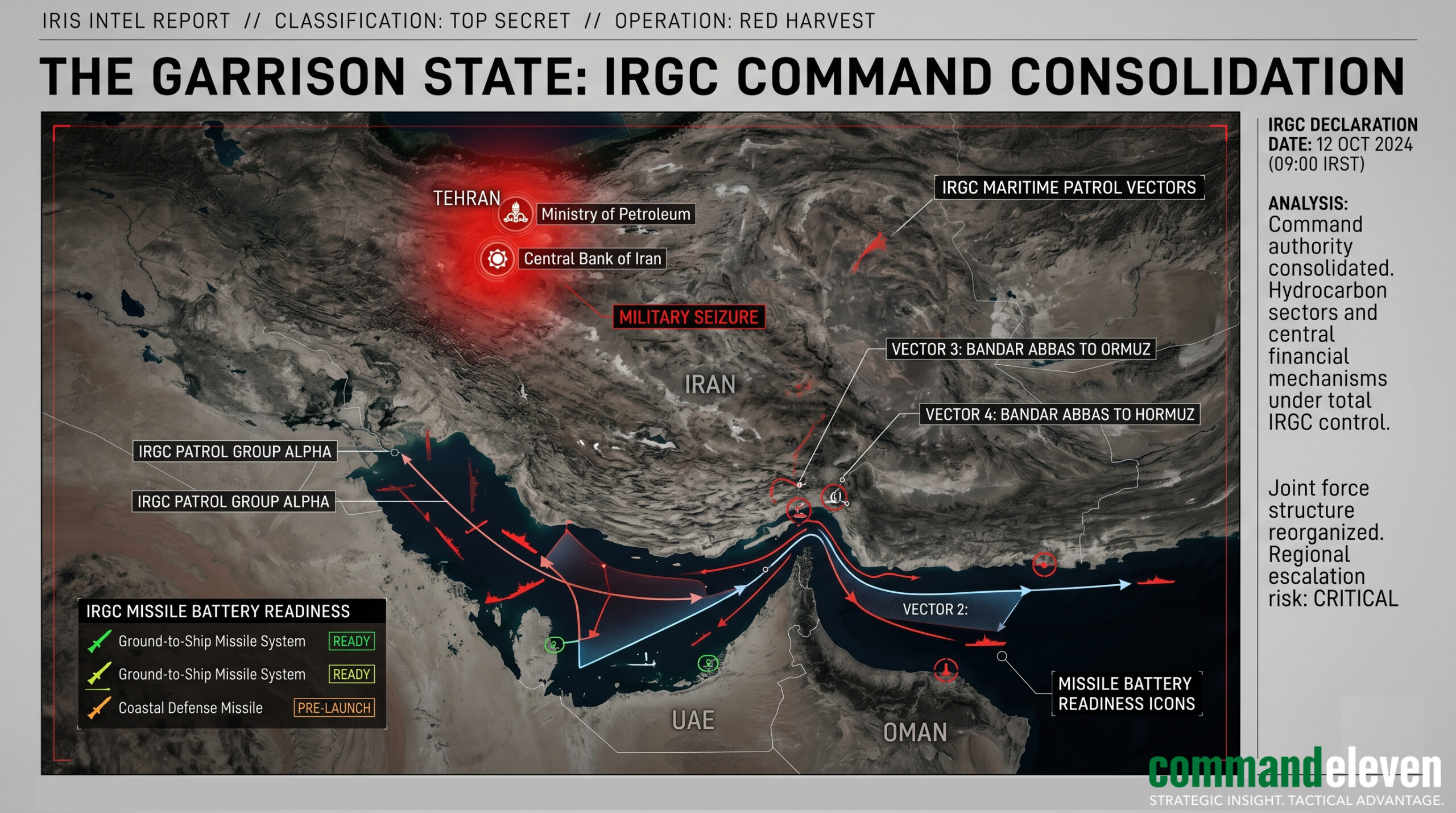
The formal declaration of absolute military control by the Islamic Revolutionary Guard Corps (IRGC) in May 2026 marks the terminal phase of Iranian civilian governance. This transition from a dual-power structure to a monolithic “Garrison State” is the direct result of kinetic exhaustion, economic isolation, and the strategic necessity of a centralized “Siege Economy”. This assessment audits the structural mechanics of the IRGC’s command consolidation and the resulting geofinancial implications for the Persian Gulf.
1. The Dissolution of the Civil-Military Divide
For decades, the Iranian state operated under a complex, often redundant system of clerical oversight, civilian administration, and paramilitary influence. The 2026 conflict environment—characterized by high-intensity kinetic exchanges and the “Flash-Dark” interdiction of digital infrastructure—rendered this bureaucracy functionally obsolete.
- The Catalyst of Exhaustion: The sheer attrition of the 2026 conflict depleted the civilian government’s ability to manage logistics, basic services, and internal security.
- The Administrative Purge: Under the “Garrison State” declaration, the IRGC has formally dissolved the remnants of the civilian cabinet, replacing technocrats with senior Quds Force and Aerospace Force commanders.
- Command Unity: By removing the friction between the elected presidency and the unelected military apparatus, the IRGC has achieved a “Single-Trigger” authority over every aspect of the sovereign state.
2. The Command Economy: Seizure of Energy and Finance
The most significant shift in the IRGC’s new architecture is the total militarization of Iran’s economic levers. This is not merely an increase in influence; it is a total administrative seizure of the state’s wealth-generating organs.
- Ministry of Petroleum Militarization: The IRGC now maintains direct oversight of all upstream and downstream energy operations. This ensures that oil revenues—though diminished by sanctions—are diverted exclusively to military persistence and “Hardening” ($D_{hard}$) initiatives.
- Banking and Liquidity Control: The Central Bank of Iran has been integrated into the IRGC’s logistical command. This allows for the immediate redirection of domestic capital toward the defense industrial base, effectively creating a closed-loop “Siege Economy”.
- The Shadow Ledger: To bypass international scrutiny and the “Digital Silk Road” vulnerabilities, the IRGC has transitioned its financial clearing to non-networked, analog ledgers, mirroring the principles of the #72/48 Protocol.
3. Strategic Implications: The Hormuz/Fujairah Threat
The consolidation of military command has immediate and dire consequences for global energy transit. The IRGC’s “Garrison State” is predicated on the ability to leverage regional chokepoints as a primary tool of statecraft.
- The “Single-Trigger” Threat: With civilian diplomatic channels closed, the decision to interdict maritime traffic in the Strait of Hormuz now rests solely with a military council focused on kinetic escalation.
- Targeting the Fujairah Bypass: The IRGC has identified the Habshan-Fujairah pipeline—which currently moves 1.5 million bpd outside the Strait—as a high-priority vulnerability.
- Cyber-Kinetic Convergence: Intelligence suggests the IRGC is prepared to utilize PLC rootkits and “HMI Ghosting” to sabotage the pipeline’s pumping stations, attempting to force a global energy crisis even if they cannot physically close the Strait.
4. Forward Projections: The Insulation of the Dark-State
As the “Garrison State” formalizes its control through the remainder of Q2 2026, the following projections are issued for strategic stakeholders:
- Total Market Insulation: The Iranian economy will continue to decouple from global markets, operating as a “Dark-State” that prioritizes internal survival over international trade.
- The “Siege Baseline”: Expect a total cessation of civilian-led diplomacy. Future engagement with the Iranian state will be purely military-to-military or through back-channel intelligence conduits.
- The Persistence of the IRGC: The centralization of power has mitigated the immediate risk of internal collapse due to unrest, as the IRGC now controls the entire food and energy distribution network.
5. Conclusion: The Imperative for Resilience
The birth of the IRGC “Garrison State” is the ultimate validation of the #72/48 Protocol. As the Iranian state pivots toward a purely kinetic and analog-hardened posture, Allied forces and global energy markets must respond in kind. The ability to verify “Hardware Truth” and maintain 72-hour operational autonomy is no longer a theoretical exercise; it is the only defense against a state that has discarded the digital handshake in favor of the iron grip.