The following intelligence assessment provides a clinical deconstruction of the Jama’at Nusrat al-Islam wal-Muslimin (JNIM) and Al-Qaeda in the Islamic Maghreb (AQIM) administrative seizure of Bamako. This development represents a terminal failure of regional security architectures and the birth of a decentralized Sahelian Caliphate.
Facilitators of the Takeover: Strategic Enablers
The rapid consolidation of control over the capital was not a sudden tactical anomaly but the result of a multi-year erosion of the Malian state’s legitimacy and kinetic capability.
- Security Architecture Fragmentation: The withdrawal of international peacekeeping missions and the subsequent reliance on decentralized military juntas created a “Security Void” that JNIM and AQIM successfully exploited.
- Administrative Erosion: Decades of institutional fragility allowed JNIM to establish shadow governance structures in the rural peripheries, which were then utilized as “Infiltration Corridors” into the urban center.
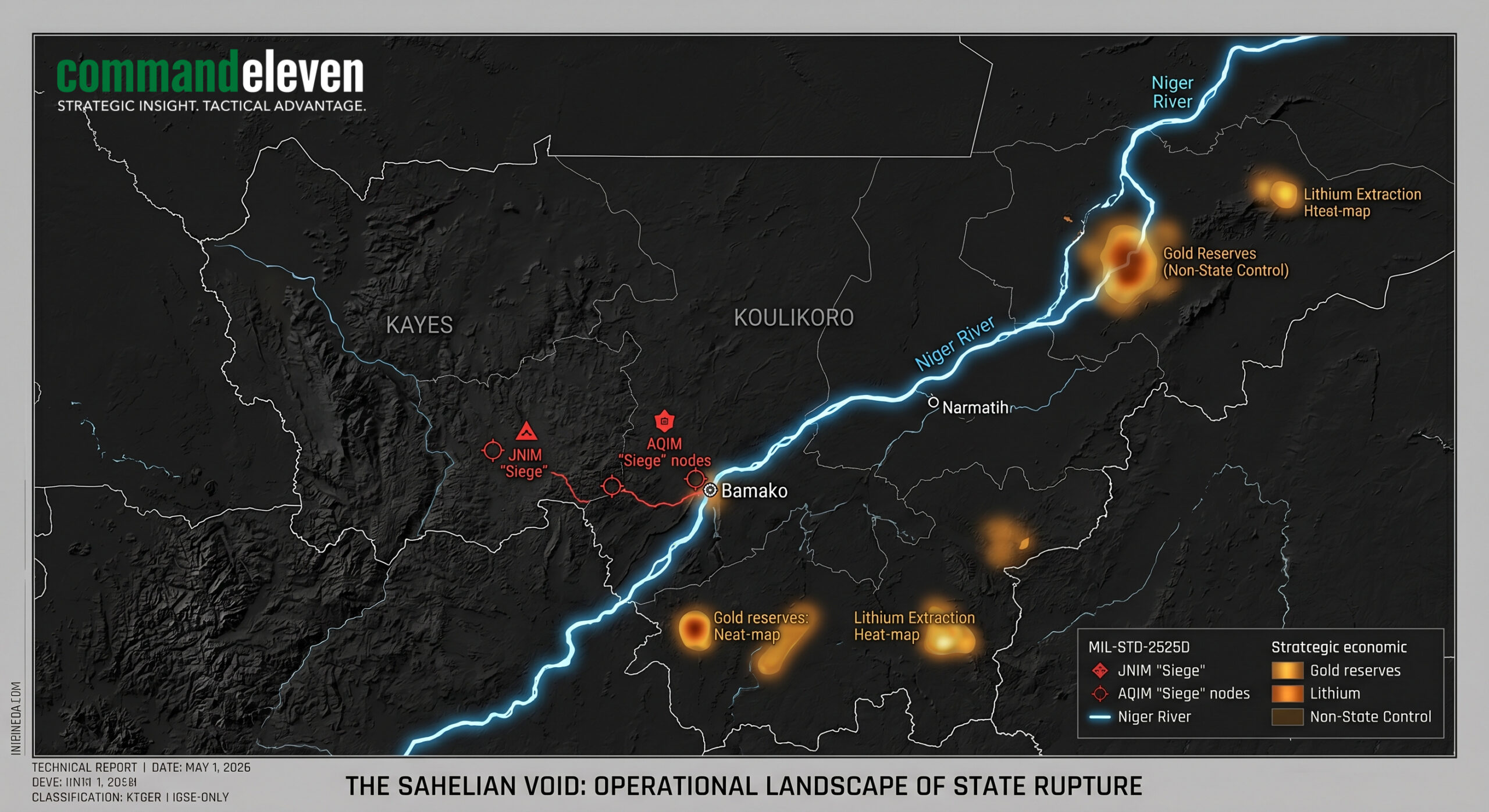
- The “Siege” Methodology: Rather than a traditional kinetic frontal assault, the takeover was achieved through a sustained blockade of major transit arteries, inducing an artificial scarcity that collapsed the city’s internal resolve.
Regional Implications: The Sahelian Contagion
The fall of Bamako serves as a primary force multiplier for non-state actors across West Africa.
- Littoral State Vulnerability: The administrative collapse of Mali places direct pressure on the northern borders of littoral states such as Ghana, Côte d’Ivoire, and Benin, which are now facing a “Spillover” effect of radicalized militia movements.
- Regional Economic Rupture: The destabilization of the Central Bank of West African States (BCEAO) regional branch in Mali has compromised the monetary stability of the West African Economic and Monetary Union (UEMOA).
Resource Implications: The “Conflict Premium” and Mineral Extraction
JNIM’s takeover has transformed Mali into a “Dark-State” extraction hub, prioritizing militant funding over sovereign wealth.
- Gold and Lithium Interdiction: Mali’s significant gold reserves and emerging lithium deposits are now under the direct oversight of militant commanders.
- Global Supply Chain Impact: The sudden removal of legitimate Malian mineral exports from the global market has induced a “Conflict Premium” spike, particularly affecting EU-bound energy transition supply chains.
Requirements for Reversal: The Restoration Matrix
Reversing the JNIM/AQIM administrative control is an “Ultra-High” complexity tasking that requires a fundamental shift in regional engagement.
- Kinetic Re-entry: Any reversal requires the deployment of a high-volume, multi-national kinetic force capable of reclaiming urban centers and securing mining infrastructure.
- Institutional Reconstruction: Re-establishing the state requires more than a military victory; it necessitates the rebuilding of the civilian governance and financial transparency that JNIM has dismantled.
- The #72/48 Requirement: Future security architectures must adopt the #72/48 Protocol,ensuring that local administrative nodes can survive a “Flash-Dark” interdiction through analog fallbacks and localized power autonomy.
Forward Projections: The Expansion Vector
As of May 2026, the expansion vector for JNIM and AQIM is projected to accelerate.
- 30-Day Outlook: Expect the formalization of “Sharia-Compliant” administrative offices in Bamako and the consolidation of extraction rights in the Koulikoro and Kayes regions.
- 90-Day Outlook: Regional intelligence suggests a pivot toward “Tactical Contagion” in Burkina Faso and Niger, aiming to create a contiguous trans-Sahelian block of militant-controlled territory.
- Market Impact: The Sahel will likely remain a “No-Go” zone for foreign direct investment through the remainder of 2026, with mineral prices remaining volatile as extraction remains under non-state control.