Executive Summary
Following the kinetic and logistical exhaustion of the 2026 Levantine conflict, the Allied posture in the Indo-Pacific has undergone a terminal shift from “Exquisite Deterrence” to a Deterrence by Denial model. This article audits the creation of the Wall of Attrition,a decentralized, hardened network of thousands of kinetic nodes designed to compensate for a 1.4x replenishment deficit in high-end munitions. By operationalizing the Acoustic Handshake across the Bashi Channel and prioritizing “Attritable” systems, Allied forces in Tokyo, Taipei, and Manila have established a mathematical barrier to PRC adventurism. This pivot acknowledges the reality of the 2026 Strategic Gap, moving away from high-value platform reliance toward a resilient, “Noised” maritime domain.
3 Key Takeaways
- Collapse of the “Exquisite” Myth: The 2026 munitions crisis has proven that high-cost, low-volume platforms cannot sustain a high-intensity peer conflict; security now relies on the mass and resilience of the Mosaic Defense.
- The Bashi “Acoustic Handshake”: Real-time, cross-national sensor fusion between Japan, Taiwan, and the Philippines has effectively “plugged” the First Island Chain’s southern egress, stripping the PRC of subsurface stealth.
- Hardening as a Force Multiplier: Physical resilience and geographic dispersal are now the primary tools for neutralizing the PRC’s fait accompli windows, shifting the strategic burden from interceptor volume to structural survival.
The Myth of Infinite Capacity: Analyzing the Western Deficit
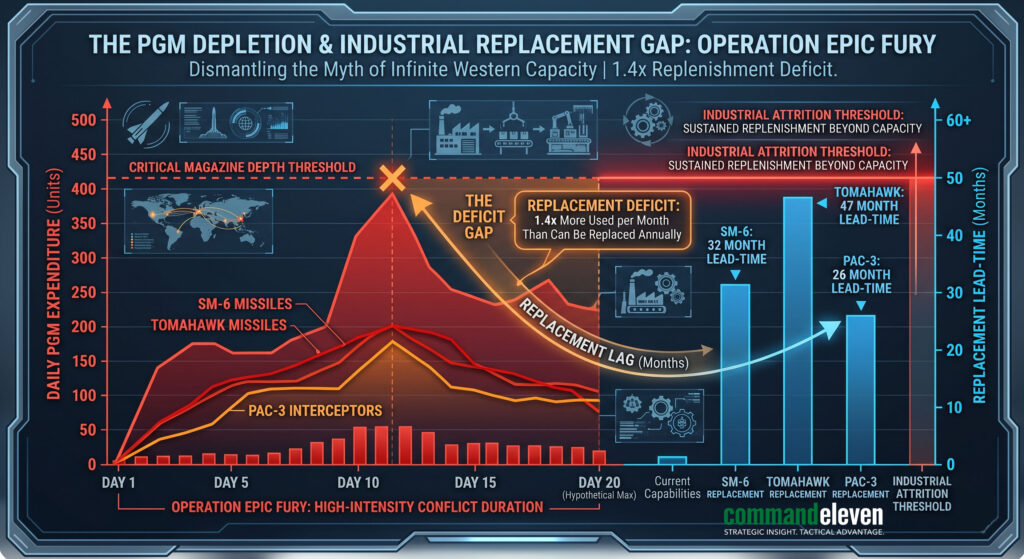
The pervasive belief among Western audiences that the United States maintains an “unbeatable” military hegemony is increasingly detached from the 2026 logistical reality. This “Belief Gap” is the most dangerous component of the current crisis.
- The PGM Exhaustion Rate: Modern warfare is a high-volume kinetic event. In the first 60 days of the Levantine conflict, the U.S. expended more Precision-Guided Munitions (PGMs) than it produced in the previous three years. This is the Logistical Rubicon.
- Carrier Strike Group (CSG) Overextension: Deterrence relies on presence. With two CSGs permanently tethered to the Middle East to prevent a “Triple Lock” collapse, the U.S. has effectively halved its “Surge Capacity” for the Taiwan Strait.
- The Maintenance Debt: 5th-Gen airframes (F-35) require intense maintenance cycles. Every hour flown over Yemen or Iraq is an hour stolen from the readiness required to contest the South China Sea. The West is currently trading its future Pacific security for present-day Middle Eastern stability.
Iran as the PRC’s Laboratory: Lessons in Western Fragility
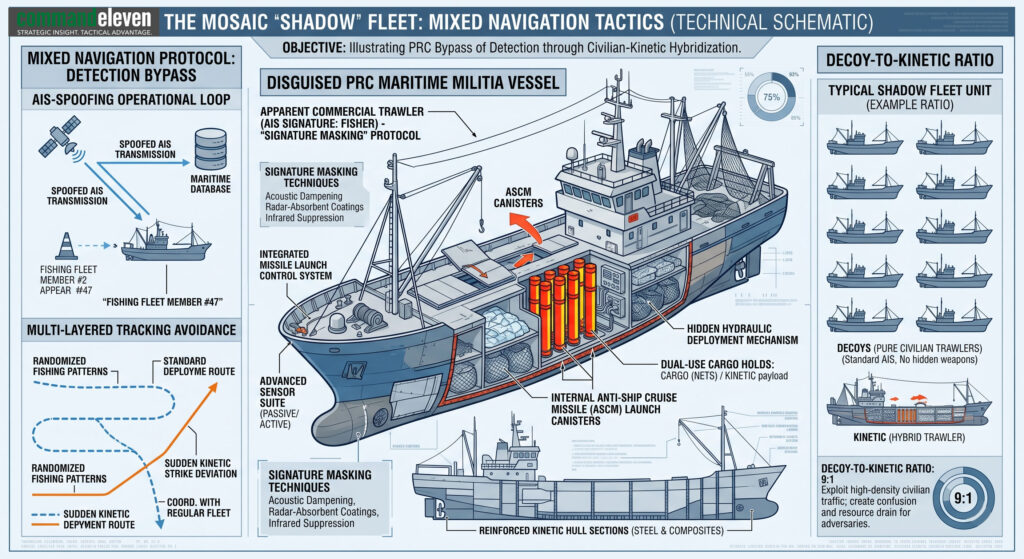
The conflict with Iran and its proxies was never a vacuum; it was a “Stress Test” for Western doctrine, observed meticulously by Beijing. Iran’s Mosaic Defense served as a successful proof-of-concept for how a mid-tier power can neutralize a superpower’s “Exquisite Technology.”
- The Kinetic Lesson: China has observed that high-tech Western interceptors can be depleted by low-cost, disposable swarms. They are currently scaling this by integrating AI-driven “Wolf Pack” maritime drones into their naval militia.
- The Economic Lesson: Iran demonstrated that “Globalized Trade” is a vulnerability, not a strength. By threatening chokepoints, a smaller actor can induce global inflationary spikes. Beijing is now applying this by preparing “Naval Quarantine” protocols for the South China Sea.
- The Overcoming of Blockades: The West’s new strategic blockades,such as the Indonesia Pact,are being cued by shortsighted U.S. planning that assumes a static adversary. China is already circumventing these “gates” by accelerating the China-Myanmar Economic Corridor (CMEC) and the Gwadar-Xinjiang land-link, effectively “Short-Circuiting” the sea-lanes.
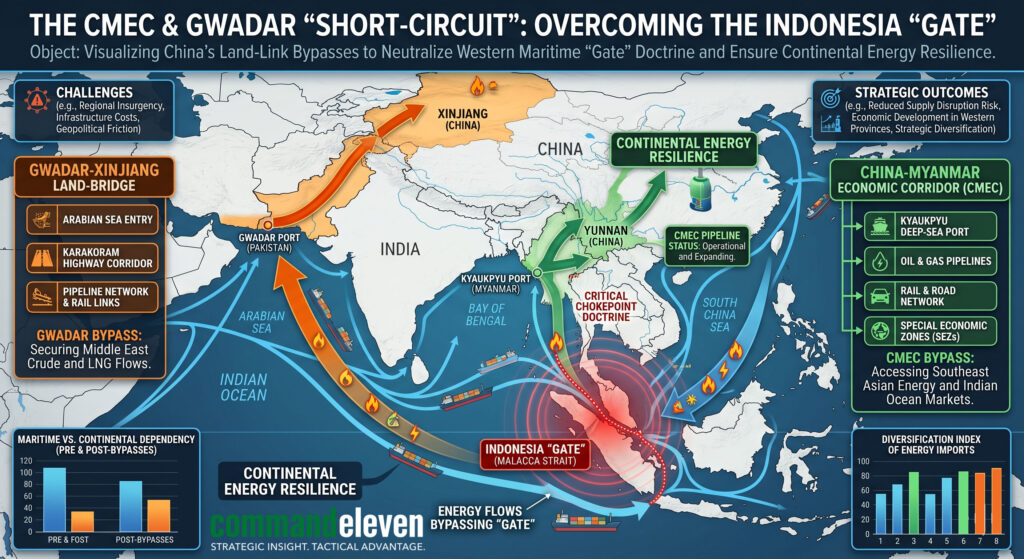
The Indonesia “Gate”: Historical Context and the Indian Ocean Corridor
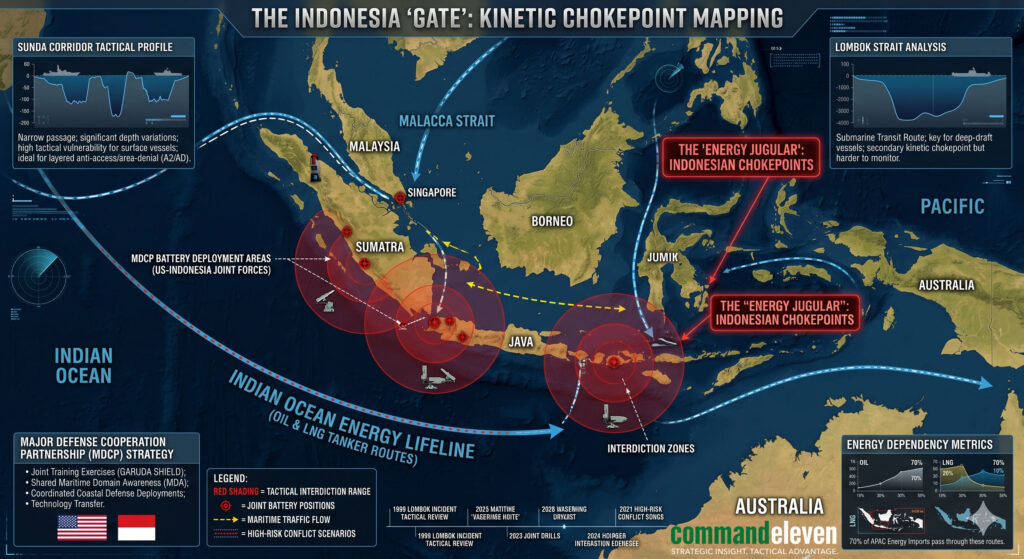
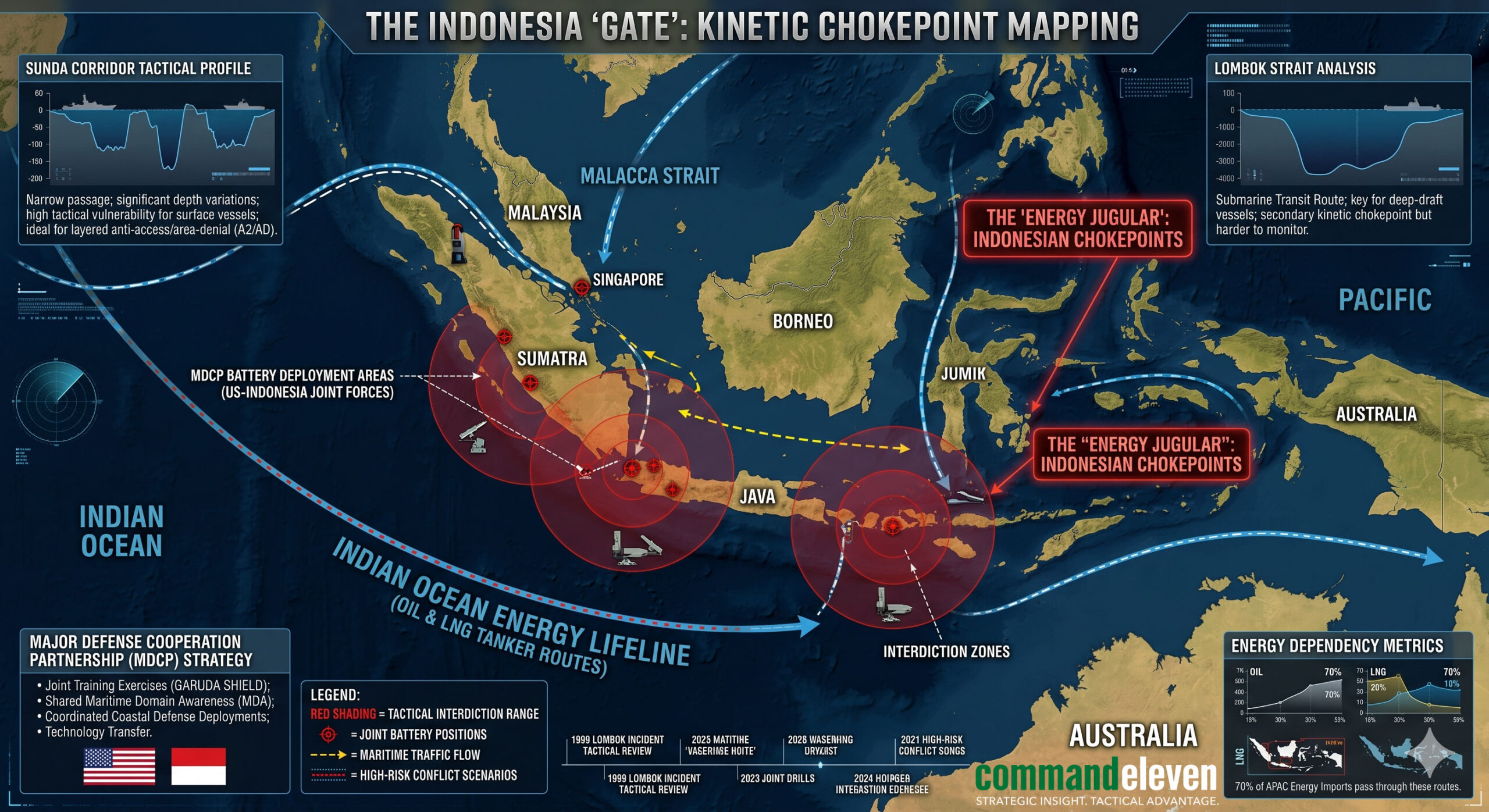
The Sunda and Lombok straits,collectively the Indonesia “Gate”,are the historical valves of global trade. Since the 15th century, controlling these waters has meant controlling the flow of wealth between the Indian and Pacific Oceans.
- The Chokepoint Reality: For Beijing, the Indian Ocean is the “Energy Jugular.” 80% of China’s oil imports pass through these corridors.
- The Blockade Logic: If the Indonesia Gate is closed by the Jakarta-Washington axis, China is forced to reroute ships around the southern tip of Australia,adding 15 days to transit and doubling fuel costs.
- The “Gate” as a Weapon: The U.S. views the gate as a deterrent; China views it as a “declaration of war.” This is the friction point of 2026.
UTM Analysis: From the Indonesia “Gate” to the Taiwan Flashpoint
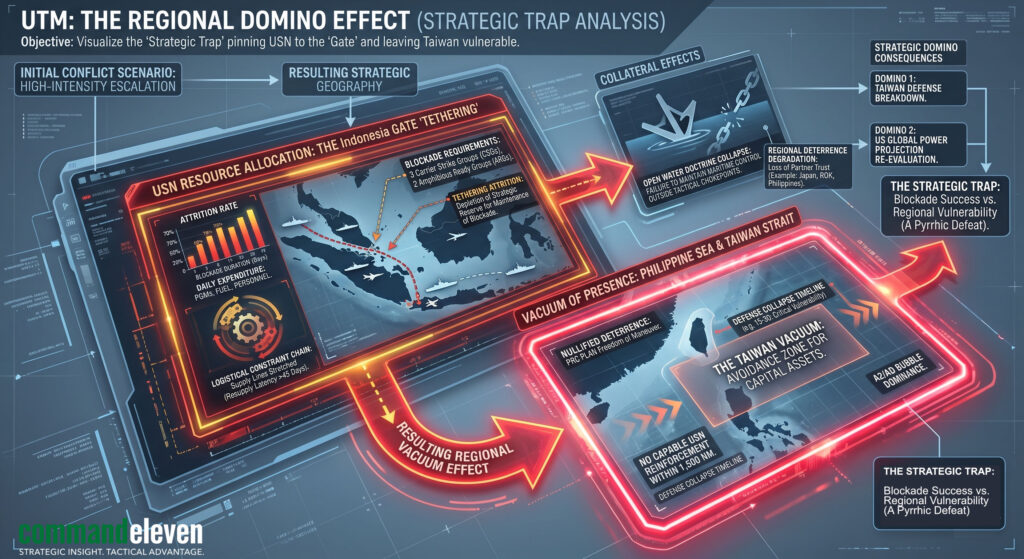
The Unified Threat Matrix (UTM) indicates that the Indonesia Gate is not an isolated tactical feature, but the first domino in a regional collapse of the “Open Water” doctrine.
| Vector | Indicator | Strategic Impact |
| KT (Kinetic) | PRC “Anti-Gate” Drills | Beijing is practicing “Kinetic Breaching” of the Sunda Strait using submarine-launched cruise missiles. |
| CPT (Cyber) | SCADA Sabotage in Jakarta | Attacks on Indonesian port infrastructure intended to make the “Gate” operationally unreliable for Allied forces. |
| GER (Geofinancial) | Yuan-based Trade Shields | PRC shifting all maritime insurance for Indo-Pacific transit to Yuan-denominated firms to bypass Western sanctions. |
| CI (Cognitive) | “Sovereignty” Narratives | Bot-networks in Southeast Asia amplifying the message that U.S. presence in the Indonesia Gate is “New Colonialism.” |
The Taiwan Pivot
As the U.S. Navy (USN) tethers its remaining Pacific assets to the Indonesia Gate to ensure the blockade holds, it creates a Vacuum of Presence around Taiwan. Historically, the USN has enjoyed “Open Waters” in the Philippine Sea; in 2026, that water is becoming a “PRC Lake.” The “Gate” that was meant to trap China is instead trapping the U.S. into a two-front dilemma it cannot mathematically win.
Red Team Conclusion: The Strategic Trap
The Indonesia Pact is a “Short-Sighted Masterpiece.” It provides the illusion of control while ignoring the reality of Sovereign Fatigue. If the USN cannot maintain the gate and protect Taiwan simultaneously,which current munition audits suggest it cannot,the gate becomes a liability.